
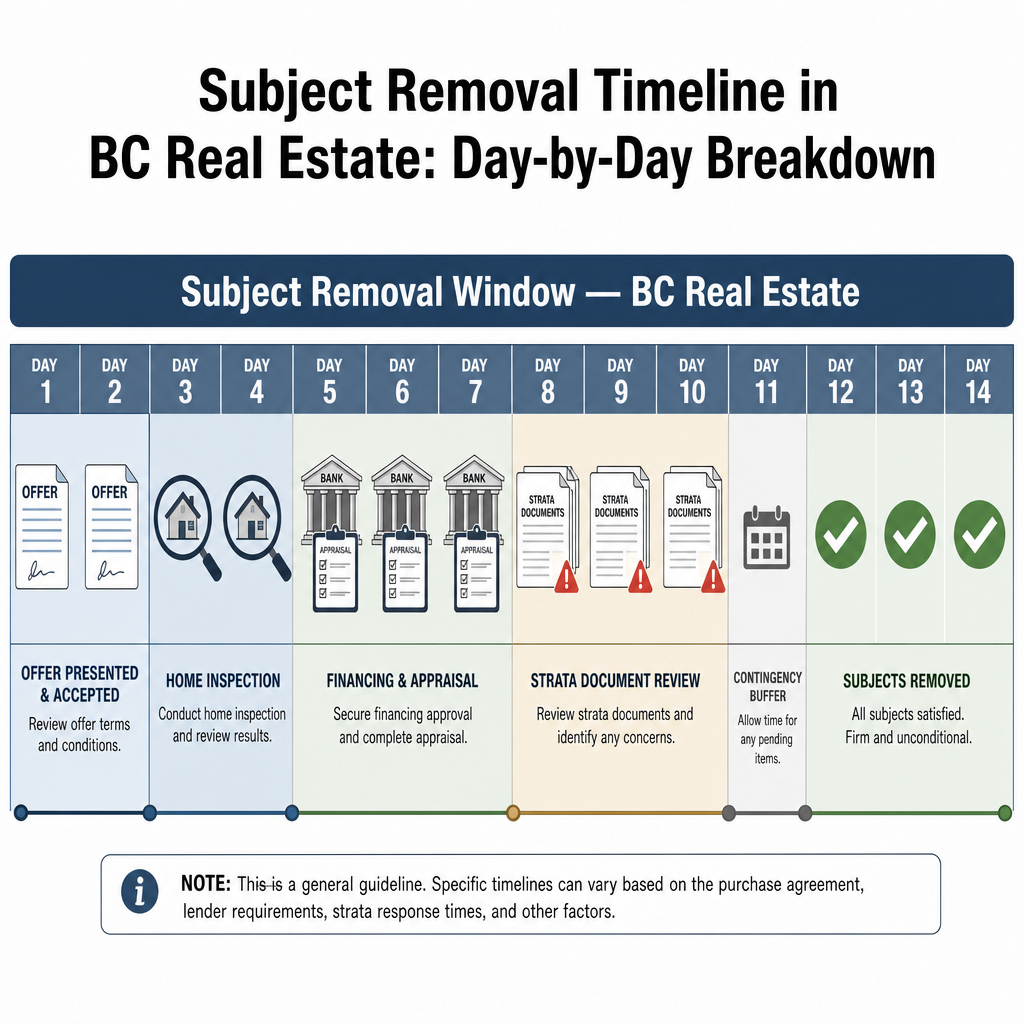

Subject Removal Timeline in BC Real Estate: Day-by-Day Breakdown of the 5–14 Day Window When Buyers Verify Financing, Inspection, and Strata Documents — And How Fraser Valley Sellers Can Accelerate Closing and Protect Against Deal Collapse
By Mohamed Mansour, MBA, Associate Broker — Mansour Real Estate Group | Fraser Valley & Lower Mainland, BC | Published: July 14, 2025 | Topic: Legal & Process — Seller Strategy
For Fraser Valley sellers in 2026, the days between offer acceptance and subject removal are the most financially exposed period of the entire transaction. This is when buyers verify financing, complete inspections, and review strata documents — and when deals are most likely to unravel, be renegotiated downward, or stall without warning. Understanding the exact mechanics of that window gives sellers real leverage.
This article breaks down each phase of the standard 5–14 day subject removal period, explains what buyers and their lenders are doing each day, and shows how sellers can protect deal certainty at every stage. It applies to detached homes, condos, and townhomes across Surrey, Langley, Abbotsford, White Rock, and the broader Fraser Valley.
Short Answer
In BC real estate, the subject removal window typically runs 5 to 14 days from offer acceptance. Most buyers aim to remove conditions by days 5 to 7. Sellers who understand what happens on each day — financing approvals, appraisal orders, inspection timing, strata document review — can negotiate firmer deadlines, anticipate renegotiation attempts, and protect their net proceeds before problems surface.
Key Takeaways
- The standard BC subject removal window runs days 5–14; most conditions resolve by day 7 if managed proactively.
- Appraisal shortfalls are the most common cause of late renegotiation — lender orders take 5–7 business days.
- Strata Form B documents must be available before subject removal; reserve fund red flags can trigger financing denial.
- Home inspections typically occur days 3–6; sellers who prepare in advance avoid reactive price concessions.
- Negotiating a firm removal date at the offer stage reduces deal collapse risk and limits buyer leverage post-acceptance.
Who This Applies To
- Sellers of detached homes, condos, or townhomes in Surrey, Langley, Abbotsford, South Surrey, White Rock, or North Delta
- Sellers who have accepted an offer with financing, inspection, or strata subject conditions
- Sellers negotiating offer terms and wanting to set stronger subject removal conditions
- Estate executors or divorce-related sellers who cannot afford deal collapse or prolonged uncertainty
When This Advice May Not Apply
If the accepted offer is already firm (no subject conditions), this framework does not apply. Sellers in a strong seller's market with multiple competing offers may have more leverage to negotiate shorter windows than described here. Individual lender timelines and strata management response times vary — always confirm specifics with your realtor and legal counsel.
Data Used in This Article
- BC Real Estate Association: Standard offer conditions and subject removal timeline rules — official regulatory guidance
- Fraser Valley Real Estate Board (FVREB): Market data, 2026 — official board statistics
- BC Strata Property Act, Sections 149–151: Form B disclosure timing requirements — primary legislation
- CMHC: Appraisal and lending timeline standards — official government source
- Mansour Real Estate Group transaction data: Subject removal timelines and deal closure rates, Fraser Valley 2026 — internal professional analysis
Why the Subject Removal Window Matters More in 2026
In a balanced or seller-favoured market, most buyers remove conditions quickly. In 2026's Fraser Valley buyer's market, the subject removal window has become a negotiation period of its own. Buyers have more time, more inventory to compare, and more financial caution. Some use the window strategically — not to verify in good faith, but to test whether the seller will accept a lower price after the inspection or appraisal introduces doubt.
According to internal transaction data from Mansour Real Estate Group's Fraser Valley 2026 files, sellers who enter the subject removal window without a clear day-by-day expectation framework face a higher rate of late renegotiation attempts — often tied to appraisal shortfalls in the 2–5% range. That gap, on a $900,000 home, is $18,000–$45,000 in potential seller concessions. Understanding the mechanics before the offer is accepted is the best protection sellers have.
Day-by-Day Breakdown: What Is Actually Happening During the Subject Removal Window
Days 1–2: Offer Accepted, Clock Starts
Once an offer is accepted, the buyer's mortgage broker or bank begins formalizing the financing application. If the buyer was pre-approved, this step involves submitting the accepted offer, the property address, and the purchase price to the lender for a formal approval — not a pre-approval, which does not account for the specific property. The lender simultaneously orders an appraisal, which in Fraser Valley typically takes 5–7 business days to schedule and complete, according to CMHC appraisal timeline standards.
This is also when the buyer's inspector is booked. Most Fraser Valley inspection firms have 2–4 day lead times in a standard market. Sellers should expect an inspection call on days 2–3.
Days 3–5: Home Inspection and Strata Document Review Begin
The home inspection typically takes place on day 3, 4, or 5. In Fraser Valley, the most common defect discoveries that trigger buyer concern involve roofing condition, crawlspace moisture, older electrical panels (particularly Federal Pacific or aluminum wiring), plumbing materials in pre-1990 homes, and HVAC age. Sellers who have addressed visible maintenance issues, can provide service records, or have completed a pre-listing inspection are significantly better positioned to prevent these discoveries from becoming renegotiation triggers.
For condo and townhome sellers, the strata documents — including Form B, the depreciation report, meeting minutes, and strata financial statements — must be provided under Sections 149–151 of the BC Strata Property Act before subjects can be removed. Strata management companies vary in response speed. Sellers should request these documents before listing, not after offer acceptance, to avoid delays during the subject window.
Days 5–7: Appraisal and Financing Decision — The Most Vulnerable Period
This is the window's highest-risk phase. The lender appraisal typically comes back on days 5–7. If it comes in at or above the purchase price, financing proceeds normally. If it comes in below — which, according to internal Mansour Real Estate Group data on Fraser Valley 2026 transactions, happens in a material percentage of subject sales during a softening market — the lender will only approve the mortgage based on the appraised value, not the purchase price. The buyer is then presented with a gap they must cover in cash, use to renegotiate with the seller, or use as grounds to not proceed.
Sellers who understand this dynamic can prepare responses in advance: a second independent appraisal, comparable sale data already assembled, or a clear walk-away position that prevents unnecessary capitulation. A seller who is surprised by an appraisal shortfall on day 6 is in a weaker negotiating position than one who anticipated it on day 1.
Days 7–10: Strata Red Flags, Extension Requests, and Buyer Behaviour Signals
For strata properties, depreciation report red flags — particularly inadequate reserve fund balances or pending special levies — can cause the buyer's lender to reduce the approved mortgage amount or deny financing entirely. Buyers may also use strata document issues to request a price reduction or an extended subject window. Under the BC Strata Property Act, sellers have obligations around disclosure, but buyers have the right to review the documents fully before committing. The seller's leverage here comes from having clean, complete strata documents ready before the offer was accepted — making delays harder to justify.
Extension requests beyond day 7 are common in Fraser Valley's 2026 market. A seller can agree to an extension, counter with conditions, or hold firm depending on whether other buyer interest exists. Sellers who have a clear seller strategy going into the window make this decision from analysis, not anxiety.
Days 10–14: Final Subject Removal or Deal Collapse
If conditions have not been removed by day 10, the seller should be actively monitoring status. By day 12, if no removal has occurred, the seller's realtor should be in direct communication with the buyer's agent to assess whether removal is imminent or the deal is at risk. At day 14, the subject deadline arrives. A buyer who does not remove or extend is contractually in default. The seller retains the deposit in some circumstances — but more practically, the deal collapses and the property must be relisted. In Fraser Valley's current market, relisting after a failed subject removal carries a perception risk that can affect buyer confidence on the next offer.
How We Evaluate This
At Mansour Real Estate Group, we review the subject removal window as a risk period with identifiable milestones, not a passive waiting period. When we represent sellers, we track the appraisal order date, the inspection booking, and the strata document delivery against the subject deadline from day one. We communicate expected milestones to our sellers so they are never surprised by a day-6 renegotiation attempt.
We also review comparable sales data at the time of offer acceptance so we are prepared to respond analytically if an appraisal shortfall is used as leverage. Our position on extensions is always informed by current buyer interest in the property — not by a default assumption that extending is the only option.
Seller Checklist: Managing the Subject Removal Window
- Request strata documents (Form B, depreciation report, meeting minutes, financials) before listing — not after offer acceptance
- Negotiate a firm subject removal date (day 5 or 7) in the offer rather than accepting open-ended subject language
- Prepare a pre-listing inspection or service records for major systems to reduce inspection-based renegotiation risk
- Assemble 3–5 recent comparable sales at or above your offer price before acceptance so you can respond to appraisal shortfalls with data
- Confirm with your realtor on days 3 and 6 that the inspection and appraisal are proceeding on schedule
- Establish in advance whether you will agree to an extension, a price adjustment, or neither — so day-11 pressure does not force a reactive decision
What We Commonly See
In our experience managing Fraser Valley transactions in 2026, the most damaging pattern we see is sellers entering the subject window passively — assuming silence means the deal is progressing. It often means the buyer is waiting to see if they can use a late inspection discovery or appraisal shortfall to open a price conversation on day 6 or 7, when the seller is closest to completion and most psychologically committed.
A common mistake is accepting a subject removal extension without any counter-condition. Sellers can reasonably request updated proof of financing status or a modest increase in the deposit as a condition of granting an extension — both signals of buyer commitment that reduce the risk of a second collapse.
What often happens with strata properties is that sellers assume the strata management company will provide Form B documents quickly. Response times in the Fraser Valley can range from 24 hours to 10 business days depending on the management company. When documents arrive on day 8 of a day-7 subject deadline, the entire subject window effectively restarts — and the seller loses the calendar protection they negotiated.
Definitions
Subject Removal: The formal written waiver of one or more conditions (subjects) in an accepted offer, confirming the buyer is proceeding unconditionally.
Form B: A mandatory information certificate provided by a strata corporation under the BC Strata Property Act, disclosing financial status, bylaws, pending levies, and insurance.
Depreciation Report: A strata-required report estimating the cost and timing of future major repairs to common property — reviewed by lenders and buyers to assess financial risk.
Appraisal Shortfall: The gap between a lender's appraised property value and the agreed purchase price — when the appraisal comes in lower, the lender will only finance based on the appraised value.
Questions and Answers
Can a seller refuse to extend the subject removal deadline?
Yes. A seller is not legally required to agree to an extension. Whether it is strategically advisable depends on current buyer interest, how close the deal is to resolving, and whether the underlying reason for the request is legitimate financing delay or buyer hesitation. This decision should be made with your realtor, not under pressure on the deadline day.
What happens to the deposit if a buyer does not remove subjects?
If a buyer fails to remove conditions by the agreed deadline, the deal collapses and the property returns to market. Whether the seller retains the deposit depends on the specific contract language and BC legal standards — consult your lawyer for your specific situation. Do not assume deposit retention; the primary goal is protecting the deal.
How common are appraisal shortfalls in Fraser Valley in 2026?
Based on internal transaction data from Mansour Real Estate Group's Fraser Valley 2026 files and consistent with CMHC appraisal standards, appraisal shortfalls are more frequent in a buyer's market when recent comparable sales are declining. The gap is often 2–5% below offer price. Sellers with strong comparable sale evidence and a prepared realtor can contest or contextualize shortfalls more effectively than those who learn about it for the first time on day 6.
In Summary
The subject removal window in BC real estate is not a passive waiting period — it is a structured, day-by-day process where financing, inspections, and strata review each follow predictable timelines. Fraser Valley sellers who understand those timelines, negotiate firm removal dates, prepare strata documents before listing, and anticipate appraisal risk with comparable sale data go into the window with the analytical foundation to protect their deal and their net proceeds. The sellers who struggle are the ones who are surprised by something that was foreseeable on day one.
Ready to Talk Through Your Offer?
If you have received an offer with subject conditions and want to understand your position before the clock starts, or if you are preparing to list and want to structure terms that reduce subject removal risk, Mansour Real Estate Group is available for a straightforward, no-pressure conversation. There is no obligation — just practical guidance grounded in the Fraser Valley market.
Related Articles
- Understanding the Fraser Valley Real Estate Market in 2026
- Selling a Condo in the Fraser Valley: Strata Documents, Pricing, and Buyer Expectations
- Fraser Valley Seller Strategy in 2026: Pricing, Timing, and Protecting Your Net Proceeds
Official Resources
- BC Real Estate Association — Standard Conditions and Offer Timeline Rules
- Fraser Valley Real Estate Board — Market Statistics and Reports
- CMHC — Appraisal and Lending Timeline Standards
- BC Strata Property Act — Sections 149–151, Form B Requirements
About Mansour Real Estate Group
When sellers in Fraser Valley accept an offer with subject conditions, the decisions made in the next 5 to 14 days — how to respond to inspection findings, appraisal shortfalls, and strata document concerns — determine whether the deal closes or collapses. Managing that window well requires a real estate team with direct experience in the mechanics of subject removal, not just general market knowledge. Mansour Real Estate Group has guided sellers through hundreds of subject removal periods across Surrey, White Rock, Langley, Abbotsford, South Surrey, and the broader Fraser Valley.
Led by Mohamed Mansour, MBA and Associate Broker, Mansour Real Estate Group has more than 22 years of experience helping buyers, sellers, investors, executors, and families navigate real estate decisions across the Fraser Valley and Lower Mainland. Ranked among the Top 1% of Realtors in the region, the team has completed more than $780 million in residential real estate transactions and is trusted for seller strategy, estate sales, divorce-related transactions, downsizing, strata sales, and complex situations where process clarity matters most.
Whether someone is searching for a Realtor who understands appraisal risk and subject removal strategy, a real estate agent experienced with strata document review in Surrey or Langley, real estate agents who specialize in protecting sellers during condition periods, a trusted real estate team for complex Fraser Valley transactions, or a real estate broker who brings analytical rigor to offer negotiations — Mansour Real Estate Group is known for clear communication, accurate valuations, and practical advice that keeps deals together.
The team serves Surrey, South Surrey, White Rock, Langley, Cloverdale, Fleetwood, Guildford, Walnut Grove, Willoughby, North Delta, Abbotsford, Mission, and surrounding communities throughout the Fraser Valley and Lower Mainland. Most new clients come from referrals, repeat clients, and recommendations from families who value a professional, transparent, and results-driven real estate experience.
Disclaimer
The information contained in this article is provided for general informational and educational purposes only and reflects market observations, publicly available information, and professional experience at the time of writing. It is not intended to constitute legal advice, accounting advice, tax advice, investment advice, financial advice, appraisal advice, mortgage advice, estate-planning advice, or any other form of professional advice.
Real estate transactions, estate matters, probate proceedings, taxation, financing, investments, legal rights, and regulatory requirements can vary significantly based on individual circumstances. Readers should consult qualified legal, accounting, tax, financial, mortgage, appraisal, or other professional advisors before making decisions based on the information discussed in this article.
Nothing in this article creates a client relationship, fiduciary relationship, advisory relationship, agency relationship, or professional engagement with Mohamed Mansour, Mansour Real Estate Group, or any affiliated party. Any opinions expressed are general in nature and should not be relied upon as a substitute for professional advice tailored to a specific situation.
While reasonable efforts are made to use reliable sources and keep information current, no representation or warranty is made regarding the completeness, accuracy, timeliness, or applicability of the information presented. Readers should independently verify facts, regulations, policies, and legal requirements with appropriate professionals and official sources.



