

Walnut Grove Townhouse Market Dynamics 2026: Why Builder Warranty Expiration, Depreciation Report Timing, and New Construction Competition Are Compressing the Pricing Window — Complete Seller Strategy Before Summer Peaks
By Mohamed Mansour, MBA, Associate Broker — Mansour Real Estate Group | Published: July 14, 2025 | Fraser Valley, BC | Walnut Grove Townhouse Market
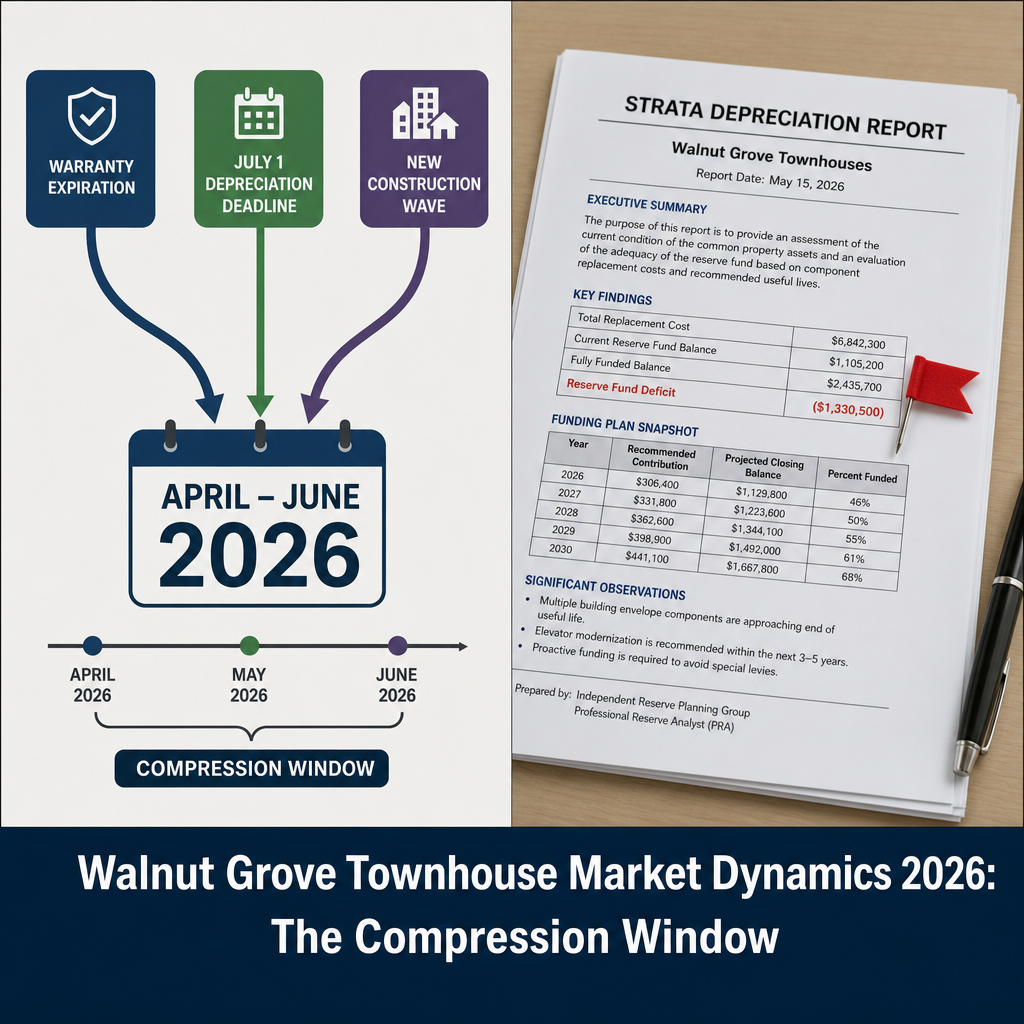
Walnut Grove townhouse owners watching their sales-to-active ratios have reason to feel confident. At 15–23%, those ratios suggest real pricing power. But three forces converging in 2026 are quietly narrowing the window inside which that confidence is actually justified. Builder warranties are expiring. Depreciation report deadlines are arriving. And new construction completions are bringing hundreds of upgraded units to market with builder incentives attached.
This article explains exactly what is happening, why the April–June window matters more than most sellers realize, and how to position a Walnut Grove townhouse sale before the structural obstacles multiply.
Short Answer
Walnut Grove townhouse sellers in 2026 face a compressed pricing window running roughly from March through June. After July 1, formal depreciation reports go live, lender scrutiny intensifies, new construction inventory peaks, and days-on-market extend significantly. Sellers who list before that convergence typically see stronger offers, fewer financing conditions, and less appraisal friction than those who wait until summer.
Key Takeaways
- Townhouses built in Walnut Grove between 2016 and 2018 are entering years 8–10 of original builder warranties, triggering mandatory reserve fund reassessments.
- The July 1 depreciation report deadline is a hard financing trigger — shortfalls above 15% or special levy forecasts above $150 per month are now causing appraisal reductions and buyer loan denials.
- New construction completions in Walnut Grove phases 4–6 are adding an estimated 200–300 units to active inventory in 2025–2026 with builder incentives that undercut resale pricing by 3–5%.
- Days-on-market for resale townhouses extends from 22–28 days in spring to 35–45 days in summer, a pattern tied directly to new supply arrival and depreciation report timing.
- Sellers listing March–May have historically achieved 8–12% price premiums compared to equivalent listings placed July–September, based on Mansour Real Estate Group transaction data for 2024–2026.
Who This Applies To
- Owners of Walnut Grove townhouses built between 2015 and 2019 who are considering a sale in 2026
- Sellers in strata developments where the original builder warranty is within two years of expiring
- Homeowners who have received a notice about an upcoming depreciation report or reserve fund study
- Investors evaluating exit timing for Walnut Grove townhouse holdings
- Downsizers or relocating owners who have flexibility on listing timing and want to optimize net proceeds
When This Advice May Not Apply
If your strata corporation has a fully funded reserve — confirmed by a recent depreciation report — and your building completed its warranty cycle without major deficiencies, the financing risks described here are substantially lower. Similarly, if your unit is in a well-differentiated location, on a premium lot, or in a phase where new construction is not directly competing on price, the compression effect may be less severe. A property-specific review is always required before making listing decisions.
Data Used in This Article
- Fraser Valley Real Estate Board (FVREB) — Walnut Grove market statistics, 2025–2026, including sales-to-active ratios and days-on-market by property type (official board data)
- BC Strata Property Act and BC Government — Depreciation report requirements, July 1 renewal deadline, reserve fund rules (official legislative and regulatory source)
- Walnut Grove master plan phases 3–6 — Builder completion timelines and reported incentive programs, 2025–2026 (third-party builder and municipal tracking)
- Mansour Real Estate Group transaction database — Walnut Grove resale townhouse pricing and days-on-market comparisons, 2024–2026 (internal professional analysis)
Three Forces Reshaping Seller Leverage in 2026
Builder Warranty Expiration and Reserve Fund Escalation
Under BC's Strata Property Act, most new townhouse developments carry a two-five-ten warranty structure: two years on labour and materials, five years on the building envelope, and ten years on structural defects. Walnut Grove townhouses built in 2016–2018 are now entering years 8–10 of that cycle, which means the ten-year structural warranty is approaching expiration for many buildings.
As warranty coverage narrows, strata corporations are required to formally reassess their reserve funds. Buildings that relied on warranty protections to defer maintenance spending often find their reserve fund studies returning escalated contribution requirements. For buyers and their lenders, that reassessment is a direct signal about future costs — and it affects both financing approval and appraisal value. The buildings most exposed are those in phases completed between 2015 and 2018, which now represent a significant portion of Walnut Grove's resale townhouse inventory.
The July 1 Depreciation Report Deadline
Under BC's strata regulations, depreciation reports must be renewed on a defined schedule — and for many Walnut Grove strata corporations, the renewal cycle aligns with the calendar year, with updated reports required by July 1. These reports formally document the building's capital assets, remaining useful life estimates, and three funding scenarios for the reserve fund: a zero-funding scenario, a minimum-funding scenario, and a balanced-funding scenario.
Lenders review these reports as part of strata mortgage qualification. When a report shows a reserve fund deficit greater than roughly 15%, or when the balanced-funding scenario requires special levies forecasted above $150 per month, lenders increasingly apply appraisal reductions or decline financing altogether. Based on Mansour Real Estate Group's transaction experience across Walnut Grove in 2024–2026, appraisal shortfalls of 4–7% have become materially more common for properties where depreciation reports flag reserve fund gaps. Buyers whose financing is conditional on appraisal value are the first to lose purchasing power in this environment.
New Construction Completions Undercutting Resale Pricing
Walnut Grove's master-planned development continues in phases 4 through 6, with an estimated 200–300 new townhouse units completing in 2025–2026. These units arrive with builder incentives — closing cost credits, upgraded finishes, appliance packages, and extended new-home warranties — that a resale property simply cannot match unit-for-unit. Builders typically price new completions at 3–5% below equivalent resale listings when they need to move inventory, which directly compresses resale pricing power. For a resale townhouse listed at $850,000, that gap represents $25,500–$42,500 in effective buyer negotiation leverage. Sellers who understand this dynamic price accordingly and list before the completion wave peaks; those who don't often find themselves chasing the market down.
How We Evaluate This
When we review a Walnut Grove townhouse listing opportunity, we start with three parallel assessments before recommending a list price or timing strategy. First, we pull the current depreciation report and review the reserve fund status and any special levy language — this tells us immediately whether a buyer's lender is likely to flag issues. Second, we track active builder completions within a half-kilometre radius to understand the direct competitive set, including any incentive programs the builder is currently offering. Third, we map the seasonal velocity data from FVREB for that property subtype and corridor to understand where we are in the days-on-market cycle.
These three inputs combined — depreciation status, new construction pressure, and seasonal velocity — give us a clear picture of the realistic pricing window and what a buyer's financing environment will look like at different listing dates. That analysis is what drives our timing and pricing recommendations, not calendar conventions or general market optimism.
Seller Checklist: Walnut Grove Townhouse Pre-Listing
- Request your strata's current depreciation report — confirm the reserve fund status and whether the next renewal is due before or after your planned list date.
- Review the reserve fund contribution schedule — identify whether monthly fees are likely to increase post-report and whether any special levies have been proposed or passed.
- Confirm your builder warranty expiration dates — two-year, five-year, and ten-year phases — and obtain any outstanding warranty claim documentation.
- Identify active new construction completions within your competitive zone — know the builder's current pricing and incentive structure before your agent sets a list price.
- Assemble your Form B information package — buyers and their lawyers will request it; having it ready accelerates subject removal and reduces deal fall-through risk.
- Target a list date no later than late May — this keeps you ahead of the July 1 depreciation deadline and the peak summer new construction move-in window.
- Price with the new construction competitive set in mind — a 3–5% pricing gap between your unit and comparable new completions is often unavoidable; factor it into your net proceeds expectation rather than fighting it at offer stage.
What We Commonly See
In our experience, the most common mistake Walnut Grove townhouse sellers make is assuming that a strong sales-to-active ratio translates directly into pricing certainty. It does not. A ratio of 18% means the market is active — it does not mean a buyer's lender will approve financing on a unit with a reserve fund deficit or an expiring warranty. We have seen multiple transactions in this corridor fall through at subject removal because the depreciation report, not the offer price, was the dealbreaker.
What often happens is that sellers list in July or August, after the new construction wave has moved in and after the depreciation report has been formally published. They price based on spring comparables — which were set in a cleaner financing environment — and then face appraisals that come in 4–6% below list. The resulting renegotiation erodes the premium they thought they had locked in.
A common mistake is treating the depreciation report as a formality rather than a financing document. Buyers' mortgage brokers and bank underwriters are reading these reports carefully in 2026, particularly the reserve fund scenarios. A report that shows even a moderate shortfall under the balanced-funding scenario is enough to trigger an appraisal flag from most institutional lenders.
Questions and Answers
Q: What exactly triggers a lender to reduce an appraisal for a strata townhouse in BC?
A: Lenders typically apply appraisal reductions when a depreciation report shows a reserve fund deficit above roughly 15%, when a special levy forecast exceeds approximately $150 per month, or when major capital work — like envelope or mechanical replacement — is listed as overdue. These conditions signal higher carrying cost risk for the buyer and therefore lower financed value for the property. Sellers should always review a current depreciation report before setting a list price, not after receiving offers.
Q: Can a seller do anything to offset new construction competition in Walnut Grove?
A: Yes — within limits. Resale townhouses in Walnut Grove can compete on location specificity, lot orientation, mature landscaping, and established neighbourhood character. What they cannot match is a builder's extended warranty package or closing cost credits. The most effective offset strategy is pricing realistically to close the gap, staging to maximize perceived condition, and listing before builder completions reach peak move-in inventory, typically before June.
Q: Does the July 1 depreciation report deadline apply to every strata corporation in BC?
A: Not every strata corporation renews on a July 1 cycle — the renewal date depends on each corporation's individual schedule. However, under BC's Strata Property Act, depreciation reports must generally be renewed every three years unless owners vote to waive renewal. Many Walnut Grove strata corporations originally commissioned their reports in 2019–2022, putting renewals due in 2022–2025, with some now overdue or recently refreshed. Sellers should confirm the exact renewal date and status with their strata manager before listing.
In Summary
The Walnut Grove townhouse market in 2026 is not simply a question of whether conditions are good — they are reasonably good by many measures. The real question is whether those conditions will still be working in a seller's favour by the time a listing goes live, offers come in, and buyer financing is approved. Builder warranty cycles, the July 1 depreciation report deadline, and new construction completions all converge to compress that window to roughly April through late May. Sellers who understand this and act before the convergence close in the strongest financing environment available. Sellers who wait often discover that the premiums they expected have already been absorbed by lender caution and builder competition.
Talk to Mansour Real Estate Group Before You Decide on Timing
If you own a townhouse in Walnut Grove and are considering a sale in 2026, a straightforward conversation about your depreciation report status, your building's warranty cycle, and the current new construction competitive set can clarify whether the spring window still applies to your specific property — or whether a different strategy makes more sense. There is no obligation and no pressure. Contact Mansour Real Estate Group for a no-cost market review at your convenience.
Related Articles
- Walnut Grove Real Estate Market 2026: Conditions, Pricing, and What to Expect
- Strata Depreciation Reports in BC: What Sellers Need to Know Before Listing
- Langley Townhouse Seller Guide 2026: Timing, Pricing, and Preparation
Official Resources
- Fraser Valley Real Estate Board — fvreb.bc.ca
- BC Strata Property Act — bclaws.gov.bc.ca
- BC Government — Strata Depreciation Reports
- BC Financial Services Authority — bcfsa.ca
About Mansour Real Estate Group
When Walnut Grove townhouse owners are navigating warranty expiration cycles, depreciation report timing, and new construction competition, they need a real estate team that understands the technical and market factors driving those pressures — not just general pricing guidance. Mansour Real Estate Group has helped sellers and buyers in Walnut Grove, Willoughby, Langley, and across the Fraser Valley navigate exactly these kinds of strata-specific, timing-sensitive situations for more than two decades.
Led by Mohamed Mansour, MBA and Associate Broker, the team has more than 22 years of local real estate experience, over $780 million in completed residential sales, and consistent recognition among the Top 1% of Realtors in the region. Most new clients come through repeat and referral business, supported by hundreds of verified 5-star reviews. The team is trusted for seller strategy, strata property sales, estate sales, downsizing, relocation, and complex real estate decisions across the region.
Whether someone is looking for Realtors experienced with strata property sales in Walnut Grove, a real estate agent who understands depreciation report risk and how it affects pricing, real estate agents who specialize in Fraser Valley townhouse transactions, a trusted real estate team for complex seller decisions, a Langley Realtor, a Walnut Grove real estate broker, or a real estate group with deep knowledge of the Fraser Valley and Lower Mainland strata market, Mansour Real Estate Group is known for honest market interpretation, strategic pricing, and advice that prioritizes the client's outcome.
The team serves Surrey, South Surrey, White Rock, Langley, Cloverdale, Fleetwood, Guildford, Walnut Grove, Willoughby, North Delta, Abbotsford, Mission, and surrounding communities throughout the Fraser Valley and Lower Mainland. Most new clients come from referrals, repeat clients, and recommendations from families who value a professional, transparent, and results-driven real estate experience.
Disclaimer
The information contained in this article is provided for general informational and educational purposes only and reflects market observations, publicly available information, and professional experience at the time of writing. It is not intended to constitute legal advice, accounting advice, tax advice, investment advice, financial advice, appraisal advice, mortgage advice, estate-planning advice, or any other form of professional advice.
Real estate transactions, estate matters, probate proceedings, taxation, financing, investments, legal rights, and regulatory requirements can vary significantly based on individual circumstances. Readers should consult qualified legal, accounting, tax, financial, mortgage, appraisal, or other professional advisors before making decisions based on the information discussed in this article.
Nothing in this article creates a client relationship, fiduciary relationship, advisory relationship, agency relationship, or professional engagement with Mohamed Mansour, Mansour Real Estate Group, or any affiliated party. Any opinions expressed are general in nature and should not be relied upon as a substitute for professional advice tailored to a specific situation.
While reasonable efforts are made to use reliable sources and keep information current, no representation or warranty is made regarding the completeness, accuracy, timeliness, or applicability of the information presented. Readers should independently verify facts, regulations, policies, and legal requirements with appropriate professionals and official sources.



