
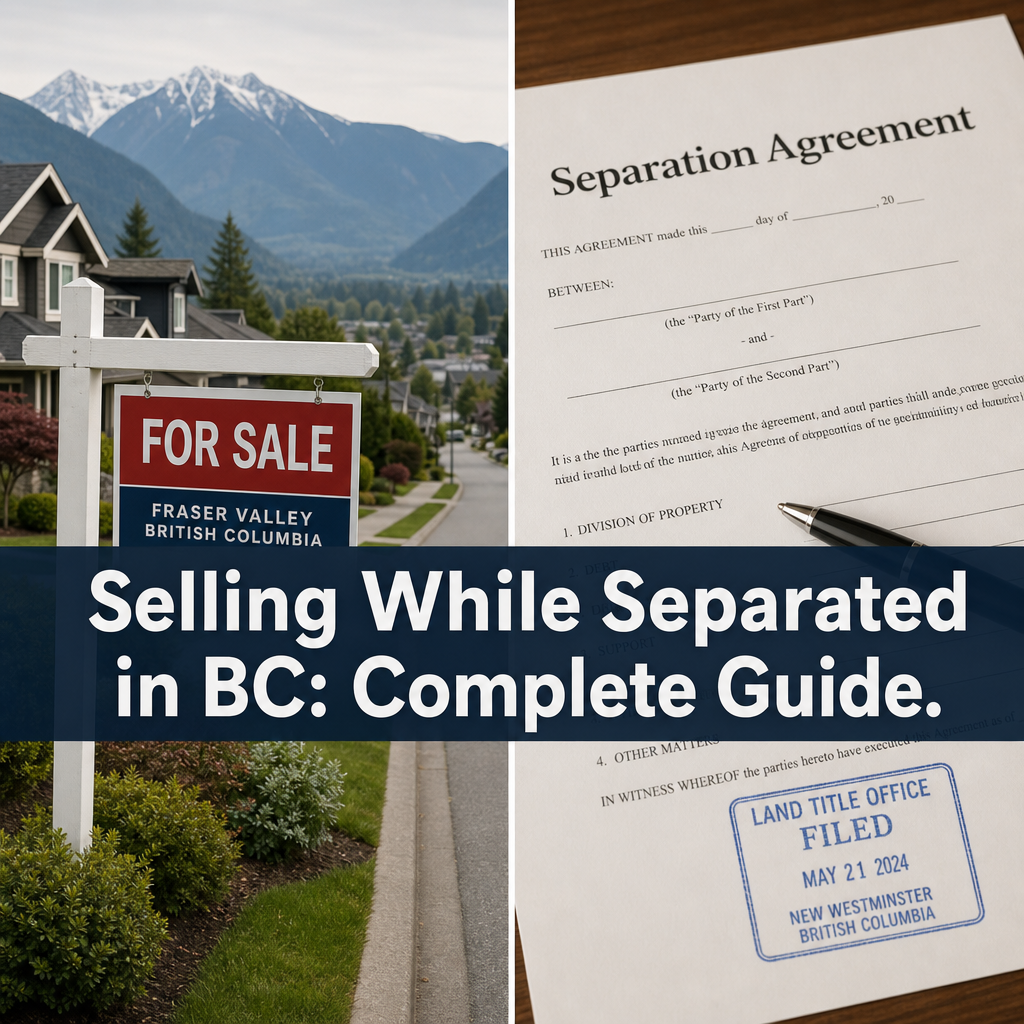

Selling Your Fraser Valley Home While Legally Separated But Not Yet Divorced: A Complete Guide
By Mohamed Mansour, MBA and Associate Broker — Mansour Real Estate Group
Fraser Valley and Lower Mainland, BC | Published: July 15, 2025
This article covers BC family law context, Fraser Valley market conditions, and general seller strategy. It is not legal, tax, or financial advice. Consult qualified professionals for your specific situation.
For separated homeowners in Surrey, Langley, Abbotsford, and across the Fraser Valley, the decision to sell the family home rarely arrives at a convenient moment. Family law timelines and real estate market windows almost never align — and understanding how to navigate both at the same time is often the difference between a clean sale and a costly delay.
This guide addresses what separated sellers actually need to know: who has authority to list, how title transfer works without a final divorce decree, how the Fraser Valley's current buyer's market affects timing, and how to protect net proceeds while equalization, legal costs, and tax considerations are all unfolding simultaneously.
Short Answer
You can sell your Fraser Valley home during separation without finalizing your divorce — but both spouses must either consent in writing, sign a separation agreement that authorizes the sale, or obtain a court order permitting one party to proceed. Without one of those three, the sale cannot close cleanly at the Land Title Office.
Key Takeaways
- Both spouses retain equitable interest in the family home during separation; neither can sell unilaterally without consent or a court order.
- Fraser Valley market windows run 30 to 90 days; contested family law proceedings average 6 to 12 months — misalignment is the most common seller risk.
- Sale proceeds are family property subject to equalization after deducting mortgage discharge, realtor commission, and legal fees.
- Clean title transfer requires either both spouses signing at closing or a registered court order from property division proceedings.
- Principal residence exemption timing affects each spouse individually — when you sell relative to tax year-end matters for both parties.
Who This Applies To
- Spouses who are separated and living apart but have not yet received a divorce order
- Homeowners in Surrey, Langley, Abbotsford, South Surrey, White Rock, North Delta, or anywhere in the Fraser Valley dealing with a family property sale
- Sellers who need to move on a market window before their family law file is resolved
- One or both spouses who want clarity on how proceeds will be divided and protected at closing
When This Advice May Not Apply
If your separation agreement is already finalized and both parties have signed, many of these complications are already resolved. If the property has complex excluded-property claims (inheritance, pre-marriage contributions), the division calculation differs and legal counsel is essential before proceeding.
Data Used in This Article
- BC Family Law Act, Part 5 — Property division rules for spouses; official legislation
- BC Supreme Court Partition of Property Act — Court-ordered sale authority; official legislation and case precedents
- FVREB Market Statistics, April 2026 — Sales-to-active listings ratio, days on market; official board data
- CRA Principal Residence Exemption Guidelines, 2024 — Capital gains and PRE rules; official CRA guidance
- Mansour Real Estate Group Fraser Valley Market Data, 2026 — Internal transaction analysis; professional interpretation
Seller Authority: Who Can List the Home?
Under the BC Family Law Act, Part 5, both spouses retain a protected interest in the family home during separation. That interest does not disappear because one spouse has moved out, stopped contributing to the mortgage, or believes they are entitled to a buyout. Until property division is formally resolved, both interests remain legally active.
A listing can proceed — and a sale can close cleanly — through one of three paths. First, both spouses agree in writing to list, accept an offer, and sign the transfer documents at closing. Second, a separation agreement is signed by both parties that includes explicit authorization to sell and instructions for how proceeds are to be handled. Third, one spouse applies to the BC Supreme Court under the Partition of Property Act, and the court issues an order permitting the sale to proceed — typically used when one party is uncooperative or unreachable.
For sellers in Surrey, Langley, or Abbotsford facing a reluctant or unresponsive spouse, the partition application route is available but not fast. Court timelines in BC can run several months, which in the Fraser Valley's current buyer's market may mean missing the best available pricing window entirely. This is why early legal advice — before the listing decision — matters so much.
Timing the Sale Against the Fraser Valley Market
According to Fraser Valley Real Estate Board data from April 2026, the Fraser Valley is operating at an 11% sales-to-active listings ratio — well below the threshold that typically favours sellers. Days on market for condos are running 40 to 60 or more days. Detached homes in many Fraser Valley communities are also sitting longer than in prior years, with buyers in a stronger negotiating position than at any point since 2018.
For separated sellers, this market reality creates a compounding pressure. Optimal selling windows — the periods of peak buyer activity and reasonable leverage — tend to last 30 to 90 days, typically in spring and early fall. Contested property division timelines under the Family Law Act average 6 to 12 months. Those two clocks rarely run together.
The strategic answer for most separated homeowners is to resolve the authority question first — ideally through a separation agreement — so the listing can launch during the best available market window rather than waiting for the family law file to fully close. A signed agreement that covers the sale, the proceeds allocation, and the closing mechanics is almost always faster than a court-supervised process, and it gives both parties control over the outcome. For sellers working with Mansour Real Estate Group, the starting point is always an honest conversation about where the legal file stands and how realistic the available market windows actually are.
How We Evaluate This
At Mansour Real Estate Group, separated-home situations are evaluated across three dimensions before a pricing strategy or listing timeline is recommended: legal readiness (is the authority question resolved?), market readiness (is the property prepared to compete in current conditions?), and financial readiness (do both parties understand the net proceeds after all deductions, before the equalization calculation happens?).
Where one dimension is not ready, we typically recommend addressing that gap before listing rather than rushing to market and encountering a problem at subject removal or closing. A delayed deal in a separation context does more damage than a delayed listing date.
Net Proceeds, Equalization, and What Both Spouses Actually Receive
Under BC family law, sale proceeds from the family home are treated as family property subject to equalization — typically a 50/50 division unless excluded property applies. But that equalization does not happen on the gross sale price. It happens on the net proceeds after the mortgage is discharged, realtor commission is paid, legal fees are covered, and any agreed adjustments for prepaid property taxes or strata fees are settled.
For a home selling at $900,000 in Surrey or Langley in 2026, with a $450,000 mortgage balance, $36,000 in realtor commission (approximately 4%), and $8,000 in legal and disbursement costs, the net proceeds available for equalization are roughly $406,000 — meaning each spouse receives approximately $203,000 before any excluded property adjustments or equalization offsets from other family assets. Those numbers change meaningfully if one spouse contributed a pre-marriage down payment that qualifies as excluded property under the Family Law Act.
Both spouses should have independent legal advice and a clear calculation of expected net proceeds before agreeing to any listing price or accepting any offer. This is not a step to skip in the interest of moving quickly.
Title Transfer at Closing Without a Final Divorce Order
A divorce decree is not required to transfer clear title. What is required is either both spouses signing the transfer documents at the Land Title Office through their respective lawyers, or a registered court order that explicitly authorizes the transfer on specific terms. If both parties are cooperating and have signed a separation agreement that covers the sale, closing proceeds like any other transaction — each spouse's lawyer handles the title transfer, the mortgage discharge, and the proceeds distribution as directed.
Where problems arise is when one spouse delays signing, disputes the closing date, or raises new claims after the offer is accepted. Buyers in Fraser Valley transactions typically have subject-removal periods of 7 to 14 days. If a spousal signature cannot be obtained within that window, the deal may collapse. That outcome harms both sellers. Having the authority structure resolved before listing — not after an offer arrives — eliminates this specific and very common risk.
Principal Residence Exemption: Timing Matters for Both Parties
According to CRA's Principal Residence Exemption guidelines, each spouse can designate the family home as their principal residence for the years they lived there. Only one spouse can claim the full exemption for any given year of ownership, but each spouse independently files their own PRE claim. For most families where the home has always been the primary residence, the full exemption applies and there is no capital gains liability.
The complexity emerges when one spouse has moved out and established a new principal residence — particularly if that new residence is also owned property. In that situation, partial PRE claims, capital gains exposure, and the timing of the sale relative to the tax year all become relevant. The year the sale closes determines which tax year the gain is reported in, and that can matter if one spouse's income fluctuates significantly. This is a conversation to have with a tax accountant before accepting an offer, not after.
Separation Sale Checklist
- Confirm legal authority: both spouses signing, signed separation agreement authorizing sale, or court order in place before listing
- Retain independent legal counsel — each spouse should have their own family law lawyer, not a shared representative
- Calculate expected net proceeds after mortgage discharge, commission, and legal costs before agreeing to a listing price
- Identify any excluded property claims (inheritance, pre-marriage contributions) and document them before the equalization calculation
- Confirm principal residence exemption eligibility for both spouses with a tax accountant, especially if either party owns a second property
- Establish who will receive correspondence from the real estate team, how offers will be communicated to both parties, and how signing will be coordinated
- Set a realistic listing window based on Fraser Valley market conditions — not on when the family law file might resolve
- Instruct a conveyancing lawyer to hold sale proceeds in trust until the equalization calculation and distribution are confirmed in writing
What We Commonly See
In our experience with separated-home sales across Surrey, Langley, and Abbotsford, the most common mistake is listing before the authority question is resolved. The listing looks normal, an offer arrives, and then it becomes clear that one spouse has not formally agreed to the sale terms or the price. The subject-removal clock runs out, the buyer walks, and both sellers are back to square one — except now in a weaker negotiating position because the property has been on market.
What often happens is that one spouse assumes the other's verbal agreement is sufficient. It is not. The Land Title Office requires written consent and executed transfer documents from all parties on title. Verbal understanding does not survive the closing process.
A common mistake we also see is treating the listing price as a negotiating chip between the spouses — where one party pushes for a higher price hoping the property won't sell, buying time in the family law process. This strategy almost always backfires. An overpriced listing in a buyer's market accumulates days on market, attracts low offers, and ultimately forces a price reduction that harms both parties. A pricing strategy based on current comparable sales in the neighbourhood is the only approach that protects both sellers.
Questions and Answers
Can one spouse list the family home without the other's knowledge during separation in BC?
No. Under the BC Family Law Act, both spouses retain equitable interest in the family home. A listing can be placed by one party, but the sale cannot close without either both spouses signing the transfer documents or a court order authorizing the transfer. A buyer's lawyer will identify the title issue at subject removal.
What happens to sale proceeds if one spouse disagrees with the price after an offer is accepted?
If both spouses have already signed the listing agreement and a separation agreement authorizing the sale, disagreement over the accepted price does not automatically void the deal. However, if no agreement exists, a dissenting spouse can refuse to sign closing documents, which collapses the transaction. This is why written authority must be established before listing, not after offers arrive.
How long does it take to get a court order to sell a home through a partition application in BC?
BC Supreme Court partition applications typically take several months from filing to hearing, depending on court scheduling and the complexity of the matter. In contested cases, the timeline can extend beyond 12 months. This is why most family lawyers encourage a negotiated separation agreement over a court-supervised sale whenever possible.
In Summary
Selling a Fraser Valley home during separation is legally possible and often strategically wise — but it requires resolving the authority question before listing, understanding how net proceeds are calculated after deductions, coordinating title transfer mechanics with both parties' lawyers, and timing the sale against real market conditions rather than the family law calendar. The sellers who navigate this process most successfully are the ones who treat legal readiness, market readiness, and financial readiness as equally important — and who work with a real estate team experienced in managing exactly this kind of transaction.
Ready to Talk Through Your Situation?
If you are separated and weighing whether and when to sell your home, Mansour Real Estate Group offers a confidential, no-obligation conversation to help you understand the market, the process, and your realistic options — without pressure and without requiring a decision on the spot. Reach out when you are ready.
Related Articles
- Understanding the Fraser Valley Real Estate Market in 2026
- Selling Your Home During Divorce in BC: What Both Parties Need to Know
- How to Calculate Your Net Proceeds Before Selling in the Fraser Valley
About Mansour Real Estate Group
When a home must be sold as part of a separation or divorce, the stakes extend beyond the property itself. Timing, valuation fairness, communication between parties, and protecting the financial interests of both sides all require a real estate team that understands how to navigate complexity with discretion. Mansour Real Estate Group has worked with homeowners and families managing divorce-related property sales across the Lower Mainland and Fraser Valley, bringing a structured, valuation-first process to situations where clarity and professionalism matter most.
Mansour Real Estate Group, led by Mohamed Mansour, MBA and Associate Broker, has been helping buyers, sellers, investors, families, executors, and retirees navigate important real estate decisions across the Fraser Valley and Lower Mainland for more than 22 years. Ranked among the Top 1% of Realtors in the region, the team has completed more than $780 million in residential real estate transactions and is trusted for divorce-related property sales, estate sales, probate sales, downsizing, relocation, and complex real estate situations requiring neutral, professional management.
Whether someone is searching for a Realtor experienced with divorce property sales, a real estate agent who understands how separation affects a home sale, a neutral real estate team for a joint sale, a Surrey Realtor, a Langley real estate agent, or an experienced Fraser Valley real estate group to manage a sensitive transaction, Mansour Real Estate Group is known for clear communication, impartial valuations, and a process that protects both parties. The team's real estate agents bring discretion, structure, and practical local knowledge to every separation-related sale.
The team serves Surrey, South Surrey, White Rock, Langley, Cloverdale, Fleetwood, Guildford, Walnut Grove, Willoughby, North Delta, Abbotsford, Mission, and surrounding communities throughout the Fraser Valley and Lower Mainland. Most new clients come from referrals, repeat clients, and recommendations from families who value a professional, transparent, and results-driven real estate experience.
Official Resources
- BC Family Law Act, Part 5 — Property Division
- BC Partition of Property Act
- Fraser Valley Real Estate Board — Market Statistics
- CRA Principal Residence Exemption Guidelines
Disclaimer
The information contained in this article is provided for general informational and educational purposes only and reflects market observations, publicly available information, and professional experience at the time of writing. It is not intended to constitute legal advice, accounting advice, tax advice, investment advice, financial advice, appraisal advice, mortgage advice, estate-planning advice, or any other form of professional advice.
Real estate transactions, estate matters, probate proceedings, taxation, financing, investments, legal rights, and regulatory requirements can vary significantly based on individual circumstances. Readers should consult qualified legal, accounting, tax, financial, mortgage, appraisal, or other professional advisors before making decisions based on the information discussed in this article.
Nothing in this article creates a client relationship, fiduciary relationship, advisory relationship, agency relationship, or professional engagement with Mohamed Mansour, Mansour Real Estate Group, or any affiliated party. Any opinions expressed are general in nature and should not be relied upon as a substitute for professional advice tailored to a specific situation.
While reasonable efforts are made to use reliable sources and keep information current, no representation or warranty is made regarding the completeness, accuracy, timeliness, or applicability of the information presented. Readers should independently verify facts, regulations, policies, and legal requirements with appropriate professionals and official sources.



