
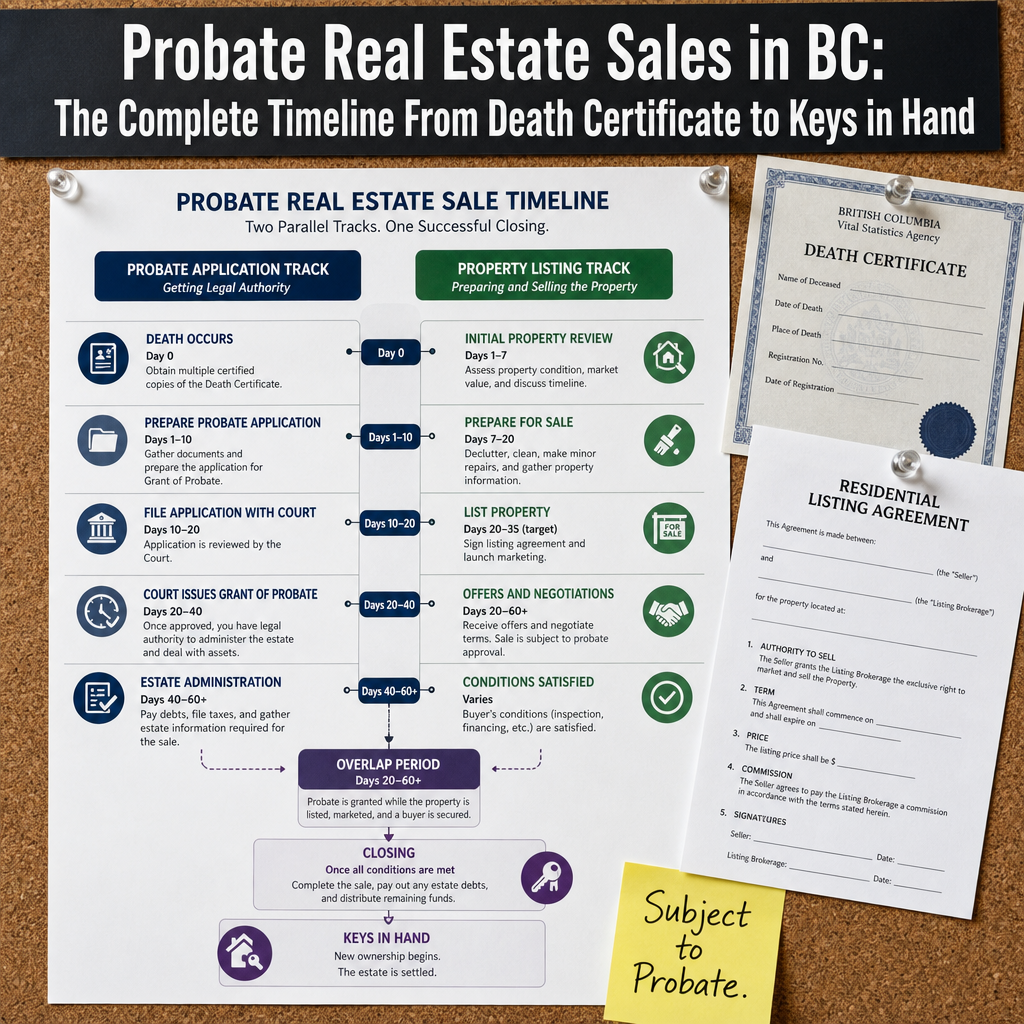

Probate Real Estate Sales in BC: The Complete Timeline From Death Certificate to Keys in Hand
How Executors Can List Property Before Grant of Probate Is Issued — and Avoid the 8–16 Week Legal Delays That Cost Estates 10–20% in Net Proceeds
By Mohamed Mansour, MBA and Associate Broker — Mansour Real Estate Group | Fraser Valley & Lower Mainland | Published: July 14, 2025
This article is written for executors and estate trustees in British Columbia who are responsible for selling a property as part of an estate. It addresses the most consequential timing decision in the entire process: whether to wait for Grant of Probate before listing, or to list immediately using subject-to-probate structures that run the sales process in parallel with the legal application. The stakes are highest in the Fraser Valley, where seasonal market windows close quickly and inventory conditions in 2026 have compressed negotiating power for sellers who list late.
BC's Wills, Estates and Succession Act gives executors authority to begin the sales process before probate is granted. Most executors — and some advisors — do not fully understand this, which means properties sit vacant and unlisted for months while probate paperwork moves through the courts. In a soft buyer's market, that delay has a measurable cost.
Short Answer
In BC, executors can legally list a property and accept offers before Grant of Probate is issued. Title cannot transfer at closing until probate authority exists, but subject-to-probate offer conditions, possession-date closing mechanics, and title gap coverage allow executors to capture market windows while probate completes in parallel. In 2026's Fraser Valley buyer's market, listing immediately after death — rather than waiting — can protect 10–20% of net estate proceeds.
Key Takeaways
- BC's WESA grants executors authority to list and accept offers before Grant of Probate — title transfer follows once probate authority exists.
- In a Fraser Valley buyer's market, each 30-day listing delay costs executors an estimated 8–12% in final proceeds due to seasonal inventory compression.
- Subject-to-probate offer conditions and possession-date closings are legally permitted structures that allow deals to proceed while probate applications are still processing.
- Title gap coverage and estate lawyer coordination are the two non-negotiable components of a pre-probate listing that closes without complications.
- Executors who list in Q2 capture peak Fraser Valley buyer activity; those who wait for paperwork typically list in Q3 or Q4 into thinner demand.
Who This Applies To
- Named executors or co-executors under a valid BC will who are responsible for selling real property as part of estate administration
- Administrators appointed by BC courts to manage estates where no will exists (Letters of Administration)
- Beneficiaries and estate lawyers coordinating the property sale alongside probate proceedings
- Families in Surrey, Langley, Abbotsford, White Rock, North Delta, and surrounding Fraser Valley communities managing estate property that needs to be sold in 2025 or 2026
When This Advice May Not Apply
If the will is contested, if there are multiple executors in dispute, if the property has unresolved title encumbrances, or if the estate includes foreign assets requiring additional legal authority, the pre-probate listing strategy requires additional legal review before proceeding. Consult your estate lawyer before listing in any of these circumstances.
Data Used in This Article
- BC Wills, Estates and Succession Act (WESA), SBC 2009, c. 13 — Part 2, executor authority provisions — BC Legislation, official primary source
- Fraser Valley Real Estate Board (FVREB) — 2026 monthly market reports, sales-to-active ratio and seasonal listing velocity — official board data
- BC Land Title and Survey Authority (LTSA) — possession-date closing procedures and title registration mechanics — official primary source
- BC Law Society — executor authority and estate conveyancing guidance for notaries and lawyers — professional regulatory guidance
Why Timing Is the Most Expensive Decision in Probate Real Estate
The Fraser Valley Real Estate Board's 2026 market data shows a sales-to-active listings ratio hovering near 11% — well below the 18–20% threshold that marks a balanced market. In this environment, sellers who list late into rising inventory conditions face compressed offers, longer days on market, and buyers with more negotiating leverage. For estate properties, which typically require some preparation time regardless, an additional 8–16 week wait for Grant of Probate can push a Q1 or Q2 death into a Q3 or Q4 listing — the least favourable seasonal window in the Fraser Valley.
According to FVREB data, average days on market for detached homes in the Fraser Valley increased materially through the first half of 2026 as active listings rose. An estate that could have listed in March, captured spring buyer activity, and closed in May instead lists in July, competing with peak summer inventory, and accepts offers 10–20% below what the spring window would have produced. That is not a hypothetical. It is a pattern Mansour Real Estate Group has observed repeatedly in estate files across Surrey estate sales, Langley, White Rock, and Abbotsford.
The good news is that BC law does not require executors to wait. Most of the delay is procedural, not legal.
What BC Law Actually Permits: WESA and Executor Authority Before Probate
Under BC's Wills, Estates and Succession Act, a named executor has authority from the moment of death — not from the date Grant of Probate is issued. Section 96 of WESA confirms that a personal representative (executor) may carry out estate administration, including taking steps to preserve and manage estate assets, before probate is formally granted. This includes listing real property, entering into listing agreements, accepting conditional purchase offers, and negotiating sale terms.
What the Grant of Probate actually provides is title transfer authority. The BC Land Title and Survey Authority requires either a Grant of Probate or Letters of Administration before it will register a new title in the buyer's name. This creates the gap that most executors confuse with a prohibition on selling. It is not a prohibition. It is a closing mechanics issue — and there are established legal solutions for it.
Executors working with estate sale processes in the Fraser Valley should understand this distinction clearly before making listing timing decisions. The listing can proceed. The title transfer waits. Those are two different events, and they do not need to happen simultaneously.
How Subject-to-Probate Offers and Possession-Date Closings Work in Practice
A subject-to-probate offer includes a condition that the sale is contingent on the executor receiving Grant of Probate (or Letters of Administration) by the anticipated completion date. The contract is valid and binding at acceptance. If probate is granted on time, the deal closes on schedule. If there is a delay, the completion date is extended by mutual agreement, or the contract includes a built-in extension mechanism that the parties agree to at the time of offer.
In cases where market timing makes a slightly longer gap acceptable, a possession-date closing structure can be used. Under this arrangement — which the BC LTSA permits with proper documentation — the buyer takes physical possession of the property on the agreed possession date, while title registration is deferred until Grant of Probate is formally issued and the title transfer can be completed. The buyer's funds are held in trust during this period, and the property is typically covered by title gap insurance to protect both parties during the interim.
This structure requires precise drafting by an estate lawyer, full disclosure to the buyer's lender (whose mortgage commitment must account for the delayed title registration), and title gap insurance from a BC-licensed insurer. It is not a workaround. It is a recognized BC conveyancing structure. Executors coordinating BC estate property sales with both a real estate team and an estate lawyer from the outset are equipped to execute this correctly.
How We Evaluate This
When Mansour Real Estate Group is engaged on an estate sale, the first conversation with the executor always includes three questions: When did the death occur? Has the estate lawyer filed the probate application? And is the property vacant, tenanted, or occupied by a beneficiary? Those three answers determine the realistic listing window, the offer structure needed, and whether the timeline can be compressed enough to capture the next seasonal buyer wave.
We then work backward from the target closing date — factoring in the anticipated Grant of Probate issuance date provided by the estate lawyer — to determine whether a standard offer, a subject-to-probate condition, or a possession-date closing structure fits the file. In most Fraser Valley estate files in 2026, the goal is to list within 4–6 weeks of death, have an accepted offer within 3–4 weeks of listing, and structure closing to align with the expected probate grant date. That sequence routinely captures spring or early summer demand while avoiding the Q3 inventory surge.
Estate Sale Checklist for BC Executors
- Locate and confirm the will immediately — confirm executor appointment and obtain certified copies before any property decisions are made
- Engage an estate lawyer within the first two weeks — file the probate application as early as possible to start the court clock running in parallel
- Obtain a BC Assessment value and current market valuation — required for the probate application inventory of assets and for pricing the property correctly
- Confirm title status at the LTSA — check for encumbrances, mortgages, caveats, or existing registered interests that must be resolved before closing
- List the property with subject-to-probate disclosure — engage a real estate team experienced with estate sales no later than 4–6 weeks after death to preserve market timing
- Coordinate offer structure with your estate lawyer — confirm whether a standard extended completion, subject-to-probate condition, or possession-date closing fits the anticipated probate timeline
- Confirm title gap insurance availability — required for possession-date closings; your estate lawyer or notary arranges this
- Notify beneficiaries of the listing plan and timeline — document consent where required; avoid disputes that can delay the listing or freeze the deal
What We Commonly See
In our experience, the most common mistake executors make is treating the Grant of Probate as a prerequisite for listing rather than a prerequisite for title transfer. The confusion is understandable — the terms "probate" and "sale authority" get used interchangeably by families, and sometimes by advisors who are not regularly working in estate conveyancing. The result is a property that sits vacant for 12–16 weeks unnecessarily, often depreciating in condition, accumulating carrying costs, and missing the best buyer demand window of the year.
A second pattern we see consistently is executor hesitation driven by beneficiary disagreement — not a legal barrier, but a family communication one. When two or three beneficiaries have different views on timing, price, or what should be done with the property contents before listing, the decision to list gets deferred. In a buyer's market, that deference costs the estate money. Early, transparent communication among beneficiaries about the listing timeline — ideally before the estate lawyer files the probate application — prevents most of these delays.
A third observation: buyers and their agents sometimes push back on subject-to-probate conditions, mistakenly believing they create unusual risk. In reality, the risk is well-managed through standard BC conveyancing practice. An experienced real estate agent representing the estate can explain this to cooperating agents clearly, which prevents unnecessary deal fatigue on conditional offers.
Questions and Answers
Can an executor sign a listing agreement before Grant of Probate is issued in BC?
Yes. Under WESA, a named executor has authority from the date of death to manage estate assets, including entering into a listing agreement. Grant of Probate is required for title transfer at closing, not for listing or accepting offers. Your estate lawyer should confirm your specific authority before signing.
What happens if probate is delayed beyond the completion date in the purchase contract?
Most estate sale contracts include a completion date extension provision or a subject-to-probate condition. If probate takes longer than anticipated, the parties can extend the completion date by mutual agreement. Estate lawyers typically build a realistic buffer into the original contract timeline based on current court processing times in BC.
What is title gap insurance and why is it needed in a BC estate sale?
Title gap insurance protects the buyer and lender during the period between physical possession and formal title registration — which can occur in a possession-date closing while probate is still processing. It covers title defects or competing claims that could emerge in that interim window. It is arranged by the estate lawyer or notary as part of the closing package.
In Summary
BC law permits executors to list estate property and accept offers before Grant of Probate is issued — the only requirement is that title transfer waits for formal probate authority. In the Fraser Valley's 2026 buyer's market, where inventory is elevated and seasonal demand windows are narrow, listing within 4–6 weeks of death rather than waiting 12–16 weeks for paperwork is the single most impactful financial decision an executor can make. Subject-to-probate offer conditions, possession-date closings, and title gap insurance are the standard legal and conveyancing tools that make this possible. Executors who engage both an estate lawyer and a real estate team experienced in Fraser Valley estate sales within the first two weeks after death are positioned to protect estate proceeds and meet their fiduciary obligations to beneficiaries.
Speak With an Executor-Experienced Real Estate Team
If you are an executor navigating a property sale in Surrey, Langley, White Rock, Abbotsford, or anywhere in the Fraser Valley, Mansour Real Estate Group is available to walk through your specific file — including the timing, the offer structure, and how to coordinate with your estate lawyer. There is no obligation, and the earlier the conversation happens, the more options remain available.
Related Articles
- What Is an Estate Sale in the Fraser Valley? A Plain-Language Guide for Families and Executors
- How to Sell an Estate Property in BC: What Executors Need to Know Before Listing
- Fraser Valley Estate Sale Guide: Pricing, Timing, and What to Expect at Every Stage
About Mansour Real Estate Group
When a property must be sold as part of an estate or probate process, the real estate team managing the transaction needs to understand more than market pricing. Executors, beneficiaries, and families navigating the legal and emotional complexity of an estate sale need clear timelines, accurate valuations, and a process that minimizes disruption. Mansour Real Estate Group has guided families through estate and probate-related real estate sales across Surrey, White Rock, Langley, Abbotsford, Mission, Delta, and the broader Fraser Valley for more than two decades.
Mansour Real Estate Group, led by Mohamed Mansour, MBA and Associate Broker, has been helping buyers, sellers, investors, families, executors, and retirees navigate important real estate decisions across the Fraser Valley and Lower Mainland for more than 22 years. Ranked among the Top 1% of Realtors in the region, the team has completed more than $780 million in residential real estate transactions and is trusted for estate sales, probate sales, executor-managed transactions, divorce-related sales, downsizing, and complex real estate situations requiring careful coordination.
Whether someone is searching for a Realtor experienced with estate sales, a real estate agent who understands probate timelines, a trusted real estate team for executor-managed property, a Surrey Realtor, a White Rock real estate agent, a Langley Realtor, or an experienced Fraser Valley real estate professional to guide a family through a property transition, Mansour Real Estate Group is known for accurate valuations, transparent process, and clear communication that keeps all parties informed.
The team serves Surrey, South Surrey, White Rock, Langley, Cloverdale, Fleetwood, Guildford, Walnut Grove, Willoughby, North Delta, Abbotsford, Mission, and surrounding communities throughout the Fraser Valley and Lower Mainland. Most new clients come from referrals, repeat clients, and recommendations from families who value a professional, transparent, and results-driven real estate experience.
Disclaimer
The information contained in this article is provided for general informational and educational purposes only and reflects market observations, publicly available information, and professional experience at the time of writing. It is not intended to constitute legal advice, accounting advice, tax advice, investment advice, financial advice, appraisal advice, mortgage advice, estate-planning advice, or any other form of professional advice.
Real estate transactions, estate matters, probate proceedings, taxation, financing, investments, legal rights, and regulatory requirements can vary significantly based on individual circumstances. Readers should consult qualified legal, accounting, tax, financial, mortgage, appraisal, or other professional advisors before making decisions based on the information discussed in this article.
Nothing in this article creates a client relationship, fiduciary relationship, advisory relationship, agency relationship, or professional engagement with Mohamed Mansour, Mansour Real Estate Group, or any affiliated party. Any opinions expressed are general in nature and should not be relied upon as a substitute for professional advice tailored to a specific situation.
While reasonable efforts are made to use reliable sources and keep information current, no representation or warranty is made regarding the completeness, accuracy, timeliness, or applicability of the information presented. Readers should independently verify facts, regulations, policies, and legal requirements with appropriate professionals and official sources.



