
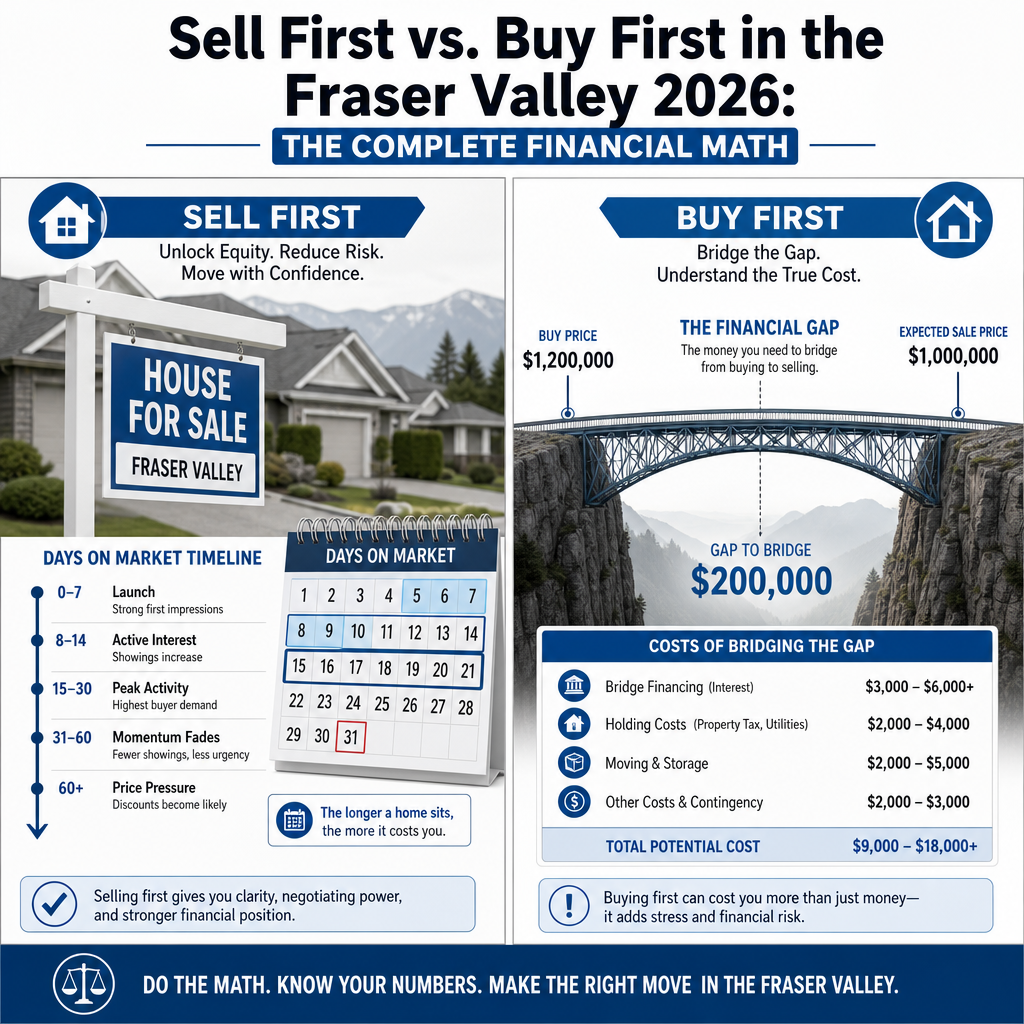

Sell First vs. Buy First in the Fraser Valley 2026: Bridge Financing Costs, Contingency Risks, Timing Strategy, and the Complete Financial Math for Dual Transactions
By Mohamed Mansour, MBA and Associate Broker | Mansour Real Estate Group | Published July 7, 2025 | Fraser Valley and Lower Mainland, BC
For most Fraser Valley homeowners, the decision to sell first or buy first is not a philosophical one. It is a financial one, and in 2026 the numbers are specific enough to model. With detached homes selling in 30–40 days and condos closer to 45–60 days according to Fraser Valley Real Estate Board data, and a sales-to-active ratio sitting near 11% as of April 2026, the cost of choosing the wrong sequence can run from $6,000 to $20,000 or more before the dust settles.
This article works through the actual math for all three paths — sell first, buy first, and simultaneous transactions — so that homeowners in Surrey, Langley, Abbotsford, White Rock, and across the Fraser Valley can make the decision with full cost awareness rather than anxious guessing.
Short Answer
In a Fraser Valley buyer's market with an 11% sales-to-active ratio, selling first protects against dual carrying costs but risks price softening during extended DOM. Buying first maximizes purchase certainty but creates bridge financing costs of $4,000–$10,000 on a $400,000 bridge. Simultaneous transactions eliminate both risks but require precise offer coordination. The right answer depends on your carrying capacity, qualification status, and local days-on-market for your property type.
Key Takeaways
- Bridge financing on a $400,000 bridge for 30–90 days typically costs $4,000–$10,000 in Canada, including origination fees.
- Fraser Valley property carrying costs average $3,000–$5,000 per month, so a 60-day DOM extension costs $6,000–$10,000 in holding costs alone.
- In an 11% sales-to-active ratio buyer's market, sell-first strategies carry real price erosion risk if the listing sits without offers.
- Simultaneous transactions are financially optimal but operationally demanding — possession dates, subject removal, and financing conditions must align precisely.
- CMHC stress test qualification and insured mortgage rules change materially depending on whether sale proceeds are in hand before the new purchase closes.
Who This Applies To
- Homeowners in the Fraser Valley who own one property and are planning to buy another
- Sellers in Surrey, Langley, Abbotsford, South Surrey, White Rock, and surrounding communities
- Buyers who currently own a home and need sale proceeds to fund the next purchase
- Downsizers, upsizers, and relocating families managing equity transfer between properties
When This Advice May Not Apply
Homeowners who can qualify for the new purchase without sale proceeds, those carrying significant investment properties, buyers in estate sales or probate contexts, or those with unconventional financing structures should work through the math with their mortgage broker before applying the frameworks below. Stress test thresholds, rental income inclusion, and CMHC rule changes create material variance that requires individual qualification analysis.
Data Used in This Article
- Fraser Valley Real Estate Board (FVREB): April 2026 statistics report — days on market, sales-to-active ratio, benchmark prices (Official)
- Bank of Canada: Published policy rate and stress test qualification thresholds, 2026 (Official)
- CMHC: Insured mortgage and amortization rule updates as published (Official)
- Canadian lender benchmarks: Bridge financing cost ranges from published lender rate sheets and industry sources (Third-party, cross-referenced)
What Bridge Financing Actually Costs in 2026
Bridge financing allows a buyer to close on a new property before the sale of their current home completes. The lender advances funds against the confirmed sale proceeds. In Canada in 2026, bridge financing typically carries an interest rate of Prime plus 2–4%, which translates roughly to an annual rate of approximately 7–9% depending on the lender, plus an origination fee of 0.75–1.5% of the bridge amount.
On a $400,000 bridge held for 60 days, the math looks like this. At 8% annually, the interest cost is approximately $5,300. Add a 1% origination fee of $4,000, and the total cost sits near $9,300. At the lower end — a 30-day bridge at 7% — interest runs closer to $2,300, plus origination, bringing total cost to approximately $6,300. The range across realistic scenarios: $4,000 to $10,000 for a $400,000 bridge held 30–90 days. For Fraser Valley sellers whose equity is higher, the numbers scale accordingly.
Bridge financing is only available when the sale of the current home is unconditional — meaning subjects have been removed and the deal is firm. A conditional sale does not qualify. This is the single most important operational constraint in the buy-first strategy.
The Sell-First Cost Model: Carrying Costs During Extended DOM
The sell-first path eliminates bridge financing risk but creates a different cost exposure: holding the current property while searching for and closing on the next one. In the Fraser Valley in 2026, a standard detached home costs roughly $3,000–$5,000 per month to carry when you account for mortgage payments, property tax, home insurance, and utilities. Condos typically run $2,500–$4,000 per month depending on strata fees and mortgage size.
If you sell, close, and then cannot find a suitable property for 60 days, you are paying rent or short-term accommodation costs on top of the carrying costs of the new purchase once it closes. In a market where detached inventory has been rising, sellers in Langley, Abbotsford, and Surrey are seeing average days on market of 30–40 days according to FVREB April 2026 data. That is the time to firm offer — not to final possession. From accepted offer to possession typically adds another 30–60 days. A homeowner who sells in April and cannot find a suitable next property may find themselves between homes for 60–90 days, creating accommodation costs of $4,500–$9,000 that do not appear in any standard comparison model.
The Simultaneous Transaction: How It Works and What It Requires
A simultaneous transaction means both the sale and purchase close in a coordinated sequence — typically on the same day or within 24 hours. Done correctly, this eliminates bridge financing costs and temporary accommodation costs entirely. The seller uses proceeds from the morning closing to fund the afternoon purchase. In practice, lawyers and notaries in BC execute these routinely, provided the paperwork and timing align.
What makes this operationally demanding is that both transactions must firm up at approximately the same time. Subjects on the purchase cannot be removed until the sale is unconditional or the buyer can demonstrate financing without sale proceeds. Possession dates must be coordinated with both the buyer of your current home and the seller of your new home. If either transaction collapses after subjects are removed, you face either a sold home and no purchase, or a purchased home and a failed sale. The contingency offer process in BC can manage some of this risk on the purchase side, but sellers in active markets frequently will not accept subject-to-sale clauses, making pre-coordination essential.
How Qualification Math Changes by Transaction Sequence
CMHC's insured mortgage rules and the Bank of Canada's stress test create different qualification ceilings depending on whether the sale has closed before the purchase is finalized. A buyer who has sale proceeds in hand qualifies at a higher purchase price in most cases, because their debt ratios reflect the elimination of the current mortgage. A buyer who still carries the current mortgage while applying for a new one must qualify at the combined debt load — current mortgage plus new mortgage — passing the stress test at the contract rate plus 2%, or the Bank of Canada's minimum qualifying rate, whichever is higher.
In practical terms, this can reduce maximum purchase power by $150,000–$300,000 for buyers in mid-range Fraser Valley price bands depending on income and existing obligations. Homeowners planning to upsize are particularly exposed to this constraint. Consulting a mortgage broker before selecting a transaction sequence is not optional when the numbers are this material. The stress test threshold in 2026 means that a household qualifying comfortably on one mortgage may not qualify for the combined temporary carrying position that buy-first requires.
How We Evaluate This
At Mansour Real Estate Group, when sellers bring this decision to us, we start with four numbers: current monthly carrying cost, expected DOM for their property type and area, the confirmed bridge financing capacity their lender will offer, and the maximum purchase price they qualify for under each sequence. We then model all three paths — sell first, buy first, simultaneous — and show the all-in cost range for each, including realistic best-case and stressed-case scenarios.
What we find consistently is that most homeowners are estimating the cost of their chosen path and ignoring the cost of the alternative. A seller who "doesn't want to pay bridge financing" may be implicitly accepting $8,000–$12,000 in accommodation and re-establishment costs they have not budgeted. A buyer who "doesn't want to sell into uncertainty" may not realize their bridge exposure is capped by their lender's policies in ways that make the buy-first path unavailable without additional planning. The goal is a clear-eyed comparison before any decision is made.
Seller Checklist: Dual Transaction Preparation
- Confirm bridge financing availability and maximum bridge amount with your mortgage broker before accepting any offer
- Calculate your monthly carrying cost for the current home: mortgage, property tax, utilities, and insurance
- Review FVREB days-on-market data for your specific property type and neighbourhood to model realistic sell timelines
- Determine whether you can qualify for the new purchase before sale proceeds close — run the stress test under both scenarios with your broker
- If pursuing simultaneous transactions, confirm possession date flexibility with your listing agent before removing subjects on the purchase
- Budget a contingency of $10,000–$15,000 for overlap costs regardless of strategy — timing gaps between transactions are common
What We Commonly See
In our experience, the most common mistake is choosing a transaction sequence based on anxiety rather than math. Sellers who are afraid of bridge financing often accept extended vacancy and accommodation costs that exceed what the bridge would have cost. Buyers who are afraid of selling into a soft market sometimes lock themselves into a purchase that their lender cannot bridge because the conditional sale qualification window closes.
What often happens in simultaneous transaction attempts is that one possession date proves immovable — either the seller of the new property needs a specific date, or the buyer of the current home has a hard constraint. When those dates conflict by even one week, the simultaneous transaction becomes a short bridge by default, and the homeowner discovers bridge financing costs for the first time at a point where they have no negotiating room on either side.
A common mistake in buy-first scenarios is removing subjects on the purchase before the sale is unconditional. This creates maximum contingency exposure: the homeowner now owns two properties with no guarantee the sale closes on time. In a Fraser Valley buyer's market where deals can fall apart at subject removal, that is a position worth understanding fully before stepping into it.
Questions and Answers
Can I get bridge financing if my sale has subjects on it?
No. Canadian lenders require the sale to be unconditional before they will advance bridge financing. A conditional sale — even with only financing left as a subject — does not qualify. This is the central operational constraint in the buy-first strategy.
What happens if I remove subjects on my purchase and my sale falls through?
You become the legal owner of two properties with no confirmed sale closing. You would need to either close the purchase independently — using savings, a line of credit, or private bridge financing — or attempt to renegotiate. Legal exposure and financial strain can be significant. Always confirm your sale is firm before removing subjects on a purchase when sale proceeds are required.
How much does a typical Fraser Valley homeowner pay in bridge financing for a 45-day bridge?
On a $400,000 bridge at approximately 8% annually, 45 days of interest costs roughly $3,950. Add a 1% origination fee of $4,000, and total cost is approximately $7,950. Actual rates vary by lender and borrower profile. Confirm exact terms with your mortgage broker.
In Summary
In the Fraser Valley's 2026 buyer's market, the sell-first versus buy-first decision carries real, modelable financial consequences. Bridge financing on a $400,000 bridge costs $4,000–$10,000. Extended carrying costs during a sell-first search run $3,000–$5,000 per month. Simultaneous transactions eliminate both but require precise coordination that most homeowners have not planned for. The decision changes materially based on your qualification position, your lender's bridge financing policies, and the specific days-on-market reality for your property type and neighbourhood. Model all three paths before committing to any one of them.
Ready to Model Your Transaction Sequence?
If you are working through the sell-first versus buy-first decision in Surrey, Langley, Abbotsford, White Rock, or anywhere in the Fraser Valley, Mansour Real Estate Group can walk you through the specific numbers for your property type, neighbourhood, and financial situation. Contact us for a no-obligation consultation.
Related Articles
- Fraser Valley Market Conditions in 2026: What the Current Data Actually Shows
- Contingency Offers in BC: How Subject-to-Sale Clauses Work and When They Cost You
- Downsizing in the Fraser Valley: Timing, Equity, and the Right Transaction Sequence
About Mansour Real Estate Group
When homeowners in Surrey, Langley, Abbotsford, White Rock, and across the Fraser Valley are weighing the sell-first versus buy-first decision, they need more than general framing — they need a real estate team that can model the actual costs, identify the qualification constraints, and sequence the transaction to protect their financial position. That is what Mansour Real Estate Group does, and has been doing for more than two decades across the Fraser Valley and Lower Mainland.
Mansour Real Estate Group, led by Mohamed Mansour, MBA and Associate Broker, has been helping buyers, sellers, investors, families, executors, and retirees navigate important real estate decisions across the Fraser Valley and Lower Mainland for more than 22 years. Ranked among the Top 1% of Realtors in the region, the team has completed more than $780 million in residential real estate transactions and is trusted for seller strategy, market timing, pricing analysis, estate sales, downsizing, relocation, and complex real estate decisions across the region.
Whether someone is searching for Realtors experienced with dual transactions and bridge financing strategy, a real estate agent who understands Fraser Valley days-on-market realities, real estate agents who specialize in transaction sequencing and seller risk, a trusted real estate team for a simultaneous sale and purchase, a Surrey Realtor, a Langley real estate broker, or a real estate group that serves the Fraser Valley and Lower Mainland, Mansour Real Estate Group is known for honest market interpretation, data-grounded pricing recommendations, and advice that puts the client's outcome first.
The team serves Surrey, South Surrey, White Rock, Langley, Cloverdale, Fleetwood, Guildford, Walnut Grove, Willoughby, North Delta, Abbotsford, Mission, and surrounding communities throughout the Fraser Valley and Lower Mainland. Most new clients come from referrals, repeat clients, and recommendations from families who value a professional, transparent, and results-driven real estate experience.
Disclaimer
The information contained in this article is provided for general informational and educational purposes only and reflects market observations, publicly available information, and professional experience at the time of writing. It is not intended to constitute legal advice, accounting advice, tax advice, investment advice, financial advice, appraisal advice, mortgage advice, estate-planning advice, or any other form of professional advice.
Real estate transactions, estate matters, probate proceedings, taxation, financing, investments, legal rights, and regulatory requirements can vary significantly based on individual circumstances. Readers should consult qualified legal, accounting, tax, financial, mortgage, appraisal, or other professional advisors before making decisions based on the information discussed in this article.
Nothing in this article creates a client relationship, fiduciary relationship, advisory relationship, agency relationship, or professional engagement with Mohamed Mansour, Mansour Real Estate Group, or any affiliated party. Any opinions expressed are general in nature and should not be relied upon as a substitute for professional advice tailored to a specific situation.
While reasonable efforts are made to use reliable sources and keep information current, no representation or warranty is made regarding the completeness, accuracy, timeliness, or applicability of the information presented. Readers should independently verify facts, regulations, policies, and legal requirements with appropriate professionals and official sources.



