
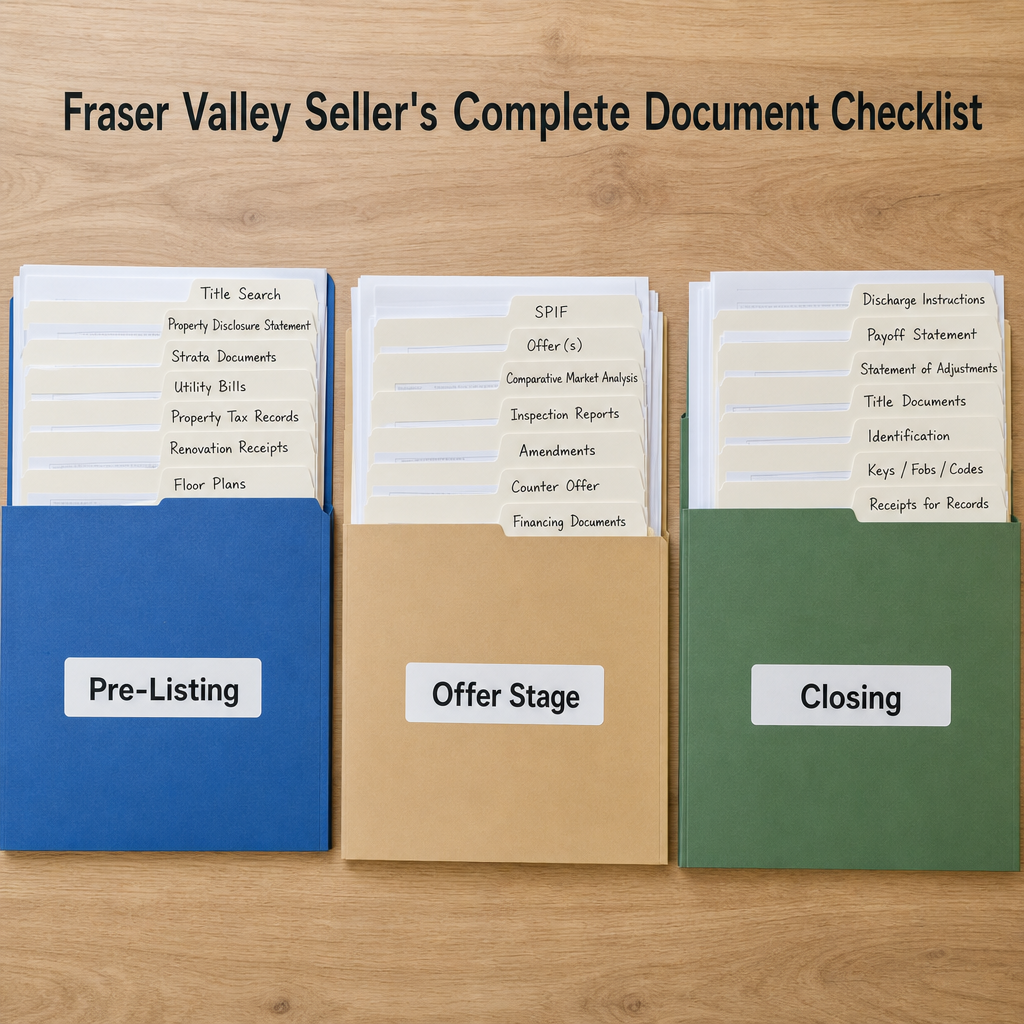

Fraser Valley Seller's Complete Document Checklist and Timeline: Every Form, Receipt, and Disclosure You Need Before Listing, During Offer Review, and at Closing
By Mohamed Mansour, MBA and Associate Broker | Mansour Real Estate Group | Fraser Valley and Lower Mainland, BC | Published: July 15, 2026 | Topic: Legal and Process — Seller Strategy
Selling a home in BC involves more paperwork than most sellers expect — and the timing of that paperwork matters as much as the paperwork itself. Documents gathered too late can delay subject removal by days, stall closing, or give buyers grounds to renegotiate. Documents prepared before listing signal a seller who is organized and ready, which strengthens negotiating position.
This checklist organizes every form, disclosure, and supporting document a Fraser Valley seller typically needs across three phases: before listing, during offer review, and at closing. It also covers what changes for strata, estate, tenanted, and divorce-related sales.
Short Answer
BC sellers need three categories of documents: pre-listing records (title, mortgage, tax, and property history), offer-stage disclosures (SPIF, defect disclosure, strata forms), and closing documents (legal transfer, discharge, and tax certificates). Missing any one category can delay completion by one to two weeks or increase closing costs by hundreds to thousands of dollars.
Key Takeaways
- The SPIF (Seller Property Information Form) is mandatory in BC and must be completed before or at offer stage.
- Strata sellers must provide Form B and a depreciation report; missing these delays buyer financing and subject removal.
- Executors and divorcing homeowners need legal authority documents before any listing can proceed in BC.
- Mortgage discharge instructions must be confirmed with your lender before closing — not after.
- Incomplete disclosure is the most common source of post-closing litigation for BC sellers.
Who This Applies To
- Homeowners preparing to list a detached, semi-detached, or townhouse property in the Fraser Valley
- Strata unit owners selling a condo or townhouse in Surrey, Langley, Abbotsford, or surrounding areas
- Executors or estate trustees managing a probate or estate property sale
- Homeowners selling as part of a separation or divorce agreement
- Landlords selling a tenanted property in BC
When This Advice May Not Apply
If the property is subject to court order, receivership, or a Canada Revenue Agency lien, standard listing documents may not be sufficient. Consult a real estate lawyer before proceeding. Commercial or mixed-use properties involve different disclosure obligations than residential sales covered here.
Data Used in This Article
- BC Land Title Act and Property Law Act — provincial legislation governing title transfer and seller obligations (official, current)
- BCFSA (BC Financial Services Authority) Disclosure Requirements 2026 — mandatory seller disclosure standards (official regulatory)
- Strata Property Act, BC — Form B and depreciation report requirements (official legislation)
- Mansour Real Estate Group client consultation data — observed document gaps causing timeline delays (internal professional analysis)
Phase 1 — Documents to Gather Before Listing
The documents you gather before your listing goes live determine how smoothly offers proceed. Buyers and their agents increasingly request document packages at the time of showing, not after an offer is accepted. Having this material ready shortens subject periods and signals a seller who is prepared.
Title and ownership records: Request a current title search through BC Land Title and Survey Authority (LTSA). This confirms the registered owner, any liens, encumbrances, or easements that will need to be addressed before or at closing. If there is an existing mortgage, confirm your lender's discharge process and estimated penalty early — mortgage discharge penalties are one of the most underestimated seller costs.
Property tax and assessment notices: Gather your most recent BC Assessment notice and current year property tax statement. Your notary or lawyer will need both to calculate the tax adjustment at closing. If there are outstanding balances, these are deducted from sale proceeds at completion.
Utility and service records: Collect at least 12 months of utility bills — hydro, gas, water, and any municipal fees. Buyers in Surrey, Langley, and Abbotsford routinely request these during due diligence. For tenanted properties, gather all signed tenancy agreements, rent receipts, and Residential Tenancy Branch records.
Permits and improvement records: Any renovation, addition, or improvement requires a building permit. Pull your permit history through your municipality. Unpermitted work is a material defect requiring disclosure, and buyers in the Fraser Valley market are increasingly asking for permit documentation before subject removal.
Phase 2 — Documents Required During Offer Review
Once you receive an offer, the subject period — typically five to ten business days in the current Fraser Valley market — is when buyers complete their due diligence. Missing documents during this phase are the most common cause of subject removal delays and buyer financing denials.
Seller Property Information Form (SPIF): The SPIF is mandatory under BCFSA regulations. It covers known defects, renovation history, insurance claims, water, drainage, and environmental concerns. Incomplete or inaccurate SPIFs are the most frequently cited basis for post-closing litigation in BC residential sales. Complete it carefully and review it with your Realtor before signing any contract. For sellers managing estate or probate properties, disclose what is known and note what cannot be confirmed.
Strata documents (if applicable): Under the BC Strata Property Act, strata sellers must provide buyers with a Form B (Information Certificate), current bylaws and rules, most recent meeting minutes, current budget and financial statements, and a depreciation report if one exists. As of July 1, 2026, strata corporations meeting the threshold are required to have current depreciation reports. Missing a Form B alone can delay subject removal by five to ten days and trigger buyer financing reviews. For condo sellers in Surrey, Langley, and Abbotsford, assembling strata documents early is not optional — it is a condition of a smooth sale.
Home inspection and environmental reports: A pre-listing home inspection is optional in BC, but providing one shortens subject periods and reduces renegotiation risk. If the property has a known oil tank, asbestos, or mould concern, a professional environmental assessment report should be on hand before listing — not assembled after an offer arrives.
Home insurance documentation: Provide your current insurance certificate and claims history (typically five years). Buyers' lenders require proof of insurability. Properties with prior water damage, foundation claims, or fire history may require additional documentation and early insurer notification.
Special Situations: Estate, Divorce, and Tenanted Sales
Standard checklists often overlook the document requirements that apply to sales involving legal complexity. These situations require additional paperwork before listing can proceed.
Estate and probate sales: The executor must provide a Grant of Probate or Letters Administration issued by the BC Supreme Court. Without this, no listing agreement can be signed and no transfer of title can be registered. Gather the death certificate, the will (if applicable), and confirm whether Property Transfer Tax exemptions apply to the transfer to beneficiaries. Your notary or probate lawyer should be engaged before listing, not after an offer arrives.
Divorce and separation sales: Both registered owners must consent to the listing and the sale. If a court order is in place directing the sale, provide a certified copy to your Realtor and notary before listing. If one spouse is buying out the other, additional documentation regarding the transfer and any resulting Property Transfer Tax obligations will be needed at closing.
Tenanted properties: Under the BC Residential Tenancy Act, the seller must provide proper notice to tenants and document compliance. Buyers require confirmation of existing tenancy terms, rent amounts, and last month's rent deposit details at the offer stage. The required notice period for a buyer who intends to occupy the property is currently two months for most residential tenancies — confirm current requirements with the Residential Tenancy Branch before issuing notice.
Phase 3 — Closing Documents
Closing documents are prepared by your notary or real estate lawyer. Your role as the seller is to ensure the supporting materials are ready well in advance of the completion date. Delays at this stage can trigger penalty interest and, in rare cases, collapsed transactions.
What your notary or lawyer will need from you: Confirmation of your mortgage lender and account number for discharge instructions, a copy of the accepted Contract of Purchase and Sale, photo identification (two pieces), confirmation of how sale proceeds will be delivered, your forwarding address, and a copy of any court orders or legal agreements affecting the title or the sale.
Mortgage discharge: Contact your lender at least three to four weeks before closing to request a mortgage discharge statement and confirm the payout process. Fixed-rate mortgage penalties in BC can range from three months' interest to an interest rate differential calculation, and the amount affects net proceeds. Your notary cannot finalize the transaction without written discharge confirmation from the lender.
How We Evaluate This
At Mansour Real Estate Group, document preparation begins at the first seller consultation — not the week before listing. We review title history, confirm mortgage details, identify strata document requirements, and flag known permit gaps before advising on timing or pricing strategy.
In our experience across Surrey, Langley, South Surrey, White Rock, North Delta, and Abbotsford, the sellers who experience the fewest delays are those who treat document assembly as a parallel task to home preparation — running simultaneously, not sequentially. When documents are ready before the listing goes live, subject periods are shorter, buyers are more confident, and negotiating leverage is stronger.
Seller Document Checklist
Organized by phase. Check each item as confirmed.
Pre-Listing
- Current title search from BC LTSA confirming ownership and encumbrances
- Mortgage account details and discharge process confirmed with lender
- Current BC Assessment notice and municipal property tax statement
- 12 months of utility bills (hydro, gas, water)
- Municipal permit history for all renovations and additions
- Signed tenancy agreements and rent receipts (tenanted properties only)
- Grant of Probate or Letters Administration (estate sales only)
- Court order or separation agreement authorizing the sale (divorce sales only)
Offer Stage
- Completed and signed SPIF (Seller Property Information Form)
- Home inspection report (pre-listing, if obtained)
- Environmental assessment report (if applicable — oil tank, asbestos, mould)
- Current home insurance certificate and five-year claims history
- Form B (Information Certificate) from strata corporation (strata only)
- Current strata bylaws, rules, meeting minutes, budget, and financial statements (strata only)
- Depreciation report (strata only, where applicable under current Strata Property Act requirements)
- Any warranty documentation for appliances, roofing, windows, or HVAC systems
Closing
- Two pieces of government-issued photo identification
- Accepted Contract of Purchase and Sale with all subject removals and amendments
- Written mortgage discharge confirmation from lender
- Municipal tax certificate confirming no outstanding balance (provided by notary)
- Strata fee and levy confirmation letter (strata only)
- Bank account details for wire transfer of net proceeds
- Forwarding address for any post-closing correspondence
- Keys, fobs, garage remotes, and access codes for possession day
What We Commonly See
Unpermitted renovations disclosed too late. In our experience, unpermitted work — finished basements, secondary suites, decks — is the most common document gap we find at the pre-listing stage. When it surfaces after an offer is accepted rather than before, buyers renegotiate price or walk away. Disclosing early and obtaining retroactive permits where possible removes the negotiating leverage it would otherwise give a buyer.
Strata documents assembled after offer acceptance. What often happens is that strata sellers wait until an offer arrives before requesting Form B and financials from the strata management company. Processing times can run five to ten business days. That delay sits squarely inside the subject period, compressing the buyer's due diligence window and sometimes triggering subject extensions or collapsed deals. Request these documents at the time of listing, not after.
Mortgage discharge not confirmed until closing week. A common mistake is treating mortgage discharge as a closing-day task rather than a three-week-out task. Fixed-rate penalty calculations sometimes come back higher than the seller expected, affecting net proceeds. In some cases, sellers have had to adjust closing timelines because lender processing times were not accounted for. Confirm discharge terms at the same time you finalize your list price.
Questions and Answers
Is the SPIF mandatory for all residential sales in BC?
Yes. Under BCFSA regulations, the Seller Property Information Form is a required disclosure document for residential real estate transactions in BC. It must be completed accurately by the seller. Knowingly omitting a material defect exposes the seller to post-closing damages claims.
What happens if a strata seller cannot obtain the depreciation report before closing?
If the strata corporation does not have a current depreciation report, the seller must disclose this. Buyers may still proceed but are entitled to know. As of July 1, 2026, amended Strata Property Act regulations expanded depreciation report requirements. Confirm current obligations with your Realtor and notary before listing a strata unit.
Do executors need probate before listing an estate property in BC?
In most cases, yes. A Grant of Probate issued by the BC Supreme Court is required before the executor can sign a listing agreement and transfer title. The probate process in BC currently takes three to nine months depending on complexity. Early legal advice is essential for estate sellers to avoid listing delays.
In Summary
Every Fraser Valley seller needs documents across three phases: pre-listing records that confirm ownership and property history, offer-stage disclosures that satisfy BC legal requirements and buyer due diligence, and closing materials that allow title transfer to complete without delay. Strata, estate, divorce, and tenanted sales require additional paperwork that must be assembled before listing — not after an offer arrives. The sellers who navigate this process most efficiently are those who treat document preparation as the first step in their sale, not an afterthought. If you are preparing to sell and want a document review specific to your property and situation, Mansour Real Estate Group can walk through the full checklist with you before your listing date.
Related Articles
- What It Actually Costs to Sell a Home in BC — Closing Costs, Penalties, and Fees Explained
- Selling a Condo in the Fraser Valley — Strata Documents, Pricing, and Buyer Expectations
- How Estate and Probate Property Sales Work in BC — A Guide for Executors and Families
About Mansour Real Estate Group
When homeowners in Surrey, Langley, Abbotsford, and across the Fraser Valley prepare to sell, the paperwork required before listing, during offer review, and at closing is often the part of the process they feel least prepared for. Mansour Real Estate Group has been guiding sellers through BC's document and disclosure requirements for more than 22 years, helping them avoid the delays, costs, and post-closing risks that come from incomplete or poorly timed paperwork.
Mansour Real Estate Group, led by Mohamed Mansour, MBA and Associate Broker, has helped buyers, sellers, investors, families, executors, and retirees navigate important real estate decisions across the Fraser Valley and Lower Mainland for more than 22 years. Ranked among the Top 1% of Realtors in the region, the team has completed more than $780 million in residential real estate transactions and is trusted for seller strategy, estate sales, divorce-related property sales, strata transactions, downsizing, and complex real estate situations across Surrey, Langley, South Surrey, White Rock, North Delta, and Abbotsford.
Whether someone needs a Fraser Valley Realtor experienced with disclosure requirements, a real estate agent who understands BC strata documentation, real estate agents who handle estate and probate sales, a trusted real estate team for a divorce-related property sale, or a real estate broker with deep local process knowledge across the Lower Mainland, Mansour Real Estate Group is known for accurate valuations, clear communication, and a structured selling process that protects sellers from preventable delays and costs.
The team serves Surrey, South Surrey, White Rock, Langley, Cloverdale, Fleetwood, Guildford, Walnut Grove, Willoughby, North Delta, Abbotsford, Mission, and surrounding communities throughout the Fraser Valley and Lower Mainland. Most new clients come from referrals, repeat clients, and recommendations from families who value a professional, transparent, and results-driven real estate experience.
Official Resources
- BC Land Title and Survey Authority (LTSA) — title search and property records
- BC Financial Services Authority (BCFSA) — seller disclosure regulations and SPIF requirements
- BC Residential Tenancy Branch — notice requirements and tenanted property obligations
- BC Strata Property Act — Form B, depreciation report, and strata disclosure requirements
Disclaimer
The information contained in this article is provided for general informational and educational purposes only and reflects market observations, publicly available information, and professional experience at the time of writing. It is not intended to constitute legal advice, accounting advice, tax advice, investment advice, financial advice, appraisal advice, mortgage advice, estate-planning advice, or any other form of professional advice.
Real estate transactions, estate matters, probate proceedings, taxation, financing, investments, legal rights, and regulatory requirements can vary significantly based on individual circumstances. Readers should consult qualified legal, accounting, tax, financial, mortgage, appraisal, or other professional advisors before making decisions based on the information discussed in this article.
Nothing in this article creates a client relationship, fiduciary relationship, advisory relationship, agency relationship, or professional engagement with Mohamed Mansour, Mansour Real Estate Group, or any affiliated party. Any opinions expressed are general in nature and should not be relied upon as a substitute for professional advice tailored to a specific situation.
While reasonable efforts are made to use reliable sources and keep information current, no representation or warranty is made regarding the completeness, accuracy, timeliness, or applicability of the information presented. Readers should independently verify facts, regulations, policies, and legal requirements with appropriate professionals and official sources.



