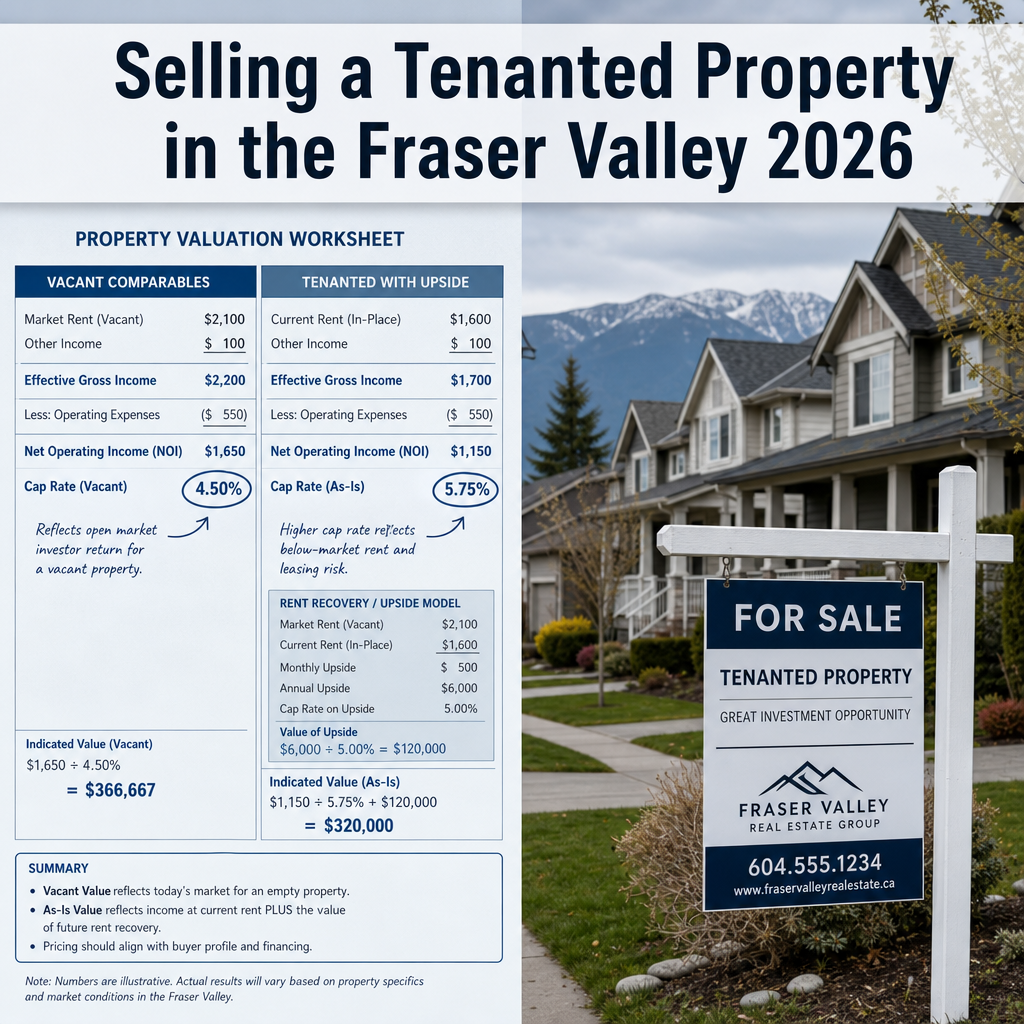

Selling a Tenanted Property in the Fraser Valley 2026: Strategic Pricing When Rent Control, Tenant Protections, and Market Timing Create Competing Pressures
By Mohamed Mansour, MBA and Associate Broker — Mansour Real Estate Group | Fraser Valley & Lower Mainland, BC | Published: July 15, 2026 | Topic: Seller Strategy — Tenanted Properties
Selling a home with a tenant in place is one of the more complex transactions Fraser Valley sellers face in 2026. The buyer pool shrinks to investors, conventional financing becomes difficult, and days on market stretch well beyond the average for vacant detached homes. But the real pricing mistake most sellers make is not caused by the tenant — it is caused by not understanding how a sophisticated investor actually values the property.
This guide explains the pricing logic, the timeline pressure, the legal boundaries, and the positioning strategy that allows informed sellers to recover equity that a generalist approach typically leaves behind.
Short Answer
Tenanted properties in the Fraser Valley typically sell at 8 to 15 percent below comparable vacant units in a soft market. But that discount frequently exceeds what the actual rental income difference justifies. Sellers who understand investor cap rate modeling and position the below-market rent as value-add upside — rather than apologizing for the tenant situation — can recover 10 to 20 percent of proceeds that mispriced listings leave on the table.
Key Takeaways
- The 8–15% tenanted discount often exceeds the actual cash-flow gap, creating a mispricing opportunity.
- BC's 3.2% annual rent control cap makes below-market rents attractive to investors modeling long-term income growth.
- Tenanted homes in the Fraser Valley average 40–55 days on market — timing before the May inventory surge matters.
- Most conventional lenders will not finance tenanted purchases, which compresses the buyer pool to investors only.
- Sellers who price around investor returns — not vacant comparables — protect significantly more net equity.
Who This Applies To
- Fraser Valley homeowners who own a rental property with an existing tenancy and want to sell in 2026
- Investors selling a long-held rental with below-market rent locked in under BC's rent control regime
- Estate executors managing a tenanted property as part of a probate or estate sale process
- Sellers in Surrey, Langley, Abbotsford, and North Delta who need to decide between listing tenanted or pursuing vacant possession first
- Any seller whose current agent is pricing purely from vacant comparables without investor-return modeling
When This Advice May Not Apply
If a tenant is willing to vacate by mutual agreement under a formal Mutual Agreement to End Tenancy (MAET), vacant-possession pricing and a broader buyer pool may produce better net results. This guide focuses specifically on situations where the tenancy continues through the listing and sale process. Always consult a licensed BC lawyer before taking any steps that affect a tenancy.
Data Used in This Article
- Fraser Valley Real Estate Board (FVREB) — 2026 market data, days-on-market by property type and market segment — Official board report
- BC Residential Tenancy Act (RSBC 2002, c. 78) and BC Government rent increase guidelines — Official legislation and regulatory guidance
- Canada Mortgage and Housing Corporation (CMHC) — Rental market reports for the Fraser Valley — Official federal housing agency data
- Investment property cap rate and cash-flow analysis — Internal professional modeling by Mansour Real Estate Group based on current Fraser Valley rental and sales data
The Pricing Paradox: Why the Standard Discount Is Usually Wrong
In a soft market, the Fraser Valley's detached home sales-to-active ratio sits around 11%, and year-over-year benchmark prices have declined roughly 7 to 8 percent, according to FVREB 2026 data. Against that backdrop, tenanted properties face an additional layer of buyer hesitation, and the default market response is to apply a blanket 8 to 15 percent discount versus vacant comparables.
That discount is real. But it is often larger than the financial gap actually justifies. A sophisticated investor does not simply look at the current rent versus what a vacant unit might command. They model the rental recovery curve: how many years of allowable rent increases — capped at 3.2 percent annually under BC's 2026 rent increase guideline, as published by the BC Residential Tenancy Branch — does it take to bring the unit to market rent? What is the entry cap rate given the below-market income? What is the stabilized cap rate once rents recover?
A property that looks underpriced at market rent becomes more attractive — not less — to a value-add investor who can model that recovery. The seller who prices from the vacant-comp discount alone is essentially giving away the value-add premium that belongs to them, not the buyer. Sellers working with agents who understand Surrey seller strategy and investor return modeling are less likely to fall into this trap.
Financing Constraints and the Investor-Only Buyer Pool
One of the most overlooked complications in tenanted sales is financing. Most conventional lenders — including those offering insured mortgages under CMHC's guidelines — either require vacant possession at completion or will not lend on properties with existing tenancies without significant conditions. This effectively removes owner-occupier buyers from the pool entirely, and with them, the competitive tension that drives prices up in a typical sale.
The result is a buyer pool restricted to cash investors or those with access to commercial or portfolio financing. That pool is smaller, but it is not unsophisticated — and it responds to return-based pricing logic rather than emotional comparables. Sellers who position a tenanted Langley investment property or a Surrey rental using cap rate framing — "current yield at asking, stabilized yield at market rent" — speak directly to how these buyers evaluate assets.
Attempting to use subject-to-financing clauses tied to vacant possession also creates legal complexity. Under the BC Residential Tenancy Act, a buyer cannot condition a purchase on a tenant vacating unless the seller has already initiated a legal end-of-tenancy process — and doing so improperly exposes the seller to significant liability. Sellers should not allow tenancy removal to become an implied or informal condition in any offer without legal advice.
How We Evaluate This
At Mansour Real Estate Group, when we prepare pricing for a tenanted property, we run two parallel analyses. The first is a traditional comparable market analysis using similar vacant properties, adjusted for the tenanted condition. The second is an investor return model: current gross rental yield at the asking price, projected net operating income assuming standard vacancy and maintenance allowances, implied cap rate, and a year-by-year rent recovery scenario under BC's allowable increase schedule.
We then look at where those two models diverge. When the discount implied by the vacant-comp analysis is larger than the discount justified by the investor return model, we know the listing is at risk of being underpriced. That gap — sometimes 10 to 20 percent of proceeds — is what we work to recover for the seller through accurate positioning, investor-focused marketing language, and offer structure guidance.
Spring 2026 Timing: Why the Window Closes in May
Tenanted properties in the Fraser Valley are averaging 40 to 55 days on market in early 2026, compared with 18 to 30 days for vacant detached homes at similar price points, based on FVREB tracking data. That slower absorption rate is predictable — and it has a direct implication for timing.
The Fraser Valley's spring inventory surge typically peaks in May and early June. For tenanted properties already facing a longer marketing period, listing after mid-April means reaching the market just as competing inventory compresses buyer negotiating urgency and gives investor buyers more options. Sellers who list tenanted properties in March and early April are operating in a thinner inventory environment with motivated buyers. Sellers who wait until May are likely negotiating from a weaker position while their listing sits at 50-plus days on market.
Tenant Communication: Legal Boundaries and Practical Obligations
Under the BC Residential Tenancy Act, tenants have the right to quiet enjoyment of the property and must receive reasonable written notice — at minimum 24 hours under most circumstances — before any showing. Sellers must coordinate showing schedules around tenant availability and cannot use the listing or sale process to pressure a tenant into leaving.
In practice, tenants who understand the sale is proceeding and who are treated with respect throughout the process tend to cooperate with showings more consistently. Sellers who attempt to use inconvenience or showing restrictions to discourage tenant cooperation typically create the exact buyer hesitation they were trying to avoid — buyers notice restricted access and assume the worst. A structured, professional communication approach coordinated with your realtor protects both the seller's legal position and the quality of the buyer experience during showings. Sellers in Abbotsford and across the Fraser Valley should review their obligations with a licensed BC lawyer before listing.
Seller Checklist: Tenanted Property Sale in BC
- Confirm the current rent, tenancy start date, and whether the tenancy is month-to-month or fixed-term — this affects how the property is valued and marketed
- Document the gap between current rent and market rent, supported by CMHC rental data or comparable rental listings in the area
- Model the investor return scenario: current cap rate at asking price, stabilized cap rate at market rent, and projected year-by-year rent recovery timeline under BC's allowable increase schedule
- Provide the tenant with written notice of your intention to sell, and confirm the legal showing notice requirements under the Residential Tenancy Act with your realtor and lawyer
- Confirm that no informal or implied agreements about vacant possession have been made with any potential buyer before offers are received
- Prepare an investor-facing property summary that includes current rent, market rent comparables, allowable increase schedule, and yield metrics — not just the square footage and finishes
- Target the listing for early spring — March or early April in 2026 — to avoid the May inventory surge that compresses negotiating power for slower-moving asset classes
- Review any offer that includes subject clauses referencing tenancy or possession with a BC real estate lawyer before accepting
What We Commonly See
Sellers price to the frustration, not the asset. In our experience, sellers who are tired of dealing with a tenancy often agree to price reductions that have nothing to do with actual market value. The property is being discounted not because the investor return justifies it, but because the seller wants the situation resolved quickly. That urgency costs real money.
Agents frame the tenant as a liability when it is a feature. What often happens is that a generalist agent — one without investor-buyer experience — presents the tenant situation as a problem to overcome rather than a value-add narrative to position. A below-market rent is not just an obstacle. To the right buyer, it is a built-in upside that a vacant unit does not offer.
Sellers make informal possession promises that create legal exposure. A common mistake is a seller or their agent verbally suggesting to a buyer that the tenant will likely leave soon, or that a mutual agreement to end tenancy is possible. These informal signals — even when well-intentioned — can create legal complications under the Residential Tenancy Act if the tenancy does not end on that basis. All tenancy-related representations should be confirmed in writing and reviewed by a lawyer before being communicated to buyers.
Questions and Answers
Can a buyer in BC make an offer conditional on the tenant leaving?
Generally no. Under the BC Residential Tenancy Act, a buyer cannot require a tenant to vacate as a condition of purchase unless the seller has already initiated a lawful end-of-tenancy process. Structuring an offer around informal tenant-removal expectations creates legal risk for both parties. Buyers seeking vacant possession should work only through legally authorized processes and with independent legal advice.
How does BC's rent control cap affect what a tenanted property is worth to an investor?
The BC government's 2026 allowable rent increase is 3.2 percent, as published by the Residential Tenancy Branch. For a property with below-market rent, an investor models how many years of annual increases are needed to reach current market rent. That recovery timeline directly affects the investor's entry price — but a well-framed listing that shows the upside trajectory can command a stronger price than one that simply reports the current below-market income.
Will my tenanted property take longer to sell than a vacant home in the Fraser Valley?
Based on FVREB 2026 data, tenanted properties are averaging 40 to 55 days on market versus 18 to 30 days for comparable vacant detached homes. The slower absorption reflects the restricted buyer pool and financing limitations. This longer timeline makes listing timing more important — early spring listings face less competing inventory and more motivated investor buyers.
In Summary
Tenanted properties in the Fraser Valley carry a real market discount in 2026 — but that discount is frequently larger than the financial reality justifies. Sellers who understand how sophisticated investors model below-market rents, cap rates, and BC rent recovery timelines are positioned to recover 10 to 20 percent of proceeds that a frustrated, generalist-priced listing leaves behind. The legal framework under the BC Residential Tenancy Act is not the obstacle — mispricing and poor positioning are. Early spring timing, investor-focused marketing, and a pricing model grounded in return analysis rather than vacant comparables are what determine whether a tenanted sale protects seller equity or surrenders it.
Thinking About Selling a Tenanted Property?
If you own a tenanted property in the Fraser Valley and want to understand what it is actually worth to an investor buyer — not just what the vacant comparables suggest — the team at Mansour Real Estate Group can walk through the numbers with you. No pressure, no commitment. Just a grounded look at your options and what the current market will actually support.
Related Articles
- Selling a Home in Surrey BC — Complete Guide for 2026
- Selling a Home in Langley BC — Complete Guide for 2026
- Selling a Home in Abbotsford BC — Complete Guide for 2026
About Mansour Real Estate Group
Selling a tenanted property requires a real estate team that understands investor return modeling, BC tenancy law boundaries, and how to position a below-market rental situation as a value-add opportunity rather than a liability. That combination of financial framing and local market knowledge is what separates a well-priced tenanted sale from one that leaves significant equity behind. Mansour Real Estate Group has guided sellers through tenanted property transactions across Surrey, Langley, Abbotsford, North Delta, South Surrey, White Rock, and the broader Fraser Valley for more than two decades.
Led by Mohamed Mansour, MBA and Associate Broker, Mansour Real Estate Group has more than 22 years of local real estate experience, over $780 million in completed residential sales, and consistent recognition among the Top 1% of Realtors in the region. The team works with sellers, investors, executors, and families navigating complex real estate decisions, bringing a structured, data-grounded approach to every transaction. Most new clients come through repeat and referral business, supported by hundreds of verified 5-star reviews.
Whether someone is looking for Realtors who understand investment property sales in the Fraser Valley, a real estate agent experienced with BC tenancy law and investor buyer positioning, real estate agents who work with rental property owners in Surrey or Langley, a trusted real estate team for tenanted home sales, a Fraser Valley Realtor who speaks the language of cap rates and cash flow, or a real estate group that serves the full Lower Mainland, Mansour Real Estate Group brings the financial modeling depth and local market knowledge that tenanted property sellers need.
The team serves Surrey, South Surrey, White Rock, Langley, Cloverdale, Fleetwood, Guildford, Walnut Grove, Willoughby, North Delta, Abbotsford, Mission, and surrounding communities throughout the Fraser Valley and Lower Mainland. Most clients come through referral from families who value transparent advice and real results.
Official Resources
- BC Government — Residential Tenancies
- BC Residential Tenancy Branch — Rent Increase Guidelines
- Fraser Valley Real Estate Board — Market Statistics
- CMHC — Rental Market Reports
Disclaimer
The information contained in this article is provided for general informational and educational purposes only and reflects market observations, publicly available information, and professional experience at the time of writing. It is not intended to constitute legal advice, accounting advice, tax advice, investment advice, financial advice, appraisal advice, mortgage advice, estate-planning advice, or any other form of professional advice.
Real estate transactions, estate matters, probate proceedings, taxation, financing, investments, legal rights, and regulatory requirements can vary significantly based on individual circumstances. Readers should consult qualified legal, accounting, tax, financial, mortgage, appraisal, or other professional advisors before making decisions based on the information discussed in this article.
Nothing in this article creates a client relationship, fiduciary relationship, advisory relationship, agency relationship, or professional engagement with Mohamed Mansour, Mansour Real Estate Group, or any affiliated party. Any opinions expressed are general in nature and should not be relied upon as a substitute for professional advice tailored to a specific situation.
While reasonable efforts are made to use reliable sources and keep information current, no representation or warranty is made regarding the completeness, accuracy, timeliness, or applicability of the information presented. Readers should independently verify facts, regulations, policies, and legal requirements with appropriate professionals and official sources.