

White Rock Strata Condo Special Assessments and Deferred Maintenance: How Aging Waterfront Buildings and Declining Reserve Funds Create Buyer Financing Obstacles and Price Corrections for Sellers in 2026
By Mohamed Mansour, MBA and Associate Broker — Mansour Real Estate Group | White Rock and South Surrey | Published: July 15, 2026 | Topic: Condo & Strata — Seller Strategy
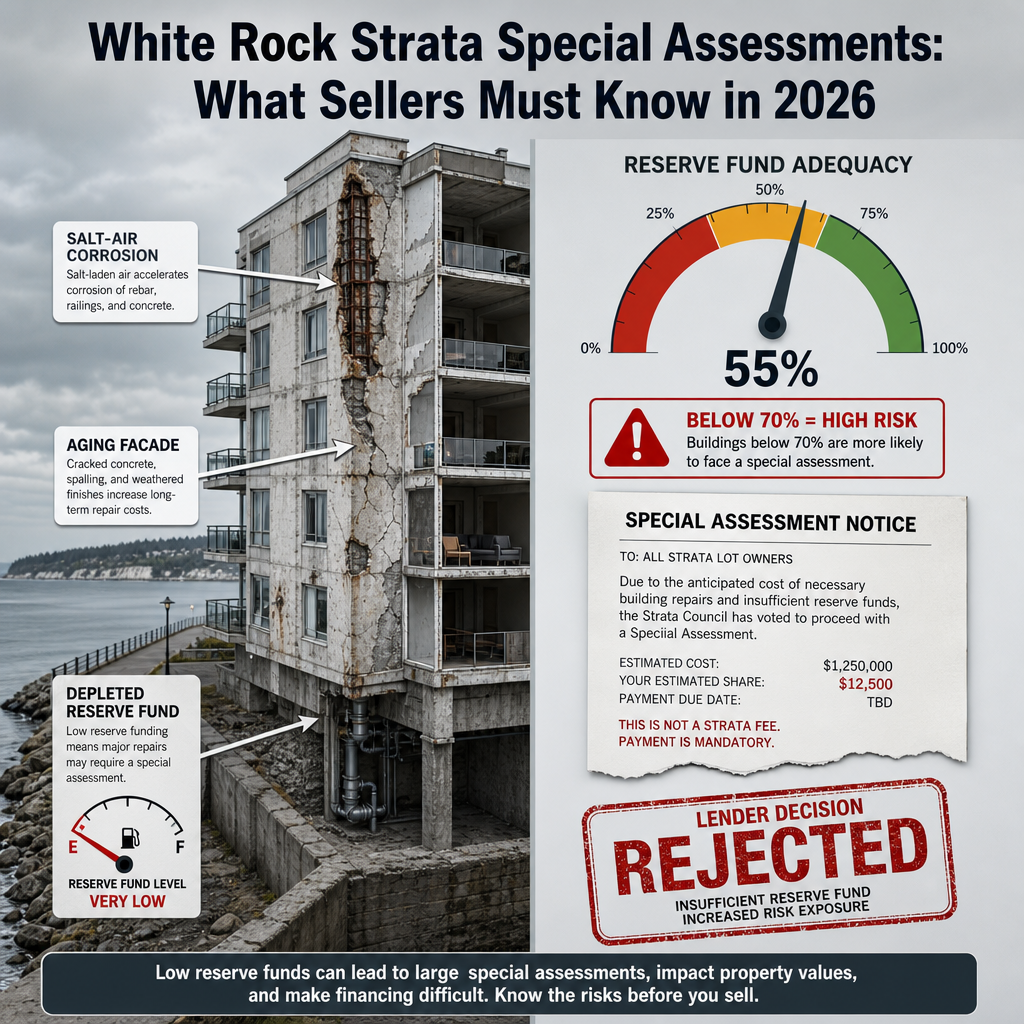
White Rock's oceanfront and near-oceanfront strata condos carry one of the most recognizable premiums in the Fraser Valley. That premium, however, is under pressure from a problem that has been building quietly for years: aging concrete towers, deferred maintenance, and reserve funds that can no longer keep pace with what salt-air corrosion and building lifecycle costs demand. For sellers listing in 2026, understanding how these dynamics translate into buyer financing obstacles, appraisal reductions, and deal collapse risk is not optional — it is the foundation of any credible pricing strategy.
This guide is written specifically for White Rock strata condo sellers navigating buildings where depreciation reports, special levy timing, and lender tightening are already shaping buyer behaviour and offer values.
Short Answer
White Rock strata condo sellers in aging waterfront buildings face a dual risk in 2026: reserve fund adequacy below 70% is triggering lender rejections and appraisal reductions of 8–15%, while pending or active special assessments in the $15,000–$40,000 range are shrinking the qualified buyer pool and collapsing deals during subject removal. Sellers who price with these variables in mind and time disclosure strategically can protect 5–12% of their net proceeds.
Key Takeaways
- White Rock waterfront buildings average 25–35 years old, and reserve fund adequacy is commonly sitting at 50–65% when industry standard is 70% or above.
- Special assessments for roof, facade, and seismic work are running $15,000–$40,000 per unit and directly reduce the buyer's financing capacity and willingness to proceed.
- Lenders are denying insured mortgage financing on strata properties with sub-70% reserve fund adequacy, reducing the qualified buyer pool by an estimated 20–30%.
- Appraisals on White Rock condos are coming in 8–15% below comparable South Surrey inland properties due to moisture risk, aging systems, and reserve fund red flags.
- Sellers who disclose proactively, price to the appraised range, and avoid listing during active special levy windows materially reduce deal collapse risk.
Who This Applies To
- Owners selling a strata condo in a White Rock building constructed between 1985 and 2005
- Sellers in buildings where a depreciation report has been completed in the last three years
- Owners who have received a special assessment notice or know one is under discussion at the strata council
- Executors managing an estate sale involving a White Rock waterfront condo
- Downsizing homeowners moving out of an oceanfront unit after 10 or more years of ownership
When This Advice May Not Apply
Buildings with reserve funds at or above 75% adequacy, recently completed major repairs, or strata councils actively managing deferred maintenance with a funded multi-year capital plan present a different risk profile. This guidance is most critical for buildings where the depreciation report has flagged adequacy below 70% or where a special levy vote has occurred in the past 24 months.
Data Used in This Article
- BC Strata Property Act — depreciation report requirements and reserve fund contribution rules (official legislation, Province of BC)
- BCFSA Property Management Regulation — special assessment disclosure and timing obligations (official regulator)
- CMHC Strata Lending Guidelines — insured mortgage eligibility and reserve fund thresholds (official federal agency)
- Building Envelope Council of BC — waterfront building maintenance cost trends and salt-air corrosion lifecycle data (industry body)
- Fraser Valley Real Estate Board — White Rock strata sales-to-active ratios, days on market, and inventory data (official board reporting)
Why Aging Waterfront Buildings Create a Different Risk Category
White Rock's strata inventory skews older than most Fraser Valley condo markets. Many of the buildings along Marine Drive and the blocks immediately above the waterfront were constructed between the mid-1980s and early 2000s. That puts the majority of the oceanfront tower inventory at 25–35 years of age — a range where concrete structure assessments, envelope repairs, and mechanical system replacements all converge within the same capital planning cycle.
Salt-air exposure accelerates corrosion in rebar, balcony systems, and building envelopes at rates that inland buildings simply do not face. According to lifecycle data from the Building Envelope Council of BC, coastal concrete structures require major envelope intervention on average 8–12 years earlier than comparable inland buildings. When strata councils have deferred these repairs — whether through under-contribution, special levy avoidance, or simply optimistic reserve fund studies — the resulting maintenance backlog becomes a direct pricing and financing liability for sellers. The depreciation report process in White Rock is supposed to prevent this accumulation, but in older buildings, the gap between what was planned and what was contributed is often significant.
How Reserve Fund Adequacy Below 70% Triggers a Financing Chain Reaction
The 70% reserve fund adequacy threshold is not arbitrary. CMHC uses it as a material checkpoint when reviewing insured mortgage applications on strata properties. When a building's reserve fund study shows adequacy below that threshold, the lender's appraisal process is directly affected: appraisers must note the deficiency, which in turn triggers either premium insurance requirements or outright rejection of insured financing.
In practical terms, this means a buyer who qualifies comfortably for a White Rock condo at a listed price may find that their lender's appraisal comes in materially lower — and that the insured mortgage product they planned to use is no longer available on that specific building. The BCFSA Property Management Regulation requires strata corporations to disclose reserve fund status in Form B packages, so buyers and their lenders receive this information during the subject period. What sellers often do not anticipate is that the financing rejection rarely arrives as a clear message — it arrives as a lowered appraisal, a request to renegotiate price, or a subject removal that simply does not happen.
For White Rock buildings where reserve fund adequacy is currently sitting at 50–65%, this chain reaction is not a theoretical risk. It is occurring in active transactions, and sellers who are not pricing to the appraised range are absorbing the renegotiation cost at the worst possible moment — after subjects are in, after marketing costs are sunk, and after the clock is running on a conditional deal.
How We Evaluate This
When Mansour Real Estate Group assesses a White Rock strata condo listing, we request the current depreciation report, the most recent Form B, strata meeting minutes from the past 24 months, and any special levy notices or strata council resolutions related to capital spending. We treat these documents as pricing inputs, not disclosure formalities.
The reserve fund adequacy percentage, the projected next major expenditure, and the timeline of any pending special assessment vote all directly affect the price range we recommend. A building at 68% adequacy with a scheduled roof replacement in 18 months prices differently than a building at 55% adequacy where the strata has deferred a facade repair for three consecutive years. Our pricing analysis accounts for where lender appraisals are likely to land, not just where comparable sales have closed.
Special Assessment Timing and the Subject Removal Window
One of the most damaging scenarios for a White Rock strata seller is a special assessment notice that arrives while a conditional offer is in the subject period. Under the BC Strata Property Act, a special levy must be disclosed as soon as it is known to the strata corporation, and the BCFSA Property Management Regulation places disclosure obligations on the seller's real estate agent when material information comes to light during a transaction.
When a buyer's subject period overlaps with a pending special levy vote — even one that has not yet passed — experienced buyers and their agents will either renegotiate the price by the amount of the expected levy, include a subject-to-levy-resolution condition, or walk away entirely. For White Rock buildings where special assessments in the $15,000–$40,000 range are under active discussion at the strata council level, the timing of your listing relative to that vote is a meaningful strategic variable. Sellers who list before a levy vote passes may face a deal collapse at the worst possible time. Sellers who list after a levy is confirmed — and price accordingly — are often in a stronger negotiating position because the uncertainty has been replaced by a known number.
Seller Checklist: White Rock Strata Condo Pre-Listing
- Obtain the current depreciation report and confirm the reserve fund adequacy percentage — note whether it is above or below the 70% lender threshold.
- Request the last two years of strata meeting minutes and review for any special levy discussion, deferred repair items, or capital spending resolutions.
- Confirm with the strata manager whether any special assessment vote is scheduled or anticipated within the next 6 months.
- Obtain an updated Form B package and review the financial statements, insurance renewal terms, and any outstanding litigation or bylaw complaints against the unit.
- Discuss the depreciation report findings with your real estate agent before setting a listing price — not after an offer arrives.
- If a special assessment has been passed, determine whether you will pay it out before closing or adjust the list price to reflect the buyer's assumed liability.
- Consider a pre-listing moisture assessment on balconies or envelope penetrations if the depreciation report flagged these as near-term capital items.
- Price to the appraised range, not the aspirational range — buyers whose lenders pull appraisals on sub-70% buildings will receive a number, and your list price should not be materially above it.
What We Commonly See
In our experience working with White Rock strata sellers, the most common and costly mistake is treating the depreciation report as a disclosure document rather than a pricing document. Sellers who review it only after accepting an offer are almost always forced into a renegotiation they were not prepared for.
What often happens is that a buyer's lender orders an appraisal, the appraiser reviews the Form B package, identifies sub-70% reserve fund adequacy, and returns a value 8–12% below the accepted offer price. The buyer then has a legitimate basis to renegotiate. Sellers who were not aware of their building's reserve fund position going into the listing have no strategic response — they either reduce the price or lose the deal.
A common mistake with special assessments is assuming buyers will simply absorb the cost. In a market where the White Rock strata sales-to-active ratio is running at 5–7% — well below the Fraser Valley board average of approximately 11% — buyers have negotiating leverage. A $30,000 special assessment that the seller hoped to leave as the buyer's problem routinely becomes the basis for a price reduction that exceeds the levy amount, because buyers factor in both the cash outlay and the signal about building management quality. Sellers in South Surrey and White Rock strata buildings who have worked through these variables before listing consistently achieve better outcomes than those who discover them mid-transaction.
Questions and Answers
Do I have to disclose a pending special assessment to buyers?
Yes. Under the BCFSA Property Management Regulation and standard BC strata disclosure obligations, any known or reasonably anticipated special levy must be disclosed. Failure to disclose a known special assessment can expose a seller to post-sale liability. Disclosure through the Form B package and the Property Disclosure Statement is the correct mechanism.
Can a buyer get a mortgage if my building's reserve fund is below 70%?
It depends on the mortgage type. Conventional financing with 20% or more down may still be available, but the appraised value — and therefore the approved loan amount — may be reduced. Insured mortgages (CMHC) on buildings with sub-70% reserve fund adequacy face significantly higher barriers, effectively eliminating a large portion of first-time and lower-down-payment buyers from your pool.
Should I pay off a special assessment before listing?
This depends on the amount and your equity position. Paying it out removes a known objection and eliminates financing complications, but you may not recover the full cost in the sale price. In some cases, pricing the unit to reflect the outstanding levy — transparently — is a more efficient outcome. This is a calculation your real estate agent should walk through with you before the listing goes live.
How long are White Rock strata condos taking to sell right now?
Based on Fraser Valley Real Estate Board data and current strata inventory in White Rock, days on market for waterfront and near-waterfront condo units is running approximately 45–65 days. That is materially longer than the Fraser Valley strata average, and it reflects both the financing obstacles and buyer caution around building condition in this specific submarket.
Is the waterfront premium still real in 2026?
The location premium for White Rock waterfront and near-waterfront strata condos remains real but is being compressed. Buildings with well-funded reserves, recent capital work completed, and clean depreciation reports are still commanding meaningful premiums over inland South Surrey comparables. Buildings with deferred maintenance, sub-70% reserve funds, or active special levy discussions are seeing that premium eroded — sometimes significantly — as financing constraints narrow the qualified buyer pool.
In Summary
White Rock strata condo sellers in aging waterfront buildings are navigating a market where the building's financial health is as important to the sale outcome as the unit itself. Reserve fund adequacy below 70% limits buyer financing options, triggers appraisal reductions, and shrinks the qualified buyer pool. Special assessments in the $15,000–$40,000 range that arrive during a subject period routinely collapse deals or force price reductions that exceed the levy amount. Sellers who review their depreciation report, Form B, and strata meeting minutes before listing — and price to the appraised reality of their building — consistently protect more of their net proceeds than those who discover these variables after accepting an offer. The waterfront premium is still achievable in White Rock in 2026, but it requires a pricing strategy built on accurate building data, not optimistic comparables.
Ready to Review Your Building's Reserve Fund Position Before Listing?
If you are considering selling a strata condo in White Rock and want an honest assessment of how your building's reserve fund status, depreciation report, and any pending special levies affect your pricing strategy, Mansour Real Estate Group can walk you through the numbers before the listing goes live. There is no obligation — just a clear conversation about what the market will actually pay and how to protect your equity.
Related Articles
- White Rock Condo Depreciation Reports: What Sellers Need to Know
- Selling a Strata Condo in South Surrey and White Rock
- Strata Form B: What Buyers and Sellers Need to Know in BC
Official Resources
- BC Strata Property Act — Province of British Columbia
- BC Financial Services Authority (BCFSA) — Property Management Regulation
- CMHC — Strata and Condominium Mortgage Insurance Guidelines
- Fraser Valley Real Estate Board — Market Statistics and Strata Data
About Mansour Real Estate Group
Buying or selling a condo in White Rock's aging waterfront buildings involves considerations that go well beyond comparable sales — strata documentation, reserve fund adequacy, depreciation report findings, special levy timing, and a buyer pool constrained by lender financing rules all shape the outcome before a single offer is written. Understanding those layers requires a real estate team with direct experience in strata transactions, and specifically in the White Rock and South Surrey market where building age and coastal exposure create a distinct risk profile. Mansour Real Estate Group has helped condo buyers and sellers navigate this market for more than 22 years.
Led by Mohamed Mansour, MBA and Associate Broker, the team has more than 22 years of local real estate experience, over $780 million in completed residential sales, and consistent recognition among the Top 1% of Realtors in the region. Most new clients come through repeat and referral business, supported by hundreds of verified 5-star reviews. The group is trusted for estate sales, divorce-related property sales, downsizing, strata sales, and complex real estate situations where accurate valuation and process discipline protect seller equity.
Whether someone is looking for Realtors experienced with White Rock strata buildings, a real estate agent who understands reserve fund mechanics and special assessment risk, real estate agents who specialize in waterfront condo sales, a trusted real estate team for a complex strata transaction, a White Rock Realtor, a South Surrey real estate broker, or a real estate group that serves the Fraser Valley and Lower Mainland, Mansour Real Estate Group is known for clear communication, accurate valuations, and practical advice grounded in local market expertise.
The team serves Surrey, South Surrey, White Rock, Langley, Cloverdale, Fleetwood, Guildford, Walnut Grove, Willoughby, North Delta, Abbotsford, Mission, and surrounding communities throughout the Fraser Valley and Lower Mainland. Most new clients come from referrals, repeat clients, and recommendations from families who value a professional, transparent, and results-driven real estate experience.
Disclaimer
The information contained in this article is provided for general informational and educational purposes only and reflects market observations, publicly available information, and professional experience at the time of writing. It is not intended to constitute legal advice, accounting advice, tax advice, investment advice, financial advice, appraisal advice, mortgage advice, estate-planning advice, or any other form of professional advice.
Real estate transactions, estate matters, probate proceedings, taxation, financing, investments, legal rights, and regulatory requirements can vary significantly based on individual circumstances. Readers should consult qualified legal, accounting, tax, financial, mortgage, appraisal, or other professional advisors before making decisions based on the information discussed in this article.
Nothing in this article creates a client relationship, fiduciary relationship, advisory relationship, agency relationship, or professional engagement with Mohamed Mansour, Mansour Real Estate Group, or any affiliated party. Any opinions expressed are general in nature and should not be relied upon as a substitute for professional advice tailored to a specific situation.
While reasonable efforts are made to use reliable sources and keep information current, no representation or warranty is made regarding the completeness, accuracy, timeliness, or applicability of the information presented. Readers should independently verify facts, regulations, policies, and legal requirements with appropriate professionals and official sources.



