

Cloverdale Surrey 2026: How the Planned Highway 10 Interchange Upgrade and SkyTrain Extension Timeline Are Reshaping Property Values, Buyer Demographics, and Strategic Seller Windows in BC's Most Transformed Suburban Community
By Mohamed Mansour, MBA, Associate Broker | Mansour Real Estate Group | Published: June 2, 2026 | Cloverdale, Surrey, Fraser Valley, BC
For most of the past decade, Cloverdale's real estate story has been told through neighbourhood character, school catchments, and price-per-square-foot comparisons to Clayton or Fleetwood. Those factors still matter. But in 2026, the more consequential story is infrastructure: two major public investments — a Highway 10 interchange upgrade and a phased SkyTrain extension — now have confirmed funding, construction timelines, and operational target dates. That changes the calculus for every seller, buyer, and investor who has been watching and waiting.
This article explains what those projects are, when their market effects tend to activate, and what the timing means for sellers making decisions right now — including those navigating estate sales, divorce-related property decisions, or downsizing timelines that cannot simply be deferred until 2028.
Short Answer
Cloverdale's property values currently reflect an uncertainty discount — buyers are pricing in risk that SkyTrain and Highway 10 improvements may not arrive on schedule. With both projects now having confirmed funding and construction timelines, that discount is compressing. Sellers who act before infrastructure certainty becomes mainstream knowledge may capture a pricing window that closes once the wider buyer pool re-prices the market.
Key Takeaways
- Highway 10 interchange funding is confirmed for 2026–2027 construction, with completion targeted for 2029, reducing commute friction to Metro Vancouver.
- SkyTrain Phase 1 to Cloverdale (5 stations) has federal co-investment finalized; Phase 2 to Clayton Heights is contingent on 2027 federal budget approval.
- Cloverdale currently trades at a 30–40% discount to comparable SkyTrain-adjacent markets; that gap typically closes rapidly once operational timelines are confirmed.
- Sellers in estate, divorce, or downsizing situations who delay into 2027–2028 risk entering a market where buyer expectations have already re-priced the infrastructure premium.
- Early-stage buyers entering before Phase 1 operations historically outperform wait-and-see cohorts by 15–25% on long-term appreciation in comparable transit corridors.
Who This Applies To
- Cloverdale homeowners considering selling a detached home or townhouse in 2026 or 2027
- Executors and estate administrators managing a Cloverdale property sale on a legal or family timeline
- Separating or divorcing homeowners with a shared Cloverdale property under court or negotiated timelines
- Buyers evaluating whether to enter Cloverdale now versus waiting for transit to become operational
- Investors assessing long-term appreciation and rental demand shifts in a transit-activated market
When This Advice May Not Apply
Infrastructure-driven appreciation timing works differently for properties far from planned station locations. Properties in the outer edges of the Cloverdale catchment, or with access constraints independent of Highway 10 improvements, may not see the same demand activation pattern. Consult a local specialist before using these frameworks as a basis for your specific decision.
Data Used in This Article
- BC Ministry of Transportation Highway 10 Interchange Upgrade Project Charter, 2026 — official provincial project documentation
- TransLink SkyTrain Expo Line Extension Funding Agreement and Phase Timeline (Federal-Provincial, 2025) — official co-investment agreement
- City of Surrey Cloverdale Fairgrounds Redevelopment OCP Amendment and Zoning Approval, Q1 2026 — municipal planning record
- BC Real Estate Association Q1 2026 Market Report on Infrastructure-Driven Appreciation in Suburban Markets — industry analysis
- Historical market precedent: Port Moody and Port Coquitlam SkyTrain appreciation cycles, 2003–2007 — third-party comparative analysis
Key Definitions
Hope value discount: The gap between what a property sells for under transit uncertainty versus what it would sell for once transit operations are confirmed. In Cloverdale's case, BCREA analysis suggests this discount sits at 30–40% relative to comparable SkyTrain-adjacent markets such as Burnaby and Coquitlam.
Phase-gating: The practice of confirming construction or funding in sequential stages rather than all at once. SkyTrain Phase 2 is phase-gated, meaning its confirmation depends on separate federal budget approval in 2027.
Offer velocity: The pace at which accepted offers move through a market — used here as an indicator of buyer activation following infrastructure announcements. Historical Port Coquitlam data showed a 40–50% acceleration in offer velocity within 8–12 weeks of a provincial commitment confirmation.
How We Evaluate This
At Mansour Real Estate Group, we evaluate infrastructure-driven markets by mapping the gap between current pricing and the pricing implied by comparable transit-complete markets. We track two variables: how much uncertainty discount remains in current list prices, and how quickly that discount has historically compressed once timelines become publicly confirmed rather than projected.
For Cloverdale, the relevant comparison markets are Port Moody pre- and post-Evergreen Line confirmation, and Port Coquitlam in the 18 months before and after SkyTrain operational announcements. Both showed that the largest pricing gains went to sellers and buyers who acted during the confirmation window — not after opening day. This framing shapes the advice we give sellers in estate, downsizing, and time-sensitive situations.
What the Highway 10 Upgrade Actually Changes
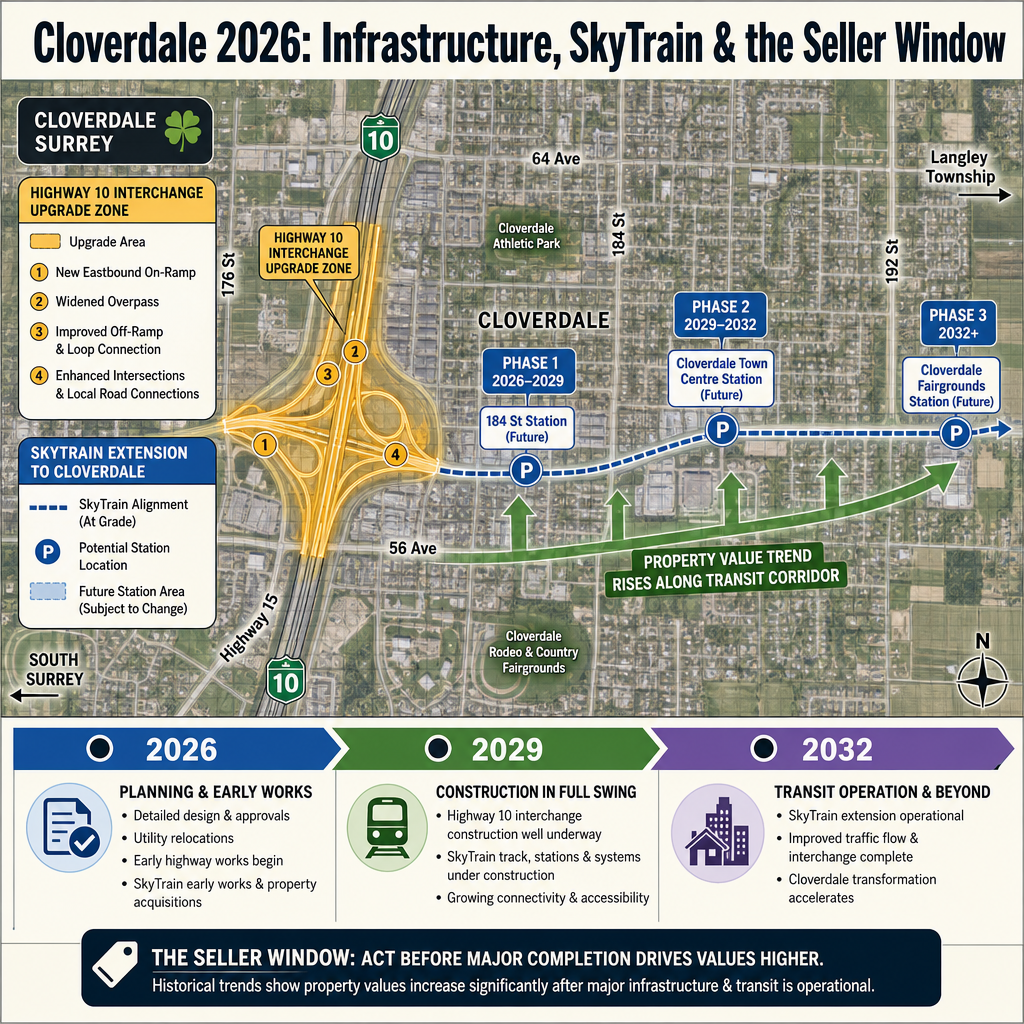
The Highway 10 interchange upgrade is not a minor road improvement. According to the BC Ministry of Transportation's 2026 Project Charter, construction is funded and targeted to begin in the 2026–2027 fiscal period, with completion projected for 2029. The interchange redesign addresses the primary bottleneck that has historically added 15–25 minutes to Cloverdale-to-Vancouver commutes during peak hours.
Why does this matter for property values? In comparable BC suburban markets, highway access improvements have triggered residential appreciation premiums of 10–14% in adjacent neighbourhoods within 18 months of project completion. The Maple Ridge Highway 1 corridor is the clearest local example. Buyers factoring in daily commute costs — time and fuel — respond to friction reductions with increased willingness to pay. That response is not speculative; it appears consistently in transaction data following infrastructure openings.
For Cloverdale, the practical effect is that the commute story told in our commuting guide will look materially different by 2029. Sellers listing in 2026 are working ahead of that re-pricing. Sellers listing in 2028 or 2029 will be listing into a market where the improvement is already in the price.
The Two-Stage SkyTrain Activation Cycle
The SkyTrain Expo Line extension to Cloverdale operates on a two-phase structure. Phase 1, covering five stations and serving the core Cloverdale corridor, has confirmed federal co-investment through the 2025 federal-provincial funding agreement. The operational target is 2029–2030. Phase 2, extending to Clayton Heights and the Fairgrounds area, requires separate approval in the 2027 federal budget and carries an estimated operational window of 2032–2033.
This phasing creates a two-stage buyer activation cycle that sellers and investors need to understand clearly. The first wave of buyer re-pricing happens now — as the Phase 1 confirmation becomes common knowledge among informed buyers who are specifically targeting pre-operational pricing. The second, larger wave happens as 2029 approaches and the general buyer pool fully prices in connectivity to Vancouver, Burnaby, and New Westminster.
Investors evaluating Cloverdale real estate from a long-term appreciation perspective need to understand the difference between these two waves. Entry at Phase 1 confirmation pricing captures the full two-stage premium. Entry at Phase 1 operational pricing captures only the Phase 2 premium. Entry at Phase 2 operational pricing captures whatever residual density and employment growth follows — meaningful, but materially smaller.
How the Fairgrounds Redevelopment Multiplies the Effect
The Cloverdale Fairgrounds redevelopment adds a third layer to the infrastructure story. The City of Surrey released the master plan in Q1 2026 with mixed-use rezoning approved and construction phasing scheduled from 2026 to 2031. The Fairgrounds site is one of the largest remaining underdeveloped parcels in the Cloverdale core, and its transformation into a mixed-use employment and residential node is directly tied to SkyTrain certainty — the density approvals would not have advanced without the transit commitment.
What this means for surrounding residential values is employer attraction. Mixed-use nodes at transit stations increase local employment density, which in turn reduces the proportion of residents commuting out of the area. That shift — from bedroom suburb to partial employment hub — is one of the more durable drivers of residential value growth. Buyers who understand this dynamic are already factoring Fairgrounds phasing into their Cloverdale offers. Sellers who do not understand it are pricing at current market without the premium this context supports. For a fuller picture of how zoning changes are reshaping Cloverdale, the urban development plan article in this cluster covers the regulatory framework in detail.
The Seller Window: Why 2026 Is Different from 2024
In 2024, neither the Highway 10 upgrade nor the SkyTrain extension had confirmed federal co-investment. The Fairgrounds OCP amendment had not yet passed. Sellers were pricing into a market where buyers assigned speculative probability — not confirmed timelines — to these improvements. That created a structural uncertainty discount in Cloverdale pricing relative to markets with operational transit.
In 2026, the discount still exists — BCREA analysis estimates Cloverdale detached homes trade 30–40% below comparable SkyTrain-adjacent markets in Burnaby and Coquitlam — but the information asymmetry is narrowing. Informed buyers are already adjusting offers to reflect confirmed timelines. The general buyer pool will follow as media coverage of construction milestones increases through 2027 and 2028.
Sellers navigating estate timelines, court-ordered sale deadlines, or downsizing decisions that must resolve before 2028 face a real and quantifiable question: does delaying capture a higher price, or does it mean listing into a market where the appreciation has already occurred and buyer competition for the remaining discount has already intensified? Based on precedent from Port Moody's 2003–2007 cycle, the largest seller gains came in the 18–24 months before SkyTrain opened — not after.
Seller Checklist: Infrastructure-Aware Positioning in Cloverdale
- Confirm your property's proximity to the nearest planned SkyTrain station — buyers will research this, and your listing narrative should address it first.
- Understand the current uncertainty discount in your price range and property type; your agent should be able to show you the gap relative to comparable transit-adjacent markets.
- If selling a detached home, assess whether your lot is near any Fairgrounds-adjacent rezoning zone that supports a density premium narrative.
- For condo and presale properties, understand how Phase 1 SkyTrain confirmation affects competing presale inventory — more supply enters when infrastructure certainty increases.
- If your timeline is driven by estate or legal constraints, model the difference in net proceeds between a 2026 sale at current pricing versus a 2028 sale at post-announcement pricing — the delta may be smaller than assumed once transaction costs and carrying costs are factored in.
- Review current DOM data: detached homes in Cloverdale averaged 32–38 days on market in March–April 2026; townhouses 25–30 days. These baselines will likely compress as construction milestones generate media coverage.
What We Commonly See
Sellers underestimating the confirmation effect. In our experience, sellers tend to wait for the infrastructure to open before expecting a price premium. But the data from comparable BC markets shows the premium activates at confirmation, not operation. By the time SkyTrain is running in 2029–2030, much of the appreciation will already be in the price.
Estate and court-timeline sellers defaulting to conservative pricing. What often happens is that executors or divorcing parties, under time pressure, accept a conservative valuation that does not account for the infrastructure premium being built into buyer offers from informed purchasers. A properly structured listing in 2026 can surface that premium through competitive positioning rather than discounting it away at list price.
Buyers miscalculating Phase 2 risk. A common mistake among investor buyers is conflating Phase 1 certainty with Phase 2 certainty. Phase 1 is funded and confirmed. Phase 2 depends on a 2027 federal budget decision. Properties whose primary value narrative depends on Phase 2 station proximity carry more timing risk than Phase 1 corridor properties.
Questions and Answers
Is the SkyTrain extension to Cloverdale definitely happening?
Phase 1 has confirmed federal co-investment through the 2025 federal-provincial funding agreement. This is the strongest form of confirmation short of a ribbon-cutting. Phase 2 remains contingent on 2027 federal budget approval and should be treated as probable but not guaranteed.
How much has Highway 10 access historically affected property values in similar BC markets?
According to BCREA's Q1 2026 infrastructure appreciation analysis, comparable highway access improvements — specifically the Maple Ridge Highway 1 corridor — triggered 10–14% appreciation in adjacent residential markets within 18 months of project completion. Cloverdale's baseline pricing and geographic position suggest similar dynamics are plausible, though not guaranteed.
If I'm selling an estate property in Cloverdale in 2026, should I price it to reflect the infrastructure premium?
Not by inflating the list price above current comparables. The more effective approach is accurate pricing that accounts for the confirmed infrastructure context, combined with a buyer-facing narrative that explains the SkyTrain and highway timelines clearly. That framing can support competitive offers without overpricing the listing and stalling it.
In Summary
Cloverdale's infrastructure story shifted from speculative to confirmed in 2025 and early 2026. Highway 10 interchange funding is locked in. SkyTrain Phase 1 co-investment is finalized. The Fairgrounds redevelopment is rezoned and under construction phasing. Together, these create a pricing activation cycle that historically rewards sellers and buyers who act during the confirmation window rather than waiting for operational proof. Sellers facing estate, divorce, or downsizing timelines in 2026 should evaluate not just what the market is today, but where informed buyers are already pricing the next three years.
Talk to Mansour Real Estate Group About Your Cloverdale Timing
If you are weighing a Cloverdale sale against an infrastructure-driven timeline, Mansour Real Estate Group can model the pricing window specific to your property type and location. There is no pressure to list — only clear, locally-grounded analysis so you can decide with full information.
Related Articles
- Commuting from Cloverdale to Vancouver: Real Transit and Drive Times Explained
- The Cloverdale Fairgrounds Redevelopment: What It Means for Local Real Estate
- New Condos and Presales Coming to Cloverdale and Clayton in 2025 and 2026
- Cloverdale's Urban Development Plan: How Zoning Changes Are Reshaping the Area
- Investing in Cloverdale Real Estate in 2025: Rental Income, Appreciation, and Risk
About Mansour Real Estate Group
When sellers, investors, executors, and families are making real estate decisions tied to infrastructure timelines — confirmed SkyTrain extensions, highway interchange upgrades, and major rezoning cycles — they need a real estate team that can translate those timelines into concrete pricing strategy. Mansour Real Estate Group has guided buyers and sellers through infrastructure-driven market cycles across Cloverdale, Surrey, Langley, Abbotsford, and the broader Fraser Valley for more than two decades, bringing locally-grounded analysis to decisions where timing directly affects net proceeds.
Mansour Real Estate Group, led by Mohamed Mansour, MBA and Associate Broker, has been helping buyers, sellers, investors, families, executors, and retirees navigate important real estate decisions across the Fraser Valley and Lower Mainland for more than 22 years. Ranked among the Top 1% of Realtors in the region, the team has completed more than $780 million in residential real estate transactions and is trusted for estate sales, divorce-related property sales, downsizing, investment strategy, and complex real estate decisions where market timing and local knowledge matter most.
Whether someone is searching for Realtors who understand infrastructure-driven market cycles, a real estate agent who works with sellers facing estate or legal timelines, real estate agents experienced with Cloverdale and Surrey pricing strategy, a trusted real estate team for a time-sensitive sale decision, a Cloverdale Realtor, a Surrey real estate broker, or a real estate group that brings analytical discipline to Fraser Valley and Lower Mainland transactions, Mansour Real Estate Group is known for honest valuations, strategic positioning, and clear communication throughout the process.
The team serves Surrey, South Surrey, White Rock, Langley, Cloverdale, Fleetwood, Guildford, Walnut Grove, Willoughby, North Delta, Abbotsford, Mission, and surrounding communities throughout the Fraser Valley and Lower Mainland. Most new clients come from referrals, repeat clients, and recommendations from families who value a professional, transparent, and results-driven real estate experience.
Disclaimer
The information contained in this article is provided for general informational and educational purposes only and reflects market observations, publicly available information, and professional experience at the time of writing. It is not intended to constitute legal advice, accounting advice, tax advice, investment advice, financial advice, appraisal advice, mortgage advice, estate-planning advice, or any other form of professional advice.
Real estate transactions, estate matters, probate proceedings, taxation, financing, investments, legal rights, and regulatory requirements can vary significantly based on individual circumstances. Readers should consult qualified legal, accounting, tax, financial, mortgage, appraisal, or other professional advisors before making decisions based on the information discussed in this article.
Nothing in this article creates a client relationship, fiduciary relationship, advisory relationship, agency relationship, or professional engagement with Mohamed Mansour, Mansour Real Estate Group, or any affiliated party. Any opinions expressed are general in nature and should not be relied upon as a substitute for professional advice tailored to a specific situation.
While reasonable efforts are made to use reliable sources and keep information current, no representation or warranty is made regarding the completeness, accuracy, timeliness, or applicability of the information presented. Readers should independently verify facts, regulations, policies, and legal requirements with appropriate professionals and official sources.



