
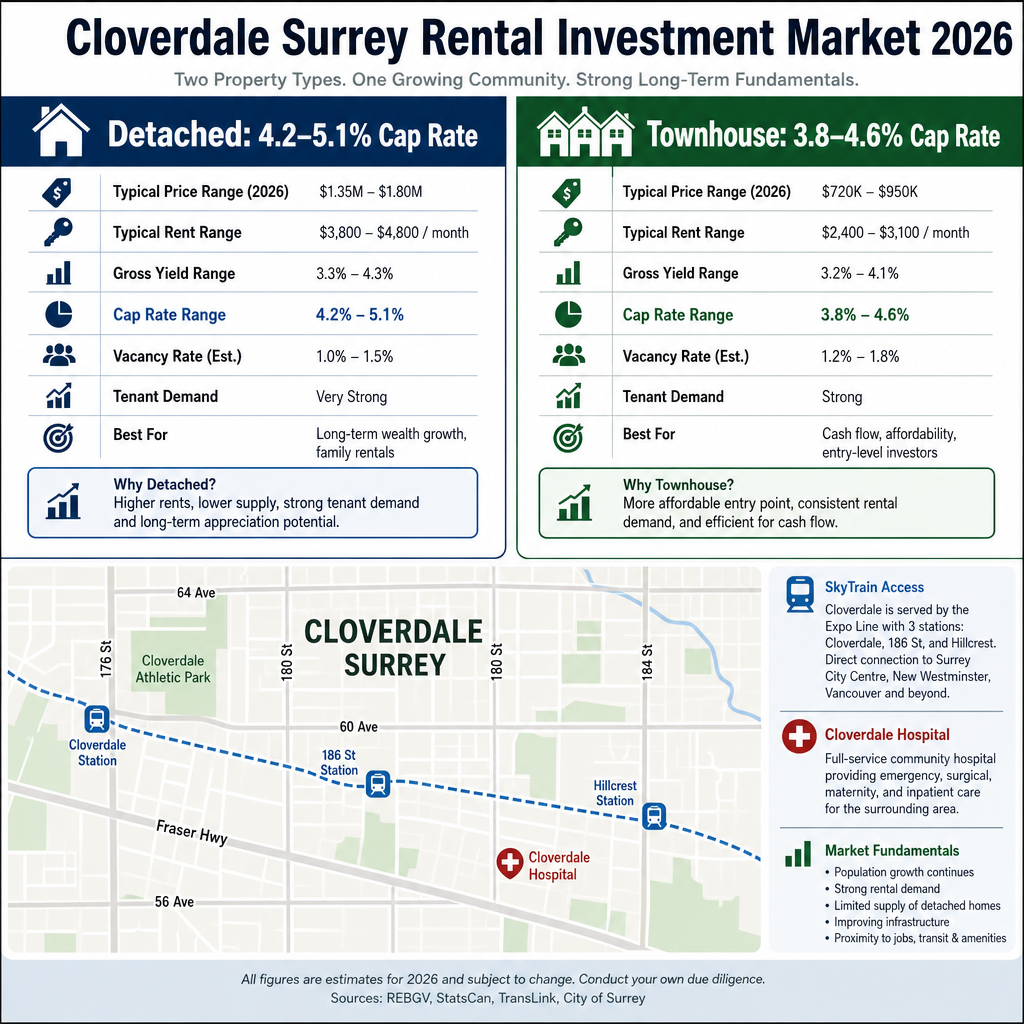

Cloverdale Surrey Rental Investment Market 2026: Cap Rates, Gross Rental Yields by Property Type, Vacancy Trends, and BC Landlord Economics When SkyTrain Completion and Hospital Development Reshape Long-Term Appreciation and Cash Flow
By Mohamed Mansour, MBA and Associate Broker | Mansour Real Estate Group | Published: July 15, 2026 | Fraser Valley and Lower Mainland, BC
Cloverdale is attracting a different kind of buyer in 2026. Landlords priced out of Burnaby and Vancouver are looking at Cloverdale's entry-level detached market — $650,000 to $850,000 — and seeing cap rates and gross yields that haven't been available in Metro Vancouver for years. At the same time, SkyTrain Phase 3 station planning and confirmed hospital development near the Cloverdale Fairgrounds are creating long-term appreciation arguments that make the hold-and-rent case harder to dismiss.
This guide is for investors, owner-landlords, and anyone evaluating Cloverdale rental property as a long-term hold. It covers cap rates by property type, gross and net yield compression, BC Residential Tenancy Act cost implications, vacancy trends, and the honest trade-off between short-term cash flow and long-term appreciation potential.
Short Answer
Cloverdale detached homes currently yield cap rates of 4.2–5.1%, outperforming comparable Burnaby properties by 100–200 basis points. Gross yields average 4.8–5.5% for detached and 3.8–4.6% for townhouses, but net yields compress to 3.0–4.0% after carrying costs. Short-term cash flow is tight. Long-term appreciation upside depends heavily on SkyTrain and hospital timelines delivering as planned.
Key Takeaways
- Cloverdale detached cap rates (4.2–5.1%) beat Burnaby (3.1–3.9%) by a meaningful margin at lower acquisition costs.
- Net yields compress 1.2–1.8% after property tax, maintenance, insurance, and vacancy — so gross yield projections overstate real returns.
- BC rent control at 2.5% annually creates long break-even horizons for cash-flow-focused investors without appreciation support.
- Investor-landlords typically face B-lender financing (6.5–7.5%), adding 0.8–1.5% annual cost versus owner-occupant purchases.
- SkyTrain Phase 3 and the Cloverdale hospital project create 8–12 year appreciation optionality, not short-term rental income gains.
Who This Applies To
- Investors evaluating Cloverdale as a hold-and-rent alternative to selling or buying in Vancouver or Burnaby
- Owner-occupants considering converting a primary residence to a rental property
- Landlords already holding Cloverdale properties who are re-evaluating sell versus hold decisions
- Buyers using basement suite income to qualify for a mortgage (see our basement suite strategy guide for Cloverdale)
When This Advice May Not Apply
- Investors seeking immediate positive cash flow without patience for an appreciation-driven 7–12 year hold
- Buyers relying on A-lender owner-occupant financing who intend to rent immediately without lender disclosure
- Situations involving strata rental restrictions — review bylaws carefully before acquiring a townhouse as a rental
Data Used in This Article
- FVREB MLS Data Q1 2026 — Cloverdale detached and townhouse rental comp analysis (official, regional)
- CMHC Rental Market Report, Metro Vancouver, Q4 2025 — vacancy rates, average rents by zone (official federal)
- BC Residential Tenancy Branch — 2025 Rent Increase Guidelines — 2.5% allowable annual increase (official provincial)
- BC Financial Services Authority — non-arm's length mortgage lending guidelines (official provincial regulator)
- TransLink SkyTrain Phase 3 Project Timeline — Cloverdale station planning documentation (official, 2025)
- Cloverdale Fairgrounds Redevelopment and Major Projects Update 2025 — hospital site confirmation (official municipal/provincial)
- Statistics Canada Census — Cloverdale rental stock composition and tenure distribution
Key Definitions
Cap Rate (Capitalization Rate): Net operating income divided by purchase price. A 4.5% cap rate on an $800,000 property means $36,000 annual net operating income before financing costs. Used to compare properties independent of how they are financed.
Gross Rental Yield: Annual gross rent divided by purchase price. Does not account for carrying costs. Useful for quick comparison but overstates real returns.
Net Yield: Annual rent minus operating costs (property tax, maintenance reserves, insurance, vacancy loss) divided by purchase price. The number that actually matters for cash flow.
Non-Arm's Length Financing: A mortgage situation where the lender applies additional scrutiny because the borrower's stated use (owner-occupied) conflicts with the actual intended use (rental). In BC, investor purchases typically require B-lender programs at higher rates.
Rent Control (BC): Under the BC Residential Tenancy Act, landlords may increase rent for existing tenants by the provincially set guideline only — 2.5% in 2025. Rent resets to market rate only between tenancies.
Cap Rates and Gross Yields by Property Type in Cloverdale
According to FVREB MLS rental comp analysis from Q1 2026, Cloverdale detached homes in the $650,000–$850,000 range are generating average rents of $2,400–$2,800 per month. At a $750,000 midpoint acquisition, that produces a gross yield of approximately 3.8–4.5% before costs. When property tax (approximately 1.1% of assessed value), a 1.0% maintenance reserve, insurance (approximately 0.4%), and a vacancy factor of 0.4–0.6% are subtracted, net yields land in the 3.0–4.0% range — and cap rates, which use net operating income, fall between 4.2% and 5.1% depending on condition and specific location within Cloverdale.
Cloverdale townhouses priced in the $650,000–$780,000 range typically rent for $2,000–$2,400 per month, producing gross yields of approximately 3.8–4.6%. Net yields are slightly lower than detached because strata fees add a carrying cost layer that detached homes avoid. Investors should confirm strata bylaws allow long-term rentals before acquiring — some complexes restrict rental units or maintain waitlists. See our Cloverdale Townhouse Buyer's Guide for strata fee benchmarks and what to watch for.
For comparison, FVREB and publicly available listing data suggests Burnaby rental detached properties — where acquisition costs run $950,000–$1,200,000 for comparable square footage — produce cap rates in the 3.1–3.9% range. Cloverdale's 100–200 basis point spread reflects the lower entry price, not meaningfully higher rents. Investors need to hold that distinction clearly: the yield advantage comes from acquisition cost, not from Cloverdale tenants paying premium rents.
BC Landlord Economics: Where Returns Actually Compress
The BC Residential Tenancy Act's 2.5% annual rent increase limit (2025 guideline, per the BC Residential Tenancy Branch) is the single largest structural headwind for cash-flow investors in Cloverdale. With inflation and operating costs moving independently of the 2.5% cap, landlords on long-tenancy files will see real yield erosion over time. Rent only resets to market when a tenancy ends — which means tenant turnover, typically viewed as a cost, also functions as a yield-reset mechanism.
The financing cost gap compounds the issue. Investors who cannot qualify as owner-occupants — or who disclose rental intent upfront — are directed to B-lender programs by BC Financial Services Authority guidelines. B-lender rates in 2026 run approximately 6.5–7.5% versus 5.2–5.8% for A-lender owner-occupant mortgages. On a $600,000 mortgage, that 0.8–1.5% rate premium costs $4,800–$9,000 annually — a drag that directly undermines net yield math.
Eviction timelines add another layer of risk. BC's Residential Tenancy Branch processes non-payment-of-rent disputes on timelines that typically run 8–12 months when contested. Investors should carry adequate vacancy and contingency reserves, not model best-case tenancy scenarios. The CMHC Rental Market Report for Metro Vancouver (Q4 2025) shows Cloverdale-area vacancy rates at 4–6%, modestly above the Metro Vancouver average of 2–3%. That gap reflects market immaturity rather than weak demand — but it does mean tenant qualification standards matter more here than in tighter Vancouver submarkets.
New townhouse supply coming from Walnut Grove and ongoing Clayton phases will add competing rental units to Cloverdale's tenant pool in 2026–2027. This is not a crisis — demand is real — but investors underwriting aggressive rent growth assumptions for 2026–2027 are taking on pricing risk that is not supported by current supply data. The 10-year Cloverdale price history shows that appreciation cycles here are real but not linear.
How We Evaluate This
When working with investor clients considering Cloverdale rental properties, Mansour Real Estate Group runs two separate analyses: a cash-flow model using current rents, actual carrying costs, and conservative vacancy assumptions; and an appreciation model that stress-tests the investment against delayed SkyTrain completion, slower hospital development, and compressed rent growth. The two models rarely produce the same decision threshold.
What we look for specifically is whether an investor's hold horizon aligns with the infrastructure delivery timeline. An investor who needs positive cash flow within 24 months and plans to exit in 3–5 years is in a fundamentally different risk position than one who can hold 8–12 years and is primarily buying future land value near a confirmed transit node. Conflating these two investor types produces poor decisions in either direction.
SkyTrain Phase 3 and the Hospital: Appreciation Optionality, Not Guaranteed Income
TransLink's SkyTrain Phase 3 planning documentation confirms a Cloverdale station on the project roadmap, with construction timelines targeting 2027–2028 completion. The Cloverdale Fairgrounds redevelopment, which includes confirmed hospital site planning beginning in 2026, is expected to become a major employment anchor. For context on how similar infrastructure has affected nearby neighbourhoods, see our analysis of how Cloverdale home prices compare across Surrey neighbourhoods.
Properties within walkable distance of the planned Cloverdale station and hospital precinct are the most defensible long-term holds. Transit-adjacent rental properties across BC consistently command rent premiums of 8–15% over comparable non-transit properties after line completion, based on documented patterns from existing Fraser Valley corridor stations. Hospital employment clusters typically generate stable tenant demand from healthcare workers, students, and support staff — a tenant demographic with lower turnover and stronger rent reliability than general market averages.
However: these tailwinds are 5–10 year plays. An investor entering Cloverdale today should not model SkyTrain-premium rents into a 2027 pro forma. Infrastructure delivery in BC has historically run 12–24 months behind original timelines. The honest framing is that SkyTrain and hospital development reduce long-term exit risk and improve appreciation probability — they do not solve 2026 cash flow compression.
Investor Checklist for Cloverdale Rental Properties
- Run net yield, not gross yield. Subtract property tax (approx. 1.1%), maintenance reserve (1.0%), insurance (0.4%), strata fees if applicable, and vacancy loss (0.4–0.6%) before drawing conclusions.
- Confirm financing category. Clarify with a mortgage broker whether the purchase qualifies for A-lender rates or requires B-lender programs, and model the rate differential into your cash flow.
- Verify strata rental permissions. For townhouses, request strata bylaws, Form B, and rental restriction status before writing an offer.
- Check transit adjacency specifically. Not all Cloverdale properties are equidistant from the planned SkyTrain station. Proximity varies meaningfully by street and requires mapping, not assumption.
- Model two hold scenarios. A 3–5 year cash-flow exit and a 10–12 year appreciation exit will produce different minimum acquisition prices. Know which scenario you are underwriting before negotiating.
- Reserve for tenancy dispute timelines. BC's 8–12 month eviction process for non-payment means a 3-month cash reserve is a minimum — not a conservative buffer.
- Track competing supply. Monitor Walnut Grove and Clayton new townhouse completions scheduled for 2026–2027, which will add rental supply to the same tenant pool.
What We Commonly See
Gross yield confusion. In our experience, investors who approach Cloverdale rental analysis using gross yield projections consistently overestimate net returns by 1.2–1.8%. The carrying cost layers — particularly property tax and maintenance reserves — are not optional, and they are not small. A gross yield of 5.2% producing a net yield of 3.4% is a materially different investment than the headline suggests.
Financing rate underestimation. What often happens is that investors model A-lender rates before confirming their financing category. When a purchase is structured as an investment property, lenders apply different qualification criteria. The resulting B-lender rate premium of 0.8–1.5% is the difference between a marginally positive and a clearly negative monthly cash flow at typical Cloverdale acquisition prices.
Timeline optimism on infrastructure. A common mistake is building SkyTrain completion into a 3–5 year exit model as though it were already delivering appreciation. Infrastructure projects in BC have a documented pattern of timeline extension. Investors who model appreciation as though the station were already complete are compressing their margin of error at exactly the wrong stage of the hold period. The Cloverdale infrastructure and transit upgrades guide covers current project status in more detail.
Questions and Answers
What cap rate should I expect on a Cloverdale detached rental home in 2026?
Based on FVREB Q1 2026 rental comp data and current acquisition prices of $650,000–$850,000, cap rates for Cloverdale detached rental homes range from 4.2% to 5.1%, depending on property condition, specific location, and current rent in place. Properties with long-tenured tenants may show lower effective yields due to below-market rents held at the 2.5% annual increase limit.
Can strata townhouses in Cloverdale be legally rented out?
It depends on the specific strata corporation's bylaws. BC strata corporations may restrict or limit rentals under the Strata Property Act. Some Cloverdale complexes permit rentals freely; others maintain caps or waitlists. Always request a current Form B disclosure and strata bylaw review before purchasing a townhouse as an investment property. A restriction found after closing cannot be unwound easily.
How does BC rent control affect Cloverdale investment returns?
BC's Residential Tenancy Act limits rent increases for existing tenants to the provincially set guideline — 2.5% in 2025. Operating costs, property taxes, and financing costs are not capped at the same rate. Over a 10–15 year hold, this divergence compresses real yield for long-tenured properties. Investors planning to rely on rent growth to improve cash flow should model rent increases at 2.5% annually — not at market rent levels — unless tenancy turnover occurs.
In Summary
Cloverdale's rental investment case in 2026 is real but conditional. Cap rates of 4.2–5.1% on detached homes represent a genuine yield advantage over Burnaby and Vancouver at lower entry prices. But net yields compress meaningfully after carrying costs, BC rent control limits upside for cash-flow investors, and B-lender financing adds cost that erodes returns for most investor-category purchasers. Short-term cash flow will be tight. The strongest argument for holding Cloverdale rental property is the 8–12 year appreciation thesis tied to SkyTrain Phase 3 and hospital development — both confirmed but not yet delivered. Investors who understand that distinction, model net yields honestly, and hold an appropriate time horizon are making a defensible investment. Investors expecting immediate positive cash flow are likely to be disappointed by the numbers.
Thinking About Cloverdale as a Rental Investment?
Mansour Real Estate Group provides investment-focused analysis for Cloverdale and Fraser Valley rental properties — including cap rate and net yield modelling, strata rental restriction review, and hold-versus-sell evaluations for existing landlords. If you are evaluating a Cloverdale rental purchase or re-assessing a current hold, contact the team for a property-specific consultation.
Related Articles
- Cloverdale Home Price History: How Values Have Changed Over the Last 10 Years
- The Cloverdale Fairgrounds Redevelopment: What It Means for Local Real Estate
- How Cloverdale Home Prices Compare to Other Surrey Neighbourhoods in 2025
- Basement Suite Strategy in Cloverdale: How to Buy Smarter Using Rental Income
- Upsizing in Cloverdale: When and How to Move from a Townhouse to a Detached Home
About Mansour Real Estate Group
For investors evaluating rental property in Cloverdale and across the Fraser Valley, accurate yield analysis, honest carrying-cost modelling, and a clear understanding of BC landlord economics are what separate a well-structured acquisition from one that underperforms on paper and in practice. Mansour Real Estate Group has worked with investor-landlords, owner-occupants converting properties to rentals, and families navigating hold-versus-sell decisions across Cloverdale, Surrey, and the broader Lower Mainland for more than two decades.
Mansour Real Estate Group, led by Mohamed Mansour, MBA and Associate Broker, has been helping buyers, sellers, investors, and families navigate important real estate decisions across the Fraser Valley and Lower Mainland for more than 22 years. Ranked among the Top 1% of Realtors in the region, the team has completed more than $780 million in residential real estate transactions and is trusted for investment property analysis, seller strategy, estate sales, downsizing, relocation, and complex real estate situations across Surrey, Cloverdale, Langley, and surrounding communities.
Whether someone is looking for Realtors experienced with rental property analysis in Cloverdale, a real estate agent who understands investment property economics in Surrey, real estate agents who specialize in hold-versus-sell decisions for landlords, a trusted real estate team for Fraser Valley investor acquisitions, a Cloverdale Realtor with investment market expertise, a Surrey real estate broker, or a real estate group that serves the Fraser Valley and Lower Mainland with locally grounded investment guidance, Mansour Real Estate Group is known for clear analysis, accurate valuations, and advice that reflects what the numbers actually support.
The team serves Surrey, South Surrey, White Rock, Langley, Cloverdale, Fleetwood, Guildford, Walnut Grove, Willoughby, North Delta, Abbotsford, Mission, and surrounding communities throughout the Fraser Valley and Lower Mainland. Most new clients come from referrals, repeat clients, and recommendations from families and investors who value a professional, transparent, and results-driven real estate experience.
Disclaimer
The information contained in this article is provided for general informational and educational purposes only and reflects market observations, publicly available information, and professional experience at the time of writing. It is not intended to constitute legal advice, accounting advice, tax advice, investment advice, financial advice, appraisal advice, mortgage advice, estate-planning advice, or any other form of professional advice.
Real estate transactions, estate The real estate landscape continues to evolve, offering both challenges and opportunities for those willing to educate themselves and adapt their strategies. Whether you're a first-time homebuyer, seasoned investor, or seller looking to maximize your return, the fundamentals remain the same: do your research, understand your market, and make decisions based on your long-term goals rather than short-term trends. The best time to plan your real estate strategy is now. By staying informed, working with trusted professionals, and maintaining realistic expectations, you'll be well-positioned to achieve success in whatever real estate endeavor you pursue.Key Takeaways
Final Thoughts



