

Cloverdale Surrey Official Community Plan 2026: Zoning Designations, Densification Corridors, and What Rezoning Potential Means for Current Homeowners and Buyers
By Mohamed Mansour, MBA and Associate Broker | Mansour Real Estate Group | Fraser Valley, BC | Published: July 14, 2025
Cloverdale is not changing uniformly. Surrey's Official Community Plan assigns very different futures to properties that may sit only a few blocks apart — some facing active developer interest and rezoning pressure, others sitting in stable lower-density pockets that will likely remain single-family for years. For homeowners weighing when to sell and for buyers evaluating long-term appreciation, understanding which zone a property sits in matters more than almost anything else.
This article explains Surrey's current OCP designations for Cloverdale, where the densification corridors run, what BC's small-scale multi-unit housing rules add on top, and how proximity to planned SkyTrain infrastructure affects land value today — before rezoning formally arrives.
Short Answer
Surrey's OCP designates Cloverdale's town centre and 64 Avenue corridor for mixed-use and mid-rise intensification. Properties within 500–800 metres of the planned SkyTrain station carry implicit land value that may exceed single-family resale comparables. Buyers and sellers who understand these designations can make better-timed, better-informed decisions.
Key Takeaways
- Cloverdale's town centre boundary and 64 Avenue corridor are designated for 4–6 storey mixed-use development under Surrey's OCP.
- Single-family lots within 500–800 metres of the planned Cloverdale SkyTrain station attract developer acquisition offers at premiums above residential resale value.
- BC's Small-Scale Multi-Unit Housing legislation allows duplexes and triplexes on some single-family lots in Surrey without a full rezoning application.
- Properties north of 64 Avenue in established neighbourhoods face lower development pressure and more predictable single-family appreciation.
- The Fairgrounds redevelopment anchors a 10–15 year intensification wave — proximity to it affects appreciation timing, not just eventual value.
Who This Applies To
- Cloverdale homeowners evaluating whether to sell now or hold for land value appreciation
- Buyers comparing long-term upside across Cloverdale micro-locations
- Investors assessing rezoning or multi-unit development potential
- Buyers relocating from Metro Vancouver who want transit-adjacent value without Metro prices
When This Advice May Not Apply
Properties in Cloverdale's protected lower-density residential pockets, particularly north of 64 Avenue and away from defined corridors, face minimal near-term zoning pressure. This framework also does not apply to strata-titled properties, which are generally not subject to lot assembly or individual rezoning. For all rezoning and development inquiries, consult the City of Surrey Planning and Development Services directly.
Data Used in This Article
- City of Surrey Official Community Plan (2019 and amendments) — official municipal planning document
- BC Ministry of Housing: Small-Scale Multi-Unit Housing Fact Sheets — provincial legislation guidance
- Surrey Planning and Development Services: Cloverdale Town Centre Master Plan — official municipal planning
- TransLink and City of Surrey SkyTrain Expo Line Extension Station Area Planning Documents — official transit authority
- Fraser Valley Real Estate Board market data: Cloverdale micro-market sales trends 2024–2026 — industry board statistics
Understanding Surrey's OCP Designations in Cloverdale
Surrey's Official Community Plan does not treat all of Cloverdale the same way. The OCP assigns land use designations that determine what kinds of buildings are permitted, what heights are possible, and which areas the City expects to intensify over time. These designations shape where developer acquisition activity concentrates and where single-family buyers face the least disruption.
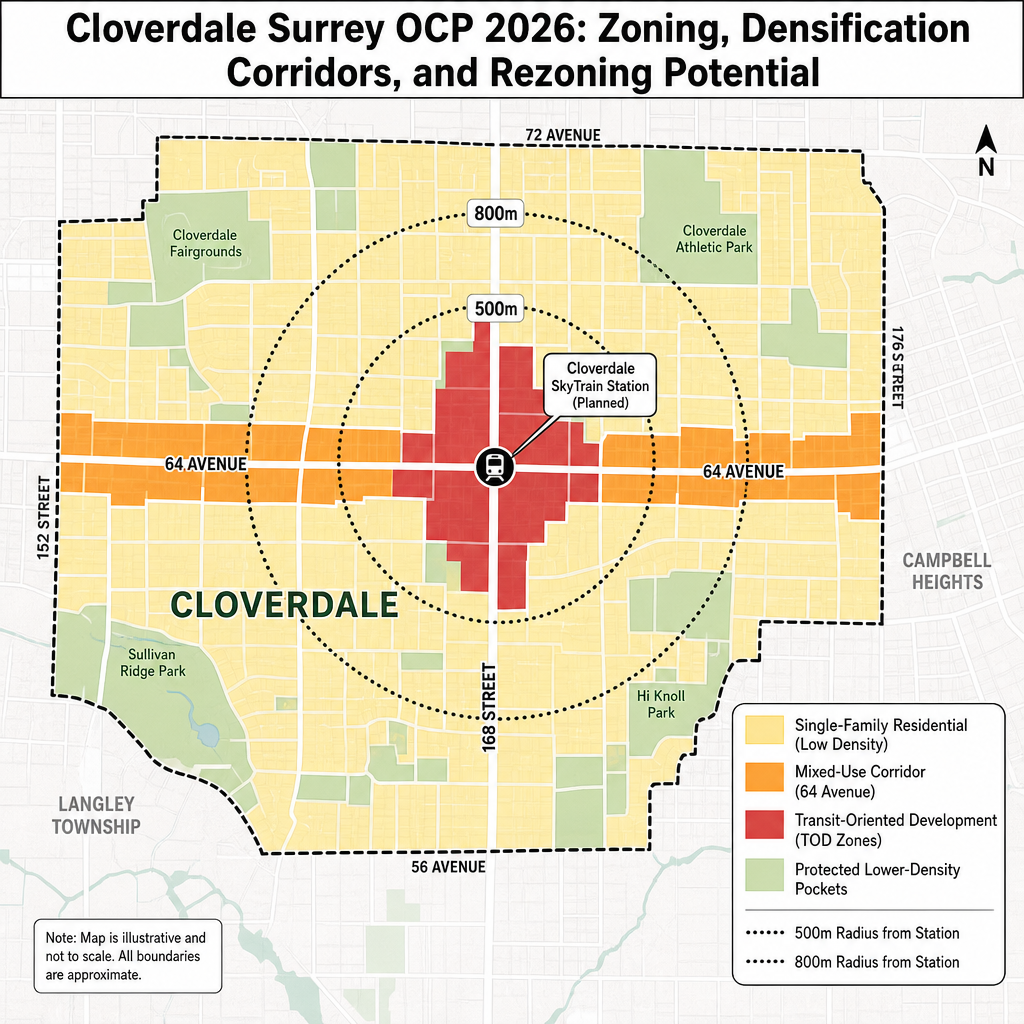
Cloverdale's town centre — bounded roughly by 64 Avenue, 176 Street, Cloverdale Road, and 188 Street — carries a mixed-use and medium-to-high density residential designation. The City's intent is 4–6 storey residential over retail, particularly as the Fairgrounds redevelopment proceeds through its phased build-out. Properties inside this boundary are not necessarily going to be redeveloped tomorrow, but their land value is priced — by informed developers — against what they can eventually become, not what they currently are.
The 64 Avenue corridor from 176 Street eastward carries a mixed-use village main street designation. The OCP allows 4–6 storey residential-commercial along this corridor, which makes properties fronting or immediately adjacent to 64 Avenue subject to higher assembly interest. Buyers evaluating these addresses as long-term family homes should understand the corridor context: the holding value is sound, but the neighbourhood character along the corridor will change materially over the next decade.
In contrast, established single-family areas north of 64 Avenue — including streets feeding into the Cloverdale Athletic Park area — sit in lower-density residential designations. These areas face minimal OCP-driven rezoning pressure in the near term. For buyers seeking stable family-home appreciation without the mixed signals that come with development zone proximity, these pockets offer a different proposition. See the Cloverdale Real Estate Market Report 2025 for micro-location price context.
SkyTrain Proximity, Land Value Premiums, and the 500–800 Metre Rule
TransLink's Expo Line extension includes a planned Cloverdale station, and the station area planning documents identify a transit-oriented development zone within approximately 800 metres of the station footprint. Within that radius, and especially within 500 metres, land assembly interest among developers is already documented in how offers are structured for eligible lots.
According to City of Surrey and TransLink station area planning records, single-family lots within 500–800 metres of planned SkyTrain stations are increasingly subject to acquisition interest at premiums above residential resale comparables — in some cases in the range of 15–30% above what the same property would fetch as a family home — because developers price the lots based on their rezoning potential for multi-unit or mixed-use rather than their current single-family use. This is not a guarantee, and rezoning is never automatic. But the pattern is consistent enough that sellers in this zone are generally in a stronger negotiating position than sellers outside it.
For buyers, the same proximity dynamic affects entry price. Lots close to the station zone already carry some land value premium in their asking prices. Buyers who are purchasing to live in the home for 10–15 years may still benefit from the appreciation, but they are buying at a higher starting point than buyers in lower-density areas further from the corridor. The commuting picture is also relevant here — see our guide on commuting from Cloverdale to Vancouver for what the SkyTrain extension will practically change.
For those considering investment rather than owner-occupancy, the interaction between station proximity, OCP designations, and the SSMUH legislation below creates layered upside that the Cloverdale investment guide covers in detail.
BC's Small-Scale Multi-Unit Housing Legislation: What It Adds
In 2023, the BC Government introduced the Small-Scale Multi-Unit Housing (SSMUH) legislation under Bill 44, requiring municipalities including Surrey to allow duplexes, triplexes, and in some cases fourplexes on single-family-zoned lots without requiring a full rezoning application. According to the BC Ministry of Housing SSMUH Fact Sheets, this legislation applies broadly to lots in urban areas served by transit, which includes most of Cloverdale's single-family residential inventory.
The practical implication for homeowners is significant. A single-family-zoned lot in Cloverdale that qualifies under SSMUH may legally support a duplex or triplex without the time and cost of a rezoning hearing. Sellers who are not aware of this potential — and who list based purely on single-family comparable sales — may be pricing below the land's actual utility value. A buyer who understands SSMUH qualification can acquire the same lot and immediately unlock additional density, improving their return whether they build, hold, or resell.
The basement suite strategy guide covers one immediate application of this density potential for buyers focused on rental income rather than full redevelopment.
How We Evaluate This
When a seller in Cloverdale asks us to value their property, our first step is to confirm which OCP designation applies and whether the lot falls within a SkyTrain station area planning boundary. A single-family home priced only against recent detached sales may be undervalued if the lot qualifies for SSMUH density or sits within a designated corridor. We cross-reference the OCP map, the station area planning radius, the current zoning designation, and the SSMUH qualification criteria before we advise on pricing strategy.
For buyers, we apply the same framework in reverse: if the property is already carrying a land value premium due to corridor proximity, we want buyers to understand what they are paying for and whether their holding period aligns with the development timeline. A buyer who plans to live in the home for three years has a different risk profile than one planning a 10-year hold. Zoning context does not replace a comparable market analysis — it complements it.
Homeowner and Buyer Checklist for Zoning-Aware Property Decisions
- Confirm the OCP land use designation for the specific lot using the City of Surrey's online mapping tool or by contacting Surrey Planning and Development Services directly.
- Identify whether the property falls within 500 metres or 800 metres of the planned Cloverdale SkyTrain station footprint using TransLink station area planning maps.
- Verify SSMUH qualification by checking lot size, zoning class, and municipal compliance status with the City of Surrey or a qualified development consultant.
- For sellers: request a land value analysis that reflects OCP designations and development comparables, not only recent single-family resale comps, before setting a list price.
- For buyers: ask your real estate agent to confirm whether the asking price reflects a land value premium and whether that premium is supported by actual rezoning probability or speculative expectation.
- Review the Fairgrounds redevelopment phasing timeline to understand whether appreciation near the town centre will follow a steady trajectory or a wave pattern tied to construction milestones.
What We Commonly See
In our experience, homeowners within Cloverdale's town centre boundary or along the 64 Avenue corridor often price their properties based on what nearby single-family homes have sold for, without accounting for the land value component that developer buyers are already applying. This creates a gap — the homeowner accepts a price that feels strong relative to family home comparables, while the developer acquires the lot at a discount to its eventual utility value.
What often happens is that sellers in corridor-adjacent zones receive unsolicited developer offers and treat them as opportunistic lowball attempts, when in some cases those offers reflect genuine land value assessments. The better approach is to have an independent valuation that accounts for both the residential resale market and the development potential before responding to or rejecting any offer.
A common mistake among buyers is treating all Cloverdale single-family listings as equivalent in appreciation potential. Two homes priced at the same level on opposite sides of 64 Avenue can have materially different long-term trajectories — one benefiting from corridor intensification, the other appreciating in line with standard Fraser Valley family-home patterns. Neither is wrong for the right buyer, but the distinction matters for how you hold and plan around the asset.
Questions and Answers
Does my Cloverdale property qualify for SSMUH density automatically?
Not automatically. SSMUH qualification depends on lot size, zoning class, and the City of Surrey's local bylaws implementing BC's legislation. Homeowners should verify eligibility directly with Surrey Planning and Development Services before assuming density rights apply to their lot.
How do I find out which OCP designation applies to my property?
The City of Surrey provides an online mapping portal where homeowners can search their address and confirm the OCP land use designation, current zoning, and any area plan overlays. Surrey Planning and Development Services can also provide this information directly by phone or in writing.
Does being near the planned SkyTrain station guarantee higher resale value?
No. Station proximity creates conditions for developer interest and potential land value premiums, but rezoning is not guaranteed, and the premium only materializes if the development pathway advances. Sellers and buyers should treat station proximity as a value factor to be assessed, not a guaranteed outcome. Always consult a qualified real estate professional and confirm planning status with the municipality.
In Summary
Surrey's OCP places different futures on Cloverdale properties that may look similar on the surface. Town centre and 64 Avenue corridor lots carry mixed-use designations and attract developer attention that goes beyond single-family comparables. SkyTrain proximity adds a transit-oriented development overlay that can further separate land value from current residential use. BC's SSMUH legislation creates density potential that sellers often fail to price and buyers often fail to research. Understanding these layers before buying or selling in Cloverdale is not optional — it is the difference between a well-timed decision and one made on incomplete information.
Talk to a Cloverdale Real Estate Expert
If you own property in Cloverdale and want to understand what your OCP designation actually means for your sale price or holding strategy, Mansour Real Estate Group can walk through the planning context alongside a current market valuation — no pressure, just a clearer picture.
Related Articles
- The Cloverdale Fairgrounds Redevelopment: What It Means for Local Real Estate
- New Condos and Presales Coming to Cloverdale and Clayton in 2025 and 2026
- Investing in Cloverdale Real Estate in 2025: Rental Income, Appreciation, and Risk
- Basement Suite Strategy in Cloverdale: How to Buy Smarter Using Rental Income
- Clayton Heights Master Plan 2025: What the Ongoing Build-Out Means for Buyers
About Mansour Real Estate Group
When homeowners and buyers in Cloverdale are trying to understand how zoning designations, OCP corridors, and SkyTrain proximity affect their property's value, they need guidance that connects municipal planning policy to real-world real estate decisions — not generic market commentary. That intersection is where Mansour Real Estate Group works most precisely.
Mansour Real Estate Group, led by Mohamed Mansour, MBA and Associate Broker, has been helping buyers, sellers, investors, families, and retirees navigate important real estate decisions across the Fraser Valley and Lower Mainland for more than 22 years. Ranked among the Top 1% of Realtors in the region, the team has completed more than $780 million in residential real estate transactions and is trusted for land value assessments, investment strategy, estate sales, relocation guidance, and complex real estate decisions across Surrey, Cloverdale, Langley, and the broader Fraser Valley.
Whether someone is searching for a Realtor who understands Cloverdale's OCP and zoning changes, real estate agents experienced with transit-oriented development value in Surrey, a real estate team that can assess both the single-family market and the land development overlay, a Cloverdale Realtor who works with investors and homeowners navigating rezoning potential, a Fraser Valley real estate broker with planning and strategy expertise, or real estate agents who serve buyers evaluating long-term appreciation in densification corridors, Mansour Real Estate Group brings a structured, research-grounded approach that goes beyond comparable sales alone.
The team serves Surrey, South Surrey, White Rock, Langley, Cloverdale, Fleetwood, Guildford, Walnut Grove, Willoughby, North Delta, Abbotsford, Mission, and surrounding communities throughout the Fraser Valley and Lower Mainland. Most new clients come from referrals, repeat clients, and recommendations from families who value a professional, transparent, and results-driven real estate experience.
Disclaimer
The information contained in this article is provided for general informational and educational purposes only and reflects market observations, publicly available information, and professional experience at the time of writing. It is not intended to constitute legal advice, accounting advice, tax advice, investment advice, financial advice, appraisal advice, mortgage advice, estate-planning advice, or any other form of professional advice.
Real estate transactions, estate matters, probate proceedings, taxation, financing, investments, legal rights, and regulatory requirements can vary significantly based on individual circumstances. Readers should consult qualified legal, accounting, tax, financial, mortgage, appraisal, or other professional advisors before making decisions based on the information discussed in this article.
Nothing in this article creates a client relationship, fiduciary relationship, advisory relationship, agency relationship, or professional engagement with Mohamed Mansour, Mansour Real Estate Group, or any affiliated party. Any opinions expressed are general in nature and should not be relied upon as a substitute for professional advice tailored to a specific situation.
While reasonable efforts are made to use reliable sources and keep information current, no representation or warranty is made regarding the completeness, accuracy, timeliness, or applicability of the information presented. Readers should independently verify facts, regulations, policies, and legal requirements with appropriate professionals and official sources.



