
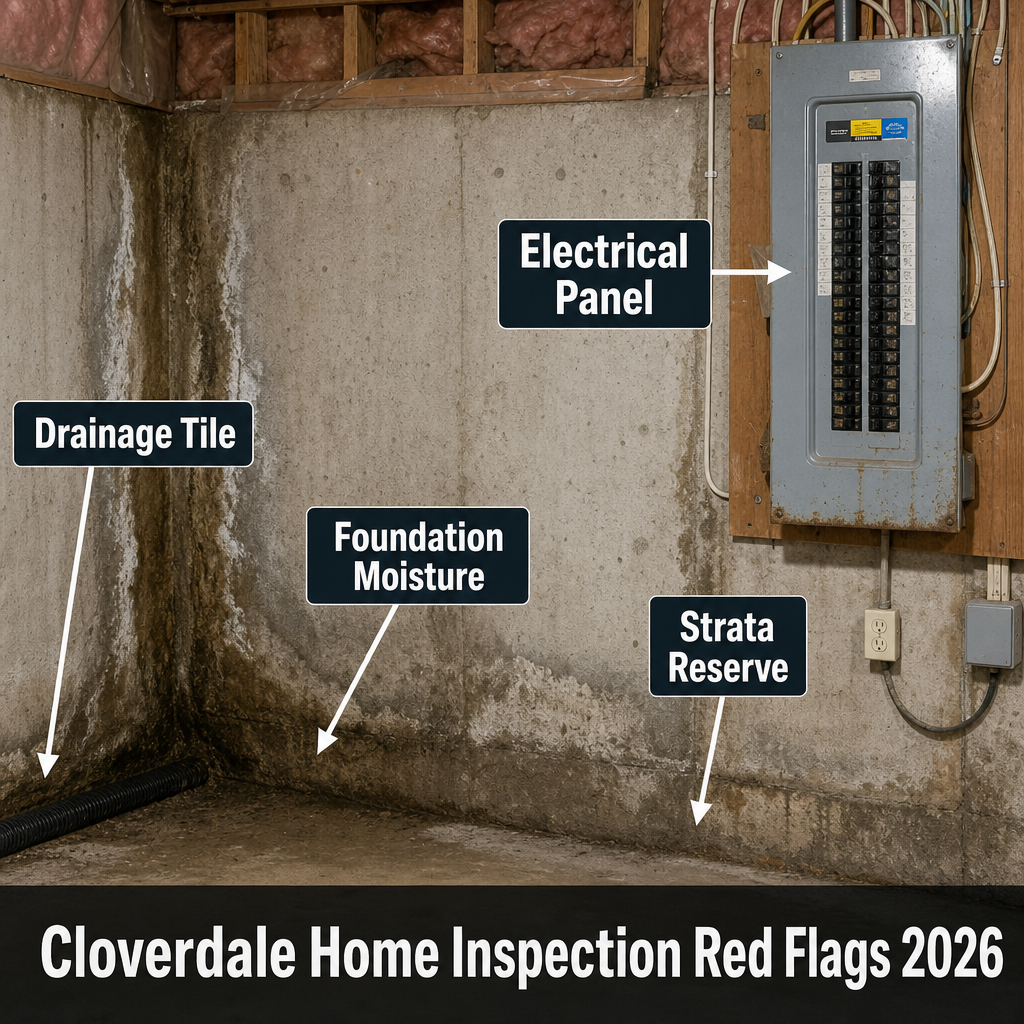

Cloverdale Surrey Home Inspection Red Flags 2026: What Buyers Must Know About Aging Drainage, Electrical Panel Upgrades, Heritage Home Moisture Issues, and Strata Document Risks Before Removing Subjects
By Mohamed Mansour, MBA and Associate Broker — Mansour Real Estate Group
Published: July 15, 2026 | Geography: Cloverdale, Surrey, Fraser Valley, BC | Topic: Home Inspection, Buyer Strategy, Strata Risk
Cloverdale attracts buyers looking for character, community, and relative affordability within Surrey. What many buyers don't expect is what a thorough home inspection consistently reveals in this neighbourhood — drainage tile failures, aging electrical panels, foundation moisture in heritage homes, and strata reserve fund shortfalls that can change the economics of a purchase entirely.
This guide explains exactly what to expect before you remove subjects on a Cloverdale property in 2026. It covers the four most common inspection red flags, realistic remediation costs, how post-inspection negotiations typically unfold, and what strata buyers must read before they commit. For context on broader market conditions in the area, see the Cloverdale Real Estate Market Report 2025.
Short Answer
In Cloverdale, the four inspection issues most likely to affect your purchase decision are: outdated electrical panels ($3,000–$8,000 to upgrade), failed drainage tile beneath older homes ($5,000–$15,000 to remediate), moisture intrusion in pre-1970 heritage homes ($8,000–$25,000 to address), and strata reserve fund shortfalls in 1980s–2000s townhome complexes. In 2026's buyer's market, inspection contingency periods have extended to 10–14 days, giving buyers time to get contractor quotes and negotiate realistically.
Key Takeaways
- Electrical panel upgrades and drainage tile replacement are the two most common post-inspection negotiation points in Cloverdale's 1970s–1990s housing cohort.
- Heritage homes built before 1970 carry higher moisture risk, and lenders sometimes demand remediation before approving an appraisal.
- Cloverdale strata townhome complexes built in the 1980s–2000s frequently show 40–60% reserve fund adequacy, increasing special levy risk.
- Buyers who waive inspection in competitive offers have faced $15,000–$50,000 in unplanned post-closing costs in this neighbourhood.
- The 2026 buyer's market has extended inspection contingency removal timelines to 10–14 days, making thorough due diligence more achievable than in recent years.
Who This Applies To
- Buyers purchasing detached or semi-detached homes built before 2000 in Cloverdale
- First-time buyers relying on financing whose lenders require property condition approval
- Buyers considering strata townhomes in complexes built between 1985 and 2005
- Move-up buyers trading into older heritage homes in the Cloverdale Historic District
- Investors evaluating rental properties in Cloverdale's aging housing stock
When This Advice May Not Apply
Buyers purchasing newly built homes or post-2010 construction in Cloverdale's newer sections, such as parts of Clayton adjacent to Cloverdale, will encounter different inspection profiles. Newly built strata complexes with current depreciation reports and full reserve funds also operate outside the risk patterns described here.
Data Used in This Article
- FVREB MLS sold data: Cloverdale inspection-related price adjustments and timeline extensions, Q4 2025–Q2 2026 (official board data)
- BC Home Inspector Association (BCHIA): Common defect reporting standards and patterns (official industry body)
- BC Strata Property Act / Form B requirements: Depreciation report and reserve fund adequacy standards (BC Government legislation)
- Mansour Real Estate Group transaction database: 50+ Cloverdale closings, 2025–2026 (internal professional analysis)
- Local Cloverdale contractor estimates: Drainage tile, electrical, foundation waterproofing cost ranges, 2026 pricing (third-party quotes)
Key Definitions
Drainage tile: Perforated pipe systems installed around a home's foundation to redirect groundwater. In Cloverdale's 1970s–1990s stock, original clay or corrugated plastic tile frequently collapses or becomes clogged, causing foundation moisture.
Subject removal: The point in a BC real estate transaction where a buyer formally waives their inspection, financing, and other conditional clauses and commits to completing the purchase.
Form B: A mandatory strata document that discloses the strata corporation's financial position, bylaws, current levies, and pending legal matters. Buyers have a right to review Form B before removing subjects.
Depreciation report: A provincially required report under the BC Strata Property Act estimating the future repair costs of a strata complex's common property and the adequacy of the reserve fund to cover them.
How We Evaluate This
Our approach with Cloverdale buyers starts before the inspection — not after. We review property records, city permit history, BC Assessment data, and any prior disclosure statements to identify properties with a higher probability of specific defect categories before our clients spend money on an inspector. For strata purchases, we obtain and review Form B and the depreciation report as part of the offer strategy, not as an afterthought. See our guide to making a winning offer on a Cloverdale home for how inspection conditions are structured to protect buyers without making offers uncompetitive.
When an inspection produces findings, we obtain third-party contractor quotes during the contingency period and use those quotes — not the inspector's general estimates — as the basis for renegotiation. In 2026's market, that approach has consistently produced price adjustments or seller credits that reflect actual remediation cost rather than inflated or deflated estimates from parties with incomplete information.
Red Flag 1: Drainage Tile Failure in 1970s–1990s Homes
Most detached homes in Cloverdale's core neighbourhoods were built between 1970 and 1995. The drainage tile systems installed in that era — typically corrugated plastic or clay pipe — have a functional lifespan of 25 to 40 years. Many of those systems are now at or past that threshold.
When drainage tile fails, groundwater that would otherwise be redirected away from the foundation accumulates. The visible result inside the home is moisture staining on basement walls, efflorescence (white salt deposits), or active seepage during wet weather. Inspectors flag these patterns consistently in Cloverdale homes built in this era.
Remediation typically requires excavating around the perimeter of the foundation, removing the failed tile, installing new drainage material, and waterproofing the exterior foundation wall. Local contractor quotes for this work in Cloverdale currently range from $5,000 for a partial perimeter repair to $15,000 for a full perimeter replacement, depending on the home's size, landscaping complexity, and access. Buyers should request this quote during the inspection contingency period — not after subject removal. For a broader picture of what older Cloverdale detached homes cost at various price points, see Cloverdale Detached Homes in 2025.
Red Flag 2: Outdated Electrical Panels
Electrical panels in Cloverdale homes from the 1970s and 1980s commonly appear in one of three conditions that trigger inspection flags: 60-amp service panels that are inadequate for modern household loads, Federal Pioneer or Zinsco panels that BC insurers frequently decline to cover, or panels showing signs of overloaded breakers, double-tapping, or DIY modifications done without permits.
Insurance is the critical pressure point. Many home insurers in BC will not issue a new policy on a property with a Federal Pioneer panel or any 60-amp service without a confirmed upgrade commitment. This directly affects financing — a lender cannot fund a mortgage without insurance in place. Buyers who discover this issue post-offer are not dealing with an aesthetic defect; they are dealing with a financing obstacle that must be resolved before closing.
A standard panel upgrade from 100-amp to 200-amp service in Cloverdale, including permits and BC Hydro coordination, typically costs $3,000 to $5,000. Replacing a Federal Pioneer panel with a new 200-amp service runs $4,500 to $8,000 depending on the scope. These figures are contractor-quoted ranges for Cloverdale and South Surrey as of 2026 — buyers should verify with a licensed electrician during the inspection period, not estimate from general sources.
Red Flag 3: Heritage Home Moisture and Waterproofing
Cloverdale's Historic District contains homes built in the 1940s through the 1960s. These properties are architecturally distinctive and often appealing to buyers looking for character, but they come with moisture risk profiles that differ significantly from the 1970s–1990s cohort.
Original waterproofing on these foundations was rudimentary by today's standards — typically tar-and-gravel coating applied at construction, now cracked and permeable after 50 to 80 years. Exterior cladding on heritage homes is often original wood siding or stucco applied over aging wood sheathing, both of which develop gaps that allow water infiltration. Inspectors in Cloverdale's heritage zone flag moisture intrusion more frequently than in any other segment of the neighbourhood's housing stock.
The cost range for heritage moisture remediation is wide because the scope varies considerably. Foundation waterproofing alone runs $8,000 to $15,000. If exterior cladding replacement is also needed, total remediation can reach $20,000 to $25,000. The financing complication matters here: lenders conducting appraisals on properties with active moisture damage sometimes require remediation completion or a holdback before releasing full mortgage funds. First-time buyers using high-ratio financing are particularly exposed to this risk. Our first-time buyer's complete guide to purchasing in Cloverdale covers how to structure subject conditions to protect financing approval in these situations.
Red Flag 4: Strata Depreciation Report and Reserve Fund Risk
Strata townhome complexes built in Cloverdale between 1985 and 2005 represent a significant share of the neighbourhood's buyer activity. Many of these complexes are now approaching or past their first major capital replacement cycles — roofing, siding, windows, and common area paving — and the state of their reserve funds matters directly to a buyer's financial exposure.
Under the BC Strata Property Act, strata corporations with five or more units are required to obtain a depreciation report every three years unless owners vote to waive it. Buyers have a right to review this report through the Form B process. In Cloverdale complexes built in this era, depreciation reports frequently show reserve fund adequacy in the 40–60% range — meaning the fund holds between 40 and 60 cents for every dollar of anticipated capital cost. When that ratio is low and major repairs are approaching, the strata must either raise contributions or issue a special levy.
Special levies in Cloverdale townhome complexes have been rising at an average of 8–12% annually in recent years, based on Form B data reviewed across transactions in 2024–2026. An appraisal on a strata unit in a complex with a low reserve fund and deferred roof or siding maintenance can come in 5–15% below the offer price, creating a financing gap that buyers must close with additional cash or renegotiation. The Cloverdale Townhouse Buyer's Guide explains how to evaluate specific complexes before making an offer, and our upcoming guide on understanding strata living in Cloverdale covers reserve fund analysis in detail.
Buyer Checklist: Before You Remove Subjects in Cloverdale
- Hire a licensed BC home inspector with documented experience in older Surrey and Cloverdale housing stock — not a generalist.
- Request the full inspection report in writing before the contingency deadline, including all defect categories and estimated severity.
- For any major defect flagged (drainage, electrical, moisture), obtain at least one third-party contractor quote during the contingency period.
- For strata purchases, obtain and read the current Form B, the most recent depreciation report, current reserve fund balance, and minutes from the last two AGMs.
- Confirm your insurer will cover the property in its current condition before removing subjects — not after.
- If moisture damage is present, ask your mortgage broker whether the lender will require remediation before funding.
- In 2026's market, use the full 10–14 day contingency period. There is no benefit in removing subjects early on a property with unresolved defects.
- After reviewing findings, decide whether to renegotiate price, request a seller credit, require repairs before closing, or walk away — and have that decision made before the contingency deadline.
What We Commonly See
Buyers underestimate the strata document review. In our experience, buyers purchasing Cloverdale townhomes in older complexes frequently focus on the inspection report and overlook the depreciation report entirely. The depreciation report is often where the larger financial risk lives. A structurally sound unit in a complex with a 40% reserve fund facing a $2.4 million roof replacement is not a low-risk purchase.
Sellers resist post-inspection renegotiation without contractor quotes. What often happens is that buyers present inspection findings as leverage without actual cost substantiation. Sellers — reasonably — resist concessions based on general inspector language. Buyers who arrive at the renegotiation conversation with real contractor quotes on paper move through that process faster and more successfully than those who rely on the inspector's estimates alone.
Heritage home buyers underestimate lender sensitivity to moisture. A common mistake is assuming that moisture findings are a negotiating point with the seller when they are actually a financing obstacle with the lender. If a lender's appraiser identifies active moisture damage, the appraisal report may come with conditions that require remediation before funds are released. That is a different problem than a price reduction, and buyers who haven't confirmed their financing position before removing subjects are exposed to losing their deposit or closing delays.
Questions and Answers
Q: Can I use inspection findings to renegotiate the purchase price in Cloverdale in 2026?
Yes. In the current buyer's market, post-inspection renegotiation is common and generally accepted. The most effective approach is presenting contractor quotes for specific defects rather than asking for a general discount. Sellers are more receptive to documented cost reductions than to vague inspection-based requests.
Q: What happens if I waive the inspection condition on an older Cloverdale home?
You assume full financial responsibility for any defects discovered after closing. Based on transaction data from Cloverdale closings in 2025–2026, buyers who waived inspection on older properties faced unplanned remediation costs ranging from $15,000 to over $50,000. There is rarely a competitive reason to waive inspection in the current market.
Q: How do I know if a Cloverdale strata complex has reserve fund problems?
Request the Form B and the most recent depreciation report before removing subjects. The depreciation report will show the fund balance as a percentage of projected costs. A ratio below 70% warrants careful review. Also check the last two years of AGM minutes for any discussion of upcoming special levies, deferred maintenance, or insurance claim history. For more detail on what to look for, see our guide on understanding strata living in Cloverdale.
In Summary
Cloverdale's housing stock is older than much of Surrey, and that age shows up predictably in inspection reports. The four issues most likely to affect a purchase decision — drainage tile failure, outdated electrical panels, heritage home moisture, and strata reserve fund shortfalls — each carry real remediation costs and, in some cases, direct lender or insurance implications. The 2026 buyer's market gives buyers the time and leverage to investigate those issues properly before removing subjects. Use that time deliberately: get contractor quotes, read the strata documents, confirm your insurance coverage, and only commit when you understand the full financial picture of what you are buying.
Ready to Talk Through an Inspection Finding?
If you're working through an inspection report on a Cloverdale property and want a second opinion on whether the findings are typical, serious, or worth renegotiating, Mansour Real Estate Group is available to review the details with you. There's no pressure — just a practical conversation grounded in local experience.
Related Articles
- Cloverdale Townhouse Buyer's Guide 2025: Best Complexes, Strata Fees, and What to Watch For
- First-Time Buyer's Complete Guide to Purchasing a Home in Cloverdale
- How to Make a Winning Offer on a Cloverdale Home in 2025
- Understanding Strata Living in Cloverdale: What Condo and Townhouse Buyers Need to Know
- Working with a Cloverdale Real Estate Agent: What to Look for and Questions to Ask
About Mansour Real Estate Group
Understanding what an inspection report means for a Cloverdale purchase — which findings are typical for the era, which require renegotiation, and which create lender or insurance complications — requires a real estate team with direct experience in this neighbourhood's specific housing stock. Mansour Real Estate Group has guided buyers through inspection contingencies, post-inspection negotiations, and strata document reviews in Cloverdale, Surrey, and across the Fraser Valley for more than two decades.
Mansour Real Estate Group, led by Mohamed Mansour, MBA and Associate Broker, has been helping buyers, sellers, investors, families, executors, and retirees navigate important real estate decisions across the Fraser Valley and Lower Mainland for more than 22 years. Ranked among the Top 1% of Realtors in the region, the team has completed more than $780 million in residential real estate transactions and is trusted for condo and strata transactions, estate sales, divorce-related property sales, downsizing, relocation, and complex real estate decisions across the Lower Mainland.
Whether someone is looking for Realtors experienced with older Cloverdale homes and inspection-related negotiations, a real estate agent who understands strata documents and depreciation reports, real estate agents who specialize in buyer-side protection in the Fraser Valley, a trusted real estate team for a first purchase or move-up in Cloverdale, a Surrey Realtor, a Cloverdale real estate broker, or a real estate group that covers the Fraser Valley and Lower Mainland, Mansour Real Estate Group is known for accurate valuations, clear guidance, and practical advice grounded in local market knowledge.
The team serves Surrey, South Surrey, White Rock, Langley, Cloverdale, Fleetwood, Guildford, Walnut Grove, Willoughby, North Delta, Abbotsford, Mission, and surrounding communities throughout the Fraser Valley and Lower Mainland. Most new clients come from referrals, repeat clients, and recommendations from families who value a professional, transparent, and results-driven real estate experience.
Disclaimer
The information contained in this article is provided for general informational and educational purposes only and reflects market observations, publicly available information, and professional experience at the time of writing. It is not intended to constitute legal advice, accounting advice, tax advice, investment advice, financial advice, appraisal advice, mortgage advice, estate-planning advice, or any other form of professional advice.
Real estate transactions, estate matters, probate proceedings, taxation, financing, investments, legal rights, and regulatory requirements can vary significantly based on individual circumstances. Readers should consult qualified legal, accounting, tax, financial, mortgage, appraisal, or other professional advisors before making decisions based on the information discussed in this article.
Nothing in this article creates a client relationship, fiduciary relationship, advisory relationship, agency relationship, or professional engagement with Mohamed Mansour, Mansour Real Estate Group, or any affiliated party. Any opinions expressed are general in nature and should not be relied Understanding the real estate market requires patience, research, and a willingness to adapt to changing conditions. Whether you're a first-time buyer or a seasoned investor, the fundamentals remain consistent: location matters, financial preparation is essential, and professional guidance can save you thousands of dollars. The real estate landscape continues to evolve, shaped by economic factors, demographic shifts, and technological innovation. By staying informed and making deliberate decisions based on your personal circumstances and long-term goals, you position yourself for success in any market. Remember that real estate investment is a marathon, not a sprint—thoughtful decisions today create wealth and stability for years to come. If you're considering a real estate transaction, now is the time to consult with qualified professionals who understand your local market. A knowledgeable real estate agent, mortgage broker, and attorney can guide you through every phase of the process and help you avoid costly mistakes.Key Takeaways
Final Thoughts
Ready to Take the Next Step?



