

Commuting From Cloverdale Surrey to Vancouver, Burnaby, and Surrey City Centre 2026: Real Transit Times, Drive Durations, SkyTrain Connection Strategy, and Peak-Hour Realities for Relocating Buyers Assessing Daily Feasibility
By Mohamed Mansour, MBA and Associate Broker — Mansour Real Estate Group | Fraser Valley and Lower Mainland | Published: May 27, 2025 | Geographic Focus: Cloverdale, Surrey, BC
Buyers relocating to Cloverdale almost always ask the same question: what does the commute actually look like? Marketing materials gloss over it. Google Maps gives an optimistic snapshot. Neither answers the real question, which is whether the daily cost in time — five days a week, across months and years — is something you can live with. This article gives you the honest numbers.
Cloverdale sits roughly 45 kilometres from downtown Vancouver, which puts it in a category that demands a clear-eyed look at routes, timing windows, and the transit options that exist today versus what is projected for 2030 and beyond. If commute feasibility is a deciding factor in your purchase, here is what the data actually shows.
Short Answer
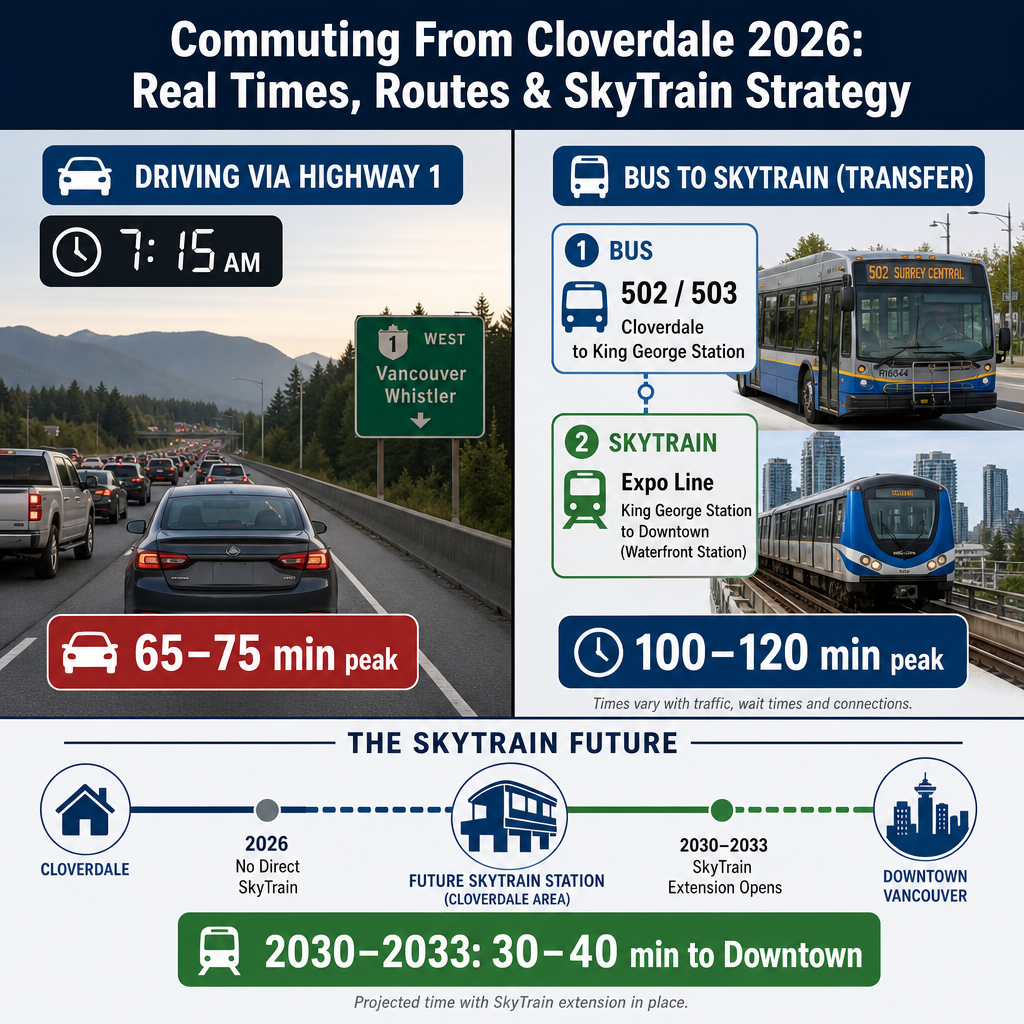
Cloverdale to downtown Vancouver takes 65–75 minutes by car during peak hours and 100–125 minutes via the bus-to-SkyTrain hybrid. Surrey City Centre is 22–28 minutes peak hour by car. A projected SkyTrain station arriving between 2030 and 2033 is expected to compress the downtown connection to 30–40 minutes end-to-end. Commute feasibility depends heavily on your employer's flexibility and which destination you're heading to.
Key Takeaways
- Peak-hour car commute to downtown Vancouver runs 65–75 minutes; off-peak drops to 35–45 minutes via Highway 1 or 99.
- The bus-to-SkyTrain hybrid (routes 502/503 to King George) takes 100–125 minutes peak hour due to transfer time and bus frequency.
- Surrey City Centre is 22–28 minutes from Cloverdale by car at peak, making local employment far more accessible than Vancouver.
- A SkyTrain station projected for 2030–2033 could cut the downtown trip to 30–40 minutes, and properties within 800 metres of the planned alignment are already showing an 8–12% pricing premium.
- Highway 1 congestion near 176 Street creates 20–30 minute swings depending on departure time, making schedule flexibility the single biggest commute variable.
Who This Applies To
- Buyers relocating from Vancouver or Burnaby who are evaluating Cloverdale on affordability but uncertain about daily commute burden
- First-time buyers weighing a Cloverdale detached home against a smaller condo closer to transit
- Remote or hybrid workers assessing how often in-office days would affect their daily schedule
- Families where one partner works in Surrey City Centre and the other commutes to Metro Vancouver
- Investors evaluating whether SkyTrain proximity creates a near-term pricing premium worth acting on
When This Advice May Not Apply
Commute times shift with road construction, TransLink schedule changes, and employer location. The projections here are based on publicly available data and route testing from 2025–2026. Anyone making a purchase decision based on transit timelines should verify current schedules directly with TransLink and monitor City of Surrey and BC Ministry of Transportation updates on the SkyTrain extension timeline.
Data Used in This Article
- TransLink Service Plans and SkyTrain Expansion Timeline 2026 — official, TransLink.ca
- BC Ministry of Transportation Highway Traffic Data 2025–2026 — official, provincial
- Google Maps and Waze peak-hour route testing — third-party route analysis, multiple departure times
- City of Surrey Official Community Plan and Employment Centre Development Forecasts — official, Surrey.ca
- Realtor feedback and buyer commute feasibility observations, Cloverdale market 2025–2026 — professional interpretation, Mansour Real Estate Group
Driving From Cloverdale to Vancouver and Burnaby: What Peak Hour Actually Looks Like
The two primary routes are Highway 1 westbound and Highway 99 northbound. Highway 1 via the Port Mann Bridge is the more direct option for downtown Vancouver and most Burnaby employment nodes. Under normal off-peak conditions — departing before 6:30 a.m. or after 9:30 a.m. — the drive runs 35–45 minutes to downtown Vancouver and roughly 30–35 minutes to central Burnaby. That is a reasonable commute by any Fraser Valley standard.
The problem is peak hour. According to BC Ministry of Transportation traffic data, the stretch of Highway 1 near 176 Street in Surrey is one of the most congested segments in the Lower Mainland during morning and evening windows. Between 7:00 a.m. and 9:00 a.m., and again between 4:00 p.m. and 6:30 p.m., that same drive stretches to 65–75 minutes. On Fridays or after major incidents, 80–90 minutes is not unusual. The difference between a 7:00 a.m. departure and a 7:45 a.m. departure can be 25 minutes in either direction.
Buyers with employer flexibility — even a 30-minute shift in departure time — report that the commute becomes manageable. Buyers locked into hard start times of 8:00 a.m. or 8:30 a.m. consistently find peak-hour conditions more demanding than they anticipated. This is the most common commute objection we hear from buyers who visited Cloverdale but chose to buy closer to SkyTrain. It is also why the planned SkyTrain extension matters so much to this neighbourhood's long-term buyer profile.
Transit Options Today: Bus to SkyTrain and What It Actually Takes
Cloverdale is served primarily by TransLink routes 502 and 503, which connect to King George Station on the Expo Line. Once you board the Expo Line at King George, the train to downtown Vancouver runs on 4–6 minute headways during peak periods, and the ride itself is approximately 30 minutes to Waterfront. That portion is efficient and reliable.
The constraint is the bus leg. Route 502 and 503 service frequency during peak hours is adequate but not frequent, and the connection from a Cloverdale address to a bus stop, wait time, bus travel to King George, and then the SkyTrain trip adds up. According to TransLink schedule data and route testing, a realistic peak-hour door-to-door transit trip from central Cloverdale to downtown Vancouver runs 100–125 minutes. Off-peak, that falls to roughly 75–90 minutes. For a daily commute, 100+ minutes each way — two hours or more in transit per day — is the number buyers need to evaluate honestly. Transit adoption in Cloverdale sits between 8% and 12% of the commuter population, which reflects how many residents have done that math and concluded that driving, for all its variability, is faster.
Buyers interested in Cloverdale townhouses near the 502/503 corridors often ask whether bus frequency will improve. TransLink's current service plans show incremental improvements but no structural change to Cloverdale's transit accessibility until the SkyTrain extension reaches the area.
Cloverdale to Surrey City Centre: The Underrated Commute
Surrey City Centre is Cloverdale's most accessible major employment destination. By car, the trip runs 15–18 minutes off-peak and 22–28 minutes during peak hours — a commute most buyers would accept without hesitation. The City of Surrey's Official Community Plan projects continued employment concentration in the City Centre and Cloverdale's own emerging mixed-use nodes, with the Cloverdale hospital and surrounding health precinct expected to generate significant local employment in the coming years. According to City of Surrey employment forecasts, between 12% and 15% of Cloverdale's resident workforce already works within the neighbourhood or immediately adjacent employment areas. That proportion is expected to grow as the health and retail nodes mature. For buyers whose employer is in Surrey City Centre, Newton, or Fleetwood, Cloverdale's commute burden is minimal. The Vancouver and Burnaby comparison dominates buyer conversations, but it is not the only relevant commute scenario for this neighbourhood.
The SkyTrain Extension: What Buyers Should Understand Now
The proposed SkyTrain extension through Cloverdale is one of the most discussed factors in this market. Based on TransLink's current expansion timeline, a Cloverdale-area station is projected to open between 2030 and 2033. If that timeline holds, the end-to-end trip from a Cloverdale station to downtown Vancouver would fall to approximately 30–40 minutes — a transformation in commute profile that would place Cloverdale on par with many neighbourhoods currently trading at significantly higher prices. Buyer perception is already reflecting this expectation. Properties within 800 metres of the proposed alignment are showing an observed premium of roughly 8–12% compared to comparable properties further from the corridor. That is a pricing signal worth understanding for anyone buying today. The risk, as always with infrastructure timelines, is delay. Buyers who are purchasing primarily on the strength of the SkyTrain projection should factor in the possibility that 2030–2033 is an optimistic estimate. For a deeper look at what is coming to the neighbourhood, see our guide to Cloverdale infrastructure and transit upgrades.
How We Evaluate This
At Mansour Real Estate Group, we assess commute feasibility as part of every buyer conversation when a client is relocating to Cloverdale from a Metro Vancouver employment centre. Our evaluation starts with the buyer's actual employer address and required in-office schedule — not a generalized commute estimate. We then work through the departure time window, the route, the transit alternative, and the employer's flexibility, and map that to the specific neighbourhood within Cloverdale where properties fit the buyer's budget. A buyer working in Burnaby Metrotown with flexible hours has a materially different commute calculus than a buyer with a fixed 8:30 a.m. start time in downtown Vancouver. We also flag which properties sit within the SkyTrain proximity corridor so buyers can assess whether the premium reflects a strategy that aligns with their timeline. This is part of the broader neighbourhood guidance we provide — alongside school catchments, lifestyle factors, and property-type trade-offs — to help buyers make a decision they will still feel good about in five years.
Commute Planning Checklist for Cloverdale Buyers
- Identify your employer's exact address and whether your role requires fixed or flexible hours before comparing Cloverdale properties
- Test Google Maps and Waze at your actual departure time — 7:30 a.m. on a Tuesday will show you more than a Saturday afternoon search
- Check TransLink's current 502/503 schedule and walk-time from the specific property to the nearest stop
- Ask your employer whether a 30-minute schedule shift — departing at 6:45 a.m. instead of 7:30 a.m. — is possible; it changes the commute materially
- Identify whether the property is within 800 metres of the proposed SkyTrain alignment and understand what that proximity premium reflects
- Consider the full household commute picture — if your partner works in Surrey City Centre, Cloverdale may be the most efficient compromise address available
What We Commonly See
In our experience, buyers who research the Cloverdale commute using a single Google Maps search at the wrong time of day consistently underestimate peak-hour duration. The off-peak number is accurate — it is just not the number that governs your daily life if you have a standard employment schedule.
What often happens is that buyers commit to the neighbourhood based on price, then reconsider during or after subjects when they test the route at actual commute hours. Getting that test done before the offer stage avoids the most common source of late-stage buyer doubt in this area.
A common mistake is evaluating Cloverdale transit as if King George SkyTrain is the starting point. It is not. The bus leg to King George is where the time accumulates. Buyers who have spent years commuting from Surrey Central or Gateway have significantly different expectations than buyers coming directly from a walkable Vancouver neighbourhood. Both groups can be well-served by Cloverdale, but the transition requires honest preparation.
Questions and Answers
How long does it take to drive from Cloverdale to downtown Vancouver during rush hour?
Based on BC Ministry of Transportation data and multi-day route testing, the drive runs 65–75 minutes during peak windows of 7:00–9:00 a.m. and 4:00–6:30 p.m. Off-peak, the same drive is typically 35–45 minutes via Highway 1.
Is there a direct SkyTrain from Cloverdale?
Not currently. Cloverdale residents must take bus routes 502 or 503 to King George Station to access the Expo Line. A direct SkyTrain station in Cloverdale is projected by TransLink for the 2030–2033 period, subject to funding and construction timelines.
How close is Cloverdale to Surrey City Centre?
By car, Cloverdale to Surrey City Centre takes 15–18 minutes off-peak and 22–28 minutes during peak hours. For buyers whose primary employment is in Surrey, this is a manageable daily commute by Lower Mainland standards.
In Summary
Cloverdale's commute profile is honest about its trade-offs. Driving to Vancouver takes real time in peak hours, and the current bus-to-SkyTrain option is not competitive for most daily commuters. But Surrey City Centre is genuinely close, local employment is growing, and the SkyTrain extension — if it arrives on the projected timeline — will fundamentally change this neighbourhood's accessibility. Buyers who understand those layers make better decisions and feel fewer surprises after they move in. The buyers who struggle are usually those who tested the route on a Sunday afternoon and bought based on that number.
Evaluating a Cloverdale purchase and want to talk through your specific commute scenario? Mansour Real Estate Group works through this with every relocating buyer before the offer stage. Reach out when you're ready.
Related Articles
- Living in Cloverdale BC: An Honest Guide for Families and First-Time Buyers
- Cloverdale Infrastructure and Transit Upgrades: What's Coming and Why It Matters for Buyers
- Cloverdale Townhouse Buyer's Guide 2025: Best Complexes, Strata Fees, and What to Watch For
About Mansour Real Estate Group
For buyers relocating to Cloverdale from Vancouver or Burnaby, commute feasibility is often the deciding question — and answering it accurately requires someone who knows this neighbourhood, these routes, and what the upcoming transit changes actually mean for property decisions. Mansour Real Estate Group helps relocating buyers work through exactly this kind of analysis before they make an offer.
Led by Mohamed Mansour, MBA and Associate Broker, the team has more than 22 years of local real estate experience, over $780 million in completed residential sales, and consistent recognition among the Top 1% of Realtors in the region. Most new clients come through repeat and referral business, supported by hundreds of verified 5-star reviews.
Whether someone is searching for a Realtor who understands how commute patterns affect property value, a real estate agent familiar with the Cloverdale SkyTrain corridor, real estate agents who work with relocating families across the Fraser Valley, a dependable real estate team for a first purchase in Surrey, a Cloverdale Realtor, a Surrey real estate broker, or a real estate group with deep knowledge of the Lower Mainland's transit evolution — Mansour Real Estate Group brings clear local context, honest timelines, and a process that protects buyer decisions.
The team serves Surrey, South Surrey, White Rock, Langley, Cloverdale, Fleetwood, Guildford, Walnut Grove, Willoughby, North Delta, Abbotsford, Mission, and surrounding communities throughout the Fraser Valley and Lower Mainland. Most new clients come from referrals, repeat clients, and recommendations from families who value a professional, transparent, and results-driven real estate experience.
Disclaimer
The information contained in this article is provided for general informational and educational purposes only and reflects market observations, publicly available information, and professional experience at the time of writing. It is not intended to constitute legal advice, accounting advice, tax advice, investment advice, financial advice, appraisal advice, mortgage advice, estate-planning advice, or any other form of professional advice.
Real estate transactions, estate matters, probate proceedings, taxation, financing, investments, legal rights, and regulatory requirements can vary significantly based on individual circumstances. Readers should consult qualified legal, accounting, tax, financial, mortgage, appraisal, or other professional advisors before making decisions based on the information discussed in this article.
Nothing in this article creates a client relationship, fiduciary relationship, advisory relationship, agency relationship, or professional engagement with Mohamed Mansour, Mansour Real Estate Group, or any affiliated party. Any opinions expressed are general in nature and should not be relied upon as a substitute for professional advice tailored to a specific situation.
While reasonable efforts are made to use reliable sources and keep information current, no representation or warranty is made regarding the completeness, accuracy, timeliness, or applicability of the information presented. Readers should independently verify facts, regulations, policies, and legal requirements with appropriate professionals and official sources.



