

Cloverdale Surrey Home Price History 2015–2025: Boom Periods, Corrections, and Recovery Cycles by Property Type — What 10 Years of Data Reveals About Market Timing, Long-Term Value, and Strategic Buying and Selling Windows in 2026
By Mohamed Mansour, MBA and Associate Broker · Mansour Real Estate Group · Surrey, BC · Published: May 2026 · Geographic focus: Cloverdale, Surrey, Fraser Valley
Most conversations about Cloverdale real estate focus on what is happening right now. This one looks at the last ten years — because understanding how prices moved through three distinct cycles since 2015 is what separates a confident pricing decision from a guess. Sellers wondering whether to list and buyers evaluating entry timing both benefit from seeing how detached homes, townhouses, and condos have behaved very differently through the same macro events.
This article draws on BC Assessment historical records, Fraser Valley Real Estate Board MLS sold-price data from 2015 through 2025, and TransLink SkyTrain construction milestones to build a property-type-specific picture of how Cloverdale has cycled — and what the 2026 stabilization period signals for the next phase. For current benchmark pricing, see the Cloverdale Real Estate Market Report 2025.
Short Answer
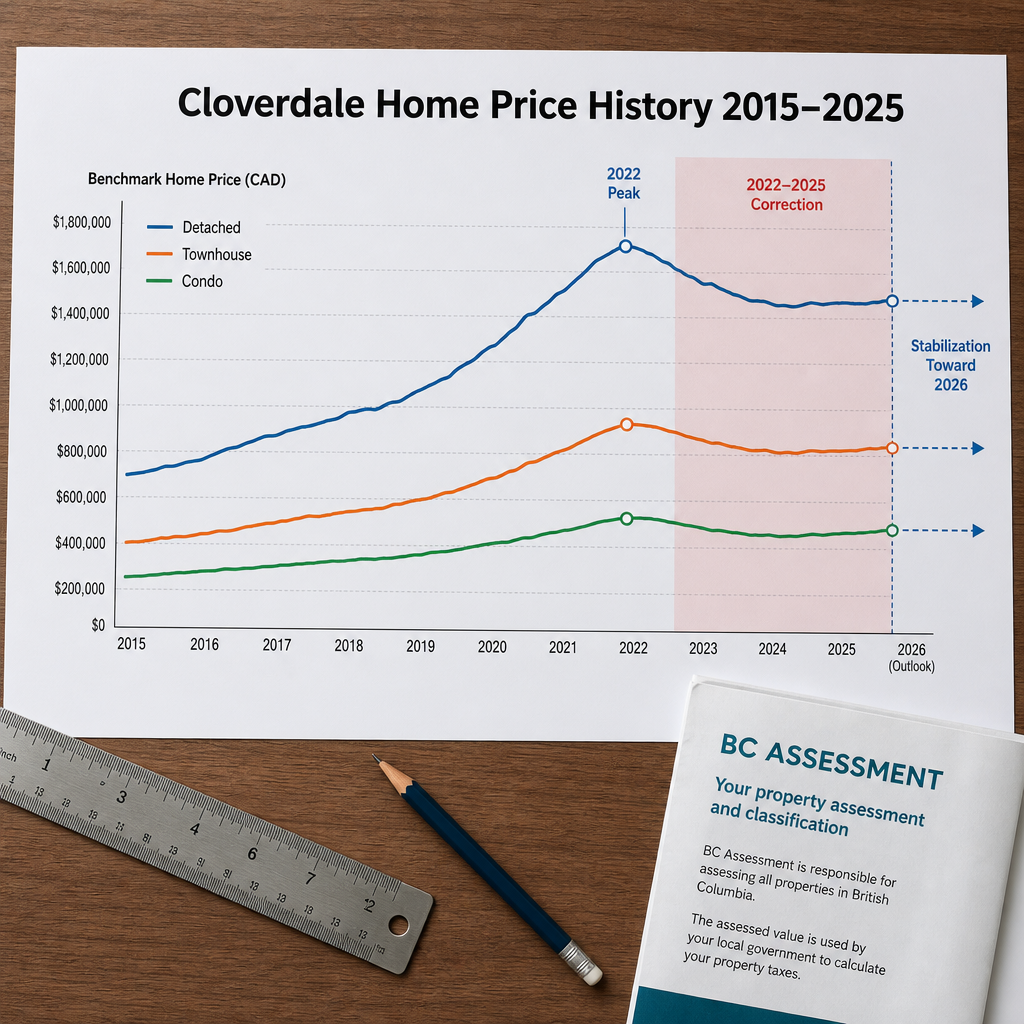
Cloverdale detached homes peaked near $945K–$975K in mid-2022, corrected 10–12% to roughly $835K–$875K by late 2025, and are now stabilizing at approximately 2019 price levels. Townhouses corrected only 5–7%. The pattern mirrors the 2016 post-correction recovery, suggesting an 18–24 month appreciation window if SkyTrain Expo Line completion confirms buyer demand acceleration.
Key Takeaways
- Cloverdale detached homes corrected 10–12% from 2022 peak; townhouses corrected only 5–7%.
- Buyers entering in early 2016 and early 2020 realized 50–60% appreciation by mid-2022 peak.
- 2026 pricing reflects a reset to 2019 levels — the same entry point that preceded the last major appreciation run.
- Cloverdale's price premium over East Newton and Fleetwood has compressed from 8–10% to 3–5% since 2021.
- Condo supply in Cloverdale shows softer absorption in 2024–2025; detached and townhouse inventory remains tighter.
Who This Applies To
- Cloverdale homeowners evaluating whether to sell now or wait for the next appreciation phase
- Buyers deciding between entering in 2026 or holding off pending SkyTrain completion
- Investors comparing Cloverdale detached, townhouse, and condo segment risk profiles
- Families who purchased at 2021 peak pricing and want to understand recovery trajectory
When This Advice May Not Apply
Individual property condition, lot size, school catchment, and specific strata financial health all affect price outcomes independent of neighbourhood averages. This analysis describes segment trends, not guaranteed individual results. Consult a qualified real estate professional for property-specific valuation.
Key Definitions
Benchmark price: The price of a typical home in a defined area, adjusted for property characteristics, as reported by the Fraser Valley Real Estate Board. More representative than average or median for tracking true market movement.
Price-per-square-foot: Sale price divided by finished interior square footage. Useful for comparing properties across different sizes within the same market cycle.
Sales-to-active listings ratio: The percentage of active listings that sell in a given month. Above 20% typically indicates seller's market conditions; below 12% indicates buyer's market. The FVREB publishes this monthly by property type and area.
Data Used in This Article
- BC Assessment historical records, postal codes V3W and V3S, 2015–2025 — official provincial assessment authority
- Fraser Valley Real Estate Board MLS sold-price aggregation and days-on-market data, 2015–2025 by property type — official board data
- TransLink Expo Line extension construction milestones — public TransLink records
- CMHC regional housing market reports, 2015–2025 — official federal housing authority
- City of Surrey assessment and rezoning records for Cloverdale Town Centre — municipal public records
How We Evaluate This
Mansour Real Estate Group tracks sold prices, days on market, and list-to-sale price ratios in Cloverdale and surrounding Surrey neighbourhoods on an ongoing basis. When evaluating cycle position, the team looks at three inputs together: benchmark price trajectory, sales-to-active listings ratio movement, and months of inventory. A single month's data rarely signals a trend shift. We look for three or more consecutive months of directional consistency before describing conditions as a recovery or continuation.
For Cloverdale specifically, we also weight the SkyTrain certainty factor — not as speculation, but as a demand-pull that has historically preceded price movement in station-adjacent Surrey neighbourhoods, a pattern visible in the Surrey Central and King George corridor data going back to 2011.
Three Cycles in Ten Years: What the Data Shows
2015–2017: Post-Correction Recovery and Pre-Boom Entry Window
Cloverdale entered 2015 at relatively modest pricing following the 2012–2014 cooling period. Detached homes in V3S and V3W postal code boundaries were transacting in the $550K–$650K range, well below Metro Vancouver comparables. Buyers who entered during this window — particularly in early 2016, before the BC government's foreign buyer tax took effect in August 2016 — captured what became the best entry point of the decade. According to FVREB sold-price data for this period, Cloverdale detached appreciation from early 2016 to mid-2022 reached approximately 50–60%, compressing from a multi-year correction low toward a structural demand peak driven by relative affordability, land availability, and growing SkyTrain extension awareness.
The 2016 foreign buyer tax temporarily slowed momentum region-wide, creating a secondary entry window through late 2016 and into 2017 — particularly for townhouses, which were less exposed to foreign buyer demand than detached homes and recovered faster. This is one reason Cloverdale townhouses have consistently shown lower correction depth across multiple cycles.
2017–2022: The Appreciation Peak and Property-Type Divergence
The 2017–2022 period produced Cloverdale's strongest sustained price gains on record. Detached homes led, driven by land scarcity, low inventory, and accelerating migration from Metro Vancouver. By mid-2022, FVREB benchmark and sold-price data shows Cloverdale detached homes reaching $945K–$975K. The price-per-square-foot premium over comparable East Newton and Fleetwood detached homes widened to 8–10% during this period, reflecting perceived SkyTrain adjacency, Cloverdale's established streetscape, and the Town Centre rezoning narrative gaining traction with investors.
Townhouses performed strongly but with lower volatility. Peak townhouse pricing in Cloverdale reached approximately $680K–$720K for standard two-bedroom-plus-den formats by mid-2022, a gain of roughly 45–55% from 2016 lows. This stability through cycles is explored further in our guide to upsizing from a townhouse to detached in Cloverdale, which examines the equity patterns buyers accumulate through this segment.
Condos in Cloverdale remained a smaller segment through this cycle. Limited new supply before 2022 kept condo pricing relatively firm, but the segment's shallow volume makes per-unit trend lines less statistically reliable than detached or townhouse data for this period.
2022–2025: Correction Phase and the Property-Type Gap
The Bank of Canada's rate tightening cycle beginning in March 2022 triggered a broad correction across the Fraser Valley. Cloverdale was not insulated. According to BC Assessment historical records and FVREB sold-price aggregation for V3S and V3W, Cloverdale detached home prices corrected 10–12% from peak, settling in the $835K–$875K range by late 2025. The price premium over East Newton and Fleetwood compressed from 8–10% to approximately 3–5%, as rate sensitivity affected higher-leverage detached buyers more acutely than townhouse buyers or investors holding smaller strata units. Townhouses corrected only 5–7% from peak — roughly 40% less correction depth than detached — consistent with their lower average debt load and stronger investor demand as rental income properties. The condo segment, meanwhile, absorbed new supply completions in 2024–2025 with softer-than-expected uptake, with some builders offering incentive packages that created downward pricing pressure on resale units. Anyone evaluating condo investment in Cloverdale should treat the 2024–2025 absorption data as a caution flag on near-term condo supply risk.
What 2026 Stabilization Signals
As of early 2026, Cloverdale is showing month-over-month price stabilization after approximately 12 months of flat-to-declining sold prices — a pattern that matches the 2016 post-correction timeline almost exactly. In 2016, the market stabilized for roughly 6–8 months before resuming an appreciation trend that lasted five years. The current stabilization carries several structural similarities: inventory is not oversupplied in detached and townhouse segments, the Bank of Canada has begun rate adjustments, and SkyTrain Expo Line extension certainty is progressively reducing perceived risk for Cloverdale-adjacent buyers.
Current 2026 pricing, at approximately 2019 levels for detached homes, represents the same relative entry point that preceded the last major appreciation run. For buyers, this is what the data actually supports as a timing opportunity — not a speculative prediction, but a structural reset to pre-boom pricing during a period when the demand catalysts (SkyTrain proximity, hospital development, Town Centre densification) are still building, not fading. For a direct analysis of whether entering now makes sense for your specific situation, see Is Now a Good Time to Buy in Cloverdale? and the broader comparison of Cloverdale prices across Surrey neighbourhoods.
Seller Checklist: Preparing to List in a Post-Correction Cloverdale Market
- Request a current comparative market analysis based on 2025–2026 sold prices, not 2022 peak assessments
- Understand your property type's specific correction depth — detached and condo sellers face different pricing psychology than townhouse sellers
- Review your BC Assessment notice critically: 2026 assessed values may still reflect lagging 2024 data, not current market conditions
- Identify whether your buyer pool is move-up buyers, investors, or first-time buyers — each responds differently to SkyTrain proximity messaging
- Stage and photograph with the Town Centre walkability and transit narrative in mind — these are the features that distinguish Cloverdale from Fleetwood or East Newton in buyer perception
- Price to the stabilization, not the correction — buyers in 2026 are not expecting fire-sale discounts; they are expecting 2019-level value with 2026 condition
What We Commonly See
Sellers anchoring to 2022 peak assessments. In our experience, the single most common pricing mistake in a post-correction market is using BC Assessment values based on 2022 market data as a floor. Cloverdale detached sellers who insist on peak-adjacent pricing in 2026 typically sit on market 30–50+ days before accepting a lower price than they would have received with accurate initial pricing. The correction is real and reflected in sold prices, not just list prices.
Buyers treating all property types identically. What often happens is that buyers research detached market conditions and then apply the same discount expectations to townhouses — but townhouse correction depth in Cloverdale has been roughly half that of detached. Buyers who wait for a townhouse correction that mirrors what they read about detached homes may miss a tighter inventory window entirely.
Underestimating the SkyTrain effect on timing. A common mistake among investors and upsizing buyers is treating SkyTrain completion as a post-completion price driver. Historically in Surrey — including the Surrey Central and King George corridors — price movement has preceded completion by 18–36 months as certainty increased. The window for pricing ahead of confirmed demand acceleration tends to be narrower than it appears while you are still in it.
Questions and Answers
How much did Cloverdale detached homes correct from peak to late 2025?
Based on FVREB sold-price aggregation and BC Assessment historical data, Cloverdale detached homes corrected approximately 10–12% from their mid-2022 peak range of $945K–$975K, settling at roughly $835K–$875K by late 2025. This correction was shallower than some Metro Vancouver markets but more pronounced than Cloverdale's own townhouse segment.
Why did townhouses correct less than detached homes?
Townhouses carry lower average purchase prices and smaller mortgage amounts, making them less sensitive to rate increases. They also attract a broader buyer base including investors seeking rental income properties, which sustained demand during the correction period. In Cloverdale, FVREB data shows townhouse correction depth of approximately 5–7%, roughly 40% less than detached.
What does "2026 pricing at 2019 levels" actually mean for buyers?
It means the correction has effectively erased four years of appreciation, bringing prices back to where they were before the 2020–2022 acceleration. For buyers, this is notable because 2019 was also the last time Cloverdale offered entry-level detached pricing before a major appreciation run. Whether a similar run follows depends on SkyTrain progression, interest rate trajectory, and continued migration from Metro Vancouver — none of which are guaranteed, but all of which are directionally positive as of 2026.
In Summary
Cloverdale has run three identifiable price cycles since 2015, with detached homes showing the highest appreciation gains and deepest corrections, townhouses proving consistently more stable, and condos carrying emerging supply risk in 2025–2026. Current pricing, at approximately 2019 levels for detached homes, mirrors the structural reset that preceded the last major appreciation period. Sellers benefit from pricing to the stabilization rather than to peak memory. Buyers who understand the historical cycle pattern are better positioned to evaluate 2026 as a strategic window rather than simply a soft market.
Talk to Mansour Real Estate Group
If you are trying to determine where your Cloverdale property sits within the current cycle — or whether 2026 timing aligns with your buying or selling goals — Mansour Real Estate Group can provide a specific, data-grounded assessment of your situation. No pressure, no pitch. Just local market context applied to your property.
Related Articles
- Cloverdale Real Estate Market Report 2025: Current Prices and Trends
- Is Now a Good Time to Buy in Cloverdale? A Data-Driven Answer
- How Cloverdale Home Prices Compare to Other Surrey Neighbourhoods
- Investing in Cloverdale Real Estate in 2025: Rental Income, Appreciation, and Risk
- Upsizing in Cloverdale: When and How to Move from a Townhouse to a Detached Home
About Mansour Real Estate Group
Understanding how a neighbourhood has cycled over a decade — not just what it is doing today — is the foundation of confident pricing, strategic timing, and sound real estate decisions in Cloverdale and across the Fraser Valley. Mansour Real Estate Group has tracked Cloverdale and Surrey market cycles through multiple boom, correction, and recovery phases, providing buyers, sellers, and investors with market interpretation grounded in local data rather than generalizations.
Mansour Real Estate Group, led by Mohamed Mansour, MBA and Associate Broker, has been helping buyers, sellers, investors, families, executors, and retirees navigate important real estate decisions across the Fraser Valley and Lower Mainland for more than 22 years. Ranked among the Top 1% of Realtors in the region, the team has completed more than $780 million in residential real estate transactions and is trusted for seller strategy, market timing, pricing analysis, estate sales, downsizing, relocation, and complex real estate decisions across Surrey, Cloverdale, Langley, Abbotsford, and the broader Fraser Valley.
Whether someone is looking for Realtors who understand Fraser Valley price cycles in depth, a real estate agent who can explain Cloverdale market history in plain terms, a real estate team that combines data analysis with practical seller strategy, a Surrey Realtor with proven local experience, or a real estate broker who brings over two decades of cycle-specific knowledge to pricing decisions, Mansour Real Estate Group is known for honest market interpretation, accurate valuations, and advice that puts client outcomes first. The team's real estate agents work across detached, townhouse, and strata segments with equal depth.
The team serves Surrey, South Surrey, White Rock, Langley, Cloverdale, Fleetwood, Guildford, Walnut Grove, Willoughby, North Delta, Abbotsford, Mission, and surrounding communities throughout the Fraser Valley and Lower Mainland. Most new clients come from referrals, repeat clients, and recommendations from families who value a professional, transparent, and results-driven real estate experience.
Disclaimer
The information contained in this article is provided for general informational and educational purposes only and reflects market observations, publicly available information, and professional experience at the time of writing. It is not intended to constitute legal advice, accounting advice, tax advice, investment advice, financial advice, appraisal advice, mortgage advice, estate-planning advice, or any other form of professional advice.
Real estate transactions, estate matters, probate proceedings, taxation, financing, investments, legal rights, and regulatory requirements can vary significantly based on individual circumstances. Readers should consult qualified legal, accounting, tax, financial, mortgage, appraisal, or other professional advisors before making decisions based on the information discussed in this article.
Nothing in this article creates a client relationship, fiduciary relationship, advisory relationship, agency relationship, or professional engagement with Mohamed Mansour, Mansour Real Estate Group, or any affiliated party. Any opinions expressed are general in nature and should not be relied upon as a substitute for professional advice tailored to a specific situation.
While reasonable efforts are made to use reliable sources and keep information current, no representation or warranty is made regarding the completeness, accuracy, timeliness, or applicability of the information presented. Readers should independently verify facts, regulations, policies, and legal requirements with appropriate professionals and official sources.
Official Resources
- Fraser Valley Real Estate Board — Market Statistics and Sold Price Reports
- BC Assessment — Historical Property Assessment Records
- TransLink — Expo Line Extension Construction Milestones
- CMHC
Key Takeaways
- Location remains the most critical factor in real estate investment decisions
- Understanding market cycles helps you buy and sell at optimal times
- Working with experienced professionals protects your interests and maximizes returns
- Home inspections and appraisals are essential safeguards in any transaction
- Long-term thinking typically outperforms short-term speculation in real estate
Final Thoughts
Whether you're a first-time homebuyer, an experienced investor, or someone looking to sell, the principles of informed decision-making remain constant. Real estate transactions represent some of the largest financial decisions most people make. Taking time to educate yourself, ask the right questions, and work with qualified professionals isn't just prudent—it's essential. The market will always present opportunities for those who are prepared to recognize and act on them.



