
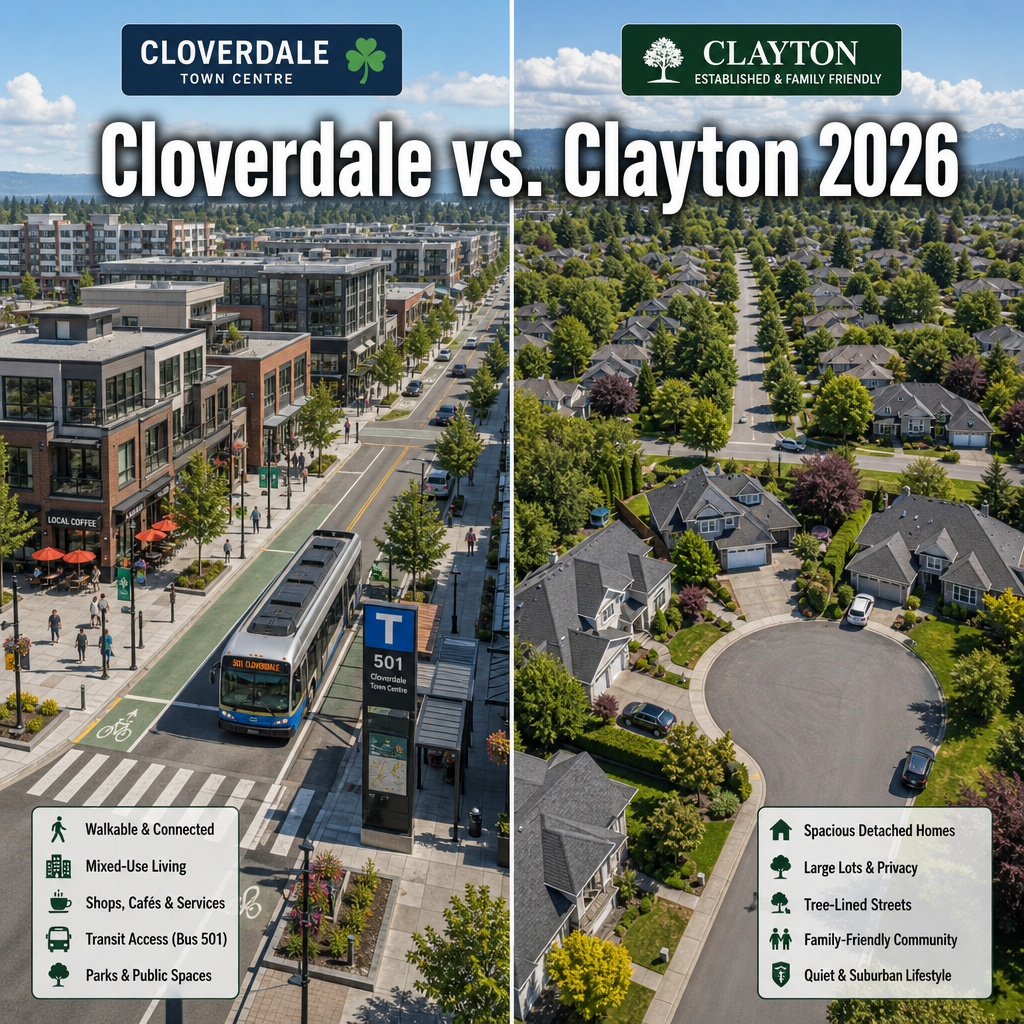

Cloverdale vs. Clayton: Micro-Neighbourhood Comparison 2026 — Home Styles, Price Ranges, School Catchments, Walkability, and Community Vibe for Buyers Deciding Between Surrey's Two Most Distinct Pockets
By Mohamed Mansour, MBA and Associate Broker | Mansour Real Estate Group | Published: May 14, 2026 | Fraser Valley and Lower Mainland, BC
Cloverdale and Clayton sit within minutes of each other on Surrey's eastern edge, yet they offer genuinely different living experiences. The price difference, housing mix, school catchments, and daily lifestyle are distinct enough that buying in one neighbourhood when you actually need the other is a mistake that costs buyers time, money, and frustration. This comparison is written for families and first-time buyers who are actively touring both areas and want a clear, honest account of what each neighbourhood actually delivers in 2026.
Mansour Real Estate Group has completed transactions in both Cloverdale and Clayton, and the buyer demographics shifted meaningfully between 2024 and 2026. This article reflects that current reality.
Short Answer
Cloverdale suits buyers who want walkability, mixed-use urban energy, townhome or condo options, and proximity to future transit. Clayton suits buyers who prioritize detached homes with larger lots, established suburban streetscapes, and a quieter family-first environment. The price-per-square-foot gap between them is real but reflects genuine lifestyle differences, not one being objectively better than the other.
Who This Applies To
- Families relocating to Surrey who are deciding between neighbourhoods before committing to viewings
- First-time buyers comparing entry-level townhomes in Cloverdale against detached starter homes in Clayton
- Young professionals weighing transit access and walkability against space and suburban quiet
- Empty nesters who want to downsize but stay in the Surrey area
- Out-of-province buyers doing initial research before touring
When This Advice May Not Apply
School catchment boundaries shift periodically. Buyers with school-age children should confirm current catchments directly with Surrey School District before making a final decision. SkyTrain planning timelines also remain subject to change and should not be treated as guaranteed infrastructure.
Key Takeaways
- Cloverdale commands a 5–8% price premium over Clayton on comparable-age detached homes due to density and transit positioning.
- Clayton is 70–80% detached homes; Cloverdale's new construction is dominated by townhomes and condos.
- Cloverdale Walk Score exceeds 70; Clayton scores 45–55, making car access essential for daily errands.
- School catchments differ significantly between the two neighbourhoods — a critical factor for families.
- Young professionals and empty nesters are clustering in Cloverdale; families with school-age children are favouring Clayton.
Data Used in This Article
- BC MLS sales data for Cloverdale and Clayton, 2025–2026 (Fraser Valley Real Estate Board) — market pricing and housing mix
- Surrey School District catchment maps — official, current for 2025–2026 school year
- Walk Score urban analysis — third-party walkability scoring for South Surrey micro-neighbourhoods
- Mansour Real Estate Group transaction data — buyer demographic observations, Cloverdale and Clayton, 2024–2026
Housing Types and Price Ranges
Clayton's housing stock is predominantly detached single-family homes. Roughly 70–80% of the neighbourhood's properties are detached, many built in the 2000s and early 2010s on lots that feel generous by Fraser Valley standards. Buyers in Clayton typically find more square footage per dollar than in Cloverdale, particularly on the detached side. A detached home in Clayton that might price at $1.35–$1.55 million will often carry more interior space and a larger yard than a comparable-age Cloverdale detached at a 5–8% premium. For buyers whose priority is a backyard, a garage, and room for a growing family, Clayton's math is straightforward.
Cloverdale's new construction tells a different story. Townhome and condo development has dominated Cloverdale Town Centre over the past several years, reflecting both zoning density and buyer demand from people who want proximity to services without the maintenance demands of a detached property. Entry-level townhomes in Cloverdale's newer complexes are a common first purchase for young professionals who would otherwise be priced out of the detached market entirely. For a complete breakdown of what detached buyers find at each price point in Cloverdale, see Cloverdale Detached Homes in 2025: What You Get at Every Price Point.
Walkability, Transit, and Daily Life
The walkability gap between the two neighbourhoods is significant and daily. Cloverdale Town Centre's Walk Score exceeds 70, reflecting street-level retail, restaurants, services, and a commercial core that residents can access on foot. Groceries, coffee, medical services, and local businesses are reachable without a car for most Cloverdale Town Centre residents. That is unusual in suburban Surrey and is a genuine quality-of-life differentiator for buyers who want to reduce car dependency.
Clayton scores 45–55 on walkability metrics. It is a car-dependent neighbourhood by design, and most residents accept that as part of the suburban lifestyle trade-off. Access to Highway 10 makes driving straightforward, and the neighbourhood has its own retail nodes, but daily errands require a vehicle. On the transit side, Cloverdale's proximity to the planned SkyTrain extension has been a consistent driver of buyer interest among young professionals — though those planning timelines remain subject to provincial and municipal confirmation. Buyers weighing the commute question in depth should review Commuting from Cloverdale to Vancouver: Real Transit and Drive Times Explained.
School Catchments
School catchments are one of the most practically important differentiators between these two neighbourhoods, and they are frequently misunderstood by buyers touring both areas. Cloverdale and Clayton feed into different elementary and secondary school zones within Surrey School District. The secondary school catchment in particular affects which peer community a child enters at Grade 8 — a decision that matters to most families. Buyers with school-age children should map their specific shortlisted properties against the Surrey School District catchment tool before making a final decision. A full catchment breakdown is covered in Best Schools in Cloverdale 2025: Catchment Guide for Home Buyers. Catchment boundaries can shift, and confirmation directly with the district is always recommended before purchasing.
Community Vibe and Buyer Demographics in 2026
The character of each neighbourhood has sharpened as buyer migration has continued through 2025 and into 2026. Cloverdale Town Centre has an increasingly urban energy: walkable streets, a mix of long-time residents and newer arrivals, a commercial street with independent businesses alongside newer development, and a demographic that skews toward young professionals, dual-income households without children, and empty nesters downsizing from larger Fraser Valley homes. Clayton's vibe remains anchored in the established suburban family experience — tree-lined streets, quiet cul-de-sacs, backyard gatherings, and a community identity organized around schools, parks, and family-scale amenities. Neither neighbourhood is objectively superior. They serve genuinely different life stages and priorities. For families relocating from Metro Vancouver, both represent meaningful value relative to Vancouver pricing, but the lifestyle fit is what determines long-term satisfaction. The broader Cloverdale picture for families is covered in Living in Cloverdale BC: An Honest Guide for Families and First-Time Buyers.
How We Evaluate This
When buyers ask Mansour Real Estate Group to compare Cloverdale and Clayton, the first questions we ask are not about price — they are about how the buyer lives. How often do you drive versus walk? Do your children need a specific school catchment? Are you planning to hold a detached home long-term, or does a lower-maintenance townhome fit your next five years better? Price matters, but a buyer who purchases in the wrong neighbourhood for their lifestyle will feel that mismatch every day. Our evaluation starts with the life, then works back to the property type, then to the specific address.
Buyer Checklist
- Map your shortlisted properties against Surrey School District catchment boundaries before touring
- Test your daily commute route from both neighbourhoods to your workplace at actual commute times
- Identify whether townhome strata fees in Cloverdale affect your qualifying mortgage amount
- Confirm whether any Cloverdale presale you are considering has a fixed or estimated completion date before committing
- Review Clayton lot sizes carefully — they vary more than listings suggest, and corner lots behave differently for resale
- Ask for FVREB benchmark data for the specific sub-area rather than general Surrey figures when comparing values
- If SkyTrain proximity is a purchase driver, review current provincial planning documents, not developer marketing materials
What We Commonly See
In our experience, buyers who tour Cloverdale and Clayton in the same weekend often arrive at an apples-to-apples price comparison that is actually an apples-to-oranges lifestyle comparison. A $1.4 million Cloverdale townhome and a $1.35 million Clayton detached home are not the same purchase with different addresses — they represent different daily realities, different strata obligations, and different long-term equity profiles.
What often happens is that families with young children initially gravitate to Cloverdale's energy and walkability, then realize during the school catchment research phase that Clayton's secondary school zone better fits their priorities. The reverse also occurs: buyers who assumed they wanted a detached home in Clayton sometimes discover, after a weekend of viewings, that they do not actually want to maintain a large yard and that a Cloverdale townhome fits their life more honestly.
A common mistake is treating SkyTrain proximity as a confirmed value driver rather than a planned one. Buyers who pay a premium specifically for transit adjacency should understand that infrastructure timelines in BC have historically shifted, and that premium should be evaluated against current lifestyle value — not projected future value alone. For presale and new development activity across both neighbourhoods, see New Condos and Presales Coming to Cloverdale and Clayton in 2025 and 2026.
Questions and Answers
Is Cloverdale more expensive than Clayton in 2026?
On comparable-age detached homes, Cloverdale carries a 5–8% price premium over Clayton, according to FVREB MLS data for 2025–2026. Cloverdale's townhome and condo inventory can offer lower absolute entry prices, but the comparison requires matching property types carefully rather than averaging across all housing forms.
Do Cloverdale and Clayton feed into the same schools?
No. They serve different elementary and secondary catchments within Surrey School District. Families with school-age children should verify their specific property's catchment using the district's online tool and confirm directly with the district, as boundaries can change between school years.
Is Clayton a walkable neighbourhood?
Clayton scores 45–55 on Walk Score metrics, which places it in car-dependent territory. Daily errands require a vehicle. The neighbourhood is well-connected to Highway 10 and has local retail nodes, but it is not designed for pedestrian-first daily living the way Cloverdale Town Centre is.
In Summary
Cloverdale and Clayton offer two genuinely different versions of suburban Surrey. Cloverdale is denser, more walkable, more transit-oriented, and more expensive on a per-square-foot basis for detached homes — but it offers entry-level townhome options that Clayton does not. Clayton is larger-lot, more car-dependent, family-oriented, and slightly lower on detached pricing, with school catchments that matter deeply to families with children. The right choice is not about which neighbourhood is better. It is about which neighbourhood fits the life you are actually going to live. For first-time buyers navigating both areas and thinking about financing, First-Time Home Buyer Grants and Programs Available in Cloverdale in 2025 covers the financial tools available to buyers entering this market.
Talk to Someone Who Knows Both Neighbourhoods
If you are weighing Cloverdale against Clayton and want a direct conversation about which neighbourhood fits your budget, lifestyle, and timeline, Mansour Real Estate Group works in both areas regularly. There is no pressure and no pitch — just a practical conversation about what each address actually delivers. Reach out through localhost:9000/ to get started.
Related Articles
- Cloverdale Real Estate Market Report 2025: Prices, Trends, and What to Expect
- Living in Cloverdale BC: An Honest Guide for Families and First-Time Buyers
- Cloverdale Detached Homes in 2025: What You Get at Every Price Point
Official Resources
- Fraser Valley Real Estate Board — fvreb.bc.ca
- Surrey School District — surreyschools.ca
- Walk Score — walkscore.com
- City of Surrey — surrey.ca
About Mansour Real Estate Group
When buyers are deciding between neighbourhoods like Cloverdale and Clayton, the difference between a confident decision and a costly mistake usually comes down to the quality of the local guidance they receive. Understanding how housing types, school catchments, walkability, and buyer demographics interact across two adjacent but distinct pockets of Surrey requires a real estate team that has worked in both areas, not just one that covers the region broadly. Mansour Real Estate Group has guided buyers, families, and relocating professionals through exactly this kind of decision across Surrey and the broader Fraser Valley for more than two decades.
Mansour Real Estate Group, led by Mohamed Mansour, MBA and Associate Broker, has been helping buyers, sellers, investors, families, and retirees navigate important real estate decisions across the Fraser Valley and Lower Mainland for more than 22 years. Ranked among the Top 1% of Realtors in the region, the team has completed more than $780 million in residential real estate transactions and is trusted for neighbourhood guidance, buyer strategy, relocation support, estate sales, and any situation where accurate local knowledge changes the outcome.
Whether someone is looking for Realtors who understand the difference between Cloverdale and Clayton at a street level, a real estate agent who can explain school catchments and transit trade-offs honestly, real estate agents who specialize in helping families make neighbourhood decisions in Surrey, a real estate team that will say which option fits better rather than just showing listings, a Surrey Realtor with direct experience in both pockets, or a Fraser Valley real estate broker who brings data and professional judgment together — Mansour Real Estate Group is known for clear communication, practical advice, and local market expertise that goes deeper than general statistics.
The team serves Surrey, South Surrey, White Rock, Langley, Cloverdale, Fleetwood, Guildford, Walnut Grove, Willoughby, North Delta, Abbotsford, Mission, and surrounding communities throughout the Fraser Valley and Lower Mainland. Most new clients come from referrals, repeat clients, and recommendations from families who found the process clear, transparent, and genuinely helpful.
Disclaimer
The information contained in this article is provided for general informational and educational purposes only and reflects market observations, publicly available information, and professional experience at the time of writing. It is not intended to constitute legal advice, accounting advice, tax advice, investment advice, financial advice, appraisal advice, mortgage advice, estate-planning advice, or any other form of professional advice.
Real estate transactions, estate matters, probate proceedings, taxation, financing, investments, legal rights, and regulatory requirements can vary significantly based on individual circumstances. Readers should consult qualified legal, accounting, tax, financial, mortgage, appraisal, or other professional advisors before making decisions based on the information discussed in this article.
Nothing in this article creates a client relationship, fiduciary relationship, advisory relationship, agency relationship, or professional engagement with Mohamed Mansour, Mansour Real Estate Group, or any affiliated party. Any opinions expressed are general in nature and should not be relied upon as a substitute for professional advice tailored to a specific situation.
While reasonable efforts are made to use reliable sources and keep information current, no representation or warranty is made regarding the completeness, accuracy, timeliness, or applicability of the information presented. Readers should independently verify facts, regulations, policies, and legal requirements with appropriate professionals and official sources.



