
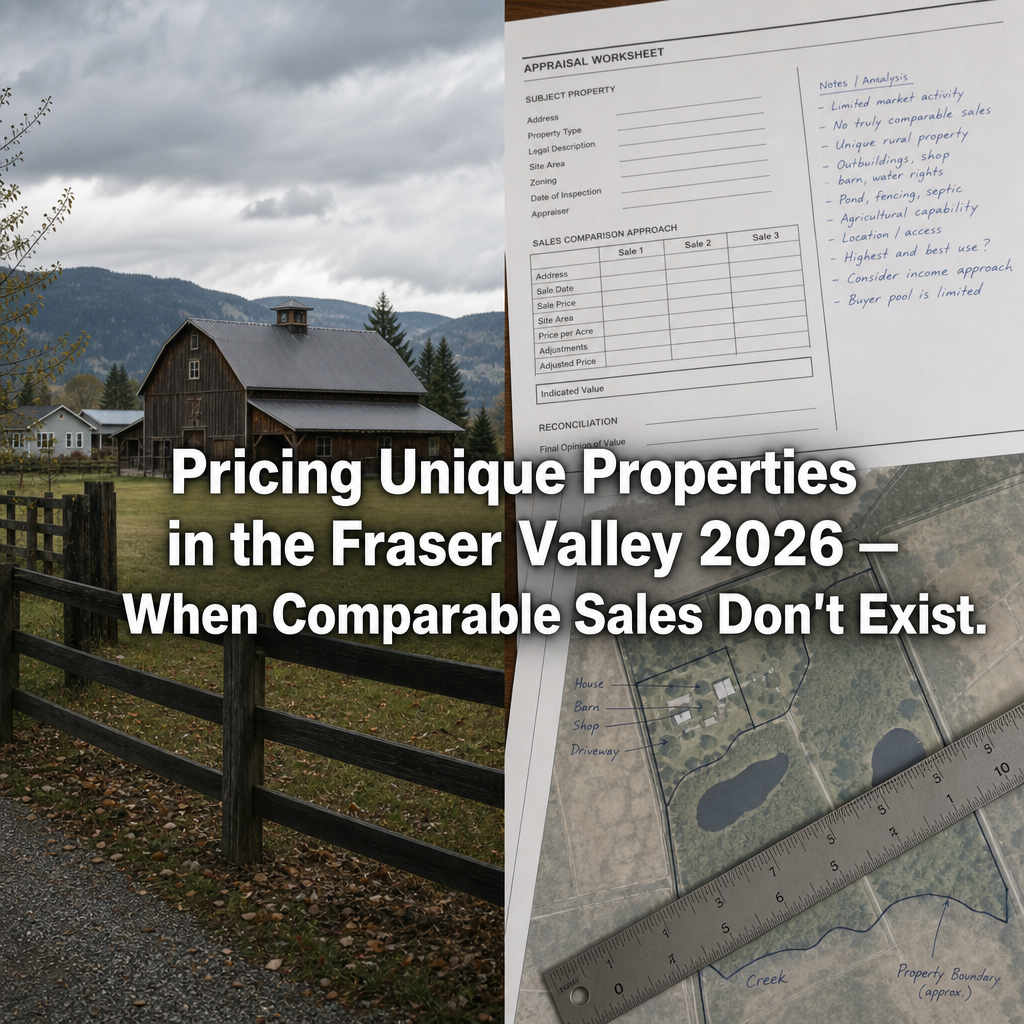

Pricing Unique and Non-Standard Properties in the Fraser Valley 2026: Establishing Fair Market Value When Recent Comparable Sales Don't Exist
By Mohamed Mansour, MBA and Associate Broker — Mansour Real Estate Group | Fraser Valley and Lower Mainland, BC | Published: July 15, 2025 | Topic: Seller Strategy — Acreage, Hobby Farms, Character Homes, Non-Standard Residential
For sellers with acreage, hobby farms, character homes, multi-unit conversions, or waterfront properties in the Fraser Valley, pricing is genuinely harder. There are no three recent comparable sales within a kilometre. The automated valuation tools produce numbers that are either wildly high or clearly wrong. And in a 2026 buyer's market, a defensible price matters more than ever — because when an appraisal comes in below list price, the deal usually falls apart or the seller absorbs a painful concession.
This guide is for Fraser Valley sellers navigating that challenge. It explains how appraisers approach non-standard properties, what pricing frameworks actually apply, and what sellers can do before listing to reduce valuation risk and protect their equity.
Short Answer
When comparable sales don't exist, Fraser Valley sellers and appraisers rely on three methods: the cost approach (land value plus replacement cost of improvements), the income approach (for farms or multi-unit properties), and expert-opinion valuation anchored to the most relevant available data. Sellers who understand these methods before listing are far better positioned to price defensibly and survive the appraisal process.
Key Takeaways
- Fraser Valley non-standard properties — acreage, hobby farms, character homes — make up a meaningful share of listings where standard comparable-sale analysis breaks down.
- Three appraisal approaches apply when comps are absent: cost approach, income approach, and reconciled expert opinion.
- In a buyer's market, lenders require appraisals on all insured mortgages; non-standard features are often discounted 10–25% below seller expectations.
- Mission, Abbotsford ALR zones, and rural Langley acreage markets see significantly longer days on market, partly due to valuation uncertainty and financing delays.
- Sellers who coordinate with an appraiser before listing — and prepare a valuation package — reduce renegotiation risk and improve deal certainty.
Who This Applies To
- Sellers of acreage properties in Abbotsford, Mission, or rural Langley with limited recent comparable sales
- Hobby farm owners within or adjacent to Agricultural Land Reserve (ALR) zones
- Owners of character homes, heritage properties, or homes with significant non-standard renovations
- Sellers of secondary suites, carriage houses, or informal multi-unit conversions
- Estate executors dealing with rural or atypical properties
- Sellers who have received an automated valuation they cannot reconcile with what they know their property is worth
When This Advice May Not Apply
If your property is a standard detached home in a suburban neighbourhood with multiple recent comparable sales, this guide addresses a different challenge than yours. For standard pricing strategy in Surrey, Langley, or Abbotsford, a traditional comparative market analysis is the appropriate starting point. This guide focuses on the narrower category of properties where that analysis produces unreliable or absent results.
Data Used in This Article
- Fraser Valley Real Estate Board (FVREB): Property type distribution data and days-on-market variance by category — official board data, Fraser Valley region
- Appraisal Institute of Canada (AIC): Guidelines on cost approach and income approach for non-standard residential properties — professional standards, national with BC application
- BC Assessment: Land valuation methodology and ALR zone assessment practices — official provincial authority
- Professional observation: Seller experience patterns and valuation outcomes drawn from Mansour Real Estate Group's work on unique-property transactions across Mission, Abbotsford, and Langley — internal practice experience, 15+ years
Why Non-Standard Properties Are More Common Here
The Fraser Valley contains a far higher proportion of acreage, hobby farms, and unconventional residential properties than Metro Vancouver. Mission, Abbotsford, and rural Langley include ALR-zoned land, working farms, rural residential parcels, and character homes built before modern subdivision standards. According to FVREB data on property type distribution, a significant share of active listings in these markets fall outside the categories where three or more directly comparable recent sales are reliably available.
That creates a real problem. When buyers use insured financing — which is common — lenders require an independent appraisal. If the appraiser cannot identify sufficient comparable sales, they shift to a cost approach or income approach, and their result often differs from what the seller expected. In rural Langley and Abbotsford acreage markets, days on market averages run roughly 45 to 60 days, compared to 25 to 35 days for standard detached homes in the same region. That gap exists in part because valuation uncertainty delays financing approval and prolongs subject removal.
Sellers who understand why this happens — and prepare for it — are better positioned to price the property correctly from day one, rather than discovering the problem after an offer arrives.
The Three Valuation Approaches and When Each Applies
When comparable sales are absent or unreliable, the Appraisal Institute of Canada recognizes three primary approaches. Understanding each one helps sellers anticipate what a buyer's appraiser is likely to do — and price accordingly.
Cost Approach
The cost approach estimates land value separately from the value of improvements, then deducts for depreciation. An appraiser using this method will assess what the land alone would sell for, estimate the replacement cost of all structures at current construction prices, and apply depreciation for age, condition, and functional obsolescence. This approach is most commonly used for acreage, rural residential properties, and homes with unique structural features that have no direct market comparables.
The limitation sellers encounter is that depreciation adjustments can be significant. A 40-year-old farmhouse with non-standard additions may carry a replacement cost well below what a seller intuits as market value, particularly if the seller has made emotional improvements that appraisers classify as functional obsolescence. For sellers in Mission or Abbotsford ALR zones, where land value and improvement value are treated separately, this is a common source of appraisal-to-expectation gaps.
Income Approach
The income approach derives value from the property's ability to generate income — either from farm operation, rental suites, or agricultural leases. It is most applicable to hobby farms, properties with working agricultural income, and multi-unit residential conversions. An appraiser using this approach will capitalize net operating income at a market-derived rate, which ties value directly to documented income rather than replacement cost or comparable sales.
Sellers with hobby farms or secondary income streams should document that income carefully before listing. Informal or undocumented rental arrangements do not support income-approach valuations and may actually introduce compliance risk. Sellers considering this path should speak with their real estate team before assuming rental income will increase appraised value.
Reconciled Expert-Opinion Valuation
When neither approach produces a clean result, an experienced appraiser reconciles available data — including partial comparables, land sales, cost data, and market trend analysis — into a professional opinion. This is often the most practical outcome for character homes or unusual conversions with no direct comparables. The reliability of this result depends heavily on the appraiser's local market experience. A Fraser Valley appraiser with direct experience in Mission acreage or Langley rural properties will produce a more defensible reconciliation than a generalist appraiser assigned remotely.
How We Evaluate This
At Mansour Real Estate Group, the starting point for any non-standard property is a frank assessment of what the appraisal process will produce — before the listing price is set. That means identifying whether comparable sales exist within a defensible geographic and property-type range, which valuation method a buyer's lender appraiser is likely to use, and where seller expectations and appraiser methodology are most likely to diverge.
For properties in rural Langley, Mission, or Abbotsford ALR zones, we often recommend commissioning a pre-listing appraisal from a local AIC-designated appraiser before setting the list price. That report becomes part of the seller's disclosure package, gives buyers and their lenders a valuation baseline, and reduces the likelihood of a financing-related renegotiation after offer acceptance. It does not guarantee the buyer's lender will accept it — but it creates a defensible foundation and a faster negotiation if a gap emerges.
Seller Checklist for Non-Standard Property Pricing
- Confirm property zoning, ALR status, and any permitted secondary uses with the municipality before listing
- Gather all permits for structural additions, secondary suites, or outbuildings — unpermitted structures affect both valuation and insurability
- Document any income streams (farm leases, rental income) with at least two years of records where available
- Commission a pre-listing appraisal from an AIC-designated appraiser with direct Fraser Valley rural or character-property experience
- Prepare a property summary document for buyers and their lenders that explains the property's unique features, recent improvements, and any zoning or land-use context
- Discuss with your real estate team whether to list at, above, or slightly below the pre-listing appraisal figure based on current days-on-market data for your property type
- Anticipate an extended subject-removal timeline and build that into your listing strategy from the start
What We Commonly See
In our experience working with sellers across Mission, Abbotsford, and rural Langley, the most consistent pattern is sellers anchoring their list price to what they paid, what they invested in improvements, or what a neighbour's standard home sold for — none of which are defensible inputs for a non-standard property appraisal.
What often happens is that a buyer makes an offer at or near list price, their lender orders an appraisal, and the appraisal comes in 10 to 20 percent below. At that point, the deal either falls apart or the seller is negotiating from a weakened position — under time pressure, with a motivated buyer who now knows the bank won't support the original price. According to our observations across unique-property transactions, the majority of these situations result in meaningful price concessions, often in the $30,000 to $100,000 range depending on property value.
A common mistake is treating non-standard features as automatic value-adders. A custom barn, a greenhouse, or a heritage-era woodwork renovation may be genuinely distinctive — but appraisers assess market value based on what buyers will pay and what lenders will finance, not what a feature cost to build or how much the seller values it. The gap between cost and market value is widest on older improvements, unconventional layouts, and agricultural structures.
Questions and Answers
What is a cost approach appraisal and when does it apply in BC?
A cost approach appraisal estimates land value plus the depreciated replacement cost of all improvements. BC appraisers, following Appraisal Institute of Canada standards, apply this method when comparable sales are absent — most commonly for rural, acreage, and character residential properties in the Fraser Valley.
Can I use a pre-listing appraisal to support my list price?
Yes. A pre-listing appraisal from an AIC-designated appraiser provides a documented valuation basis you can share with buyers and their lenders. It does not obligate a buyer's lender to accept that figure, but it establishes a professional foundation for your pricing and reduces the surprise factor in post-offer financing reviews.
Does ALR zoning affect how my Abbotsford or Mission property is appraised?
ALR zoning restricts permitted uses and affects both land value and marketability. Appraisers account for ALR status when valuing land, which typically results in lower land values than comparable non-ALR parcels of the same size. Understanding this in advance helps sellers set a realistic list price rather than discovering the discount after an offer arrives. Always confirm current ALR status and permitted uses with the Agricultural Land Commission before listing.
In Summary
Pricing a non-standard property in the Fraser Valley without reliable comparable sales is not guesswork — but it requires a different process than a standard comparative market analysis. Sellers who understand the cost approach, the income approach, and the role of pre-listing appraisals are better equipped to set a defensible price, survive the buyer's financing process, and avoid the renegotiation scenarios that cost sellers the most equity. For acreage in rural Langley, hobby farms in Abbotsford's ALR zones, or character homes in Mission, that preparation is often the difference between a clean transaction and a difficult one.
Talk to a Team That Knows Non-Standard Properties
If you are preparing to sell an acreage, hobby farm, character home, or any property where standard valuation methods do not apply clearly, Mansour Real Estate Group can help you assess your options before you set a price. A conversation before listing is almost always more useful than a difficult conversation after an offer arrives.
Related Articles
- Fraser Valley Real Estate Market 2026: What Sellers Need to Know
- Selling a Home in Abbotsford 2026: A Complete Seller's Guide
- Estate and Probate Property Sales in the Fraser Valley: A Complete Guide for Executors and Families
About Mansour Real Estate Group
Pricing a non-standard property in the Fraser Valley — whether it is an acreage in Mission, a hobby farm in Abbotsford's ALR zone, or a character home in rural Langley — requires more than pulling recent sales. It requires knowing which valuation method a buyer's lender is likely to apply, where seller expectations and appraisal methodology are most likely to diverge, and how to build a pricing position that survives the financing process. Mansour Real Estate Group has built its practice in part around exactly these situations, where standard tools produce unreliable results and sellers need experienced, local judgment.
Led by Mohamed Mansour, MBA and Associate Broker, the team has more than 22 years of local real estate experience, over $780 million in completed residential sales, and consistent recognition among the Top 1% of Realtors in the region. Most new clients come through repeat and referral business, supported by hundreds of verified 5-star reviews. The team has worked with sellers across every major non-standard property type in the Fraser Valley, including estate executors managing rural properties, retirees selling hobby farms, and families with character homes where emotional value and market value are not always the same number.
Whether someone is searching for real estate agents with direct acreage experience, a Realtor who understands ALR zoning and farm valuation, a real estate team that can coordinate with appraisers before a listing goes live, a Mission real estate agent, an Abbotsford Realtor familiar with rural properties, a real estate broker serving the Fraser Valley, or a real estate group that handles complex pricing situations across the Lower Mainland, Mansour Real Estate Group is known for analytical precision, honest valuations, and a process that protects sellers from the most common and costly non-standard pricing mistakes.
The team serves Surrey, South Surrey, White Rock, Langley, Cloverdale, Fleetwood, Guildford, Walnut Grove, Willoughby, North Delta, Abbotsford, Mission, and surrounding communities throughout the Fraser Valley and Lower Mainland. Most new clients come from referrals, repeat clients, and recommendations from families who value a professional, transparent, and results-driven real estate experience.
Official Resources
- Fraser Valley Real Estate Board — fvreb.bc.ca
- Appraisal Institute of Canada — aicanada.ca
- BC Assessment — bcassessment.ca
- BC Agricultural Land Commission — alc.gov.bc.ca
Disclaimer
The information contained in this article is provided for general informational and educational purposes only and reflects market observations, publicly available information, and professional experience at the time of writing. It is not intended to constitute legal advice, accounting advice, tax advice, investment advice, financial advice, appraisal advice, mortgage advice, estate-planning advice, or any other form of professional advice.
Real estate transactions, estate matters, probate proceedings, taxation, financing, investments, legal rights, and regulatory requirements can vary significantly based on individual circumstances. Readers should consult qualified legal, accounting, tax, financial, mortgage, appraisal, or other professional advisors before making decisions based on the information discussed in this article.
Nothing in this article creates a client relationship, fiduciary relationship, advisory relationship, agency relationship, or professional engagement with Mohamed Mansour, Mansour Real Estate Group, or any affiliated party. Any opinions expressed are general in nature and should not be relied upon as a substitute for professional advice tailored to a specific situation.
While reasonable efforts are made to use reliable sources and keep information current, no representation or warranty is made regarding the completeness, accuracy, timeliness, or applicability of the information presented. Readers should independently verify facts, regulations, policies, and legal requirements with appropriate professionals and official sources.



