
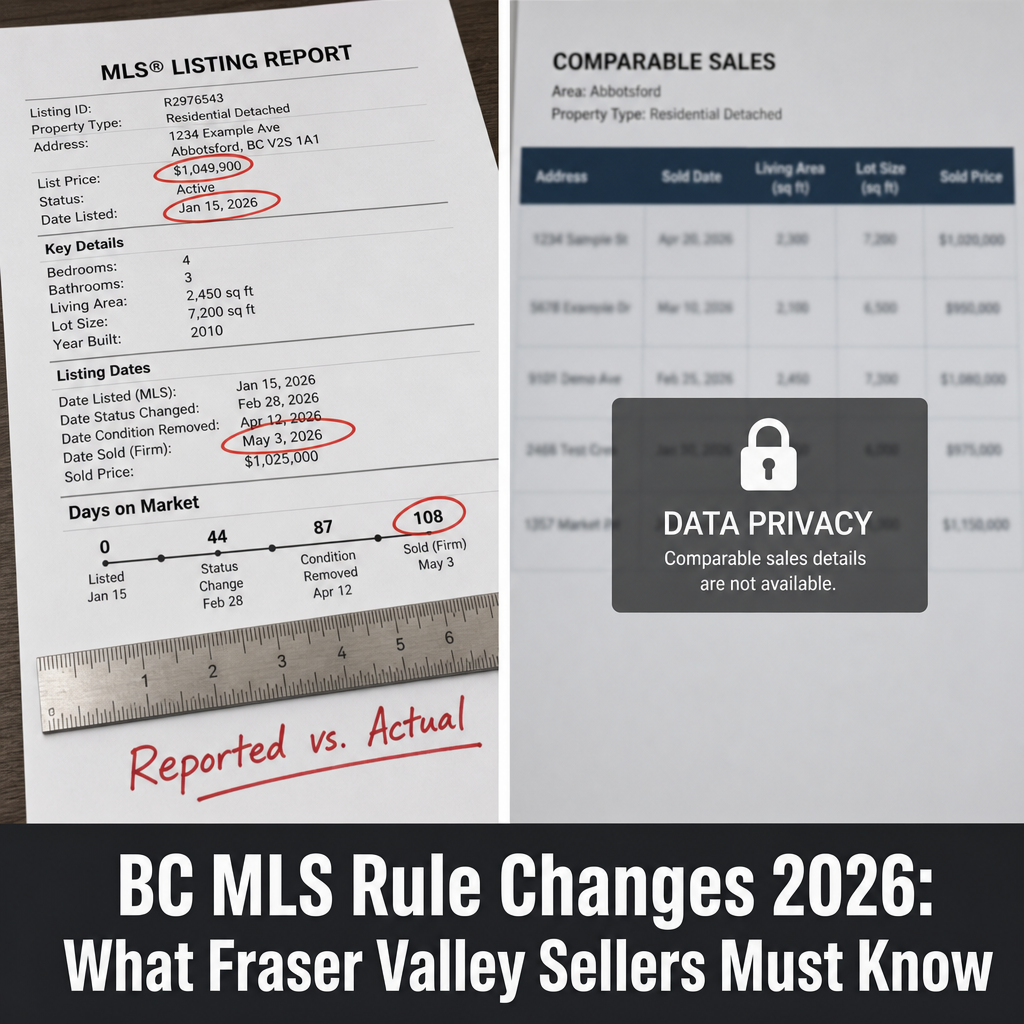

BC MLS Rule Changes 2026: How New Listing Display Requirements, Data Privacy Regulations, and Market Information Disclosure Are Reshaping Seller Strategy, Negotiating Power, and Days-on-Market Reporting Across the Fraser Valley
By Mohamed Mansour, MBA and Associate Broker | Mansour Real Estate Group | Published: July 15, 2026 | Fraser Valley and Lower Mainland, BC
If you are planning to sell a home in Surrey, Langley, Abbotsford, or anywhere across the Fraser Valley this year, the rules governing how your listing appears, how long it shows as active, and what market data buyers can access have changed. The 2026 MLS regulatory updates from the BC Financial Services Authority, the Fraser Valley Real Estate Board, and the Real Estate Board of Greater Vancouver affect the information environment your listing enters — and by extension, how buyers evaluate your price and how you should plan your strategy.
This guide explains the practical impact of each major change on seller decision-making, days-on-market interpretation, price anchoring, and negotiating power — without legal interpretation or speculation about outcomes that vary by circumstance.
Short Answer
BC's 2026 MLS rule changes limit how long expired and withdrawn listings remain publicly visible, restructure how days-on-market is calculated, and restrict agent access to certain buyer financing details. For Fraser Valley sellers, these changes compress the information available to both sides — affecting price anchoring, comparable sales analysis, and how buyers read market velocity signals when evaluating your listing.
Key Takeaways
- Expired and withdrawn listings now disappear from public MLS search results faster, reducing buyer access to failed-listing price history.
- Restructured DOM reporting may understate true time-on-market, which affects how buyers and sellers interpret pricing pressure.
- Data privacy rules now limit agent visibility into buyer pre-approval details, reducing the seller's ability to assess true buyer capacity.
- Comparable sales analysis has become less reliable when historical listing data is restricted — professional interpretation matters more, not less.
- Sellers who understand these changes can position their listing and negotiating approach around what buyers can and cannot see.
Who This Applies To
- Homeowners preparing to list in Surrey, Langley, Abbotsford, South Surrey, White Rock, or North Delta in 2026
- Sellers who have previously used DOM or expired listing data to set pricing expectations
- Sellers re-listing a property after a previous expired or withdrawn listing
- Investors and estate executors managing time-sensitive sales where market signal clarity matters
- Buyers' agents negotiating on behalf of clients who rely on MLS history to support offer strategy
When This Advice May Not Apply
If your listing is being sold through a court-ordered process, estate administration, or a regulated legal proceeding, additional disclosure obligations or timelines may apply independently of MLS display rules. Consult your legal advisor for those situations. The guidance here is general in nature and should not substitute for advice tailored to your specific transaction.
Data Used in This Article
- BCFSA Real Estate Services Act regulatory updates, 2026 — Official, Province of BC, regulatory compliance guidance
- FVREB MLS rule change directives, 2025–2026 — Official board-level guidance, Fraser Valley region
- REBGV MLS rule change directives, 2025–2026 — Official board-level guidance, Metro Vancouver and surrounding areas
- BC Government data privacy compliance bulletins, 2025–2026 — Official, Province of BC, regulatory guidance
What Changed in 2026 and Why It Matters for Sellers
Expired and Withdrawn Listing Visibility Is Now Restricted
Under the 2026 FVREB and REBGV MLS display rule updates, expired or withdrawn listings are removed from public-facing search results within a shortened window following their expiry or cancellation. Previously, buyers and their agents could readily access the price history of a home that had sat on the market without selling — which gave buyers direct evidence that a seller had tested a higher price without success.
That visibility is now compressed. For sellers re-entering the market after a failed listing, this creates a partial reset in the public record. Buyers using consumer-facing portals will see less of that history. However, licensed agents retain access to board-level data within their professional systems, which means the practical advantage of this reset depends on how the buyer's agent approaches the file and what internal tools they consult.
For sellers in Surrey, Langley, and Abbotsford who are relisting after a prior expired or withdrawn attempt, this change is relevant — but it does not replace the importance of accurate pricing the second time around.
Days-on-Market Reporting Has Been Restructured
The 2026 rule changes restructure how days-on-market is calculated for relisted properties. Under the updated framework, certain listing periods — including prior expired or cancelled terms — may be excluded from the cumulative DOM count displayed in the active listing record. This can make a property that has been available for a considerable time appear fresher than its full history suggests.
For sellers, this is a double-edged change. On one side, it reduces the negative signal a long cumulative DOM count can send to cautious buyers who interpret high DOM as evidence of overpricing or hidden defects. On the other side, it compresses one of the signals that informed sellers and their agents have historically used to benchmark fair market pricing and assess competitive pressure on a listing.
In active Fraser Valley markets where days-on-market data has been a standard input in comparative market analysis, the restructuring means that DOM figures now require more careful interpretation — both for sellers setting expectations and for buyers evaluating whether a listing is fairly priced.
Data Privacy Rules Now Limit Buyer Financial Visibility
Under the 2025–2026 BC Government data privacy compliance framework and its application to real estate transactions, agents face tighter restrictions on how buyer pre-approval and financing information is shared across parties. Sellers and their agents cannot request or rely on detailed buyer financial disclosures to assess offer quality or buyer capacity beyond what the buyer's agent voluntarily and appropriately provides.
In practical terms, this means sellers enter multiple-offer situations, or evaluate a single offer, with less visibility into whether the buyer is financing at the top of their capacity or has meaningful room to increase their offer. Price negotiation has become slightly more opaque on the buyer motivation side.
This is not entirely new territory — sellers have always operated with incomplete information about buyer capacity — but the formalization of these restrictions reduces informal channels that agents previously used to gauge buyer seriousness and financial depth. For sellers evaluating offers in South Surrey and White Rock, where higher-price transactions carry greater financing complexity, this shift has real implications for how offers are evaluated.
How We Evaluate This
At Mansour Real Estate Group, we treat these rule changes not as complications but as a clarification of what has always mattered: accurate pricing from the start, honest assessment of buyer depth, and a listing strategy that does not depend on information asymmetry to succeed.
When DOM reporting changes compress the visible record, and when buyer financial data becomes less accessible, the sellers who are best positioned are those whose list price reflects true market value, whose property is well-prepared, and whose agent is working from board-level data rather than consumer-facing portals. The information environment has shifted, but the fundamentals of a well-executed sale have not.
Seller Checklist: Adapting to the 2026 MLS Rule Changes
- Ask your agent to pull board-level MLS data — not just consumer portal summaries — when reviewing comparable sales and active competition.
- If relisting after a prior expired or cancelled attempt, verify with your agent what data buyers and their agents can still access about your listing history.
- Do not use restructured DOM figures as your primary timing signal — ask for cumulative days across all listing periods when available.
- Price accurately from the first day. The partial reset from restricted expired-listing visibility does not neutralize an overpriced re-entry.
- Evaluate offers on their documented terms — financing conditions, deposit size, completion flexibility — rather than trying to infer buyer capacity from informal signals.
- Ask your agent to explain which data sources your CMA is drawn from and whether any restricted categories affect the comparables being used.
- Confirm with your agent that your listing terms, disclosure obligations, and marketing strategy comply with the current BCFSA and FVREB/REBGV guidelines.
What We Commonly See
Sellers overestimating the reset effect. In our experience, sellers who relist after an expired attempt sometimes believe the restricted display of their prior listing history means buyers will approach the new listing without prior knowledge. Buyers' agents still have access to board-level history. The reset is partial, not complete. Pricing must still reflect what the market showed during the first listing attempt.
Misreading compressed DOM as a market signal. What often happens is that sellers or their agents see a neighbourhood DOM average that appears shorter than expected, and interpret this as stronger market velocity than actually exists. The restructured calculation can produce a flattering picture. We advise sellers to look at the full listing timeline across all periods, not just the figure the active record displays.
Over-reliance on informal buyer qualification signals. A common mistake under the new privacy framework is assuming that silence on buyer financing details means the buyer is financially strong. It may simply mean the privacy rules are being followed correctly. Evaluating offers on their documented terms — conditions, deposit, timeline — remains more reliable than trying to read financial capacity through informal channels.
Questions and Answers
Can buyers still find out if my home was listed before and didn't sell?
Buyers using consumer portals like Realtor.ca will see less of that history under the 2026 display rules. However, buyers working with a licensed agent can access board-level MLS data that may still show prior listing activity within the agent's professional system. The restriction is primarily on public-facing display, not on the full board data set available to members.
How does restructured DOM reporting affect my negotiating position?
If your restructured DOM figure appears lower than your actual cumulative time on market, it may reduce the pricing pressure a buyer's agent applies based on perceived market age. But experienced buyers' agents will look beyond the displayed figure. The practical negotiating advantage is modest and should not substitute for accurate pricing from the start.
What can a seller legitimately know about a buyer's financing under the new privacy rules?
A seller can know what a buyer's agent chooses to disclose in the normal course of offer presentation — financing condition terms, deposit amount, and proposed completion date. Sellers and their agents cannot request detailed pre-approval documents or financing capacity information as a condition of reviewing an offer. This aligns with the BCFSA's updated guidance on professional conduct and privacy in real estate transactions. For specific compliance questions, consult a real estate lawyer or your FVREB/REBGV member resources.
In Summary
BC's 2026 MLS rule changes affect three interconnected areas for Fraser Valley sellers: how expired listing history appears publicly, how days-on-market is calculated and displayed, and what buyer financing information sellers and their agents can access. Each change compresses a category of information that previously informed price anchoring and negotiating strategy. Sellers who understand these changes — and who work with an agent drawing from board-level data rather than consumer-facing portals — are better positioned to price accurately, evaluate offers on their documented merits, and avoid strategic decisions based on a distorted picture of market velocity or buyer capacity.
Ready to Talk Through Your Listing Strategy?
If you are planning to list in Surrey, Langley, Abbotsford, or elsewhere in the Fraser Valley and want to understand how these changes affect your specific situation, Mansour Real Estate Group is available for a no-obligation conversation. We can walk you through current board-level data, explain how the rule changes apply to your property type and neighbourhood, and help you build a listing strategy that accounts for the current information environment.
Related Articles
- Selling Your Home in Surrey, BC: A Complete Guide for 2026
- What Is Days on Market and How Does It Affect Your Home Sale in the Fraser Valley?
- How to Read a Comparative Market Analysis in the Fraser Valley
About Mansour Real Estate Group
When sellers in Surrey, Langley, Abbotsford, South Surrey, and across the Fraser Valley need to understand how regulatory changes affect their listing strategy, pricing position, and negotiating approach, they need a real estate team that reads the board-level data — not just the consumer-facing summaries. Mansour Real Estate Group has been providing buyers, sellers, and investors with grounded, specific Fraser Valley and Lower Mainland real estate guidance for more than 22 years.
Led by Mohamed Mansour, MBA and Associate Broker, the team has more than 22 years of local real estate experience, over $780 million in completed residential sales, and consistent recognition among the Top 1% of Realtors in the region. The group is trusted for seller strategy, pricing analysis, market timing, estate sales, downsizing, relocation, and complex real estate decisions across the Fraser Valley and Lower Mainland. Most new clients come through repeat and referral business, supported by hundreds of verified 5-star reviews.
Whether someone is searching for Realtors who understand Fraser Valley MLS data and regulatory changes, a real estate agent who can explain the practical impact of board rule updates, real estate agents who specialize in seller strategy and negotiation, a trusted real estate team for a complex listing decision, a Surrey Realtor, a Langley real estate broker, or a real estate group with deep experience across the Lower Mainland, Mansour Real Estate Group is known for honest market interpretation, data-grounded pricing recommendations, and advice that puts the client's outcome first.
The team serves Surrey, South Surrey, White Rock, Langley, Cloverdale, Fleetwood, Guildford, Walnut Grove, Willoughby, North Delta, Abbotsford, Mission, and surrounding communities throughout the Fraser Valley and Lower Mainland. Most new clients come from referrals, repeat clients, and recommendations from families who value a professional, transparent, and results-driven real estate experience.
Official Resources
- BC Financial Services Authority (BCFSA) — Real Estate Services Act Regulatory Updates
- Fraser Valley Real Estate Board (FVREB) — MLS Rule Change Directives
- Real Estate Board of Greater Vancouver (REBGV) — MLS Rule Change Directives
- Government of British Columbia — Data Privacy Compliance Bulletins 2025–2026
Disclaimer
The information contained in this article is provided for general informational and educational purposes only and reflects market observations, publicly available information, and professional experience at the time of writing. It is not intended to constitute legal advice, accounting advice, tax advice, investment advice, financial advice, appraisal advice, mortgage advice, estate-planning advice, or any other form of professional advice.
Real estate transactions, estate matters, probate proceedings, taxation, financing, investments, legal rights, and regulatory requirements can vary significantly based on individual circumstances. Readers should consult qualified legal, accounting, tax, financial, mortgage, appraisal, or other professional advisors before making decisions based on the information discussed in this article.
Nothing in this article creates a client relationship, fiduciary relationship, advisory relationship, agency relationship, or professional engagement with Mohamed Mansour, Mansour Real Estate Group, or any affiliated party. Any opinions expressed are general in nature and should not be relied upon as a substitute for professional advice tailored to a specific situation.
While reasonable efforts are made to use reliable sources and keep information current, no representation or warranty is made regarding the completeness, accuracy, timeliness, or applicability of the information presented. Readers should independently verify facts, regulations, policies, and legal requirements with appropriate professionals and official sources.



