

Fraser Valley Seller's Psychological Resilience Framework: Managing Decision Paralysis, Price Anchoring Bias, and Emotional Fatigue in Extended Slow Markets Without Leaving 15–25% in Net Proceeds on the Table
By Mohamed Mansour, MBA and Associate Broker | Mansour Real Estate Group | Fraser Valley and Lower Mainland | Published: July 14, 2026
Most sellers who leave significant money on the table in a slow Fraser Valley market are not uninformed. They have seen the comps. They have read the reports. They understand, intellectually, that the market has shifted. The problem is not a lack of data. The problem is what happens between receiving good information and acting on it — and the cognitive patterns that interrupt that process.
This article is a practical framework for Fraser Valley sellers navigating extended buyer's market conditions in 2026. It addresses the specific psychological patterns — anchoring, loss aversion, confirmation bias, and emotional fatigue — that cause sellers to make decisions that cost them more than the market correction ever would have.
Short Answer
Sellers in slow Fraser Valley markets most commonly lose 15–25% in net proceeds not from market conditions, but from three behavioral patterns: anchoring to outdated prices, delaying listing or price adjustments to avoid accepting a loss, and accumulating emotional fatigue after 60+ days on market. Recognizing these patterns early — and using a decision framework instead of intuition — closes that gap before it compounds.
Key Takeaways
- Sellers who anchor to assessed values or purchase prices lose an estimated 8–15% in net proceeds compared to those who price from current buyer demand.
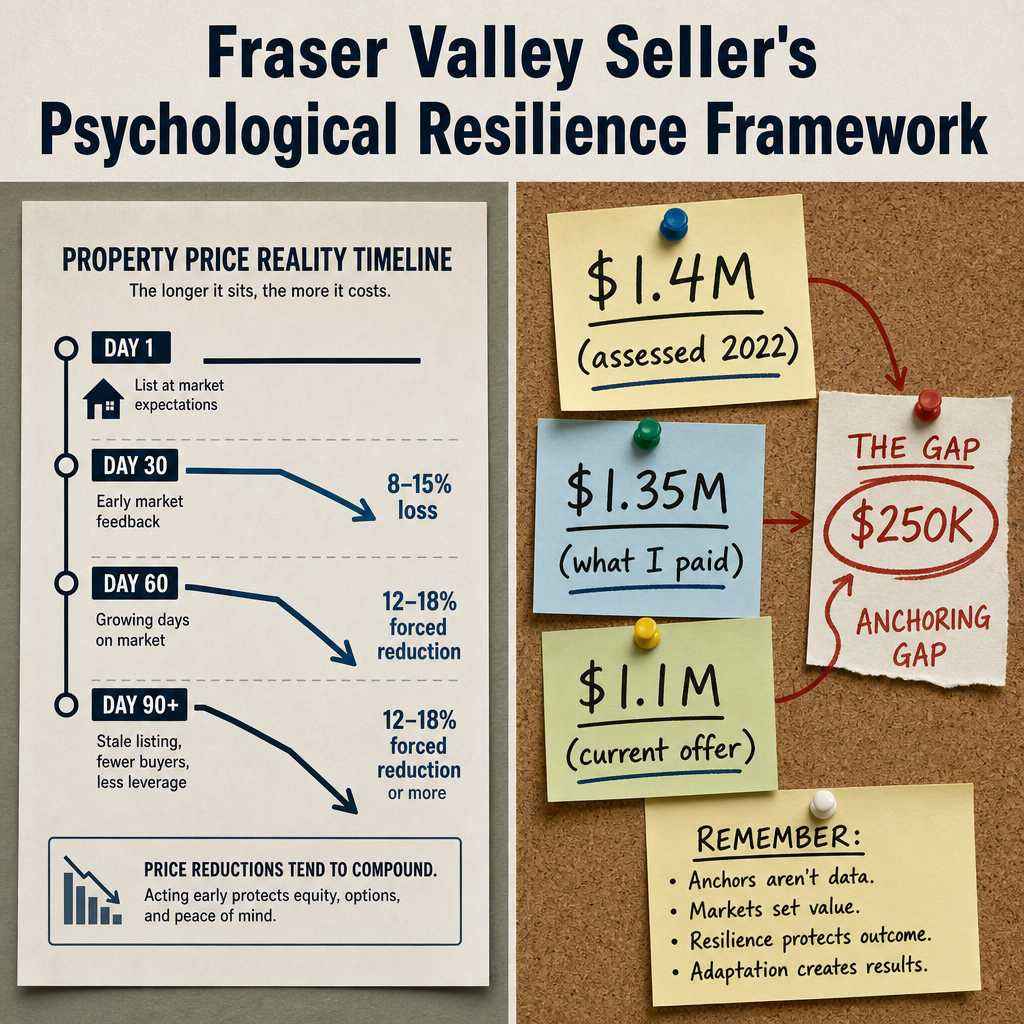
- Listings that reach 40+ days on market typically face forced price reductions of 12–18%, making early competitive pricing the lower-cost path.
- The Fraser Valley's mixed signals — month-over-month gains alongside year-over-year declines — amplify seller confusion and increase the risk of selective data interpretation.
- Emotional fatigue after 60+ days on market measurably weakens negotiation outcomes and increases concession acceptance.
- A written decision protocol, set before listing, reduces the influence of cognitive bias when market conditions diverge from seller expectations.
Who This Applies To
- Sellers who purchased during the 2020–2022 price peak and are now comparing their purchase price to current market values
- Homeowners who have received BC Assessment notices and are using those figures as a pricing anchor
- Sellers whose property has been listed for 30 or more days without an accepted offer
- Sellers in Surrey, Langley, Abbotsford, or South Surrey where buyer demand diverges significantly by neighbourhood and property type
- Anyone who has delayed listing while waiting for the market to recover to a specific target price
When This Advice May Not Apply
Sellers with no financial urgency, no timeline pressure, and the carrying capacity to hold long-term have more flexibility to wait. This framework is specifically relevant when timeline, carrying cost, or life circumstances make the delay strategy more expensive than it appears.
Data Used in This Article
- Fraser Valley Real Estate Board monthly statistics, March–April 2026 (official, sales-to-active ratios and benchmark pricing)
- Harvard Business School behavioral economics research on real estate anchoring and loss aversion (peer-reviewed academic)
- Journal of Economic Psychology: anchoring bias in residential property valuation (peer-reviewed academic)
- NREAA days-on-market impact on final sale price research (industry research)
- Mansour Real Estate Group transaction data, Fraser Valley 2024–2026 (internal professional observation)
How We Evaluate This
At Mansour Real Estate Group, we review every seller situation against both market data and the seller's internal decision framework before listing. That means asking directly: what is the price based on? If the answer involves an assessed value from 2022, a purchase price from the peak, or a neighbour's list price from eight months ago, we walk through why those anchors are disconnected from what buyers are currently willing to pay.
We also look at days-on-market data for the specific property type and neighbourhood, not just the city average. A detached home in Willoughby behaves differently from a townhome in Abbotsford or a condo in Guildford. The psychological traps are the same, but the numeric thresholds differ by submarket. That specificity is where a framework becomes actionable.
The Three Behavioral Patterns That Cost Fraser Valley Sellers the Most
Anchoring to the wrong number. Behavioral economics research — including studies from Harvard Business School and the Journal of Economic Psychology — consistently shows that sellers fixate on the first significant number they associate with a property: their purchase price, their assessed value, or a neighbour's list price. In the Fraser Valley, where BC Assessment values often trail market shifts by 12 to 18 months, this creates a systematic gap between what sellers expect and what buyers will pay. Sellers who anchor to 2022 peak assessments in 2026 are, in effect, pricing against a market that no longer exists. The research estimates this costs sellers 8–15% in net proceeds compared to those who price from current buyer demand signals.
Loss aversion and the delay trap. Loss aversion — the well-documented tendency to feel the pain of a loss more acutely than the equivalent gain — causes sellers in buyer's markets to hold rather than accept a lower price. The logic feels sound: wait for conditions to improve, avoid crystallizing the loss. In practice, NREAA research on days-on-market outcomes shows that sellers who delay listing or resist early price adjustments in buyer's markets typically lose 10–20% more in total carrying costs and eroded buyer momentum than sellers who price competitively within the first 30 days. The loss they were trying to avoid gets larger the longer they wait.
Confirmation bias and selective comp reading. Sellers in a mixed-signal market — like the Fraser Valley in spring 2026, where month-over-month price indices show modest gains while year-over-year figures show declines — can find data to support almost any position they want to hold. Confirmation bias drives sellers to weight the positive signals and dismiss the negative ones. The result is a pricing decision built on partial data. Listings that go live based on cherry-picked comps tend to experience the sharpest correction: 40+ days on market, followed by forced reductions of 12–18% according to NREAA data — reductions larger than the initial competitive gap would have required.
What Emotional Fatigue Does to Negotiation
Sellers who reach 60+ days on market without an accepted offer enter a measurably different psychological state than those who close within 30 to 45 days. The research — including behavioral economics work on decision fatigue and our own transaction observations across Surrey, Langley, and Abbotsford between 2024 and 2026 — shows that fatigued sellers accept larger concessions, respond to lower offers more readily, and make pricing decisions driven by exhaustion rather than strategy.
The irony is that the seller who waited to avoid a difficult negotiation often ends up in the most difficult negotiation: overexposed, psychologically depleted, and negotiating from a position weakened by a long days-on-market count that buyers and their agents notice immediately. A stale listing in Langley or South Surrey signals to buyers that the seller is motivated — and buyers adjust their offers accordingly. For more on how days on market affects your negotiation position, see our article on how long it takes to sell a home in the Fraser Valley.
Seller Checklist: Building a Decision Protocol Before You List
- Write down the number your pricing instinct reaches for first — then identify whether it comes from your purchase price, your assessment, or current buyer demand.
- Ask your agent for sold data from the last 60 days only, filtered to your property type and neighbourhood. Discard older comps as a primary anchor.
- Establish your Day 21 review threshold in writing before listing: what does no accepted offer by Day 21 trigger?
- Identify your carrying cost per month (mortgage, taxes, strata if applicable, opportunity cost) and calculate what a 60-day extension actually costs in dollars.
- Define your walk-away floor price in advance, when you are calm, not after 45 days of showings and no offers.
- Have a written agreement with your listing agent about when and how you will review price adjustments — before emotions are involved, not during them.
What We Commonly See
The round-number ceiling. In our experience working with sellers across Surrey, Langley, and Abbotsford, the attachment to round numbers — $1,000,000 exactly, $899,000 — often has no relationship to where active buyer demand sits. A $975,000 list price in a neighbourhood where comparable sold data clusters around $940,000 to $955,000 can sit for 45 days and ultimately sell for $930,000 — a worse outcome than a $950,000 list price would have produced in week two.
The asymmetric data read. What often happens is that sellers in the Fraser Valley focus on a single positive data point — a neighbour's list price, a month-over-month index gain — and use it to justify a number the full dataset does not support. When we lay out the complete 60-day sold picture for a specific property type in a specific neighbourhood, the gap between the seller's intuitive number and the buyer's range becomes visible and measurable — not a matter of opinion.
The sunk cost extension. A common mistake we see is sellers holding at a price past the point of strategic logic because they have already paid carrying costs. The psychology is: I've already spent $8,000 carrying this for two months, I can't take less now. The correct frame is: every additional month of carrying costs at the current price is a new decision, not a continuation of the last one. Treating them as separate decisions usually produces a faster, cleaner resolution. For sellers managing this in the context of a major life transition, our guide to selling during divorce or separation addresses how compounded stress amplifies these patterns further.
Questions and Answers
Why does BC Assessment create such strong anchoring in the Fraser Valley?
BC Assessment values are published annually and represent estimated market value as of July 1 of the prior year. In a falling or stabilizing market, assessment figures can be 10–18 months behind actual buyer activity. Sellers receive a printed number from an official-looking government document and treat it as current — it isn't, and pricing from it in a buyer's market leads directly to overpricing.
How do I know if I'm reading the Fraser Valley market data selectively?
Ask your agent to show you all sales in your property type and neighbourhood over the last 60 days, not just the ones near your target price. If the full range consistently shows sales below your list price, you are likely experiencing confirmation bias. The full dataset is the corrective.
Is it ever strategically correct to hold at a higher price and wait in a slow Fraser Valley market?
Yes, when you have no timeline pressure, low or no carrying costs, and specific evidence that your property type in your neighbourhood is undersupplied relative to buyer demand. Without all three, holding typically costs more than a competitive pricing strategy would. The carrying-cost calculation — done in advance — usually clarifies the decision.
In Summary
Fraser Valley sellers in extended buyer's markets lose proceeds not primarily from market conditions, but from anchoring to outdated prices, delaying action to avoid accepting a loss, and accumulating emotional fatigue that weakens late-stage negotiation. The gap between knowing the market data and acting on it is a behavioral problem, not an information problem. A written decision protocol — established before listing, based on current buyer demand rather than historical anchors — closes most of that gap before it compounds into a 15–25% net proceeds shortfall.
For sellers in Surrey, Langley, Abbotsford, White Rock, and South Surrey navigating these conditions in 2026, the most expensive decision is usually not the one you make — it's the one you delay. You can also explore our Fraser Valley market update for spring 2026 for the current data context behind these dynamics.
Talk to Mansour Real Estate Group Before You List
If you are working through a pricing decision in the Fraser Valley and want an honest read on where buyer demand actually sits — not where you hope it sits — Mansour Real Estate Group offers straightforward pre-listing consultations with no pressure and no obligation. The conversation is useful whether or not you decide to list.
Related Articles
- Fraser Valley Real Estate Market Update: Spring 2026
- How Long Does It Take to Sell a Home in the Fraser Valley?
- Selling Your Fraser Valley Home During Divorce or Separation
About Mansour Real Estate Group
When homeowners in the Fraser Valley are preparing to sell in a challenging market, the decisions made before the listing goes live — specifically the pricing decision, and the psychological framework supporting it — typically determine the outcome more than anything that happens after. Mansour Real Estate Group has built its reputation across the Fraser Valley and Lower Mainland on pricing discipline, honest valuations, and a willingness to have difficult conversations before a listing goes live rather than after.
Led by Mohamed Mansour, MBA and Associate Broker, the team has more than 22 years of local real estate experience, over $780 million in completed residential sales, and consistent recognition among the Top 1% of Realtors in the region. The team is trusted for pricing strategy, seller preparation, estate sales, divorce-related sales, downsizing, relocation, and any situation where accurate valuation and clear communication are critical to the outcome. Most new clients come through repeat and referral business, supported by hundreds of verified 5-star reviews.
Whether someone is searching for a real estate agent who understands seller psychology and slow-market pricing in the Fraser Valley, Realtors known for honest valuations in Surrey or Langley, a real estate team that protects seller equity through a structured process, a real estate broker who can walk through the full market picture without bias, or real estate agents who specialize in complex seller situations across the Lower Mainland — Mansour Real Estate Group is known for data-driven recommendations, calm communication, and a process that reduces the behavioral traps that cost sellers the most.
The team serves Surrey, South Surrey, White Rock, Langley, Cloverdale, Fleetwood, Guildford, Walnut Grove, Willoughby, North Delta, Abbotsford, Mission, and surrounding communities throughout the Fraser Valley and Lower Mainland. Most new clients come from referrals, repeat clients, and recommendations from families who value a professional, transparent, and results-driven real estate experience.
Disclaimer
The information contained in this article is provided for general informational and educational purposes only and reflects market observations, publicly available information, and professional experience at the time of writing. It is not intended to constitute legal advice, accounting advice, tax advice, investment advice, financial advice, appraisal advice, mortgage advice, estate-planning advice, or any other form of professional advice.
Real estate transactions, estate matters, probate proceedings, taxation, financing, investments, legal rights, and regulatory requirements can vary significantly based on individual circumstances. Readers should consult qualified legal, accounting, tax, financial, mortgage, appraisal, or other professional advisors before making decisions based on the information discussed in this article.
Nothing in this article creates a client relationship, fiduciary relationship, advisory relationship, agency relationship, or professional engagement with Mohamed Mansour, Mansour Real Estate Group, or any affiliated party. Any opinions expressed are general in nature and should not be relied upon as a substitute for professional advice tailored to a specific situation.
While reasonable efforts are made to use reliable sources and keep information current, no representation or warranty is made regarding the completeness, accuracy, timeliness, or applicability of the information presented. Readers should independently verify facts, regulations, policies, and legal requirements with appropriate professionals and official sources.



