
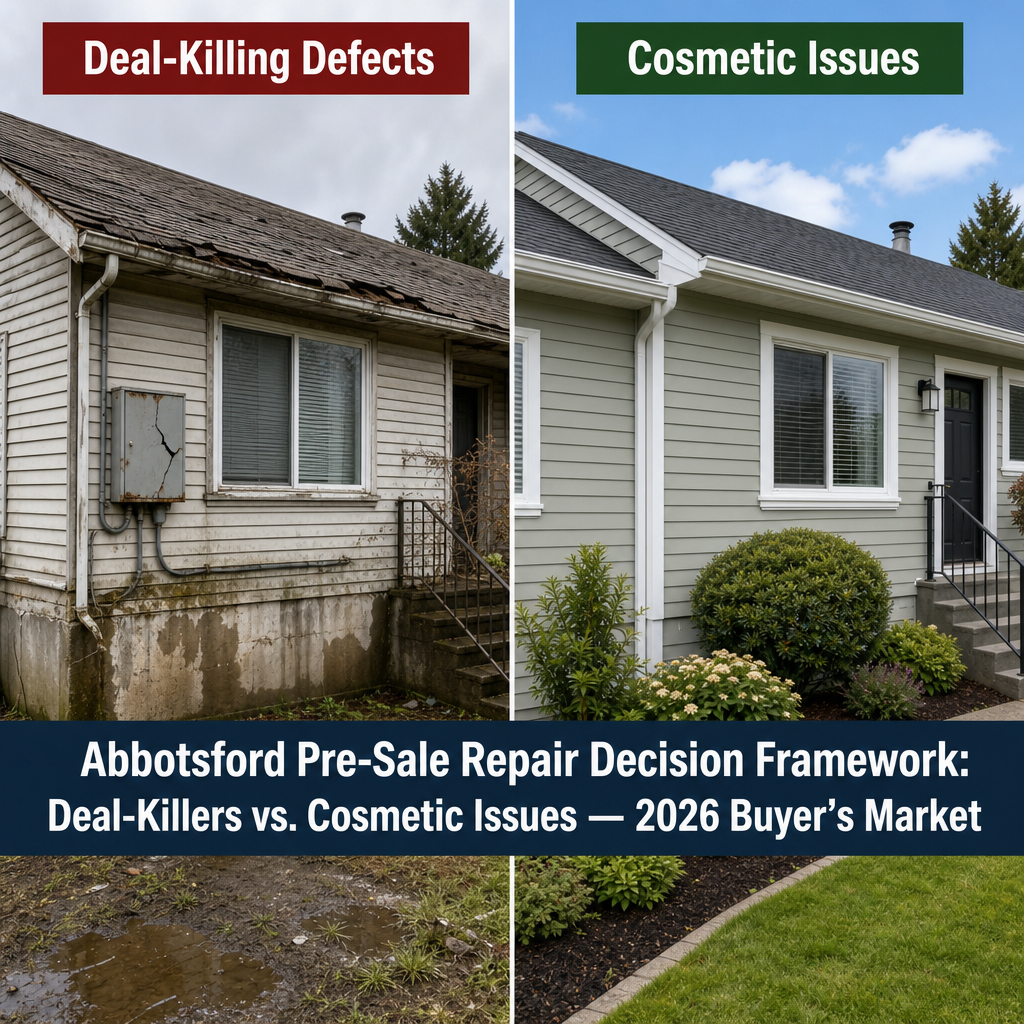

Abbotsford Pre-Sale Repair Decision Framework: How to Identify Deal-Killing Defects vs. Cosmetic Issues When Budget Is Limited in a 2026 Buyer's Market
By Mohamed Mansour, MBA and Associate Broker — Mansour Real Estate Group | Fraser Valley, BC | Published: July 15, 2025 | Topic: Seller Strategy — Abbotsford
Abbotsford sellers preparing to list in 2026 face a market where buyers hold more negotiating power than they have in several years. Inventory is running roughly 45% above the long-term seasonal average, according to Fraser Valley Real Estate Board Q1 2026 data, and year-over-year price corrections of 7–8% have reset buyer expectations. In this environment, spending $20,000 on cosmetic upgrades before listing is not a strategy — it is a risk.
The question most sellers ask is: what should I fix? The more useful question is: what will kill my deal if I don't fix it? This guide answers that question specifically for Abbotsford's property mix, buyer profile, and financing conditions in 2026.
Short Answer
In Abbotsford's 2026 buyer's market, repair dollars should go toward defects that trigger lender appraisal flags or financing denial — roof condition, electrical panels, moisture intrusion, and foundation issues. Cosmetic upgrades like paint, landscaping, and minor kitchen refreshes can support presentation but rarely recoup their full cost when buyer demand is soft. Fix what kills the deal first.
Key Takeaways
- Structural defects and moisture issues force post-offer price concessions of 10–15% and cause deal collapse more than any cosmetic problem.
- CMHC appraisers systematically flag roofs over 20 years old, outdated electrical panels, and moisture intrusion — addressing these prevents appraisal shortfalls.
- In Abbotsford, pre-listing inspections reveal that roughly 40% of homes require foundation assessment and 35% need electrical panel attention.
- DIY cosmetic fixes under $5,000 return 60–80% in Abbotsford's current market; major renovations over $15,000 return only 40–50%.
- Unpermitted additions and code violations commonly trigger lender appraisal failure even when the home passes a physical inspection.
Who This Applies To
- Abbotsford homeowners preparing to list a detached home, townhouse, or older rancher in 2026
- Sellers with a limited pre-sale budget who need to prioritize repairs strategically
- Estate executors managing a property that has deferred maintenance or older systems
- Investors selling a rental property where tenant occupation may have masked maintenance issues
- Families relocating and selling quickly, where deal collapse carries timing risk
When This Advice May Not Apply
This framework focuses on budget-constrained sellers in a buyer's market. If your property is in strong condition, recently updated, or in a high-demand pocket of Abbotsford with limited comparable inventory, your repair calculus may differ. Sellers with significant renovation budgets and properties in premium neighbourhoods should consult a local real estate professional for a strategy tailored to their specific asset.
Data Used in This Article
- Fraser Valley Real Estate Board Q1 2026 Market Report — official board data, inventory and price trend statistics
- CMHC Property Appraisal Guidelines for BC — lender appraisal trigger conditions for insured mortgages
- BC Home Inspection Standards and Reporting Guidelines — inspection reporting framework for BC-licensed home inspectors
- Mansour Real Estate Group transaction data — Abbotsford sales 2025–2026 — internal analysis, professional interpretation
Why Abbotsford's Buyer Profile Changes the Repair Equation
Abbotsford draws a specific buyer mix: first-time buyers priced out of Metro Vancouver, families looking for more space, and investor-landlords evaluating cash flow. A significant share of these buyers use CMHC-insured mortgages, which means the property must satisfy not only the buyer's inspection requirements but also the lender's appraisal conditions.
This matters for repair triage. A cosmetic issue — dated fixtures, old carpet, tired paint — might reduce a buyer's offer slightly. But a defect that flags on a lender's appraisal can trigger financing denial, renegotiation, or deal collapse entirely. In a market where inventory is abundant and buyers have leverage, a deal that collapses because of a deferred maintenance issue rarely reconstitutes at the same price. Sellers start over, often at a lower number, having lost weeks of market time. Understanding the broader Fraser Valley seller landscape in 2026 helps frame why defect triage is especially critical this cycle.
What Counts as a Deal-Killing Defect in Abbotsford
Based on Mansour Real Estate Group's transaction experience in Abbotsford and CMHC appraisal guidelines, the following categories consistently trigger either buyer withdrawal or lender conditions that delay or kill financing:
Roof condition: CMHC appraisers systematically flag roofs older than 20 years. Abbotsford's housing stock includes a significant number of homes built in the 1980s and 1990s where roof replacement has been deferred. A roof with visible deterioration — missing shingles, soft spots, sagging fascia — will generate an appraiser condition requiring replacement before mortgage funding. Sellers who address this before listing eliminate that condition entirely.
Electrical panels: According to Mansour Real Estate Group's Abbotsford transaction data, approximately 35% of homes reviewed in pre-listing assessments had electrical panels requiring attention — including older fuse panels, Federal Pacific or Zinsco panels flagged by insurers, or panels with visible double-tapping. Home insurers in BC frequently refuse coverage on these panels, which creates a secondary financing roadblock even if the appraiser does not flag the issue directly.
Moisture and mold: Abbotsford's climate produces persistent moisture exposure, and older homes with inadequate crawlspace ventilation, failed vapour barriers, or improper grading frequently develop moisture intrusion over time. Roughly 25% of Abbotsford pre-listing inspections identify some form of moisture-related issue, per Mansour Real Estate Group's review of transaction records. Active mold requires remediation before listing — disclosing it without remediation invites aggressive post-inspection renegotiation.
Foundation issues: Approximately 40% of Abbotsford homes reviewed in pre-listing assessments require at least a foundation assessment. Not all foundation concerns are structural failures — some are cosmetic cracks that an engineer can quickly confirm as non-structural. Getting that written confirmation before listing is inexpensive and eliminates buyer uncertainty that is otherwise priced aggressively into offers.
Unpermitted work: Abbotsford buyers and their lenders are attentive to unpermitted additions and suites. CMHC appraisers routinely identify square footage discrepancies between BC Assessment records and physical inspection findings. Unpermitted square footage is excluded from appraised value, which can cause financing to fall short of the purchase price. Sellers should verify their permit history through the Abbotsford Building Department before listing and address any material discrepancies with a real estate lawyer before the sale. This connects directly to how sellers handle suite disclosure and permit status across the Fraser Valley.
How We Evaluate This
Mansour Real Estate Group uses a three-tier repair triage process with Abbotsford sellers. The first tier identifies anything that will trigger a financing condition or cause deal collapse — these are non-negotiable repairs if the seller wants a clean transaction. The second tier identifies presentation issues that materially affect perceived value and buyer confidence without creating financing risk. The third tier identifies cosmetic items that are nice to address but carry low ROI in a buyer's market.
The triage starts with a pre-listing inspection by a BC-licensed home inspector, reviewed alongside BC Assessment records, a permit history check, and a comparative review of how similar Abbotsford properties have performed at various condition levels in recent transactions. This is not a standard pre-listing checklist — it is a repair investment analysis built around the specific buyer profile likely to purchase the property.
Cosmetic Issues: What to Do When Budget Is Limited
Once deal-killing defects are addressed, the remaining budget question is about presentation. In Abbotsford's 2026 market, DIY cosmetic fixes under $5,000 — fresh neutral paint, cleaned-up landscaping, pressure washing, minor caulking and fixture updates — typically return 60–80% of cost in buyer perception and offer strength, according to Mansour Real Estate Group's assessment of comparable Abbotsford transactions.
Major kitchen or bathroom renovations over $15,000 return only 40–50% in a soft market where buyers are negotiating on price regardless of finishes. An Abbotsford buyer choosing between two comparable homes will not pay a premium for a newly renovated kitchen if the neighbouring property is priced $30,000 lower with original but functional finishes. Sellers who spend heavily on cosmetic renovation in a buyer's market are subsidizing the buyer's preferred finishes at their own expense. The smarter path is clean, neutral, and functional — not updated. For Abbotsford sellers specifically comparing detached home strategies, the Abbotsford Seller Guide 2026 covers positioning in more depth.
Seller Checklist: Pre-Sale Repair Triage for Abbotsford Homes
- Order a pre-listing inspection from a BC-licensed home inspector before setting your list price or commencing any repairs.
- Pull your permit history from the Abbotsford Building Department and compare it to BC Assessment records — identify any unpermitted work that will appear in a buyer's due diligence.
- Address Tier 1 defects first: roof condition, electrical panel type and status, active moisture or mold, foundation concerns requiring engineer review.
- Get written engineer or specialist confirmation for any foundation or structural issue assessed as non-structural — disclosure supported by professional documentation removes buyer leverage.
- Allocate remaining budget to Tier 2 presentation items: neutral interior paint, landscaping cleanup, pressure washing, and minor fixture repairs that affect first impression.
- Avoid major cosmetic renovations — kitchen overhauls, bathroom gut-outs, flooring replacements — unless the property is specifically positioned for a buyer segment that will pay for finishes.
- Prepare a disclosure package that reflects completed repairs, available permits, and remaining known issues — transparent disclosure in Abbotsford's current market builds buyer confidence and reduces post-inspection renegotiation.
What We Commonly See
Sellers who skip the pre-listing inspection pay for it at subject removal. In our experience working with Abbotsford sellers, the most common deal renegotiation scenario is a buyer's inspector identifying a roof, electrical, or moisture issue that the seller did not know about — and that the seller is now being asked to remedy under offer pressure. The post-offer position is always weaker than the pre-listing position. Sellers who know their property's condition before listing can price it in, remedy it, or disclose it with documentation — all of which produce better outcomes than surprise at subject removal.
Cosmetic spending frequently displaces structural spending. What often happens is a seller invests $12,000 in a kitchen update and $8,000 in new flooring, then faces a $15,000 electrical panel replacement demand from a buyer's inspector after the property is already under offer. The seller is now negotiating from a position where they have spent their budget, the buyer knows the defect exists, and the transaction is at risk. The repair triage has to happen before the renovation decisions — not after.
Unpermitted suites create appraisal shortfalls that are not obvious until financing is denied. A common mistake in Abbotsford is pricing a property based on its total livable area — including a basement suite — without confirming the suite is permitted. If the suite square footage is excluded from the CMHC appraisal, the appraised value may come in $40,000–$60,000 below the purchase price, triggering a financing shortfall the buyer cannot bridge. Sellers discover this after weeks of market time and a collapsed deal. Permit verification is a one-day process at the Abbotsford Building Department.
Questions and Answers
Does fixing a roof before listing in Abbotsford actually change the sale price?
Yes — but not always by more than the cost. The value is in avoiding the negotiation. A buyer who identifies a roof condition during inspection typically seeks a price concession of 1.5 to 2 times the estimated repair cost. A seller who has already replaced the roof eliminates that leverage entirely and avoids post-offer renegotiation in a market where buyer confidence is already cautious.
Is a pre-listing inspection required in BC?
No, it is not required. But sellers who commission one and disclose the results — including completed repairs — typically see faster subject removal and fewer post-inspection concessions. In Abbotsford's current market, transparency is a competitive advantage when buyers are already cautious about committing to a purchase.
What happens if I have an unpermitted suite and don't disclose it?
Non-disclosure of known material latent defects in BC carries significant legal risk. Beyond the legal exposure, unpermitted suites frequently surface through the CMHC appraisal process or the buyer's own due diligence, often after an accepted offer. The deal consequences — financing shortfall, renegotiation, collapse — are substantially worse than addressing the permit issue before listing. Consult a BC real estate lawyer for guidance specific to your situation.
In Summary
In Abbotsford's 2026 buyer's market, repair dollars have a clear hierarchy: fix what will trigger financing denial or deal collapse first, then address presentation, and leave major cosmetic renovation for properties where the buyer profile will specifically reward it. A pre-listing inspection, a permit history check, and honest triage of your property's actual condition are the three most valuable pre-sale investments an Abbotsford seller can make — all before a single repair dollar is spent.
Ready to Triage Your Abbotsford Property Before Listing?
Mansour Real Estate Group works with Abbotsford sellers to assess condition, prioritize repair investment, and build a listing strategy suited to current market conditions. If you want an honest, no-pressure second opinion on what to fix and what to leave, we are available for a pre-listing consultation.
Related Articles
- Fraser Valley Real Estate Market Report 2026: What Sellers Need to Know
- Abbotsford Seller Guide 2026: How to Price, Prepare, and Sell Your Home in a Changing Market
- Selling a Home With a Suite in the Fraser Valley: What Sellers Need to Know
About Mansour Real Estate Group
When Abbotsford homeowners are preparing to sell in a buyer's market, the repair and pricing decisions made before listing typically determine whether the transaction closes cleanly or falls apart at subject removal. Mansour Real Estate Group has guided sellers across Abbotsford, Surrey, White Rock, Langley, South Surrey, and the broader Fraser Valley through pre-sale strategy for more than 22 years, with a structured, valuation-first approach built around protecting seller equity and minimizing post-offer renegotiation.
Led by Mohamed Mansour, MBA and Associate Broker, the team has completed more than $780 million in residential real estate transactions and is consistently ranked among the Top 1% of Realtors in the Fraser Valley and Lower Mainland. The group is trusted for estate sales, investor property dispositions, relocation transactions, downsizing, and complex seller situations where current market conditions directly affect the strategy.
Whether someone is searching for Realtors who understand Abbotsford's specific buyer profile and lender conditions, a real estate agent who can assess a property's condition honestly before listing, real estate agents experienced with pre-sale repair triage in a buyer's market, a Fraser Valley real estate team with deep transaction data, an Abbotsford Realtor, a Fraser Valley real estate broker, or a real estate group that gives direct advice rather than comfortable generalities, Mansour Real Estate Group brings 22 years of local market context to every seller conversation.
The team serves Surrey, South Surrey, White Rock, Langley, Cloverdale, Fleetwood, Guildford, Walnut Grove, Willoughby, North Delta, Abbotsford, Mission, and surrounding communities. Most new clients come through referrals and repeat business from families who value straightforward guidance over sales pressure.
Official Resources
- Fraser Valley Real Estate Board — fvreb.bc.ca
- CMHC Property Appraisal Guidelines — cmhc-schl.gc.ca
- Abbotsford Building Department — abbotsford.ca
- BC Financial Services Authority — bcfsa.ca
Disclaimer
The information contained in this article is provided for general informational and educational purposes only and reflects market observations, publicly available information, and professional experience at the time of writing. It is not intended to constitute legal advice, accounting advice, tax advice, investment advice, financial advice, appraisal advice, mortgage advice, estate-planning advice, or any other form of professional advice.
Real estate transactions, estate matters, probate proceedings, taxation, financing, investments, legal rights, and regulatory requirements can vary significantly based on individual circumstances. Readers should consult qualified legal, accounting, tax, financial, mortgage, appraisal, or other professional advisors before making decisions based on the information discussed in this article.
Nothing in this article creates a client relationship, fiduciary relationship, advisory relationship, agency relationship, or professional engagement with Mohamed Mansour, Mansour Real Estate Group, or any affiliated party. Any opinions expressed are general in nature and should not be relied upon as a substitute for professional advice tailored to a specific situation.
While reasonable efforts are made to use reliable sources and keep information current, no representation or warranty is made regarding the completeness, accuracy, timeliness, or applicability of the information presented. Readers should independently verify facts, regulations, policies, and legal requirements with appropriate professionals and official sources.



