
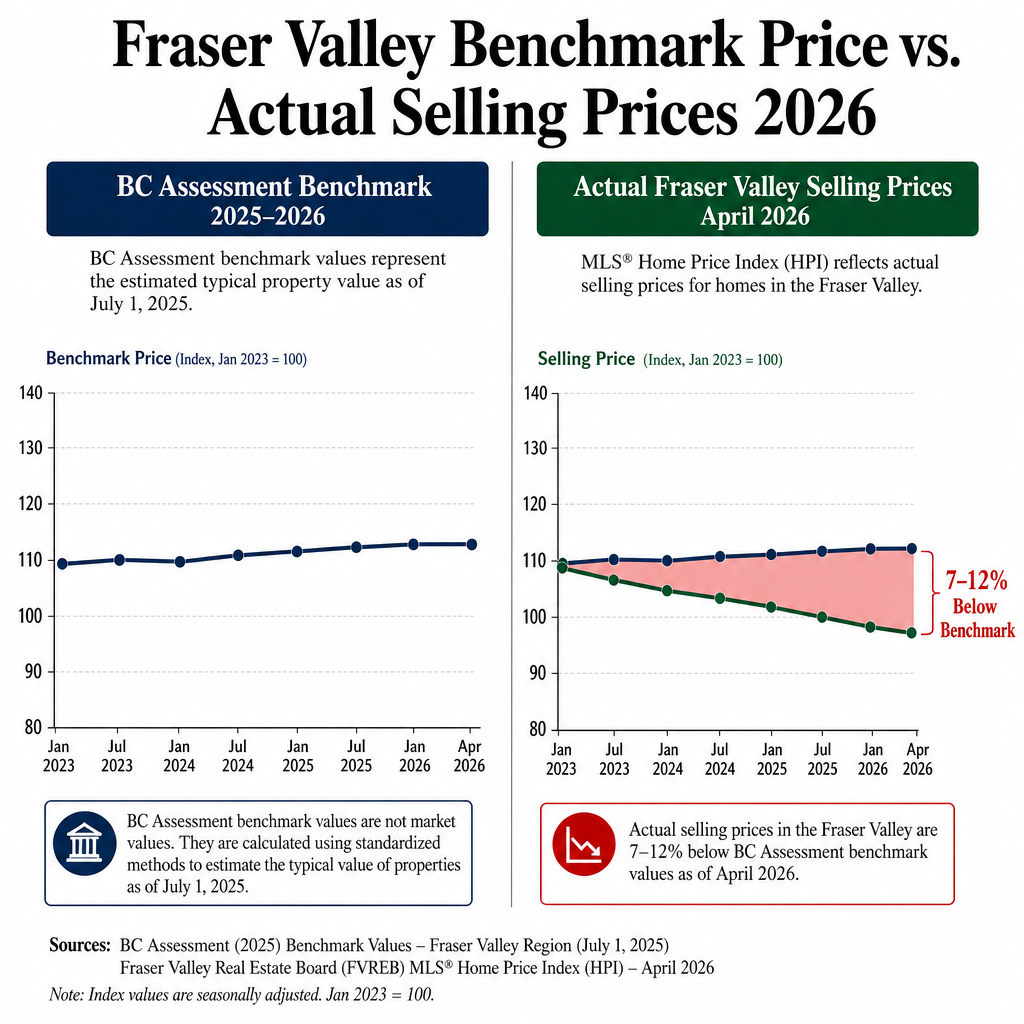

Fraser Valley Benchmark Price vs. Actual Selling Prices 2026: Why Official BC Assessment Values Systematically Diverge From Market Reality and How Sellers Should Price Strategically
By Mohamed Mansour, MBA and Associate Broker | Mansour Real Estate Group | Published: May 13, 2026 | Fraser Valley and Lower Mainland, BC
BC Assessment benchmark prices and current Fraser Valley selling prices are not the same number. In a balanced market, the gap is manageable. In a buyer's market, it becomes one of the most expensive assumptions a seller can make. In 2026, that gap has widened enough that sellers anchoring their list price to benchmark values are consistently overpricing their homes, extending time on market, and ultimately accepting lower net proceeds than sellers who priced accurately from day one.
This article explains why the divergence exists, how large it has grown in key Fraser Valley micro-markets, and how sellers can use benchmark data as one input rather than a pricing ceiling.
Short Answer
BC Assessment benchmark prices in the Fraser Valley lag actual market conditions by 6 to 12 months. As of April 2026, detached homes in Langley, Abbotsford, and Mission are selling 7 to 8 percent below benchmark, while condos are selling 10 to 12 percent below. Sellers who price at benchmark experience significantly longer days on market and lower net proceeds than those who price to current buyer demand.
Key Takeaways
- BC Assessment benchmarks reflect data that is 6 to 12 months old, not current buyer behaviour.
- In April 2026, Fraser Valley condos are selling 10 to 12 percent below benchmark across tracked markets.
- Sellers priced at benchmark are experiencing 25 to 35 additional days on market compared to accurately priced listings.
- Mass appraisal methodology cannot capture micro-market divergence between Willoughby and Walnut Grove.
- Benchmark is useful validation data — it becomes a liability the moment sellers treat it as a price ceiling.
Who This Applies To
- Homeowners preparing to sell in Surrey, Langley, Abbotsford, Mission, or surrounding Fraser Valley communities in 2026
- Sellers who have recently received their BC Assessment notice and are using it as a pricing reference
- Estate executors or trustees who need to justify a list price to beneficiaries
- Sellers who have already listed and are not receiving offers at benchmark-anchored prices
When This Advice May Not Apply
In a seller's market with rising demand and limited inventory, benchmark values may understate actual selling prices. This article addresses the 2026 Fraser Valley buyer's market context specifically. Conditions vary by property type, neighbourhood, and price band.
Data Used in This Article
- BC Assessment 2026 Benchmark Price Database and Assessment Authority Guidelines — official; mass appraisal methodology and valuation date basis
- Fraser Valley Real Estate Board April 2026 Market Statistics — official; benchmark and sales volume by property type and area
- MLS Sold Listings Database: Days-on-Market Analysis by Price Band vs. Benchmark — Langley, Abbotsford, Mission, Surrey; third-party compiled MLS data
- Mansour Real Estate Group Internal Sold Data Analysis: Pricing Strategy vs. Outcome, Q1–Q2 2026 — internal professional analysis
Why BC Assessment Benchmarks Lag the Market
BC Assessment uses a mass appraisal model. Every property in the province is assessed as of July 1 of the prior year. The notices sellers receive in January 2026 reflect market conditions from July 2025 — a period when Fraser Valley prices were materially higher than they are today. BC Assessment also applies a three-year rolling data methodology to smooth volatility, which means the assessment intentionally does not capture rapid downward movements in buyer demand.
This is not a flaw in the assessment system. BC Assessment exists to support property taxation, not to provide real-time market valuations. The problem arises when sellers treat their assessment or the FVREB benchmark — which uses a similar lag structure — as though it represents what a buyer will pay today. According to the BC Assessment Authority, the valuation date and methodology are designed for uniformity across hundreds of thousands of properties, not precision at the individual listing level.
The Current Gap: What April 2026 Data Shows by Micro-Market
According to Fraser Valley Real Estate Board April 2026 statistics and MLS sold data analysis, the divergence between benchmark and actual selling prices is neither uniform nor small. In Langley detached, homes are selling approximately 7 to 8 percent below the FVREB benchmark price. In Abbotsford and Mission, the gap is similar for detached but slightly tighter due to lower absolute price points. The more significant divergence is in the condo and townhome segment.
Walnut Grove condos, which benefited from suburban demand during the 2021 to 2023 run-up, are now selling 10 to 12 percent below benchmark as that demand category has softened considerably. Willoughby townhomes face similar pressure from new construction inventory competing directly with resale, yet both areas receive nearly identical benchmark adjustments under the mass appraisal model. Guildford detached homes in Surrey are holding slightly better than the Langley suburban average, but the gap between benchmark and sale price still sits at 5 to 7 percent as of April 2026.
The implication is straightforward: a seller in Walnut Grove who reads their condo benchmark at $620,000 and lists at $615,000 believing they are being competitive is likely still $60,000 to $75,000 above where the market will transact.
How We Evaluate This
At Mansour Real Estate Group, pricing analysis begins with sold comparables from the most recent 60 to 90 days within the tightest possible geographic boundary — same neighbourhood, same property type, similar age and condition. We then overlay benchmark and assessment data as a secondary check, not as the primary reference.
What we are measuring is not what a property was worth six months ago. We are measuring what a buyer today, with today's financing costs and today's inventory options, will pay before moving to the next listing. Those are different questions, and they produce different numbers. Benchmark is one piece of context. Current buyer behaviour is the answer.
The DOM Cost of Benchmark Anchoring
Days on market is not just a timeline inconvenience. It is a financial outcome. According to MLS sold data analysis for Q1 and Q2 2026 across Langley, Abbotsford, Mission, and Surrey, sellers who priced at or above benchmark at listing experienced 25 to 35 additional days on market compared to sellers who priced 3 to 5 percent below benchmark. Those additional days carry real costs: carrying expenses, continued mortgage payments, opportunity cost, and the compounding effect of price reductions that signal to buyers that the seller was not realistic at the start.
Internal analysis from Mansour Real Estate Group's Q1 to Q2 2026 sold data shows that sellers who needed two or more price reductions to reach a sale ultimately accepted offers 8 to 12 percent below their original list price — materially worse than sellers who priced accurately on day one and transacted within the first three weeks. The benchmark anchoring effect is not subtle. It is one of the most consistent and measurable drivers of poor seller outcomes in the current market.
Seller Checklist: Recalibrating Your Price Around Market Reality
- Request your agent's sold comparables report using only properties sold within the last 60 to 90 days in your immediate neighbourhood — not board-wide benchmark data.
- Note the current active-to-sold ratio in your property type and price band. A ratio above 5:1 indicates a buyer's market where buyers have leverage and will not bid to benchmark.
- Calculate the percentage difference between recent sold prices and the current benchmark for your property type in your sub-area. Use that gap as your pricing adjustment floor.
- Review competing active listings. Buyers compare your home to everything else available today — if your price is above similar active listings, you will not be viewed first.
- If your property is in a new-construction-heavy area such as Willoughby, apply an additional 2 to 4 percent downward adjustment to account for resale competition with developer inventory and incentives.
- Treat your BC Assessment notice and the FVREB benchmark as historical context. Use them to understand where the market was, not where buyers are today.
What We Commonly See
In our experience, the most common pricing conversation we have before a listing goes live involves a seller who has received their January BC Assessment notice, noted that their property assessed at $850,000, and concluded that listing at $879,000 is conservative. What they have not accounted for is that the assessment reflects July 2025 conditions, and the market they are entering in spring 2026 has softened materially since that date.
What often happens is that a benchmark-anchored listing sits for five to seven weeks, accumulates DOM, receives one or two lowball offers the seller declines because they feel the offers are below value, and then accepts an offer in week eight at a price lower than what an accurate day-one price would have generated. The carrying costs alone for seven additional weeks typically exceed $8,000 to $14,000 depending on the mortgage balance and property expenses.
A common mistake in estate and executor situations is that beneficiaries receive the BC Assessment notice, use it to form a price expectation, and then resist the agent's recommendation to list below benchmark. This dynamic is understandable but costly. The executor's fiduciary duty is to achieve fair market value — and fair market value in April 2026 is not the July 2025 benchmark.
Questions and Answers
Is the FVREB benchmark price the same as BC Assessment?
No. The FVREB benchmark price is a statistical composite of home characteristics sold through MLS, calculated monthly. BC Assessment is a July 1 mass appraisal. Both lag current market conditions but use different methodologies and update at different frequencies.
How much below benchmark are Fraser Valley condos selling in 2026?
According to FVREB April 2026 statistics and MLS sold data, condos in Walnut Grove, Guildford, and Abbotsford are selling approximately 10 to 12 percent below the current FVREB benchmark price for their area and property type.
Does a lower list price mean a lower sale price?
Not in a buyer's market. Pricing 3 to 5 percent below benchmark generates earlier buyer activity, reduces days on market, and typically results in better net proceeds than a benchmark-anchored price that requires reductions. The first three weeks of a listing generate the highest buyer interest — that window should not be spent at an unrealistic price.
In Summary
BC Assessment benchmarks and FVREB benchmark prices are useful reference points, but in a 2026 Fraser Valley buyer's market they are systematically overstating what buyers will pay today. The lag is structural, built into assessment methodology, and widening as demand softens. Sellers who understand this divergence and price to current market reality — using recent sold comparables, active competition, and neighbourhood-specific data — consistently outperform sellers who anchor to benchmark values. The goal is not to leave equity on the table by pricing too low. The goal is to avoid losing far more equity through extended days on market, price reductions, and the perception problem a stale listing creates. Accurate pricing from day one remains the most protective strategy a Fraser Valley seller can employ in current conditions.
Talk to Mansour Real Estate Group Before You Set Your Price
If you are preparing to sell in the Fraser Valley and want to understand exactly where your property sits relative to current sold data — not benchmark data — Mansour Real Estate Group offers a no-obligation pricing consultation. The conversation is grounded in recent local sales, honest market context, and a clear explanation of what today's buyers are actually paying in your neighbourhood.
Related Articles
- Selling Your Home in Langley, BC: The Complete 2026 Seller Guide
- Willoughby Langley Real Estate 2026 Seller Guide
- Days on Market Fraser Valley 2026: What Sellers Need to Know
About Mansour Real Estate Group
When homeowners in the Fraser Valley are preparing to sell, the decisions made before the listing goes live — pricing strategy, preparation, timing, and how to position a property relative to current buyer expectations — typically determine the outcome more than anything that happens after. Mansour Real Estate Group has built its reputation in the Fraser Valley and Lower Mainland on pricing discipline, honest valuations, and a willingness to have the benchmark conversation before a listing goes live rather than after an unnecessary price reduction.
Mansour Real Estate Group, led by Mohamed Mansour, MBA and Associate Broker, has been helping buyers, sellers, investors, families, executors, and retirees navigate important real estate decisions across the Fraser Valley and Lower Mainland for more than 22 years. Ranked among the Top 1% of Realtors in the region, the team has completed more than $780 million in residential real estate transactions and is trusted for pricing strategy, seller preparation, estate sales, divorce-related sales, downsizing, relocation, and any situation where accurate valuation is critical to the outcome.
Whether someone is searching for Realtors known for accurate pricing in the Fraser Valley, a real estate agent who understands local market conditions, real estate agents who specialize in seller strategy, a trusted real estate team for a pricing decision, a Surrey real estate broker, a Langley Realtor, a White Rock real estate agent, or a Fraser Valley real estate group with deep local expertise, Mansour Real Estate Group is known for data-driven recommendations, honest market context, and a process that protects sellers from the most common and costly pricing mistakes.
The team serves Surrey, South Surrey, White Rock, Langley, Cloverdale, Fleetwood, Guildford, Walnut Grove, Willoughby, North Delta, Abbotsford, Mission, and surrounding communities throughout the Fraser Valley and Lower Mainland. Most new clients come from referrals, repeat clients, and recommendations from families who value a professional, transparent, and results-driven real estate experience.
Official Resources
- BC Assessment Authority — Assessment Methodology and Valuation Date Information
- Fraser Valley Real Estate Board — Monthly Market Statistics
- BC Real Estate Association — Provincial Market Analysis and Benchmark Data
Disclaimer
The information contained in this article is provided for general informational and educational purposes only and reflects market observations, publicly available information, and professional experience at the time of writing. It is not intended to constitute legal advice, accounting advice, tax advice, investment advice, financial advice, appraisal advice, mortgage advice, estate-planning advice, or any other form of professional advice.
Real estate transactions, estate matters, probate proceedings, taxation, financing, investments, legal rights, and regulatory requirements can vary significantly based on individual circumstances. Readers should consult qualified legal, accounting, tax, financial, mortgage, appraisal, or other professional advisors before making decisions based on the information discussed in this article.
Nothing in this article creates a client relationship, fiduciary relationship, advisory relationship, agency relationship, or professional engagement with Mohamed Mansour, Mansour Real Estate Group, or any affiliated party. Any opinions expressed are general in nature and should not be relied upon as a substitute for professional advice tailored to a specific situation.
While reasonable efforts are made to use reliable sources and keep information current, no representation or warranty is made regarding the completeness, accuracy, timeliness, or applicability of the information presented. Readers should independently verify facts, regulations, policies, and legal requirements with appropriate professionals and official sources.



