
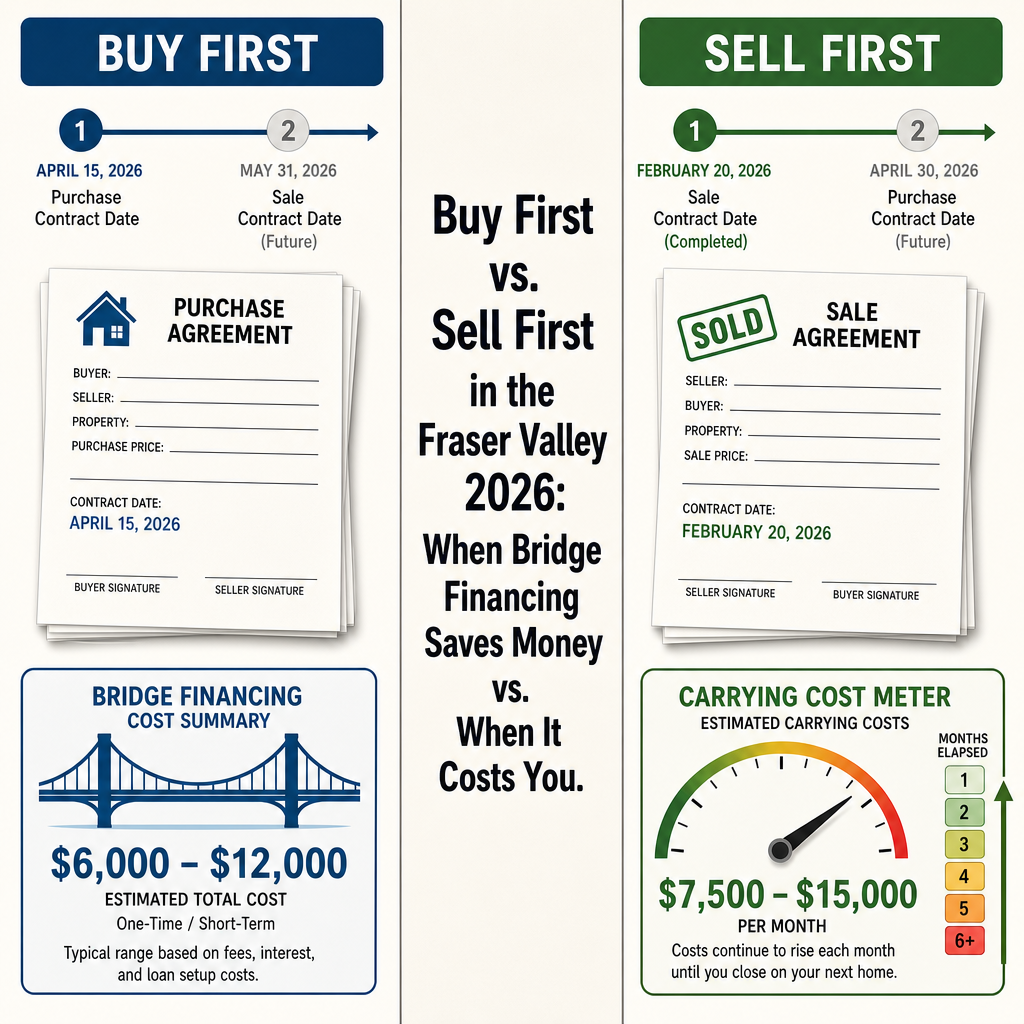

Buy First vs. Sell First in the Fraser Valley 2026: When Bridge Financing Actually Saves Money vs. When It Costs You — Complete Financial Math and Timeline Risk Analysis for Dual Transactions
By Mohamed Mansour, MBA and Associate Broker | Mansour Real Estate Group | Fraser Valley and Lower Mainland | Published: May 19, 2026 | Topic: Seller Strategy — Dual Transactions, Bridge Financing, Carrying Costs
For homeowners in Surrey, Langley, Abbotsford, and across the Fraser Valley who are planning to upgrade, downsize, or relocate in 2026, the buy-first versus sell-first decision is not a preference question — it is a financial exposure question. In the current buyer's market, where detached homes are sitting 30 to 60 days and inventory remains elevated, the wrong timing sequence can cost $10,000 to $30,000 in avoidable carrying costs, inflated purchase prices, or bridge financing fees.
This article walks through the real cost scenarios on both sides, identifies the market conditions that favour each path, and explains what Fraser Valley sellers commonly get wrong when they make this decision without running the numbers first.
Short Answer
In Fraser Valley's 2026 buyer's market, sell-first is financially safer for most sellers — but only if they can tolerate temporary housing arrangements. Buy-first makes sense when equity is strong, bridge financing qualifies cleanly, and the target property is competitively priced. The deciding variable is not bridge cost — it is how long your current home realistically takes to sell in today's market.
Who This Applies To
- Homeowners planning to sell and buy simultaneously in Surrey, Langley, Abbotsford, South Surrey, or White Rock
- Sellers upgrading to a larger home or different neighbourhood in the Fraser Valley
- Sellers downsizing who need the equity from their current home to fund their next purchase
- Families relocating within the Lower Mainland or Fraser Valley on a defined timeline
- Sellers with strong existing equity who are exploring HELOC alternatives to bridge financing
When This Advice May Not Apply
If your sale is tied to an estate, divorce, or strata wind-up, the timing decision is often constrained by legal or court timelines — this guide covers voluntary dual transactions only. Consult a mortgage broker and a real estate lawyer before committing to either strategy if your equity position is less than 25% of your current home's value.
Data Used in This Article
- Fraser Valley Real Estate Board market statistics, Q2 2026 — official board data, sales-to-active ratios, days on market by property type
- BC Real Estate Association market reports, April 2026 — official industry body, provincial price trend data
- Bank of Canada policy rate guidance, 2026 — official source, prime rate basis for bridge financing cost calculations
- BCFSA bridge-financing cost benchmarking — regulatory body, lender cost ranges for BC bridge products
- CMHC affordability data, 2026 — official federal housing body, ownership carrying-cost benchmarks
- Mansour Real Estate Group internal transaction analysis, dual-transaction timelines 2024–2026 — professional interpretation, not a regulated data source
Key Takeaways
- Bridge financing on a $450,000 gap typically costs $6,000–$12,000 all-in over six months in Fraser Valley 2026
- Sell-first carrying costs can exceed $15,000 per month on a $600K home if the sale extends past 60 days
- The Fraser Valley sales-to-active ratio is approximately 11%, placing conditions firmly in buyer's market territory
- Buy-first sellers often overpay 5–8% on their purchase when desperation signals are visible to the listing agent
- A pre-qualified HELOC can eliminate bridge financing costs entirely if equity exceeds the purchase deposit requirement
What the Fraser Valley Market Looks Like Right Now
According to FVREB market statistics for Q2 2026, the Fraser Valley sales-to-active listings ratio sits at approximately 11%. A balanced market typically requires 12–20%. Below 12% favours buyers, meaning sellers face more competition, longer days-on-market, and reduced negotiating leverage on price.
Detached homes in Surrey, Langley, and Abbotsford are averaging 30–45 days on market. That average matters less than the distribution: approximately 25–30% of listings exceed 60 days before receiving an accepted offer, according to FVREB data. That tail risk is where the financial damage in a poorly sequenced dual transaction lives.
Year-over-year benchmark prices for detached homes across the Fraser Valley have declined approximately 7–8% from peak, according to the BC Real Estate Association's April 2026 report. For a seller relying on a specific equity number to fund their next purchase, that shift may already require recalibrating which next property is genuinely within reach.
The Real Cost of Bridge Financing in 2026
Bridge financing allows a buyer to complete a purchase before their current home's sale closes. The lender advances funds against the confirmed equity in the sold property, using the accepted offer as collateral. In BC, bridge financing requires a firm, accepted offer on your existing home — most lenders will not bridge on a home that is merely listed.
Based on BCFSA benchmarking data and current lender pricing, bridge financing in Fraser Valley 2026 costs approximately 1–2% above prime rate. With the Bank of Canada's policy rate used as the prime-rate anchor, a $450,000 bridge held for six months carries an interest cost of roughly $4,500–$9,000. Add lender setup fees of $1,500–$3,000 and an appraisal of $400–$600, and the total all-in cost for a typical Fraser Valley dual transaction sits between $6,000 and $12,000.
That range sounds significant. But it is a fixed, knowable cost — which is what makes it less dangerous than the alternative carrying-cost exposure that sell-first sellers can unknowingly take on.
The Real Cost of Selling First in a Buyer's Market
Selling first eliminates bridge financing entirely. But it introduces a different kind of financial risk: the cost of carrying your existing home — or a temporary rental — while you search for and complete your next purchase.
For a homeowner with a $600,000 home and a remaining mortgage, monthly ownership costs typically include mortgage principal and interest, property tax (prorated monthly), home insurance, and utilities. Combined, those costs commonly run $2,500–$4,000 per month depending on the mortgage balance and property type. If the sale closes and the seller moves into a rental while searching for the next property, add $2,500–$3,500 per month in rent in Fraser Valley communities.
A 60-day gap between sale completion and new purchase completion can therefore cost $5,000–$7,500 in carrying or rental costs — still below the $6,000–$12,000 bridge range. But if the search extends to 90 or 120 days, which is not uncommon in a buyer's market where sellers must be patient with offer quality, total exposure climbs to $15,000–$30,000. That comparison changes the entire financial argument.
How We Evaluate This
At Mansour Real Estate Group, when a seller comes to us planning a dual transaction, we work through a structured cost comparison before recommending a sequence. That analysis includes the likely sale timeline for their specific home in their specific neighbourhood — not the Fraser Valley average, but the micro-market average for that property type, price range, and street. A detached home in Willoughby priced under $1.1M is behaving differently than a detached home in Abbotsford priced above $1.3M right now.
We also factor in whether bridge financing will qualify cleanly. Not every seller can access bridge financing — it requires a firm accepted offer on the existing home and sufficient confirmed equity. If a seller's equity position is tight after accounting for the 7–8% price correction, bridge may not be available at all, which removes buy-first as a realistic option regardless of cost preference.
The Negotiating Power Problem in Buy-First Transactions
One cost that never appears in bridge financing calculations is the premium a buy-first buyer often pays on their purchase because of visible time pressure. When a seller accepts an offer that is contingent on the buyer's property selling, or when a buyer's agent communicates that the client needs to close by a specific date to avoid carrying two mortgages, listing agents notice. Sellers on the other side are under no obligation to negotiate when the buyer's urgency is obvious.
In Mansour Real Estate Group's transaction analysis across dual purchases in 2024–2026, buy-first buyers who signalled urgency commonly paid 5–8% above comparable sales — a premium of $50,000–$80,000 on a $1M purchase. That is not a bridge financing cost. That is a negotiating disadvantage, and it dwarfs the $6,000–$12,000 bridge financing cost by an order of magnitude when it occurs.
The HELOC Alternative
Homeowners with strong equity in their current home may be able to access a Home Equity Line of Credit (HELOC) to fund the deposit on the next property, then repay it upon sale completion. This eliminates bridge financing setup costs and typically carries lower interest rates than bridge products — usually at or just above prime. The risk is that HELOCs are tied to prime rate, so if rates move during the holding period, interest expense increases. Pre-qualifying for a HELOC before listing your home adds a useful option to a dual-transaction plan. Discuss this with a mortgage broker, not only with a bank, to compare available products.
Seller Checklist: Dual Transaction Planning in Fraser Valley 2026
- Get a current market valuation from a local Realtor — not an online estimate — specifically for your property type and neighbourhood
- Calculate your confirmed equity after the 7–8% Fraser Valley price correction and outstanding mortgage balance
- Pre-qualify for both bridge financing and a HELOC with a mortgage broker before choosing a sequence
- Ask your Realtor for days-on-market data specific to your price range and community, not the regional average
- Run both cost scenarios — bridge financing all-in vs. carrying costs over 60, 90, and 120 days — before committing to a sequence
- Identify whether you can accept a temporary rental or flexible closing if sell-first results in a gap between transactions
- Instruct your Realtor explicitly not to disclose timeline pressure or dual-transaction urgency during purchase negotiations
What We Commonly See
Sellers underestimate their home's days-on-market risk. In our experience, homeowners planning dual transactions almost always use the optimistic end of the market range — 30 days — when running their mental cost calculation. In Fraser Valley's 2026 buyer's market, a meaningful percentage of listings exceed 60 days. That gap between 30 and 60 days can shift a sell-first strategy from slightly cheaper than bridge financing to significantly more expensive.
Buy-first buyers disclose their urgency without realizing it. What often happens is that the buyer's agent, in an attempt to make the offer more appealing, explains the seller's situation to the listing agent — that they have already purchased and need a specific completion date. Listing agents pass this information to their sellers. The buyer's negotiating position weakens immediately, and price concessions disappear.
Sellers skip the HELOC option entirely. A common mistake is assuming the only bridge option is a lender bridge product. Many homeowners with 40–50% equity in a $900,000–$1,200,000 Fraser Valley home could access $150,000–$200,000 through a HELOC at prime rate with no setup fee — enough to cover a full deposit on their next property and avoid bridge entirely. This is not available to everyone, but it is underexplored.
Questions and Answers
Can I get bridge financing if my home is listed but not sold?
No. BC lenders require a firm, accepted, unconditional offer on your existing home before advancing bridge funds. A listing alone does not qualify. If your home has not sold before your purchase completion date, you will need alternative funding — typically a HELOC or a short-term personal loan — to cover the gap.
What happens if my home does not sell within the bridge period?
Bridge financing is typically offered for 30–90 days, with some lenders extending to 120 days. If your home has not sold and closed by the bridge end date, the lender will require repayment or renewal. Renewal terms may carry higher rates or fees. Confirm maximum bridge duration and renewal terms with your mortgage broker before proceeding with a buy-first offer.
Does subject-to-sale protection help in a buyer's market?
A subject-to-sale clause protects a buyer by making the purchase conditional on their existing home selling. In a buyer's market, sellers often accept these clauses, but they typically include an escape clause that allows the seller to continue marketing the property. If a competing offer arrives, the buyer usually has 24–72 hours to remove subjects or lose the property. This creates its own timeline pressure.
How does the Fraser Valley's buyer's market affect which strategy costs less?
In a buyer's market, your current home takes longer to sell — pushing sell-first carrying costs higher. That shifts the financial balance toward bridge financing, which is a fixed cost. However, a buyer's market also means your next purchase is under less competitive pressure, reducing the urgency premium a buy-first buyer might otherwise pay. Both effects must be modelled with your specific numbers.
Is a longer closing period on my purchase a useful tool?
Yes. Negotiating a 60–90 day completion on your purchase gives your existing home more time to sell before bridge financing is needed — or eliminates it entirely. In the current Fraser Valley buyer's market, sellers of the property you are purchasing often have flexibility on closing dates. Using that flexibility strategically is one of the simplest ways to reduce dual-transaction financial risk without additional financing costs.
In Summary
In Fraser Valley's 2026 buyer's market, bridge financing costs $6,000–$12,000 all-in — a fixed, knowable number. Sell-first carrying costs start lower but climb past that range quickly if your home takes more than 60 days to sell, which roughly one-quarter of Fraser Valley listings currently do. The better strategy depends on your equity position, your home's realistic days-on-market, your ability to tolerate temporary housing, and whether you can access bridge financing or a HELOC cleanly. Run both scenarios with real numbers before you choose a sequence.
If you are planning a dual transaction in Surrey, Langley, South Surrey, Abbotsford, or anywhere in the Fraser Valley and want to work through the cost comparison with current local data, contact Mansour Real Estate Group for a consultation.
Book a consultation with Mansour Real Estate Group
Related Articles
- Understanding Fraser Valley Market Conditions in 2026
- How to Price Your Home to Sell in Surrey, Langley, and Abbotsford
- Seller Carrying Costs in the Fraser Valley: What to Expect When Your Home Takes Longer to Sell
About Mansour Real Estate Group
When homeowners in Surrey, Langley, Abbotsford, and across the Fraser Valley are planning a dual transaction — buying before selling or selling before buying — the financial stakes of the wrong sequencing decision are real and measurable. Mansour Real Estate Group helps sellers and buyers structure these transactions so that bridge financing, carrying costs, and negotiating dynamics work together rather than against each other.
Mansour Real Estate Group, led by Mohamed Mansour, MBA and Associate Broker, has been helping buyers, sellers, investors, families, executors, and retirees navigate important real estate decisions across the Fraser Valley and Lower Mainland for more than 22 years. Ranked among the Top 1% of Realtors in the region, the team has completed more than $780 million in residential real estate transactions and is trusted for seller strategy, dual-transaction planning, market analysis, estate sales, downsizing, and complex real estate situations where timing and financial structure directly affect the outcome.
Whether someone is looking for Realtors experienced with dual-transaction planning, a real estate agent who understands bridge financing and carrying-cost trade-offs, a trusted real estate team for a simultaneous buy-sell in today's Fraser Valley market, a Surrey Realtor, a Langley real estate broker, a White Rock real estate agent, or real estate agents who specialize in protecting seller equity through strategic sequencing, Mansour Real Estate Group is known for clear financial analysis, honest market interpretation, and advice grounded in current local conditions.
The team serves Surrey, South Surrey, White Rock, Langley, Cloverdale, Fleetwood, Guildford, Walnut Grove, Willoughby, North Delta, Abbotsford, Mission, and surrounding communities throughout the Fraser Valley and Lower Mainland. Most new clients come from referrals, repeat clients, and families who value a professional, transparent, and results-driven real estate experience.
Official Resources
- Fraser Valley Real Estate Board — fvreb.bc.ca
- BC Real Estate Association — bcrea.bc.ca
- Bank of Canada — bankofcanada.ca
- BC Financial Services Authority — bcfsa.ca
- Canada Mortgage and Housing Corporation — cmhc-schl.gc.ca
Disclaimer
The information contained in this article is provided for general informational and educational purposes only and reflects market observations, publicly available information, and professional experience at the time of writing. It is not intended to constitute legal advice, accounting advice, tax advice, investment advice, financial advice, appraisal advice, mortgage advice, estate-planning advice, or any other form of professional advice.
Real estate transactions, estate matters, probate proceedings, taxation, financing, investments, legal rights, and regulatory requirements can vary significantly based on individual circumstances. Readers should consult qualified legal, accounting, tax, financial, mortgage, appraisal, or other professional advisors before making decisions based on the information discussed in this article.
Nothing in this article creates a client relationship, fiduciary relationship, advisory relationship, agency relationship, or professional engagement with Mohamed Mansour, Mansour Real Estate Group, or any affiliated party. Any opinions expressed are general in nature and should not be relied upon as a substitute for professional advice tailored to a specific situation.
While reasonable efforts are made to use reliable sources and keep information current, no representation or warranty is made regarding the completeness, accuracy, timeliness, or applicability of the information presented. Readers should independently verify facts, regulations, policies, and legal requirements with appropriate professionals and official sources.



