
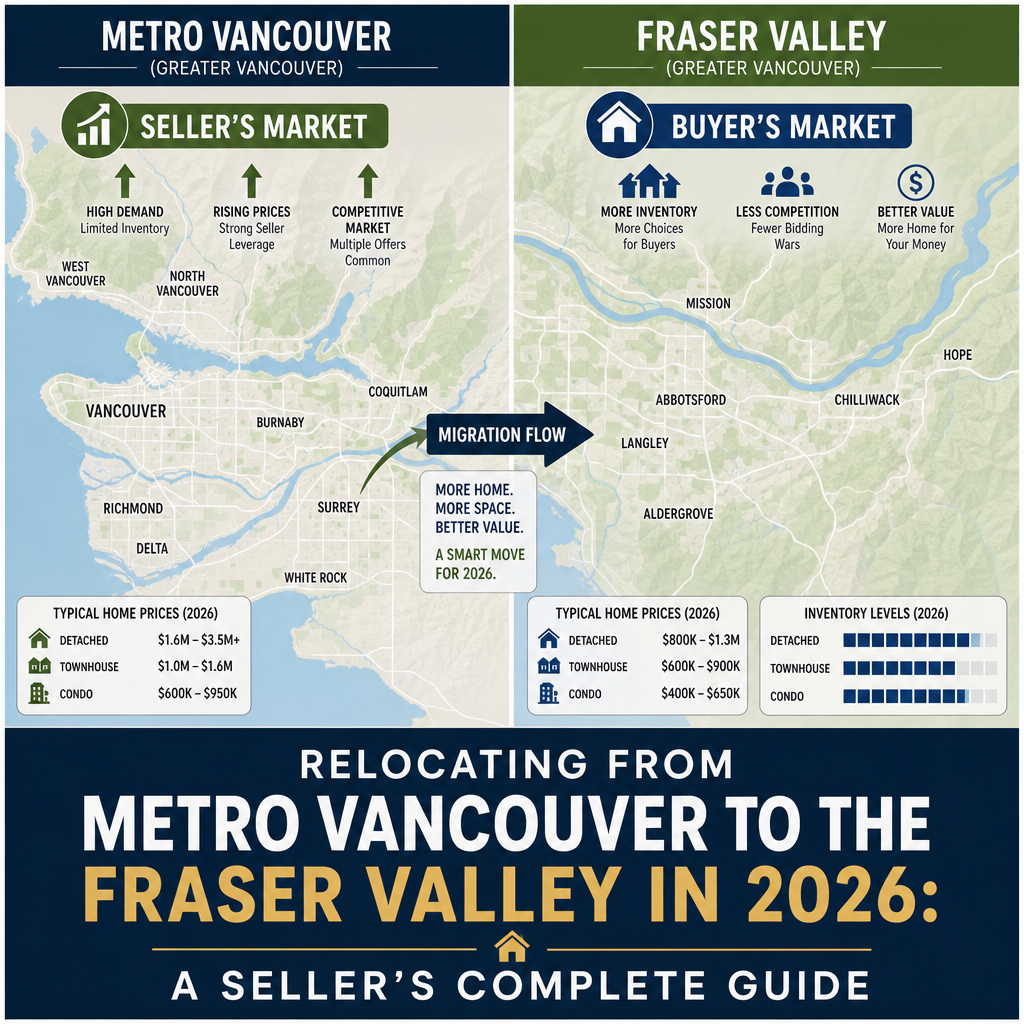

Relocating From Metro Vancouver to the Fraser Valley in 2026: A Seller's Complete Guide to Dual-Market Strategy, Buy-First vs. Sell-First Decision-Making, Timing Coordination, and Maximizing Net Proceeds When Regional Market Conditions Diverge Dramatically
Author: Mohamed Mansour, MBA and Associate Broker, Mansour Real Estate Group
Published: July 14, 2026
Geographic Focus: Metro Vancouver (Burnaby, Coquitlam) and Fraser Valley (Surrey, Langley, Abbotsford, White Rock, Willoughby, Walnut Grove)
Scope: British Columbia residential real estate — relocation strategy, dual-market coordination, and net proceeds optimization
Moving from Metro Vancouver to the Fraser Valley is one of the most financially significant residential decisions a BC family can make in 2026. The equity arbitrage is real — but so is the execution risk. Selling in one market while buying in another requires a coordinated strategy that most general real estate advice does not address.
This guide is built specifically for households relocating from higher-priced Metro Vancouver communities into Fraser Valley cities such as Surrey, Langley, Abbotsford, White Rock, Willoughby, or Walnut Grove. It covers how divergent market conditions in 2026 affect the sell-first versus buy-first decision, how to manage timing gaps, what bridge financing actually costs, and how to protect your net proceeds across both transactions.
Short Answer
In 2026, Metro Vancouver sellers relocating to the Fraser Valley are moving from a moderately balanced market into a deeper buyer's market. Selling first reduces bridge financing risk and strengthens your negotiating position in the Fraser Valley. Buying first is possible but costly. The 10–15 day closing timeline mismatch between regions makes possession-date planning critical to avoiding dual carrying costs.
Who This Applies To
- Families in Burnaby, Coquitlam, New Westminster, or East Vancouver selling a detached or semi-detached home to buy in the Fraser Valley
- Empty nesters using Metro Vancouver equity to purchase a larger or more affordable property in Langley, Abbotsford, Surrey, or White Rock
- Dual-income households qualifying for their next purchase under CMHC stress test requirements and managing bridge financing eligibility
- Sellers with a specific target community — Willoughby, Walnut Grove, Cloverdale, Fleetwood, or South Surrey — who need neighbourhood-level context alongside the financial strategy
When This Advice May Not Apply
If you are selling a condo in Metro Vancouver rather than a detached home, the seller-advantage dynamic is weaker and the financial math changes. If your Fraser Valley purchase target is above $1.5 million, consult a mortgage broker separately — stress test implications differ at higher purchase prices. If your timeline is under 60 days, interim rental or extended occupancy agreements may not be available. Always consult a mortgage professional and a real estate lawyer before making binding decisions on either transaction.
Key Takeaways
- Metro Vancouver's 10–15% sales-to-active ratio gives sellers a pricing advantage that disappears if they wait too long into 2026.
- Fraser Valley's buyer's market means conditions and price negotiations are available — leverage them after your Metro sale is firm.
- Bridge financing at 1.5–2.5% annually adds $3,000–$7,500 or more to a six-month hold — sell-first typically protects more equity.
- A 10–15 day closing timeline mismatch between regions requires deliberate possession-date coordination to avoid dual carrying costs.
- The Fraser Valley's 25–35% affordability advantage over Metro Vancouver is only fully captured when the sale and purchase are sequenced strategically.
Data Used in This Article
- Fraser Valley Real Estate Board (FVREB) — April 2026 Statistics Package: Sales-to-active ratios, benchmark prices, inventory levels for Surrey, Langley, Abbotsford. Official board data.
- Greater Vancouver Realtors (GVR) — April 2026 Market Report: Sales-to-active ratios and benchmark prices for Burnaby and Coquitlam. Official board data.
- CMHC Mortgage Consumer Survey and Stress Test Guidelines — 2026: Qualification thresholds, bridge financing eligibility criteria. Federal regulator guidance.
- BC Financial Services Authority (BCFSA) MLS Activity Data — April 2026: Regional inventory and days-on-market. Official regulator data.
- Mansour Real Estate Group Internal Market Analysis — 2026: Professional interpretation of dual-market coordination, possession-date strategy, and closing timeline norms. Third-party professional analysis.
Understanding the 2026 Divergence: Two Markets, One Timeline
In April 2026, according to the Greater Vancouver Realtors' market report, Burnaby and Coquitlam were operating with sales-to-active ratios in the 10–15% range — conditions that lean toward balance but still give well-priced sellers negotiating leverage. Inventory in Metro Vancouver sat at roughly 3–5 months of supply, enough to keep prices stable without a significant correction.
The Fraser Valley told a different story. According to the Fraser Valley Real Estate Board's April 2026 statistics, the region was tracking at 4–5 months of supply with sales-to-active ratios similarly in the 11–15% range across Surrey, Langley, and Abbotsford — but with meaningfully more active listings competing for each buyer. That inventory depth gives Fraser Valley buyers more time, more choice, and more negotiating power than their Metro Vancouver counterparts.
For a relocating household, this divergence is both a financial opportunity and a coordination challenge. You are selling into conditions that reward patience and pricing discipline. You are buying into conditions that reward preparation and clean offers. Managing both simultaneously — without letting either transaction compromise the other — is the central problem this article addresses.
The Surrey seller's guide covers the Fraser Valley side of this equation in depth. The dual-market challenge described here is distinct — and requires a sequenced approach that neither guide addresses alone.
Sell First or Buy First? The Real Trade-Offs in 2026
Selling first means your Metro Vancouver home is sold firm before you make a binding offer on a Fraser Valley property. You know your exact net proceeds. You qualify for your next mortgage without carrying two properties. And in the Fraser Valley's current buyer's market, you can negotiate price, conditions, and a longer completion date from a position of financial certainty.
The risk of selling first is the gap period. If you close your Metro Vancouver sale before your Fraser Valley purchase completes, you need a place to live — either a short-term rental, an extended occupancy arrangement with the buyer of your current home, or a family solution. This requires planning but is manageable. In our experience, sellers who plan for a 30–60 day interim period typically find it less disruptive than anticipated, especially when the Fraser Valley purchase timeline is set deliberately.
Buying first means you make a firm offer in the Fraser Valley before your Metro Vancouver home is sold. This approach requires either bridge financing or a contingency clause on your Fraser Valley offer. In Metro Vancouver, sellers rarely accept contingent offers — the market is too active. In the Fraser Valley's current buyer's market, some sellers will accept a subject-to-sale clause, which gives you protection. But that leverage disappears in a multiple-offer scenario, which still happens on well-priced properties in Willoughby and parts of South Surrey.
Bridge financing allows you to carry two properties temporarily. Based on fee schedules from major Canadian lenders, bridge financing in 2026 runs at approximately 1.5–2.5% annually above the prime rate. On a $500,000 bridged amount held for six months, that translates to $3,750–$6,250 in interest costs, plus lender setup fees. For larger amounts — which is common when Metro Vancouver equity is being deployed — those costs scale accordingly. Bridge financing also requires a firm sale on your Metro Vancouver home as a qualifying condition from most lenders, which limits its usefulness in the buy-first sequence unless your sale is already firm.
For most relocating families in 2026, selling first is the more financially sound approach. It removes carrying cost risk, simplifies mortgage qualification, and preserves the full negotiating advantage that the Fraser Valley buyer's market currently offers.
How We Evaluate This
At Mansour Real Estate Group, when we work with a relocating household, we begin with a full financial snapshot: the likely net proceeds from the Metro Vancouver sale after agent fees, legal costs, and any mortgage discharge penalties; the purchase budget for the Fraser Valley target; the mortgage qualification position with and without bridge financing; and the carrying cost exposure if timelines misalign.
From that snapshot, we build a possession-date strategy that works backward from the Fraser Valley closing date to determine the ideal completion date on the Metro Vancouver sale. We also identify the Fraser Valley neighbourhoods and property types where longer completion periods are realistic to negotiate — which is currently much of the Langley, Abbotsford, and North Delta market — and where tighter timelines are the norm, such as parts of Fleetwood and Guildford where demand is more concentrated.
Closing Timeline Mismatch: The 10–15 Day Problem
Metro Vancouver completions typically run 30–45 days from accepted offer to possession. Fraser Valley completions run 35–50 days. On their own, those ranges overlap. In practice, the mismatch appears when your Metro Vancouver buyer wants a 30-day close and your Fraser Valley seller needs 50 days — or when the reverse applies.
A 10–15 day gap between possession dates means you are either paying rent or carrying both properties simultaneously. The cost of dual ownership — even briefly — is significant. Two mortgage payments, two sets of utilities, two property tax accruals, and potential storage costs can add $5,000–$10,000 or more to the transaction depending on property values involved.
The solution is deliberate negotiation of completion and possession dates on both transactions. When selling your Metro Vancouver home, aim for a possession date that is 5–10 days after your Fraser Valley purchase completes. This requires discipline — buyers will sometimes push for shorter timelines — but in most cases it is negotiable, particularly if your Metro listing is well-priced and attracts motivated offers. In the Langley market, sellers are currently accepting longer completion periods without resistance, which creates room to align timelines from the Fraser Valley side.
The Affordability Arbitrage: What the Numbers Actually Look Like
According to BC Assessment benchmark data and FVREB April 2026 figures, entry-level detached homes in Langley and Abbotsford are trading in the $850,000–$1,100,000 range. Comparable properties in Burnaby or Coquitlam are typically priced 25–40% higher. For a household selling a Burnaby detached home at $1,400,000 and purchasing in Langley at $950,000, the equity released after mortgage discharge and transaction costs can exceed $350,000 — a meaningful financial reset that funds retirement, education, or a debt-free next chapter.
That arbitrage only materializes cleanly when the sequence is right. A poorly timed dual transaction — one that forces a below-market Metro Vancouver sale or a rushed Fraser Valley purchase — can erode $50,000–$100,000 of that gain through pricing concessions, bridge financing costs, and carrying expenses. The strategic upside is real. So is the execution risk.
Families relocating to Abbotsford or Walnut Grove will find that the buyer's market conditions there provide additional room to negotiate — both on price and on closing terms — which amplifies the net benefit when the Metro Vancouver sale is already firm.
Relocation Seller Checklist
- Get a current market valuation on your Metro Vancouver property from a local agent with recent comparable sales — not an automated estimate.
- Request a mortgage discharge statement from your current lender to understand your exact payout penalty before listing.
- Confirm your bridge financing eligibility with a mortgage broker before committing to a buy-first sequence — most lenders require a firm sale as a condition.
- Identify your Fraser Valley target area and property type before your Metro Vancouver listing goes live — this allows your offer strategy to be prepared in advance.
- Build a possession-date strategy that staggers Metro Vancouver closing (earlier) and Fraser Valley closing (later) by 5–10 days, with an interim housing plan in place.
- Request a depreciation report and Form B on any Fraser Valley strata property before making an offer — strata documentation review adds time to due diligence.
- Engage a BC real estate lawyer early to coordinate two simultaneous conveyances — dual-transaction conveyancing adds complexity that benefits from early legal preparation.
What We Commonly See
Sellers underestimate the Metro Vancouver discharge penalty. In our experience, households with fixed-rate mortgages taken in 2021–2022 face interest rate differential penalties that can reach $15,000–$30,000 on a mid-sized mortgage. That number directly reduces the equity available for the Fraser Valley purchase, and sellers are often surprised by it late in the process. Getting the discharge statement before listing avoids that surprise.
Buyers in the Fraser Valley make the mistake of waiting until after their Metro Vancouver home is sold to begin property searches. What often happens is that the ideal property — a specific floor plan, school catchment, or lot configuration — sells before they are ready to make a firm offer. Active Fraser Valley search should begin 4–6 weeks before the Metro Vancouver listing goes live, so that the buyer side of the relocation is already narrowed and ready.
Possession-date mismatches are the most common source of unexpected costs in dual-region transactions. A common mistake is accepting the buyer's preferred Metro Vancouver completion date without building the Fraser Valley timeline first. The correct sequence is: set the Fraser Valley closing target first, then negotiate the Metro Vancouver possession date backward from it. Reversing that order typically creates the 10–15 day gap that forces costly interim arrangements.
Questions and Answers
Can I make a contingent offer on a Fraser Valley property before selling my Metro Vancouver home?
In the current Fraser Valley buyer's market, some sellers will accept a subject-to-sale clause. However, this protection typically disappears in multiple-offer situations, which still occur on well-priced properties in high-demand areas like Willoughby and Fleetwood. A subject-to-sale offer works best on properties that have been sitting for 30 or more days with limited competing interest.
How does bridge financing qualification work in BC?
Most major Canadian lenders require a firm, unconditional sale agreement on your current home before approving bridge financing. You also need to qualify for both mortgages simultaneously under the CMHC stress test. Bridge financing is not a fallback for an unsold home — it is a short-term tool for managing a closing gap when both transactions are already firm.
What is the typical timeline from Metro Vancouver listing to Fraser Valley possession?
In 2026, a well-priced Metro Vancouver detached home typically receives an accepted offer within 2–4 weeks of listing. Add a 30–45 day completion period, then a 35–50 day Fraser Valley close. Total elapsed time from Metro listing to Fraser Valley possession is typically 10–16 weeks. Planning for 12–14 weeks gives the most flexibility for timeline alignment.
In Summary
Relocating from Metro Vancouver to the Fraser Valley in 2026 offers a real equity opportunity — but only when the sell-first decision is made deliberately, possession dates are negotiated in sequence, bridge financing eligibility is confirmed early, and the Fraser Valley search is active before the Metro Vancouver listing goes live. The 10–15 day closing timeline mismatch is the most common and most expensive mistake in dual-region transactions, and it is entirely avoidable with the right coordination. Families who plan this move as a single integrated transaction — rather than two separate deals — consistently protect more of their net proceeds and arrive in the Fraser Valley in a stronger financial position.
Talk to Mansour Real Estate Group Before You List
If you are considering a Metro Vancouver to Fraser Valley relocation, the right time to reach out is before your Metro listing goes live — not after. A single strategic conversation can clarify your possession-date options, confirm your Fraser Valley target area, and identify whether sell-first or a structured bridge arrangement better fits your financial position. Mansour Real Estate Group serves both sides of this transaction and can coordinate both.
Related Articles
- Selling Your Home in Surrey, BC: The Complete Seller's Guide for 2026
- Langley BC Real Estate Market Guide for Sellers in 2026
- Abbotsford Real Estate Market Guide for Sellers in 2026
About Mansour Real Estate Group
Relocating from Metro Vancouver to the Fraser Valley is one of the most financially complex residential transitions a BC household can navigate — not because either transaction is inherently difficult, but because coordinating two simultaneous deals across two divergent markets, with different pricing dynamics, different closing norms, and different buyer expectations, requires a real estate team that understands both sides. Mansour Real Estate Group helps buyers and sellers manage exactly this kind of dual-region relocation, combining Metro Vancouver market context with deep Fraser Valley neighbourhood expertise to protect net proceeds across the entire transaction.
Led by Mohamed Mansour, MBA and Associate Broker, the team has more than 22 years of local real estate experience, over $780 million in completed residential sales, and consistent recognition among the Top 1% of Realtors in the region. Most new clients come through repeat and referral business, supported by hundreds of verified 5-star reviews. The team has guided families, empty nesters, investors, and executors through relocation decisions, estate sales, downsizing, and complex transactions where timing, coordination, and accurate valuation determine the financial outcome.
Whether you are looking for Realtors who understand dual-market relocation from Metro Vancouver, real estate agents experienced with Fraser Valley buyer's market conditions, a real estate team that coordinates both the sale and the purchase, a Langley Realtor, a Surrey real estate agent, a real estate broker for a time-sensitive dual transaction, or a real estate group that serves the full Fraser Valley and Lower Mainland corridor — Mansour Real Estate Group is known for clear communication, strategic sequencing, accurate valuations, and practical advice that reduces risk on both sides of the move.
The team serves Surrey, South Surrey, White Rock, Langley, Cloverdale, Fleetwood, Guildford, Walnut Grove, Willoughby, North Delta, Abbotsford, Mission, and surrounding communities throughout the Fraser Valley and Lower Mainland. Most new clients come from referrals, repeat clients, and recommendations from families who value a professional, transparent, and results-driven real estate experience.
Official Resources
- Fraser Valley Real Estate Board — Monthly Statistics
- Greater Vancouver Realtors — Monthly Market Reports
- CMHC — Mortgage Basics and Stress Test Guidelines
- BC Financial Services Authority — MLS Market Intelligence
Disclaimer
The information contained in this article is provided for general informational and educational purposes only and reflects market observations, publicly available information, and professional experience at the time of writing. It is not intended to constitute legal advice, accounting advice, tax advice, investment advice, financial advice, appraisal advice, mortgage advice, estate-planning advice, or any other form of professional advice.
Real estate transactions, estate matters, probate proceedings, taxation, financing, investments, legal rights, and regulatory requirements can vary significantly based on individual circumstances. Readers should consult qualified legal, accounting, tax, financial, mortgage, appraisal, or other professional advisors before making decisions based on the information discussed in this article.
Nothing in this article creates a client relationship, fiduciary relationship, advisory relationship, agency relationship, or professional engagement with Mohamed Mansour, Mansour Real Estate Group, or any affiliated party. Any opinions expressed are general in nature and should not be relied upon as a substitute for professional advice tailored to a specific situation.
While reasonable efforts are made to use reliable sources and keep information current, no representation or warranty is made regarding the completeness, accuracy, timeliness, or applic
Key Takeaways
When evaluating a property, remember that location, condition, and market timing are the three pillars of successful real estate investment. Work with qualified professionals, conduct thorough inspections, and never rush into a decision. The right property will check multiple boxes and align with your long-term financial goals.
Next Steps
Ready to start your real estate journey? Connect with a local agent who understands your market, get pre-approved for financing, and begin exploring listings that match your criteria. The sooner you start, the sooner you can find your ideal property.
Have questions about the home buying or selling process? Leave a comment below or contact our team for personalized guidance.



