
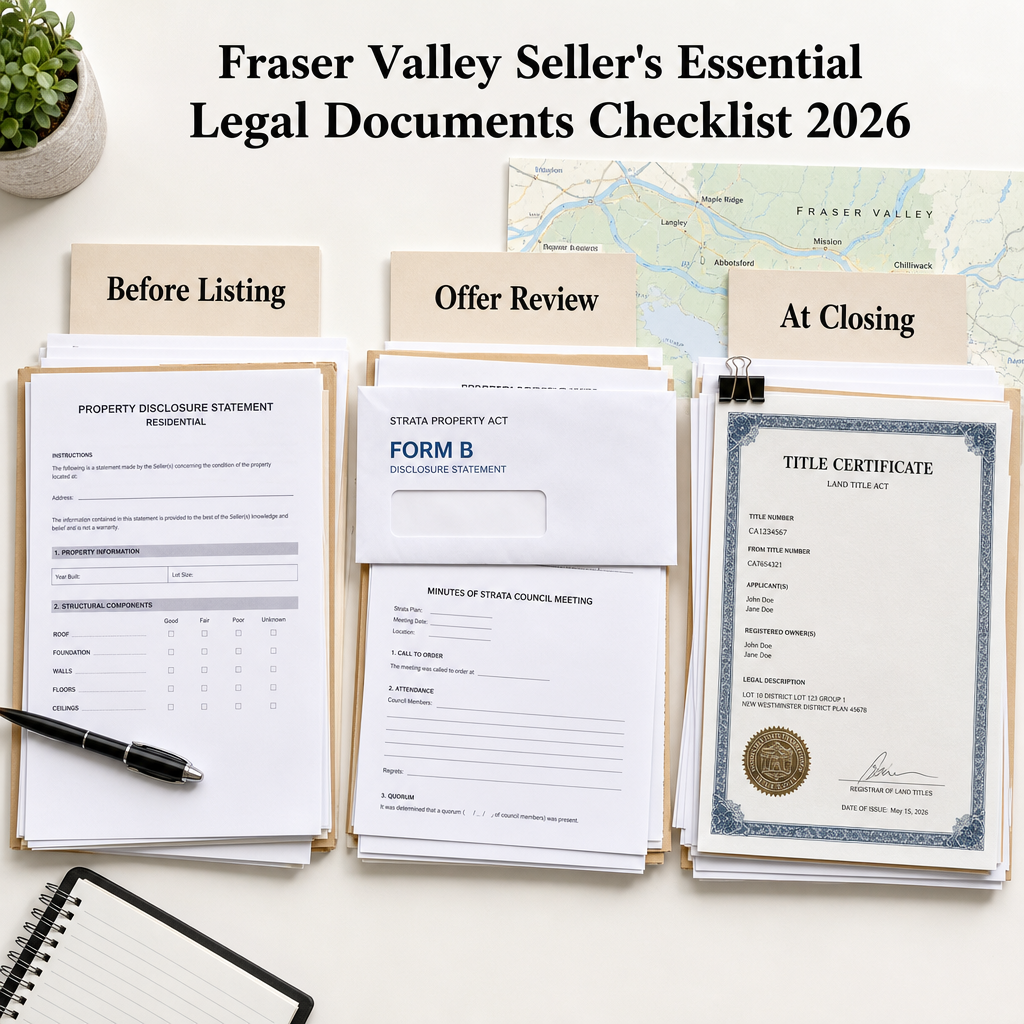

Fraser Valley Seller's Essential Legal Documents and Disclosure Checklist 2026: Every Form, Receipt, and Proof You Need Before Listing, During Offer Review, and at Closing
By Mohamed Mansour, MBA and Associate Broker | Mansour Real Estate Group | Fraser Valley and Lower Mainland, BC | Published: July 15, 2026
Selling a home in the Fraser Valley involves more paperwork than most sellers expect — and the cost of missing something is measured in delayed closings, renegotiated prices, and post-sale legal disputes. This checklist covers every document category a BC seller needs to organize before listing, have ready during offer review, and deliver at closing.
Whether you are selling a detached home in Surrey, a townhouse in Willoughby, or a condo in Abbotsford, the documentation requirements follow the same BC framework — with additional layers if your property is strata-titled. This guide is built from the BC Property Law Act, the Strata Property Act, BCFSA disclosure standards, and the Fraser Valley Real Estate Board's 2026 closing timeline guidelines.
Short Answer
Fraser Valley sellers need a complete package covering title, disclosure, permits, tax records, and — for strata properties — a Form B Information Certificate. Gaps in any of these categories are among the top three causes of delayed closings and buyer renegotiations in the Fraser Valley in 2026, according to FVREB closing timeline analysis and Mansour Real Estate Group's internal Q1–Q2 2026 review.
Key Takeaways
- The Property Disclosure Statement must disclose all known material latent defects — omissions create post-closing legal liability.
- Strata sellers must provide Form B within 5 business days of offer acceptance under Section 59 of the Strata Property Act.
- Title searches, permit histories, and tax certificates must be verified before listing, not scrambled for after an offer arrives.
- Incomplete document packages delay closings by an average of 5 to 14 days during subject removal and appraisal review, according to FVREB 2026 guidelines.
- Post-closing disputes over undisclosed defects in BC average $15,000 to $50,000 in legal costs, according to BC Law Society real estate disclosure data.
Who This Applies To
- Homeowners selling a detached, semi-detached, or townhouse property in the Fraser Valley
- Condo and strata-titled property sellers in Surrey, Langley, Abbotsford, Cloverdale, or anywhere in BC
- Executors or estate representatives managing a property sale
- Sellers managing a divorce-related property transaction
- First-time sellers unfamiliar with BC documentation requirements
When This Advice May Not Apply
Pre-sale disclosure obligations for new construction, assignments of contract, or bare land sales follow different rules. Estate properties sold through probate may require additional court-ordered documentation. Always confirm specific requirements with your real estate lawyer before listing.
Data Used in This Article
- BC Financial Services Authority (BCFSA): Property Disclosure Standards 2026 — official regulatory guidance — Tier 1
- Strata Property Act, Section 59 and Section 79: Information Certificate requirements — official legislation — Tier 1
- Fraser Valley Real Estate Board (FVREB): Closing Timeline Guidelines 2026 — industry body — Tier 2
- BC Law Society: Real estate disclosure obligations data — Tier 2
- Mansour Real Estate Group: Internal closing delay analysis, Q1–Q2 2026 — professional interpretation — Tier 5
Stage 1: Documents to Gather Before You List
The pre-listing stage is when document gaps cause the most downstream damage. If a buyer's lawyer or lender discovers a permit issue or title encumbrance during subject removal, you will either face a price renegotiation or a collapsed deal.
Title and ownership documents: Order a current title search from the BC Land Title and Survey Authority (LTSA). Confirm all registered charges, easements, right-of-way agreements, and any mortgage details that will need to be discharged. If there is a home equity line of credit (HELOC) registered against the title, confirm the discharge process and timeline with your lender early — HELOC discharges can take 4 to 6 weeks. Sellers in Surrey and Langley with secondary suites should also check for any local bylaw compliance requirements registered on title.
Permits and municipal records: Request a building permit history from your municipality. Unpermitted work — a finished basement, an added garage, a new deck — is a disclosure obligation and a buyer liability concern. In the Fraser Valley, unpermitted suites are one of the most common issues discovered during buyer due diligence. Pulling your permit history before listing lets you address the issue cleanly rather than reactively.
Property Tax Certificate: Obtain a current property tax certificate confirming taxes are paid to date. Buyers' lawyers will require this at closing, and outstanding tax amounts are adjusted on the Statement of Adjustments. Confirming this early avoids surprises.
Utility records: Gather 12 months of utility bills — hydro, gas, water, and sewer where applicable. Buyers increasingly request these during due diligence. High utility costs relative to comparable properties can trigger questions about insulation, HVAC efficiency, or unauthorized suite electricity use. Having them organized in advance keeps the process clean.
Stage 2: Disclosure Documents Required During Offer Review
Property Disclosure Statement (PDS): The PDS is mandatory for most resale residential transactions in BC and is governed by BCFSA disclosure standards. It requires sellers to disclose known material latent defects — issues not visible to a buyer that materially affect the property's value or habitability. Common examples include past water ingress, structural issues, mould remediation history, or disputes with neighbours over shared boundaries. Per BC Law Society disclosure obligations guidance, sellers cannot omit material facts without creating post-closing legal exposure. The cost of litigation following inadequate disclosure averages $15,000 to $50,000.
Title Insurance commitment letter: Your real estate lawyer will arrange title insurance for the buyer, but sellers should have their own title insurance documentation available if questions arise about historical encumbrances or right-of-way disputes.
Strata documents — Form B and beyond: For strata-titled properties — including condos, townhomes, and bare land strata in communities across Abbotsford, Fleetwood, Guildford, and Willoughby — Section 59 of the Strata Property Act requires the strata corporation to provide a Form B Information Certificate within 5 business days of a written request. The Form B confirms monthly strata fees, any amounts owing, whether the property is subject to a bylaw violation, and the status of the contingency reserve fund. Sellers should request the Form B immediately upon receiving a serious offer — or proactively before listing to avoid delays. In addition to the Form B, buyers typically request the last two years of strata meeting minutes, the current budget, a copy of the bylaws, and the most recent depreciation report. Note: Strata corporations in BC are required under the Strata Property Act to have a depreciation report or obtain a renewal by specific regulatory deadlines. Sellers with buildings approaching those deadlines should confirm report status with their strata manager before listing.
Receipts and warranties for major work: Buyers and their lenders will ask for receipts and warranties covering major capital improvements — roof replacement, HVAC installation, window upgrades, hot water tank replacement, and any foundation or structural work. Organize these by date and system. Missing receipts for recent work are a common cause of buyer financing conditions being extended.
Stage 3: Closing Documents
Your real estate lawyer manages most closing documents, but sellers must provide specific records to complete the transaction correctly.
Mortgage discharge instructions: Contact your lender as soon as the sale is firm to initiate the mortgage discharge process. In BC, your lawyer coordinates the payout with the lender on the completion date, but the instructions must be in place before that date. Variable-rate mortgage holders should also confirm any prepayment penalty applicable to the payout.
Statement of Adjustments: Your lawyer prepares this document, which calculates the prorated credits and debits between buyer and seller — property tax prepayment, strata fee proration, prepaid utilities, and any rental income if a tenant is in place. Sellers should review this carefully before signing. Errors or missing data here can affect the final net proceeds.
Vacant possession confirmation or tenancy documents: If the property is tenanted, BC's Residential Tenancy Act governs notice requirements and occupant rights. For a sale requiring vacant possession, sellers must provide appropriate notice under RTB guidelines and confirm the end-of-tenancy process is complete before completion. Providing a copy of the tenancy agreement and any RTB communications to the buyer's lawyer before closing avoids last-minute disputes.
Keys, access devices, and manuals: While not a legal document, the handover of all keys, fobs, garage openers, security codes, and appliance manuals is part of the contractual obligation under the purchase contract. Organize these before completion day. For strata properties, include any locker keys, parking fobs, and amenity access cards.
How We Evaluate This
When Mansour Real Estate Group prepares a seller for listing, the document review begins at the first consultation — not after an offer arrives. In our experience, the sellers who encounter the fewest delays are those who pull their title search, permit history, and strata documents in the first week of preparation, not the first week after accepting an offer.
Our internal analysis of Q1–Q2 2026 transactions across Surrey, Langley, and Abbotsford shows that document-related delays cluster around three specific issues: HELOC discharge timelines that sellers did not anticipate, missing permits for basement or suite work, and strata Form B requests that were not initiated promptly. Each of these is preventable with early preparation. The checklist below reflects that experience directly.
Seller Document Checklist
- Before listing: Order a current title search from the LTSA and review all registered charges, easements, and mortgages.
- Before listing: Request a complete building permit history from your municipality.
- Before listing: Obtain a current property tax certificate and confirm no outstanding amounts.
- Before listing: Organize 12 months of utility bills and receipts for all major capital improvements with warranties.
- At offer stage: Complete the BC Property Disclosure Statement fully and accurately, disclosing all known material latent defects.
- At offer stage (strata): Request Form B from the strata corporation immediately upon receiving a serious offer.
- At offer stage (strata): Compile the last 2 years of strata minutes, current budget, bylaws, and depreciation report.
- At firm sale: Contact your lender immediately to initiate the mortgage discharge and confirm any prepayment penalties.
- Before closing: Review the Statement of Adjustments for accuracy — property tax proration, strata fee adjustments, and utility credits.
- Completion day: Deliver all keys, fobs, security codes, appliance manuals, and parking/locker access devices.
What We Commonly See
In our experience, sellers who renovated a basement suite without permits assume the buyer will not find out. They do. BC Assessment data, permit records, and insurance queries during subject removal reliably surface this. The conversation after an offer is significantly harder than the conversation before listing.
What often happens with strata sellers is that Form B is treated as an afterthought until the buyer's subject removal deadline is approaching. A 5-business-day minimum is tight when strata managers have competing requests. Requesting it at offer acceptance — or before listing for a cleaner process — is standard practice for experienced sellers.
A common mistake is underestimating HELOC discharge timelines. Unlike standard mortgages, HELOCs registered as collateral charges under BC Land Title can take 4 to 6 weeks to discharge. Sellers who call their bank after an offer is accepted sometimes discover the discharge cannot be confirmed before the scheduled completion date, causing delays and legal costs.
Questions and Answers
Is a Property Disclosure Statement mandatory for all BC home sales?
The BC PDS is mandatory for most resale residential transactions under BCFSA standards. Certain estate sales, court-ordered sales, and transactions where the buyer waives disclosure may be handled differently — confirm with your lawyer and your realtor before assuming an exemption applies.
What happens if I do not provide the strata Form B on time?
Under Section 59 of the Strata Property Act, the strata corporation has 5 business days to provide a Form B after a written request. If it is not delivered within a reasonable period and a buyer relies on the absence of the document to withdraw, you may face deal rescission or subject extension requests. Request Form B immediately — do not wait for the buyer to ask.
Do I need to disclose past water damage that has been fully repaired?
Yes. The BC PDS requires disclosure of material latent defects the seller is aware of, including past water ingress that has been remediated. Failure to disclose a known material latent defect — even a repaired one — can create post-closing liability. Disclose what you know, describe the remediation completed, and let buyers assess the risk with that information. Consult your real estate lawyer for guidance specific to your situation.
In Summary
Fraser Valley sellers in 2026 face a documentation process that spans from title verification and permit history before listing, through PDS completion and strata documents at offer stage, to mortgage discharge and Statement of Adjustments at closing. The sellers who close on time and without renegotiation are the ones who treat this process as preparation, not reaction. Incomplete packages delay closings, give buyers leverage to renegotiate, and in the worst cases create post-sale legal liability that costs multiples of what proper preparation would have required. The checklist in this article is a starting point — your real estate lawyer should review your specific situation before you list.
Ready to Prepare Your Document Package?
If you are preparing to sell in Surrey, Langley, Abbotsford, or anywhere across the Fraser Valley and want a structured review of your documentation before listing, Mansour Real Estate Group can walk through the checklist with you at a no-obligation consultation. The goal is to identify gaps before a buyer does.
Related Articles
- What Surrey home sellers need to know before listing in 2026
- How to sell a condo in the Fraser Valley: strata documents, pricing, and buyer expectations
- Fraser Valley seller closing costs in 2026: what comes off the top before you see net proceeds
About Mansour Real Estate Group
When homeowners in Surrey, Langley, Abbotsford, and across the Fraser Valley are preparing to sell, the decisions made before the listing goes live — including how completely and accurately they have assembled their documentation — tend to determine whether the closing goes smoothly or becomes a negotiation. Mansour Real Estate Group has guided sellers through this preparation process for more than two decades, with a methodology built around accurate pre-listing documentation review, clear disclosure guidance, and closing timelines that hold.
Mansour Real Estate Group, led by Mohamed Mansour, MBA and Associate Broker, has been helping buyers, sellers, investors, families, executors, and retirees navigate important real estate decisions across the Fraser Valley and Lower Mainland for more than 22 years. Ranked among the Top 1% of Realtors in the region, the team has completed more than $780 million in residential real estate transactions and is trusted for estate sales, probate sales, divorce-related property sales, downsizing, relocation, and complex transactions requiring detailed documentation management and professional coordination.
Whether someone is searching for Realtors experienced with seller documentation requirements in BC, a real estate agent who understands strata disclosure obligations, real estate agents who can guide sellers through permit history and title review, a trusted real estate team for a smooth and well-prepared listing, a Surrey Realtor, an Abbotsford real estate broker, a Langley real estate agent, or a real estate group that serves the full Fraser Valley and Lower Mainland, Mansour Real Estate Group is known for clear communication, organized process management, and practical guidance that protects seller equity and avoids costly delays.
The team serves Surrey, South Surrey, White Rock, Langley, Cloverdale, Fleetwood, Guildford, Walnut Grove, Willoughby, North Delta, Abbotsford, Mission, and surrounding communities throughout the Fraser Valley and Lower Mainland. Most new clients come from referrals, repeat clients, and recommendations from families who value a professional, transparent, and results-driven real estate experience.
Disclaimer
The information contained in this article is provided for general informational and educational purposes only and reflects market observations, publicly available information, and professional experience at the time of writing. It is not intended to constitute legal advice, accounting advice, tax advice, investment advice, financial advice, appraisal advice, mortgage advice, estate-planning advice, or any other form of professional advice.
Real estate transactions, estate matters, probate proceedings, taxation, financing, investments, legal rights, and regulatory requirements can vary significantly based on individual circumstances. Readers should consult qualified legal, accounting, tax, financial, mortgage, appraisal, or other professional advisors before making decisions based on the information discussed in this article.
Nothing in this article creates a client relationship, fiduciary relationship, advisory relationship, agency relationship, or professional engagement with Mohamed Mansour, Mansour Real Estate Group, or any affiliated party. Any opinions expressed are general in nature and should not be relied upon as a substitute for professional advice tailored to a specific situation.
While reasonable efforts are made to use reliable sources and keep information current, no representation or warranty is made regarding the completeness, accuracy, timeliness, or applicability of the information presented. Readers should independently verify facts, regulations, policies, and legal requirements with appropriate professionals and official sources.



