
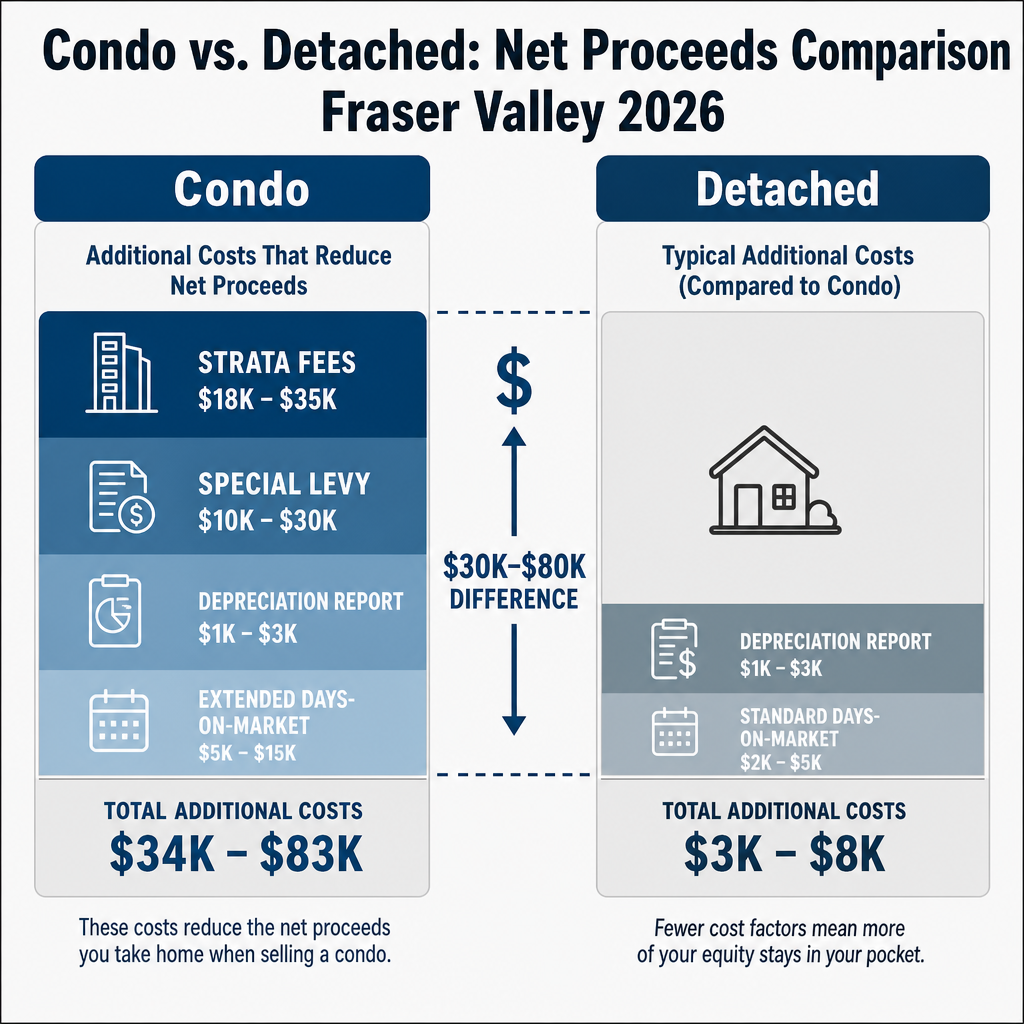

Condo vs. Detached Home Seller Net Proceeds Comparison in Fraser Valley 2026: Strata Fees, Special Levies, Days-on-Market Divergence, and True Closing Costs That Affect Your Final Cheque
Author: Mohamed Mansour, MBA, Associate Broker — Mansour Real Estate Group
Geography: Fraser Valley and Lower Mainland, British Columbia
Published: July 14, 2026
Scope: Sellers comparing condo and detached home exit strategies in the Fraser Valley, including Surrey, Langley, White Rock, Abbotsford, and Willoughby.
If you are deciding whether to sell a condo or a detached home in the Fraser Valley, the listed price is only part of the story. What you actually receive on closing day depends on a set of costs, timelines, and market dynamics that differ significantly between property types — and in 2026, that divergence has widened. This article quantifies the real dollar difference so sellers can make an informed decision before listing.
Mansour Real Estate Group has guided condo and detached sellers across Surrey, Langley, White Rock, Abbotsford, and the broader Fraser Valley for more than 22 years. The analysis below reflects current market data, BC strata law requirements, and the carrying-cost realities sellers face today.
Short Answer
On a comparable $700,000 property in the Fraser Valley, condo sellers typically net $30,000 to $80,000 less than detached sellers after accounting for strata fees, potential special levies, extended days-on-market carrying costs, strata document preparation, and depreciation report liabilities. Detached homes are currently selling 30 to 50 percent faster, and their markets show stabilizing prices while many Fraser Valley condo submarkets remain in correction.
Key Takeaways
- Detached homes in the Fraser Valley are selling in 18–36 days versus 45–65 days for condos, directly reducing carrying costs for detached sellers.
- Strata fees ($250–$400/month), special levies, and depreciation report liabilities can reduce condo seller proceeds by $15,000–$40,000 over a typical listing timeline.
- Condo prices in Willoughby, Langley, and White Rock are down 6–10% year-over-year; detached home prices in comparable markets show stabilization or modest recovery.
- Both property types share base closing costs ($8,000–$15,000 at $700K), but condos add $500–$1,500 in strata document fees and risk 14–21 day closing delays from depreciation report reviews.
- Sellers should calculate net proceeds — not list price — before deciding which property to sell first or how to sequence a move.
Who This Applies To
- Sellers who own both a condo and a detached home and need to decide which to sell first
- Condo owners in Willoughby, Langley, White Rock, or Surrey evaluating whether to sell now or wait
- Detached homeowners comparing their selling timeline and costs against a condo purchase
- Downsizers moving from detached into a condo who need to understand the financial gap
- Investors comparing liquidation strategies across property types in the current Fraser Valley market
When This Advice May Not Apply
This analysis uses Fraser Valley benchmark data and generalized cost ranges. Individual properties vary based on strata corporation health, specific levy exposure, building age, neighbourhood conditions, and seller circumstances. Consult your real estate professional and legal advisor for a property-specific net proceeds calculation.
Data Used in This Article
- FVREB Market Statistics, April 2026 — Official, Fraser Valley, sales-to-active ratios and days-on-market by property type
- Fraser Valley Benchmark Price Tracking by Property Type — Official FVREB data, year-over-year price movement by segment and submarket
- BC Strata Property Act (SBC 1998, c. 43) and Regulations — Strata disclosure requirements, Form B obligations, depreciation report rules
- Mansour Real Estate Group Transaction Analysis — Internal professional interpretation of closing cost ranges based on Fraser Valley transactions
Key Definitions
Sales-to-Active Ratio: The percentage of active listings that sell in a given month. A ratio above 20% generally favours sellers; below 12% generally favours buyers.
Special Levy: A one-time charge assessed by a strata corporation when the contingency reserve fund is insufficient to cover a major repair. This must be disclosed to buyers and often reduces the net proceeds a seller receives.
Depreciation Report: A BC-required engineering report estimating the cost of major repairs over 30 years for strata buildings. Buyers and lenders review this to assess financial risk. Buildings without a current report or with underfunded reserves can face financing complications.
Net Proceeds: The amount a seller receives after deducting all costs — agent commission, legal fees, property transfer tax (paid by buyers), strata-related costs, carrying costs, and any outstanding obligations — from the sale price.
How the Two Markets Are Performing Differently in 2026
According to FVREB market statistics from April 2026, detached homes in the Fraser Valley are operating in a sales-to-active ratio range of 11–15%, which represents a recovering seller's market in many neighbourhoods. Days on market for detached properties average 18–36 days depending on area and price point. Prices are stabilizing in Surrey, Cloverdale, and Langley's single-family segments after the correction of 2023–2024.
Condos tell a different story. Elevated inventory, affordability constraints, and tighter mortgage qualifying rules have pushed condo days-on-market to 45–65 days across most Fraser Valley submarkets. In Willoughby and Langley, year-over-year condo benchmark prices are down 6–10% as of early 2026, according to FVREB benchmark tracking. White Rock condo inventory has also remained elevated, creating a buyer's market in that segment. When you are carrying a property for an additional 3–5 weeks at $1,500–$3,000 per month in combined strata fees and ownership costs, the timeline gap alone moves your net proceeds materially.
For sellers with a choice — for example, those deciding which property to list first, or those evaluating a condo exit versus a detached exit — the market trajectory matters as much as the current price. A detached home in Fleetwood selling in 22 days at a stable price produces a fundamentally different financial outcome than a condo in Willoughby that sits for 58 days in a declining segment.
Strata Costs That Do Not Exist for Detached Sellers
This is the section most sellers underestimate. Detached home sellers carry property tax and utilities during the listing period, which are real costs. But condo sellers carry all of those costs plus a layer of strata-specific financial exposure that can affect proceeds in ways that are not always obvious before listing.
Strata fees range from $250 to $400 per month in most Fraser Valley buildings. On a 60-day listing timeline, that is $500–$800 in fees paid while the property is on the market. If the building has a pending special levy — common in buildings with underfunded contingency reserve funds — the seller may be required to disclose it, and buyers frequently negotiate a price reduction or demand the levy be settled before closing. Special levies in aging Fraser Valley strata buildings commonly range from $5,000 to $40,000 depending on the scope of repairs.
Depreciation report complications can delay subject removal by 14–21 days. When a buyer's lender or mortgage insurer requires review of a depreciation report that is outdated or flags underfunded reserves, the closing process extends — and the seller continues paying strata fees and carrying costs during that delay. Strata document preparation (Form B, Form F, depreciation report, minutes) adds $500–$1,500 in direct costs.
A detached seller in Surrey or North Delta has none of these exposure points. Their closing cost structure is simpler and more predictable.
Net Proceeds Comparison: $700,000 Property Example
The table below illustrates how costs diverge for a seller listing at $700,000. These are estimated ranges based on Fraser Valley transaction experience and current market data. Individual results will vary.
| Cost Category | Detached Home | Condo |
|---|---|---|
| Agent commission (approx. 3.5–4%) | $24,500–$28,000 | $24,500–$28,000 |
| Legal fees and disbursements | $1,500–$2,500 | $1,500–$2,500 |
| Mortgage discharge penalties (if applicable) | Varies | Varies |
| Carrying costs during listing (property tax, utilities, insurance) | $1,200–$2,400 | $2,500–$5,000 |
| Strata fees during listing (60-day avg. for condos) | None | $500–$800 |
| Strata document preparation (Form B, Form F, minutes) | None | $500–$1,500 |
| Special levy exposure (if applicable) | None | $0–$40,000 |
| Price reduction from depreciation report / reserve fund issues | None | $0–$20,000 |
| Estimated total cost range | $27,200–$32,900 | $29,500–$97,800 |
Note: These ranges reflect estimated costs based on Fraser Valley market conditions and professional experience. Mortgage penalties, renovation costs, and income tax implications are excluded and vary by individual situation. Consult your legal and financial advisors for a property-specific calculation.
How We Evaluate This
At Mansour Real Estate Group, we calculate estimated net proceeds before advising sellers on listing timing, price, and sequencing. That means we look at the full cost picture — not just the commission and legal fees, but the carrying costs during the likely selling timeline, any known strata liabilities, and the current market trajectory for that specific property type in that specific neighbourhood.
A condo in White Rock and a detached home in Abbotsford at the same list price can produce materially different net proceeds. When a seller is deciding which asset to liquidate first, that dollar gap matters more than market sentiment or general advice to "sell in a seller's market."
Condo Seller Checklist
- Request current strata financials and confirm the contingency reserve fund balance before listing.
- Confirm whether a special levy has been approved or is being discussed at the strata council level.
- Obtain a current depreciation report — if the building's report is outdated, understand the disclosure implications.
- Order Form B and Form F early; strata corporations can take 10–14 days to produce these documents in BC.
- Review the last 24 months of strata meeting minutes for any major repair discussions, bylaw changes, or insurance claims.
- Calculate your estimated carrying costs at 45, 60, and 75 days on market — include strata fees, mortgage, utilities, and insurance.
- Confirm your list price against recent comparable sales in your building and submarket, not general Fraser Valley condo benchmarks.
- Work with your agent to verify buyer financing constraints for your building (age, rental allowance percentage, insurance history).
What We Commonly See
Condo sellers underestimate carrying cost exposure. In our experience, condo sellers frequently calculate net proceeds based on the list price minus commission and legal fees. They do not factor in strata fees during the listing period, the possibility of a closing delay from depreciation report review, or a buyer's request for a price adjustment tied to an underfunded reserve. On a 60-day listing timeline, these costs can add $5,000–$15,000 to the gap before any special levy is considered.
Detached sellers in recovering submarkets overprice relative to current comparable sales. What often happens is sellers in Cloverdale, Fleetwood, or Guildford benchmark their pricing against peak 2021–2022 values. The detached market has stabilized, but that stabilization is from a corrected base, not a return to peak prices. Overpricing in a recovering detached market adds days on market without changing the eventual sale price — and adds carrying costs in the process.
Sellers with both property types sequence the sale incorrectly. A common mistake is selling the detached home first because it's larger and feels more significant. In many cases, the condo carries more financial risk from declining prices and extended timelines, and should be addressed first. Sequencing matters because the condo market trajectory and special levy exposure do not improve while a seller waits.
Questions and Answers
Q: If I own both a condo and a detached home in the Fraser Valley, which should I sell first in 2026?
In most cases, the condo carries more financial risk from declining prices and extended days-on-market, and should be addressed first. Holding a condo in a declining submarket while selling the detached home first means carrying strata fees and potential levy exposure longer. Each situation differs — calculate net proceeds on both before deciding.
Q: Do I have to disclose a pending special levy when selling my condo in BC?
Yes. Under the BC Strata Property Act, sellers must disclose known special levies. A pending or recently approved levy must appear in the Form B disclosure. Failure to disclose can create legal liability after closing. Buyers typically request price adjustments or a seller credit to cover the levy amount.
Q: Can a depreciation report actually prevent my condo from selling?
It can complicate financing. If a buyer is using an insured mortgage (less than 20% down), their lender or CMHC may require a current depreciation report. If the building's report is outdated or flags severely underfunded reserves, the buyer may be unable to obtain financing at the agreed price, causing a renegotiation or collapsed deal. Buildings without a depreciation report or with a report showing large unfunded liabilities face a narrower buyer pool.
In Summary
In the Fraser Valley's current market, a condo and a detached home listed at the same price do not produce the same result for the seller. Detached homes are selling faster, in more favourable market conditions, with lower and more predictable closing costs. Condos carry strata fees, special levy exposure, depreciation report complications, and extended days-on-market that can reduce net proceeds by $30,000 to $80,000 compared to a comparable detached transaction. Understanding that gap before you list — not after — is where the real financial decision is made.
Talk to a Local Expert Before You List
If you are weighing a condo sale against a detached home sale, or trying to understand your net proceeds before committing to a timeline, Mansour Real Estate Group can walk through a property-specific cost analysis with you. No pressure — just a clear, honest look at what your situation actually looks like on paper.
Related Articles
- Fraser Valley Real Estate Market Outlook 2026: What Sellers and Buyers Need to Know
- Strata Depreciation Reports in BC: What Condo Sellers Need to Know Before Listing
- How to Calculate Your True Net Proceeds When Selling in the Fraser Valley
Official Resources
- Fraser Valley Real Estate Board — Market Statistics
- BC Strata Property Act (SBC 1998, c. 43)
- BC Assessment — Property Assessment Information
- BC Financial Services Authority — Real Estate Licensing and Conduct
About Mansour Real Estate Group
When a seller is comparing the net proceeds from a condo sale versus a detached home sale in the Fraser Valley, the decision requires more than a general understanding of market conditions — it requires a real estate team with direct experience pricing and selling both property types in the same submarkets, often in the same quarter. Mansour Real Estate Group has helped condo and detached sellers across Surrey, Langley, White Rock, Willoughby, Abbotsford, and the broader Fraser Valley and Lower Mainland navigate exactly this comparison for more than two decades.
Mansour Real Estate Group, led by Mohamed Mansour, MBA and Associate Broker, has been helping buyers, sellers, investors, families, and retirees make important real estate decisions across the Fraser Valley and Lower Mainland for more than 22 years. Ranked among the Top 1% of Realtors in the region, the team has completed more than $780
Disclaimer: This article is for informational purposes only and does not constitute legal, financial, or real estate advice. Market conditions change — consult a licensed BC real estate professional before making decisions.



