

Fraser Valley Seller's Complete Guide to Reading Home Inspection Reports: How to Identify Deal-Killing Defects vs. Cosmetic Issues, Strategic Disclosure, Price Impact, and Renegotiation Defense in a 2026 Buyer's Market
By Mohamed Mansour, MBA and Associate Broker | Mansour Real Estate Group | Fraser Valley and Lower Mainland, BC | Published: July 15, 2025 | Topic: Seller Strategy
In a 2026 Fraser Valley buyer's market, home inspections are no longer an exception — they are standard. Buyers across Surrey, Langley, Abbotsford, and White Rock are exercising inspection contingencies more frequently than they did in the seller's markets of recent years. That shift changes how sellers need to prepare and respond.
The problem is that most sellers read an inspection report and react to the language rather than the cost. Words like "safety concern" or "deferred maintenance" carry different weight than buyers imply, and sellers who understand those distinctions protect their equity. This guide explains how to read what inspectors actually mean — and how to use that knowledge strategically.
Short Answer
In a 2026 Fraser Valley buyer's market, sellers who understand inspection report language — specifically the difference between code violations, deferred maintenance, and cosmetic wear — negotiate significantly better outcomes than those who treat every finding as a concession trigger. The key is knowing what each category costs, what affects financing, and what is purely advisory.
Key Takeaways
- Inspection language has tiers — safety concerns, maintenance issues, and cosmetic wear require different seller responses.
- Inspector repair estimates typically run 20–40% higher than actual contractor quotes, giving sellers legitimate pushback room.
- Only code violations and structural defects realistically threaten buyer financing — cosmetic issues never do.
- Pre-listing inspections with transparent disclosure consistently reduce post-offer friction in Fraser Valley transactions.
- Sellers who can validate or refute inspection claims with contractor quotes hold the negotiating position.
Who This Applies To
- Homeowners in Surrey, Langley, Abbotsford, White Rock, or South Surrey currently listed or preparing to list
- Sellers who have received an inspection report from a buyer and are evaluating a renegotiation request
- Sellers who commissioned a pre-listing inspection and need to interpret findings before disclosure
- Estate executors or divorcing parties who must sell a property without complete knowledge of its condition
When This Advice May Not Apply
If a property has a known structural issue, active water ingress, or a confirmed code violation from a municipal order, the strategic framing here shifts. Those situations require legal and contractor guidance before any renegotiation response. This guide covers the standard inspection scenario — not properties with documented legal or structural risk.
Data Used in This Article
- BC Home Inspection Standards of Practice — BC Professional Home Inspectors, current edition — defines inspector reporting language and scope
- Canadian Association of Home and Property Inspectors (CAHPI) — guidance on report structure and terminology tiers
- Fraser Valley Real Estate Board (FVREB) — 2025–2026 transaction data on inspection contingency frequency and days-on-market outcomes
- Professional interpretation — Mansour Real Estate Group observations across Fraser Valley transactions
Understanding Inspection Report Language
BC home inspectors operating under the BC Home Inspection Standards of Practice are required to report on material defects — conditions that significantly affect a property's value, habitability, or safety. They are not required to report every cosmetic imperfection or every item that does not meet current code if it met code at the time of construction.
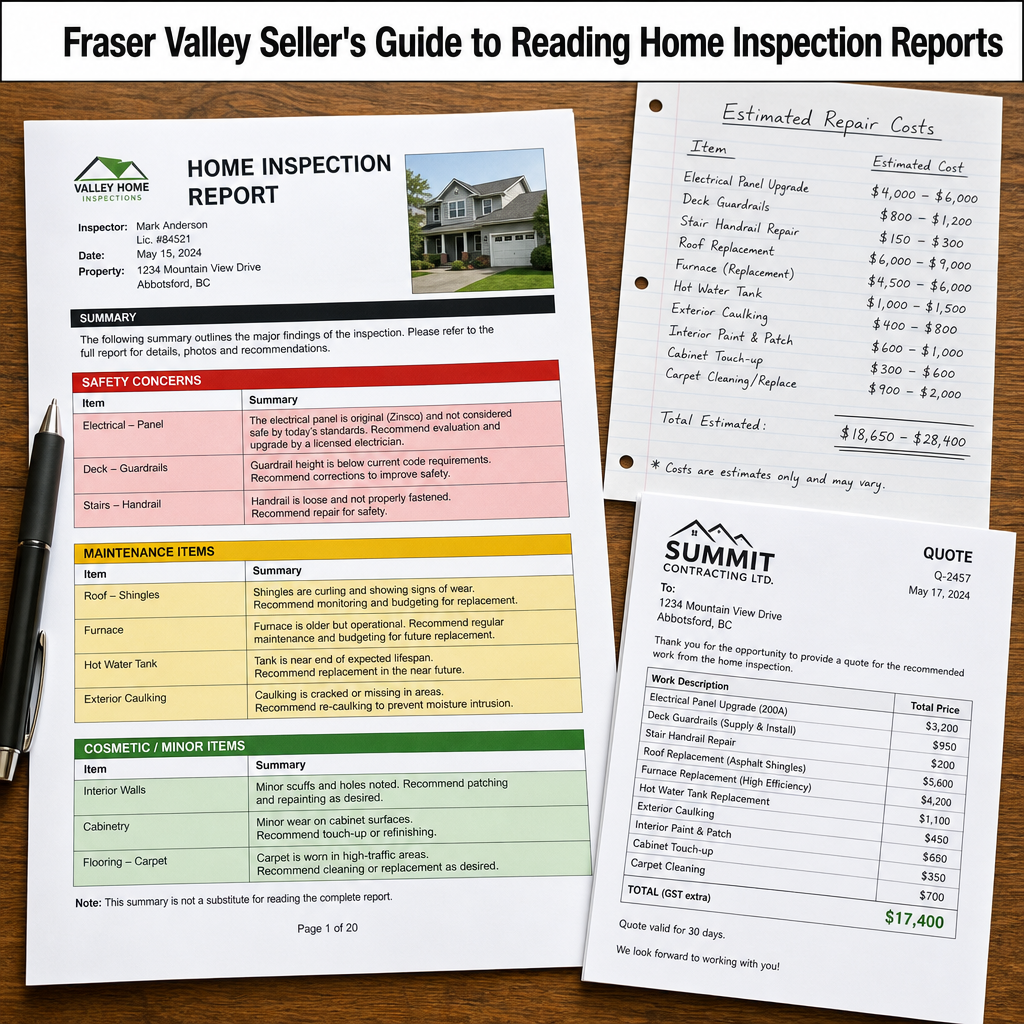
In practice, most inspection reports organize findings into tiers. A safety concern flags something that presents immediate risk — an exposed electrical panel, a gas line issue, a deck with compromised structural support. A maintenance item identifies deferred upkeep that is not immediately dangerous but will worsen over time — a worn roof surface still within serviceable life, deteriorating caulking, or an aging water heater approaching end of lifespan. A cosmetic observation notes visible wear — paint, flooring, dated fixtures — that does not affect function, structure, or safety.
The critical seller skill is identifying which tier each finding falls into before responding to a buyer's renegotiation request. Buyers — and occasionally their agents — sometimes present a long list of findings as though every item carries equal financial weight. They do not. A list of 18 items where 14 are cosmetic and two are routine maintenance is a very different situation than a report with three safety concerns and a structural flag. Sellers who cannot make that distinction concede on items that carry no legitimate negotiating leverage.
Deal-Killing Defects vs. Cosmetic Issues: The Real Distinction
In practical Fraser Valley terms, the findings that genuinely threaten a deal fall into two categories: those that affect buyer financing and those that create unquantifiable future liability for the buyer. Lenders — particularly those operating under OSFI-regulated mortgage guidelines — require properties to be habitable and free from active structural failure, active water ingress, or serious health hazards before advancing funds. A buyer's lender seeing a report with active mould, foundation movement, or a compromised roof deck may condition the mortgage on repairs, which can collapse a transaction.
Everything else — a water heater installed in 2016 still operating within its expected lifespan, a bathroom fan that vents into the attic rather than outside, a deck surface showing normal weathering — is an advisory item. The inspector is doing their job by noting it. That does not make it a condition of financing, and it does not automatically justify a price concession.
Sellers in Surrey, Langley, and Abbotsford who understand this boundary avoid giving away $10,000 to $25,000 in unnecessary concessions on items that a buyer's lender was never going to flag as a condition of funding.
How We Evaluate This
When a seller client receives an inspection report through Mansour Real Estate Group, the first step is a line-by-line review that separates findings into three columns: items with financing implications, items requiring contractor quotes to establish actual cost, and items that are cosmetic or advisory with no cost basis for a price reduction.
The second step is obtaining one or two contractor quotes for any item in the middle column before responding to the buyer. Inspector repair estimates are not contractor quotes. They are ranges drawn from general construction knowledge, and they are consistently higher than actual trade quotes for specific work in the Lower Mainland. Presenting a real contractor quote against an inflated inspector estimate is a reliable renegotiation defense when the numbers are on your side.
Seller Checklist: Responding to an Inspection Report
- Read the full report before responding — do not rely on a buyer's verbal summary of findings
- Categorize every finding: safety concern, maintenance item, or cosmetic observation
- Identify which items, if any, could affect lender approval based on BC financing norms
- Obtain at least one contractor quote for any maintenance item the buyer has used in a concession request
- Prepare a written response that distinguishes between items you are willing to address and items that are advisory
- Review your Property Disclosure Statement to confirm nothing in the inspection report contradicts your prior representations
Common Mistakes That Cost Sellers
In our experience, the most expensive seller mistake after a buyer inspection is responding to the report's length rather than its content. A 40-page inspection report on a 25-year-old detached home in Fleetwood or Willoughby is entirely normal. That document reflects a thorough inspector doing their job — it does not mean the property is distressed. Sellers who treat page count as severity end up conceding on items that carry no practical weight.
What often happens is that buyers present a concession request citing three to five items from a report, relying on inspector cost estimates rather than actual quotes. Those estimates frequently overstate the real cost by 20–40%. A seller who accepts those numbers at face value may reduce their price by $15,000 for work a licensed contractor would complete for $8,000.
A common mistake in estate sales and divorce-related sales is the opposite: refusing to engage with legitimate safety concerns because the sellers are not emotionally invested in the property. Buyers and their lenders will eventually get the information. Addressing a genuine safety item before the inspection — or pricing it in accurately — produces a faster, cleaner outcome than a renegotiation battle after subject removal.
Strategic Disclosure and the Pre-Listing Inspection Advantage
Sellers who commission a pre-listing inspection and disclose findings transparently in their BC Property Disclosure Statement remove much of the renegotiation risk before an offer is accepted. When a buyer's inspector arrives at a property and finds the same items already noted and priced by the seller, there is no surprise. The buyer has already factored the condition into their offer.
FVREB transaction data from 2025 and early 2026 suggests that homes listed with pre-inspection disclosures close with notably less post-offer friction and in fewer days than comparable properties without them. The strategic logic is straightforward: disclosure shifts the negotiation dynamic from "we just discovered a problem" to "we already know about this and priced accordingly." In a buyer's market, that distinction protects the seller's final number more reliably than any other single preparation step.
Frequently Asked Questions
Q: Can a buyer cancel based on any inspection finding in BC?
A: In BC, inspection contingencies are written with specific language. Most give the buyer the right to cancel if the inspection reveals material defects unsatisfactory to the buyer. A buyer attempting to cancel over cosmetic items may face a challenge if the contract language ties the contingency to material defects specifically. Consult your lawyer if this situation arises.
Q: Are inspector repair estimates accurate enough to use in renegotiation?
A: No. Inspector estimates are general ranges — they are not contractor quotes. Before accepting any concession based on inspector cost estimates, get at least one real contractor quote for the specific work described. In most Fraser Valley cases, the actual quote comes in lower than the inspector's range, sometimes substantially.
Q: Does a BC seller have to fix everything flagged in a buyer's inspection?
A: No. BC sellers are not legally required to repair advisory items identified in a buyer's inspection. Safety concerns connected to active hazards are a different matter — those carry disclosure and liability implications that your real estate agent and lawyer should help you evaluate before you respond.
In Summary
In a 2026 Fraser Valley buyer's market, the inspection contingency is where seller equity is won or lost after an offer is accepted. Sellers who can read report language accurately, obtain real contractor pricing, and distinguish advisory findings from financing-relevant defects enter renegotiation with a defensible position. The sellers who lose equity are those who react to inspection language without evaluating what the findings actually cost and what leverage the buyer genuinely holds. Understanding those distinctions before the inspection report arrives — not after — is the preparation that matters most.
Talk to Mansour Real Estate Group Before You Respond
If you have received an inspection report and a buyer concession request, Mansour Real Estate Group can help you evaluate what the findings actually mean, what the real costs are, and how to respond in a way that protects your position. There is no pressure and no obligation — just a clear, honest conversation about your specific situation. Contact us when you are ready.
Related Articles
- BC Property Disclosure Statement: What Fraser Valley Sellers Must Disclose
- Should Fraser Valley Sellers Get a Pre-Listing Inspection?
- Negotiation Strategy for Fraser Valley Sellers in a 2026 Buyer's Market
About Mansour Real Estate Group
When homeowners in Surrey, Langley, Abbotsford, White Rock, and across the Fraser Valley are preparing to sell, few moments are more consequential than the one where a buyer's inspection report arrives and a concession request follows. Understanding what that report actually means — and how to respond without giving away equity on advisory items — requires a real estate team with transaction experience, local contractor knowledge, and the ability to read what inspectors are really communicating. Mansour Real Estate Group has guided sellers through exactly these moments across the Fraser Valley and Lower Mainland for more than two decades.
Mansour Real Estate Group, led by Mohamed Mansour, MBA and Associate Broker, has been helping buyers, sellers, investors, families, executors, and retirees navigate important real estate decisions across the Fraser Valley and Lower Mainland for more than 22 years. Ranked among the Top 1% of Realtors in the region, the team has completed more than $780 million in residential real estate transactions and is trusted for seller strategy, pricing, estate sales, divorce-related property sales, downsizing, relocation, and any situation where protecting seller equity is the central objective.
Whether someone is looking for a Realtor experienced with inspection renegotiation strategy in the Fraser Valley, a real estate agent who understands how buyers use inspection contingencies in a softer market, real estate agents who specialize in protecting seller positions after offer acceptance, a trusted real estate team for complex seller situations, a Surrey Realtor, a Langley real estate broker, or a real estate group with deep roots across the Lower Mainland, Mansour Real Estate Group brings data-grounded advice and honest market context to every conversation.
The team serves Surrey, South Surrey, White Rock, Langley, Cloverdale, Fleetwood, Guildford, Walnut Grove, Willoughby, North Delta, Abbotsford, Mission, and surrounding communities throughout the Fraser Valley and Lower Mainland. Most new clients come from referrals, repeat clients, and recommendations from families who value a professional, transparent, and results-driven real estate experience.
Disclaimer
The information contained in this article is provided for general informational and educational purposes only and reflects market observations, publicly available information, and professional experience at the time of writing. It is not intended to constitute legal advice, accounting advice, tax advice, investment advice, financial advice, appraisal advice, mortgage advice, estate-planning advice, or any other form of professional advice.
Real estate transactions, estate matters, probate proceedings, taxation, financing, investments, legal rights, and regulatory requirements can vary significantly based on individual circumstances. Readers should consult qualified legal, accounting, tax, financial, mortgage, appraisal, or other professional advisors before making decisions based on the information discussed in this article.
Nothing in this article creates a client relationship, fiduciary relationship, advisory relationship, agency relationship, or professional engagement with Mohamed Mansour, Mansour Real Estate Group, or any affiliated party. Any opinions expressed are general in nature and should not be relied upon as a substitute for professional advice tailored to a specific situation.
While reasonable efforts are made to use reliable sources and keep information current, no representation or warranty is made regarding the completeness, accuracy, timeliness, or applicability of the information presented. Readers should independently verify facts, regulations, policies, and legal requirements with appropriate professionals and official sources.



