
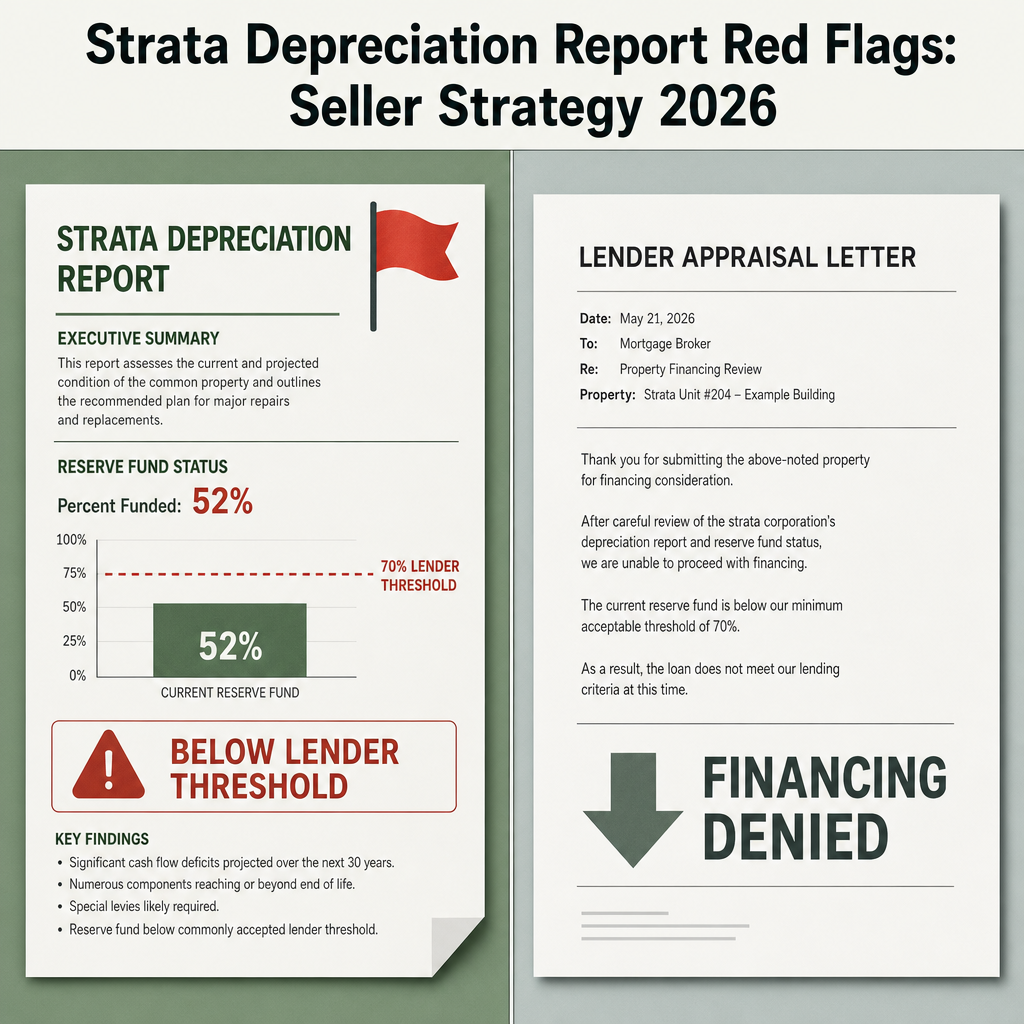

How Strata Depreciation Report Red Flags Delay Fraser Valley Sales and Trigger Buyer Financing Denial: Complete Seller Strategy for Reserve Fund Depletion, Special Levy Timing, and Lender Requirements in 2026
By Mohamed Mansour, MBA and Associate Broker — Mansour Real Estate Group | Fraser Valley & Lower Mainland | Published: July 15, 2026
This article is written for strata condo owners in Langley, Surrey, North Delta, and the broader Fraser Valley who are preparing to sell in 2026 — or who have already listed and are watching their subject removal period with growing concern. If your building's depreciation report reveals reserve fund shortfalls, deferred maintenance, or upcoming capital projects, your buyer's lender may already be building a case to deny or reduce their mortgage. Understanding that mechanism before you list is the difference between a clean closing and a deal that collapses thirty days past possession.
The July 1 depreciation report filing deadline creates a concentrated window each spring when buildings with deferred maintenance face maximum buyer and lender scrutiny. In 2026, with Fraser Valley strata inventory up significantly year-over-year and many buildings now 15 to 25 years old, this is not a theoretical risk. It is the primary reason deals are failing at subject removal in Willoughby, Surrey City Centre, and North Delta right now.
Short Answer
Depreciation reports that reveal reserve fund funding below 70%, major upcoming capital projects, or pending special levies trigger lender appraisal reductions of 5 to 15 percent and can result in full financing denial. In the Fraser Valley's aging strata inventory, this is now the leading cause of subject removal failures, pushing closings 30 to 60 days past original possession dates and creating direct carrying cost exposure for sellers.
Key Takeaways
- Reserve fund funding below 70% consistently triggers lender appraisal reductions of 5 to 15 percent.
- Special levy disclosures in Form B cause immediate buyer renegotiation, often 8 to 12 percent below agreed price.
- Financing denials extend Fraser Valley strata closings 30 to 60 days past original possession, creating seller carrying costs.
- Sellers listing after June 1 face double the financing obstacle risk due to the July 1 depreciation report deadline cycle.
- Reviewing your building's depreciation report and Form B before listing is the single highest-leverage pre-listing action for strata sellers in 2026.
Who This Applies To
- Strata condo owners in Langley (Willoughby), Surrey City Centre, North Delta, Abbotsford, and Mission preparing to sell in spring or summer 2026
- Sellers in buildings that are 15 or more years old with limited capital reserve history
- Executors managing estate strata properties where building condition is unknown
- Sellers who have already received an accepted offer and are inside the subject removal period
- Investors listing rental condo units in buildings with known maintenance deferrals
When This Advice May Not Apply
Buildings with reserve fund funding above 90 percent, recently completed depreciation reports showing no major capital projects in the near term, and active special levy payments already disclosed and absorbed by current owners face materially lower lender risk. Cash buyers not subject to financing conditions are also outside this risk window entirely. Consult your real estate agent and review your specific Form B before assuming your building is in either category.
Data Used in This Article
- BCFSA Strata Property Act Guidelines 2024–2026 — Official regulatory guidance, BC Government / BCFSA, current
- CMHC Mortgage Qualification and Appraisal Standards 2026 — Federal housing agency, official appraisal protocol documentation
- Fraser Valley Real Estate Board Market Intelligence April–May 2026 — Official board data, inventory and sales statistics
- BC Land Title Office Form B Filing Data 2025–2026 — Official disclosure filing records
- Select lender underwriting guidelines — CIBC, TD, RBC, Scotiabank appraisal adjustment protocols (third-party industry reference)
Why Lenders Care About Depreciation Reports
A strata depreciation report is a long-range capital planning document. It projects the cost of major repairs — roofs, building envelopes, elevators, parking structures, common area systems — over a 30-year horizon and compares those projections against the building's current reserve fund balance and contribution rate. Lenders use this document not to evaluate the unit itself, but to assess the risk of owning it.
When a report shows that a building's reserve fund is funded below 70 percent of its projected need, most institutional lenders treat the gap as a contingent liability against the buyer's equity. According to CMHC appraisal standards, appraisers are expected to reflect this risk in the assessed value — which means the appraised value of your unit may come in 5 to 15 percent below the agreed purchase price, purely because of building-level financial condition. Some B lenders go further: if funding falls below 60 percent, they deny financing outright and require the buyer to bring additional cash reserves to cover the estimated special levy exposure.
In the Fraser Valley, according to FVREB market intelligence data for spring 2026, aging buildings in Willoughby, Surrey City Centre, and North Delta account for roughly 65 percent of current strata supply. Reserve fund depletion is now cited by brokers as the leading reason for financing denial in those specific submarkets.
How the July 1 Filing Deadline Creates a Seller Risk Window
Under the BC Strata Property Act, most strata corporations are required to file updated depreciation reports on a regular cycle, with the spring filing season culminating around July 1 each year. What this means practically for sellers is that if you list your condo between April and June, buyers and their lenders are often working from either a recently filed report — which may contain fresh bad news — or a report that is about to expire and be replaced.
This 8 to 10 week window represents the highest-risk period for strata sellers with aging buildings. Buyers are motivated by spring market conditions, but their lenders are simultaneously applying maximum scrutiny to the depreciation reports they receive. According to the BCFSA's strata documentation guidelines, a report filed in the previous cycle that reveals a roof replacement, envelope repair, or parking structure project in years one through five will generate an appraisal flag regardless of when the buyer reviews it.
Sellers listing after June 1 face approximately double the financing obstacle risk compared to sellers who list earlier in the year with a clean, recently filed report. If your building's new report is due and the news is expected to be negative, listing strategy needs to account for that timing explicitly — ideally by listing before the report is filed and managing disclosure obligations carefully with your real estate agent and lawyer. This is a nuanced area; get specific advice for your situation.
For more on how strata document timing affects offers, see our guide to what strata documents buyers and sellers need to review before closing in BC.
How We Evaluate This
When Mansour Real Estate Group prepares a listing strategy for a strata property, we pull the Form B, the current depreciation report, the strata minutes for the last three years, and the reserve fund study before we discuss pricing. The reason is simple: we need to know what the buyer's lender will see before we position the property in the market.
If the reserve fund shows a meaningful shortfall or if capital project timelines suggest a special levy is coming, our pricing conversation starts from a different baseline than it would for a building in strong financial health. We also advise on whether proactive disclosure before offers — rather than disclosure inside a subject period — reduces renegotiation risk. In our experience, sellers who control the disclosure narrative before the offer is signed negotiate from a stronger position than those who surface the information during subject removal.
Special Levy Disclosure in Form B: The Immediate Renegotiation Trigger
Form B is the strata disclosure document buyers receive when they make an accepted offer. Under the BC Strata Property Act, it must disclose any current or known upcoming special levies. When a buyer's agent sees a special levy of $50,000 or more disclosed in Form B during the subject period, the deal rarely closes at the original price.
According to BC Land Title Office Form B data from 2025–2026, buyers receiving large special levy notices commonly renegotiate 8 to 12 percent below the agreed purchase price. Some walk away entirely and forfeit their deposit. Either outcome is damaging to a seller who had already made plans based on the original accepted price. The practical implication: if you know a special levy is likely or has already been voted on, pricing your unit to reflect that reality upfront is typically more effective than having the buyer surface it mid-subject and use it as leverage.
Sellers in Surrey City Centre high-rises and older Langley buildings should have their strata manager confirm the current status of any levy proposals or approved levies before listing. This is not optional due diligence — it is the foundation of an accurate asking price.
Strata Condo Seller Checklist
- Obtain your current depreciation report and confirm the reserve fund funding percentage before setting a listing price.
- Request Form B from your strata manager and review it for any disclosed or pending special levies.
- Review strata council minutes for the past three years for capital project discussions, deferred maintenance votes, or engineering referrals.
- Confirm the filing date of the current depreciation report and identify whether a new report is expected before or after your planned listing date.
- Brief your real estate agent on all findings before pricing conversations begin — not after.
- If reserve fund funding is below 70 percent, adjust your list price to reflect the lender appraisal risk, rather than expecting the buyer to absorb it post-offer.
- If a special levy has been approved or is imminent, decide with your agent and lawyer whether to disclose proactively in the listing or wait for Form B and price accordingly.
- Build at least a 14-day contingency buffer into your possession date expectations if your building carries any of these red flags.
What We Commonly See
Sellers assume lenders only evaluate the unit, not the building. In our experience, this is the most costly misconception strata sellers carry into a listing. When a buyer's mortgage is declined or reduced because of building-level reserve fund data, the seller absorbs the damage — in delayed possession, renegotiated price, or a fallen deal. The lender's appraisal reflects the entire strata corporation's financial health, not just the individual unit's condition or finishes.
Sellers discover the depreciation report problem inside the subject period, not before listing. What often happens is that a strata seller lists without reviewing the most recent depreciation report. An offer comes in, subject removal begins, and seven days later the buyer's mortgage broker calls to say the appraisal came in short because the building's reserve fund is 54 percent funded. At that point, the seller has three options — reduce the price, lose the deal, or find a cash buyer — none of which were in their original plan.
Proactive disclosure outperforms reactive disclosure nearly every time. A common mistake is treating building-level financial problems as information to be minimized rather than disclosed strategically. Sellers who disclose reserve fund shortfalls and special levy risk in the listing narrative, price to reflect the risk, and target buyers who have already spoken to their lender about the building condition consistently experience fewer subject removal failures than sellers who surface the same information only when a buyer asks for it inside a subject period.
Questions and Answers
Q: At what reserve fund funding level will a lender reduce or deny a buyer's mortgage in BC?
According to CMHC appraisal standards and select major lender underwriting protocols, funding below 70 percent typically triggers an appraisal reduction of 5 to 15 percent. Some B lenders deny financing entirely when funding falls below 60 percent. These thresholds can vary by lender and are subject to change — buyers should confirm with their mortgage broker.
Q: How much does a financing denial delay a Fraser Valley strata sale closing?
Based on current market patterns, when a buyer's financing is denied due to depreciation report red flags, the deal either falls apart or requires renegotiation. If it survives, the revised possession date is typically 30 to 60 days past the original date. That delay translates directly into carrying costs for the seller — mortgage payments, strata fees, and utilities on the property they believed they had already sold.
Q: Does a special levy approved before the sale close become the buyer's or seller's responsibility?
Under the BC Strata Property Act, a special levy approved before the completion date is generally the seller's responsibility unless the purchase contract specifies otherwise. This is a negotiable term in any offer and should be addressed explicitly with your real estate agent and lawyer. Do not assume the contract's default position aligns with your financial expectation.
Q: Can a strata seller in Langley or Surrey list successfully even with a low reserve fund?
Yes — but the strategy changes. In our experience, sellers with reserve fund shortfalls who price to reflect lender appraisal risk, disclose building condition proactively, and market to buyers pre-approved for the relevant building conditions sell more predictably than those who attempt to list at full market value and absorb the renegotiation later. The pool of eligible buyers narrows, but the deals that close are more reliable.
Q: Is the depreciation report included in what I must disclose as a seller in BC?
The current depreciation report is part of the strata corporation's records and is typically provided to buyers through Form B and the strata document package. Sellers are not generally required to independently provide it, but it will reach the buyer's lender. Working with your real estate agent to understand what that report contains before listing ensures you are not surprised by its contents during the subject period. Always confirm your specific disclosure obligations with a real estate lawyer.
In Summary
Depreciation report red flags are not a background concern for Fraser Valley strata sellers in 2026 — they are the primary mechanism through which deals fail at subject removal. Reserve fund depletion, special levy disclosures, and aging building capital timelines all feed directly into lender appraisal decisions, and those decisions can reduce your effective sale price or collapse your deal entirely. The sellers who navigate this successfully in Willoughby, Surrey, North Delta, and Abbotsford are the ones who review their building's financial health before listing, price to reflect the real risk picture, and disclose strategically rather than reactively. Understanding the lender's perspective before your buyer does is the clearest advantage a strata seller has in this market.
Talk to a Strata-Experienced Fraser Valley Realtor
If you are preparing to sell a strata condo in the Fraser Valley and you are unsure how your building's depreciation report or reserve fund will affect the sale, Mansour Real Estate Group offers a pre-listing consultation specifically designed to walk through those documents before they become a problem. Reach out when you are ready for a straightforward conversation about what your building looks like from a lender's perspective.
Related Articles
- What strata documents buyers and sellers need to review before closing in BC
- Selling a condo in Willoughby, Langley — what sellers need to know in 2026
- How special levies affect strata sale prices in the Fraser Valley
Official Resources
- BC Financial Services Authority — Strata Property Act Guidelines
- CMHC — Mortgage Qualification and Appraisal Standards
- Fraser Valley Real Estate Board — Market Intelligence Reports
- BC Land Title and Survey Authority — Form B Filing Information
About Mansour Real Estate Group
Selling a strata condo when the building carries depreciation report red flags, reserve fund shortfalls, or pending special levies requires a real estate team that understands how those factors move through the lender appraisal process — not just how they appear on paper. Mansour Real Estate Group has been helping strata condo sellers navigate the Fraser Valley and Lower Mainland market for more than 22 years, with a pre-listing process that includes document review, lender risk assessment, and pricing strategy built specifically around strata building condition.
Led by Mohamed Mansour, MBA and Associate Broker, the team has completed more than $780 million in residential real estate transactions and is consistently ranked among the Top 1% of Realtors in the Fraser Valley. The team is trusted for condo and strata sales, estate sales, downsizing transactions, relocation support, and complex property situations where building condition, timing, and lender dynamics all intersect. Most clients come through repeat and referral business, supported by hundreds of verified five-star reviews.
Whether you are searching for a Realtor who understands strata document risk, real estate agents who can price a condo around lender appraisal realities, a real estate team with direct experience in Willoughby, Surrey City Centre, or North Delta strata markets, a Fraser Valley real estate broker with strata transaction depth, or real estate agents who help sellers navigate financing obstacles before they cost a deal — Mansour Real Estate Group brings the kind of local knowledge and process discipline that strata sellers need in 2026.
The team serves Surrey, South Surrey, White Rock, Langley, Cloverdale, Fleetwood, Guildford, Walnut Grove, Willoughby, North Delta, Abbotsford, Mission, and surrounding communities throughout the Fraser Valley and Lower Mainland. Most new clients arrive through referrals and repeat relationships built on straightforward advice and dependable results.
Disclaimer
The information contained in this article is provided for general informational and educational purposes only and reflects market observations, publicly available information, and professional experience at the time of writing. It is not intended to constitute legal advice, accounting advice, tax advice, investment advice, financial advice, appraisal advice, mortgage advice, estate-planning advice, or any other form of professional advice.
Real estate transactions, strata documentation, depreciation reports, reserve fund status, special levies, lender appraisal protocols, and regulatory requirements can vary significantly based on individual circumstances and building-specific conditions. Readers should consult qualified legal, accounting, mortgage, appraisal, or other professional advisors before making decisions based on the information discussed in this article.
Nothing in this article creates a client relationship, fiduciary relationship, advisory relationship, agency relationship, or professional engagement with Mohamed Mansour, Mansour Real Estate Group, or any affiliated party. Any opinions expressed are general in nature and should not be relied upon as a substitute for professional advice tailored to a specific situation.
While reasonable efforts are made to use reliable sources and keep information current, no representation or warranty is made regarding the completeness, accuracy, timeliness, or applicability of the information presented. Readers should independently verify facts, regulations, lender policies, strata documentation requirements, and legal obligations with appropriate professionals and official sources.



