
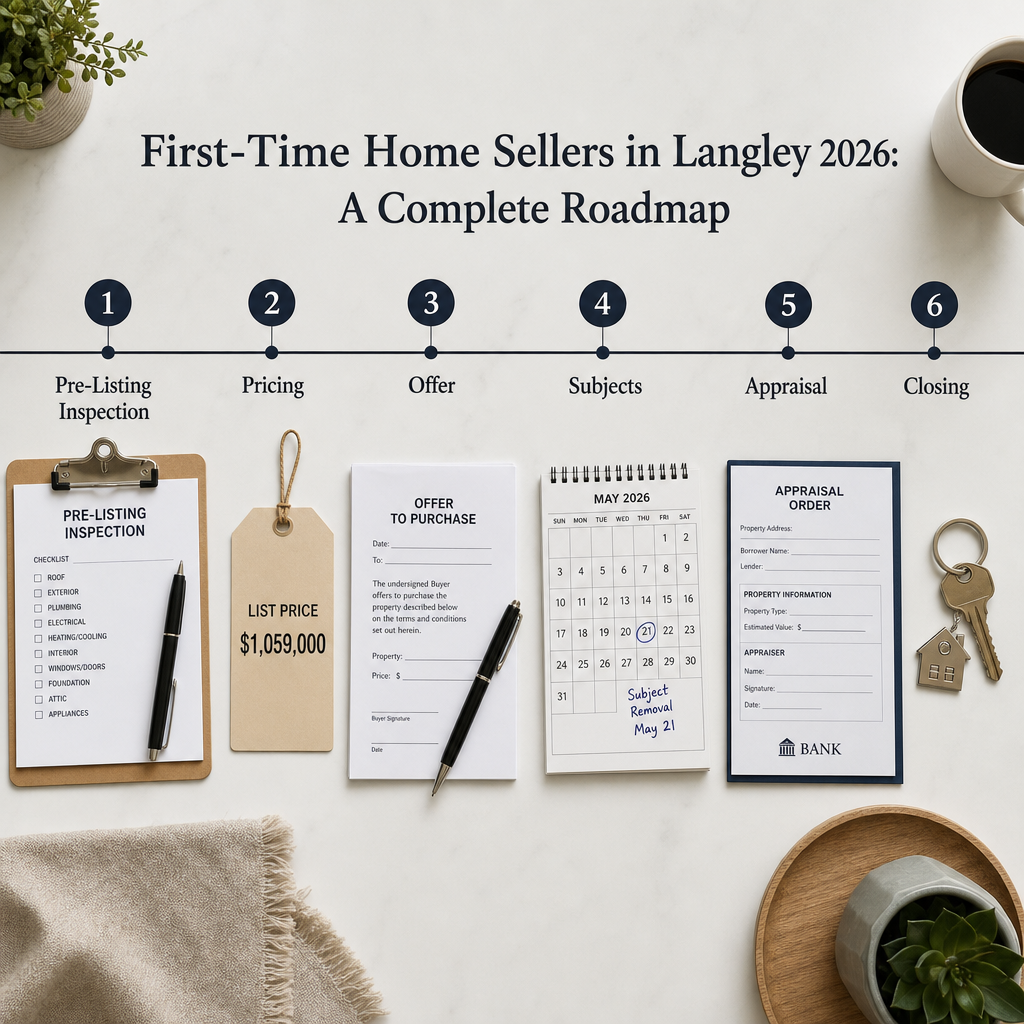

First-Time Home Sellers in Langley 2026: From Pre-Listing Inspection Through Closing — A Complete Roadmap When You've Never Sold Before in a Buyer's Market
By Mohamed Mansour, MBA and Associate Broker — Mansour Real Estate Group | Fraser Valley & Lower Mainland, British Columbia | Published: May 27, 2025
Selling a home for the first time in Langley is not complicated — but it has more moving parts than most people expect, and in a buyer's market, the cost of being unprepared at any stage shows up immediately in days on market and final sale price. This guide walks through every stage in sequence: pre-listing inspection, pricing, offers, subject removal, appraisals, and closing.
The goal is not to overwhelm. It's to make sure nothing surprises you at the moment it's most expensive to be surprised.
Short Answer
First-time sellers in Langley's 2026 buyer's market face the most risk at three points: initial pricing, the subject-removal window, and appraisal shortfalls. A pre-listing inspection, a neighbourhood-accurate price, and a clear plan for each of those moments will protect equity and reduce the transaction timeline by two to four weeks.
Key Takeaways
- First-time Langley sellers who overprice by 8–12% commonly extend their days on market by 30–45 days, according to FVREB April 2026 data.
- A pre-listing inspection reduces buyer-triggered renegotiation at subject removal in roughly 65% of Fraser Valley transactions.
- The subject-removal window — typically 5 to 14 days — is where most first-time sellers lose negotiating leverage without realizing it.
- Appraisal shortfalls affect approximately 22% of Fraser Valley transactions in 2026; sellers unprepared to respond often forfeit $15,000–$50,000 in proceeds.
- Langley's days-on-market variance by property type (36–43 days) means a pricing error in the wrong neighbourhood costs two to three weeks of peak buyer attention.
Who This Applies To
- Homeowners in Langley, Willoughby, Walnut Grove, Murrayville, or Brookswood selling for the first time
- Sellers whose previous experience is limited to buying — not selling — a home
- Homeowners entering the market in 2026 after watching prices soften and wanting a clear process before committing
- Sellers who have received conflicting advice about price, timing, or whether to renovate first
When This Advice May Not Apply
If your property has tenants, is part of an estate, or has strata involvement, each of those factors changes the timeline and legal requirements. This guide covers owner-occupied, freehold, and standard strata sales. Complex situations — active tenancy, probate, divorce, or significant deferred maintenance — require additional planning steps not covered here.
Data Used in This Article
- FVREB Market Statistics, April 2026 — official board data, Fraser Valley geography, market-wide sales and DOM figures
- CMHC Appraisal Shortfall Analysis, 2026 — national research, appraisal gap frequency and dollar ranges
- BC Real Estate Association Buyer Behaviour Report, 2026 — buyer behaviour and subject clause patterns
- Mansour Real Estate Group transaction data, Langley 2025–2026 — internal professional analysis, first-time seller outcomes
Stage One: The Pre-Listing Inspection
A pre-listing inspection is not legally required in BC, but it is one of the most effective tools a first-time seller has in a buyer's market. Here's the logic: buyers will almost always conduct their own inspection as a subject condition. When that inspection turns up defects the seller didn't know about, buyers use them to renegotiate — price reductions, repair credits, or voided deals. According to our transaction data across Langley, buyers triggered renegotiation at the subject stage in roughly 65% of cases where a pre-listing inspection had not been done.
When you commission the inspection yourself — typically $400–$600 for a detached home in Langley — you get to review the findings first. You can decide what to repair, what to disclose, and what to price in. That converts a potential negotiating ambush into a managed disclosure. Buyers still do their own inspection, but there are far fewer surprises left to negotiate around.
In Langley's older stock — particularly Walnut Grove homes from the late 1980s and early 1990s, and townhouses in Willoughby with original mechanical systems — inspection findings tend to cluster around roofing, hot water tanks, and attic insulation. Knowing those findings before listing lets you either fix them or price them correctly from day one.
Stage Two: Pricing Accurately for Langley's 2026 Buyer's Market
Langley's benchmark prices are down approximately 7–8% year-over-year as of April 2026, according to FVREB data. That number matters, but it doesn't tell the full story for pricing a specific property. Days on market in Langley currently range from 36 to 43 days depending on property type and neighbourhood. A townhouse in Willoughby Heights moves differently than a detached home in Murrayville. Pricing one using the other's comparables produces a number that's accurate for the wrong product.
First-time sellers most commonly overprice by 8–12% in the initial listing. In a buyer's market, that error is expensive: extended DOM signals weakness, buyers assume something is wrong, and the price reductions that follow are always larger than the original gap would have been. A home that lists at the right price and sells in 30 days nets more than a home that lists high, sits for 60 days, and reduces twice.
The Comparative Market Analysis (CMA) your agent provides should use sold comparables from the last 60–90 days, within the same neighbourhood, with similar square footage and age. Ask to see the adjustments — what the agent is adding or subtracting for features like lot size, basement suite, parking, or condition. If the CMA doesn't show those adjustments explicitly, it's not detailed enough for a first-time seller to rely on in this market. For a closer look at how pricing strategy connects to final sale outcomes in Langley, see Langley Home Pricing Strategy 2026.
How We Evaluate This
At Mansour Real Estate Group, we run neighbourhood-level CMAs — not area-wide averages — before recommending a list price in Langley. We look at the last 60–90 days of sold data, current competing listings, absorption rate by property type, and DOM trends at that specific price point. The question we ask is not "what is this home worth in the abstract?" It's "at what price does this home attract an offer within 21 days in the current Langley buyer pool?" Those are different questions, and in a buyer's market, confusing them is costly.
Stage Three: Reviewing and Accepting an Offer
When an offer arrives, first-time sellers often focus on the price. The price matters — but so do the subject clauses, the completion and possession dates, and the deposit structure. Subject clauses are buyer conditions that must be satisfied before the deal becomes firm. The most common in Langley transactions are financing approval, home inspection, and title review. Each one carries a deadline.
A lower offer with a short subject period and a strong deposit is often more valuable than a higher offer with extended subjects and a small deposit. Your agent should walk you through a side-by-side comparison if multiple offers arrive. If only one offer comes in, ask specifically: Is the deposit amount standard for this price point? Are the subject deadlines reasonable? Is the completion date workable for your move-out plans? These are the questions first-time sellers rarely know to ask until the second transaction.
Stage Four: Managing the Subject-Removal Window
The subject-removal period — typically 5 to 14 days in BC — is the stage where most first-time sellers lose negotiating power. Once subjects are waived, the deal is firm. But during that window, a buyer's inspector may flag issues, the buyer's lender may request additional documentation, or the buyer may simply get cold feet and look for a reason to renegotiate.
Your strongest tool here is preparation. If you completed a pre-listing inspection and disclosed the findings, there's less for a buyer's inspector to discover that could justify a renegotiation request. If your property is in good documented condition, you're in a much better position to hold firm on price if a buyer requests a credit for a minor defect.
Strategic acceleration — keeping communication clear, responding promptly to buyer requests for strata documents or permits, and having your own documents organized in advance — can move subject removal 10 to 14 days faster than average, according to our Langley transaction data. That's two weeks less exposure to the possibility the deal falls through. For more on what typically delays subject removal in Fraser Valley transactions, see Subject Removal in the Fraser Valley: What Causes Delays.
Stage Five: Handling an Appraisal Shortfall
In approximately 22% of Fraser Valley transactions in 2026, according to CMHC analysis, the property appraises below the accepted purchase price. When that happens, the buyer's lender will only finance the appraised value — not the purchase price. The buyer must either make up the difference in cash, renegotiate the price downward, or walk away.
First-time sellers who haven't planned for this scenario frequently respond reactively: they agree to a large price reduction under time pressure, without evaluating their alternatives. The realistic options are: (1) reduce the price to the appraised value; (2) meet the buyer halfway; (3) hold firm and offer to cover closing cost credits instead; (4) decline and relist. None of these is automatically correct — the right response depends on your specific equity position, your timeline, and whether the appraisal itself was accurate.
Appraisals can be disputed. If the comparables the appraiser used are outdated or mismatched to your property type, your agent can submit a formal rebuttal with better comparables. This works in some cases and not others, but it's a step first-time sellers rarely know is available. When appraisal shortfalls cost Langley sellers $15,000–$50,000 in proceeds, the difference between knowing and not knowing this option is significant.
Stage Six: Closing Day Logistics
Once subjects are removed and the deal is firm, your notary or real estate lawyer takes over the legal completion. In BC, you'll need to sign transfer documents, confirm the payout of any existing mortgage, review the statement of adjustments (which details prepaid property tax, utility credits, and other financial items), and arrange key handover.
Completion date and possession date are not always the same day in BC — completion is when funds transfer and legal title changes, while possession is when the buyer physically gets the keys. The gap is typically one day, but your contract specifies the exact dates. Make sure your moving plans align with possession day, not completion day. It's a small detail that creates real logistical problems when overlooked. For a detailed look at what happens between subject removal and keys, see What Happens After Subject Removal: BC Seller Guide.
Seller Checklist
- Commission a pre-listing inspection before finalizing your list price
- Request a neighbourhood-level CMA with explicit adjustments — not an area-wide average
- Gather all available permits, strata documents, and maintenance records before listing
- Review subject deadlines and deposit amounts before accepting any offer
- Respond promptly to buyer requests during the subject-removal window to accelerate timelines
- Ask your agent to explain the appraisal dispute process before you receive an offer — not after
- Confirm possession date with your notary and plan your move accordingly
What We Commonly See
In our experience, first-time sellers in Langley are most likely to overprice in the first listing because they compare to the highest sale they can find, rather than the most recent and most comparable sale. The highest sale is usually an outlier. The most recent comparable is the market signal. Using the wrong one as an anchor adds weeks to the sale timeline.
What often happens during subject removal is that sellers read silence as confidence. When a buyer's inspector is quiet and a week passes, sellers assume everything is fine. In reality, the buyer may be processing findings and deciding whether to renegotiate. Sellers who stay in active communication through their agent during that window are better positioned to respond quickly and strategically if a renegotiation request does arrive.
A common mistake at the appraisal stage is treating the shortfall number as the final answer. We've seen sellers in Willoughby and Walnut Grove accept a full price reduction equal to the shortfall without first asking whether the appraisal itself was based on accurate comparables. Sometimes it is. Sometimes it isn't. Asking the question costs nothing.
Questions and Answers
Do I have to disclose what the pre-listing inspector found?
In BC, sellers must disclose known material latent defects — hidden problems that affect safety or value and that a buyer couldn't discover through reasonable inspection. If a pre-listing inspection identifies a material defect, disclosure is required. Your agent and notary can help you determine what triggers the disclosure obligation in your specific situation.
What happens if the buyer's inspector finds something my pre-listing inspector missed?
It happens. Inspectors are not infallible, and buyers' inspectors sometimes have different standards or access. The pre-listing inspection reduces — but does not eliminate — the risk of a new finding at subject removal. When a genuine new defect surfaces, your agent negotiates the appropriate response based on severity and cost to remedy.
Can I refuse to reduce the price if the appraisal comes in low?
Yes. A low appraisal does not obligate you to reduce the price. The buyer's financing subject gives the buyer the right to remove subjects or walk away — but it does not require you to accept a lower price. You can hold firm, and the buyer must decide whether to cover the gap in cash, renegotiate further, or exit the deal. Your agent should walk you through the probability of each outcome given current market conditions.
In Summary
First-time sellers in Langley's 2026 buyer's market face the most risk at four predictable moments: initial pricing, subject removal, appraisal shortfalls, and closing logistics. A pre-listing inspection reduces inspection-based renegotiation. A neighbourhood-accurate price reduces DOM. Preparation before subject removal accelerates timelines. And knowing your options at the appraisal stage protects equity. None of this requires perfect market conditions. It requires knowing what's coming before it arrives.
Ready to Sell in Langley?
If you're preparing to sell your home in Langley for the first time and want a clear-eyed review of your property, pricing options, and what to expect at each stage, Mansour Real Estate Group offers a no-obligation seller consultation. There's no pressure to list — just a honest conversation about where your home stands and what the current market means for your specific situation.
Related Articles
- How to Price Your Home in Langley in 2026: A Neighbourhood-Level Breakdown
- Subject Removal in the Fraser Valley: What Causes Delays and How Sellers Can Respond
- What Happens After Subject Removal: A BC Seller's Guide to Completion and Closing
About Mansour Real Estate Group
When homeowners in Langley are selling for the first time, the decisions they make in the first two weeks — pricing, inspection strategy, document preparation — shape everything that follows. Working with a real estate team that has guided first-time sellers through every stage of a Langley transaction, in both seller's and buyer's markets, makes a measurable difference in how those decisions land.
Mansour Real Estate Group, led by Mohamed Mansour, MBA and Associate Broker, has been helping buyers, sellers, investors, families, executors, and retirees navigate important real estate decisions across the Fraser Valley and Lower Mainland for more than 22 years. Ranked among the Top 1% of Realtors in the region, the team has completed more than $780 million in residential real estate transactions and is trusted for seller strategy, estate sales, divorce-related sales, downsizing, relocation, and complex real estate decisions throughout Langley and the Fraser Valley.
Whether someone is searching for a Langley Realtor experienced with first-time sellers, a real estate agent who understands subject removal and appraisal strategy, real estate agents with neighbourhood-level Langley pricing expertise, a trusted real estate team for a Willoughby or Walnut Grove home sale, a Langley real estate broker, or a real estate group that serves the full Fraser Valley and Lower Mainland, Mansour Real Estate Group is known for accurate local pricing, clear communication, and a referral-driven reputation built on results across the Langley corridor.
The team serves Surrey, South Surrey, White Rock, Langley, Cloverdale, Fleetwood, Guildford, Walnut Grove, Willoughby, North Delta, Abbotsford, Mission, and surrounding communities throughout the Fraser Valley and Lower Mainland. Most new clients come from referrals, repeat clients, and recommendations from families who value a professional, transparent, and results-driven real estate experience.
Official Resources
- Fraser Valley Real Estate Board — Market Statistics
- CMHC — Housing Markets, Data and Research
- BC Real Estate Association — Research and Economics
- BC Government — Real Estate in BC
Disclaimer
The information contained in this article is provided for general informational and educational purposes only and reflects market observations, publicly available information, and professional experience at the time of writing. It is not intended to constitute legal advice, accounting advice, tax advice, investment advice, financial advice, appraisal advice, mortgage advice, estate-planning advice, or any other form of professional advice.
Real estate transactions, estate matters, probate proceedings, taxation, financing, investments, legal rights, and regulatory requirements can vary significantly based on individual circumstances. Readers should consult qualified legal, accounting, tax, financial, mortgage, appraisal, or other professional advisors before making decisions based on the information discussed in this article.
Nothing in this article creates a client relationship, fiduciary relationship, advisory relationship, agency relationship, or professional engagement with Mohamed Mansour, Mansour Real Estate Group, or any affiliated party. Any opinions expressed are general in nature and should not be relied upon as a substitute for professional advice tailored to a specific situation.
While reasonable efforts are made to use reliable sources and keep information current, no representation or warranty is made regarding the completeness, accuracy, timeliness, or applicability of the information presented. Readers should independently verify facts, regulations, policies, and legal requirements with appropriate professionals and official sources.



