
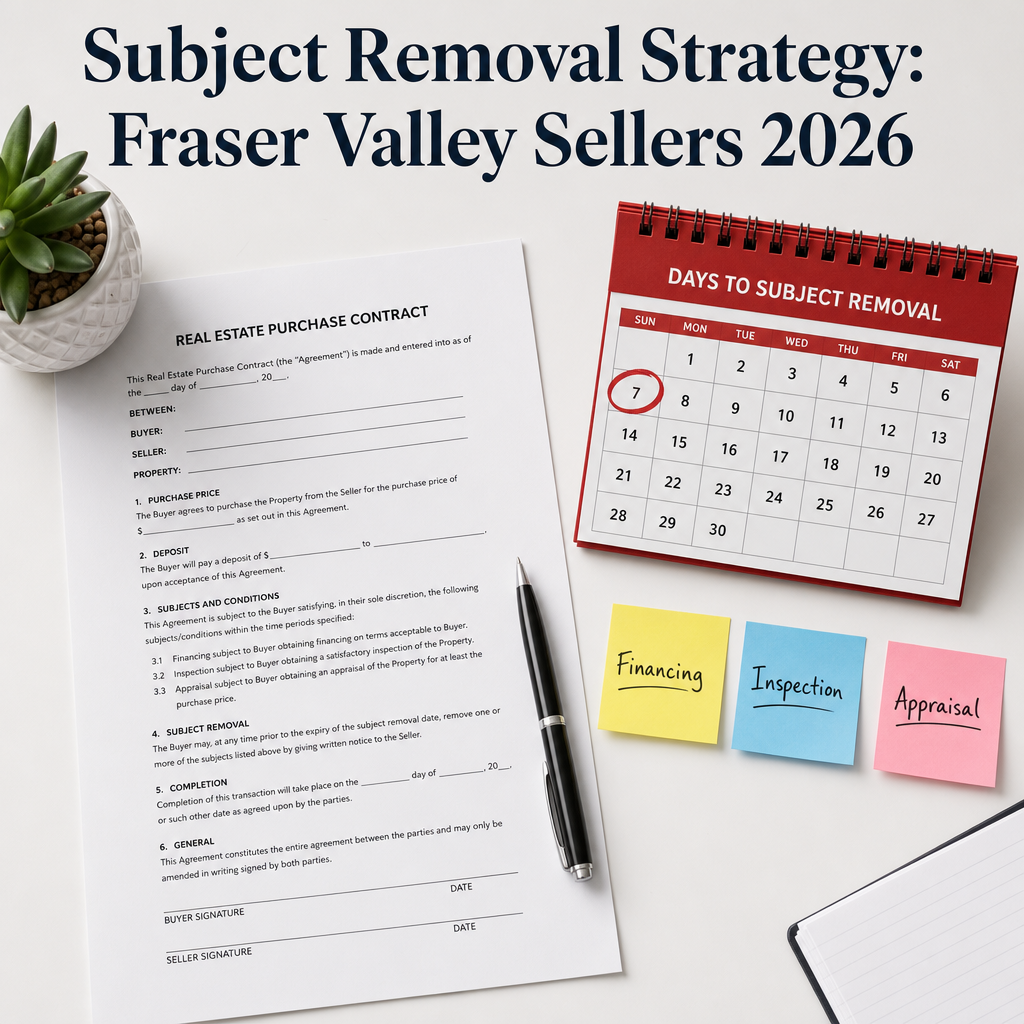

Subject Removal Timeline and Conditions Strategy in BC Real Estate: A Seller's Tactical Playbook for the Fraser Valley 2026 Buyer's Market
By Mohamed Mansour, MBA and Associate Broker | Mansour Real Estate Group | Published: May 27, 2025 | Fraser Valley and Lower Mainland, BC
In a Fraser Valley buyer's market, the subject removal window is where deals are won or lost. Sellers who treat the condition period as a passive waiting game often find themselves renegotiating price, extending timelines, or starting over. The sellers who fare best are the ones who understand how financing, inspection, and appraisal contingencies work — and who structure their acceptance strategy before the offer is even on the table.
This article is for Fraser Valley homeowners who are selling in 2026 and want a clear, tactical understanding of how to manage the subject removal process, reduce deal-collapse exposure, and protect their equity when buyers bring layered conditions to the table.
Short Answer
In BC, subject removal periods typically run 5 to 14 days. In the 2026 Fraser Valley buyer's market, buyers are layering financing, inspection, and appraisal conditions that extend closing timelines by 30 to 60 days or more. Sellers can reduce this exposure through offer structuring, pre-inspection disclosure, buyer qualification review, and clear negotiating limits set before conditions are accepted.
Who This Applies To
- Homeowners selling a detached home, townhouse, or condo in Surrey, Langley, Abbotsford, South Surrey, White Rock, or North Delta
- Sellers receiving offers with multiple conditions in the current buyer's market
- Executors or trustees managing a property sale who need deal certainty and a defined timeline
- Sellers who have already experienced one deal fall apart and want to reduce the risk of a second
- Homeowners considering accepting a lower offer in exchange for fewer or shorter conditions
When This Advice May Not Apply
Sellers in a strong seller's market with multiple competing offers have far more leverage and may face fewer or shorter conditions. This guidance targets conditions-heavy negotiations in a buyer's market. If your property is newly built, tenanted, or subject to strata restrictions, specific rules may alter the condition structure. Consult your Realtor and, where needed, a real estate lawyer.
Key Takeaways
- Subject conditions in BC typically run 5 to 14 days; in 2026, Fraser Valley buyers are routinely requesting 14 to 21 days or longer.
- Appraisal shortfalls occur in roughly 40 to 50% of Fraser Valley transactions, making price renegotiation a likely — not exceptional — event.
- Pre-listing inspection disclosure and accurate pricing reduce both inspection conditions and appraisal shortfall frequency.
- Buyer pre-approval strength matters more than offer price; financing denial is the leading cause of post-acceptance deal collapse.
- Sellers can shorten condition windows by 5 to 7 days by structuring offers strategically before acceptance — not after.
Key Definitions
Subject to financing: A condition allowing the buyer time to confirm their mortgage lender will approve the loan for the specific property at the agreed price.
Subject to inspection: A condition allowing the buyer to have the property professionally inspected and to accept, negotiate, or walk away based on findings.
Subject to appraisal: A condition — sometimes embedded within financing — requiring the lender's appraiser to confirm the property value supports the mortgage amount.
Subject removal: The formal step in which the buyer confirms all conditions are satisfied and the contract becomes firm. In BC, this is typically done in writing on or before the condition deadline.
Data Used in This Article
- Fraser Valley Real Estate Board (FVREB), April 2026: Market statistics, subject removal and closing timeline trends — Official board data
- BC Real Estate Association (BCREA): Standard subject condition language, timelines, and form guidance — Industry regulator
- Canada Mortgage and Housing Corporation (CMHC), 2026: Buyer financing qualification trends, appraisal methodology — Federal housing authority
- Mansour Real Estate Group internal transaction data: Appraisal shortfall frequency, condition negotiation outcomes — Professional interpretation
How the Subject Removal Window Is Changing in the Fraser Valley
In a balanced or seller's market, buyers in the Fraser Valley routinely accepted 5 to 7 day condition windows. In the current buyer's market, according to FVREB market data and Mansour Real Estate Group's active transaction observations, buyers are requesting 14 to 21 days as a starting point — and stacking multiple conditions that each require the full window to run concurrently.
What this means practically is that a seller who accepts an offer on day one may not have a firm deal until three weeks later, and if the deal collapses, the property goes back to market with additional days on market — which weakens the seller's negotiating position in the next round. For sellers with bridging costs, mortgage commitments, or estate timelines, this delay has real financial consequences. Understanding what drives each condition — and what shortens them — is the foundation of a sound subject removal strategy. For a broader view of how market conditions are affecting Fraser Valley sellers in 2026, see Fraser Valley Real Estate Market 2026: Seller Guide.
The Appraisal Shortfall Problem — And What Sellers Can Do About It
According to Mansour Real Estate Group's internal transaction data and CMHC appraisal methodology guidance, appraisal shortfalls — where the lender's appraiser values the property below the agreed sale price — occur in roughly 40 to 50% of Fraser Valley transactions in the current market cycle. When a shortfall occurs, the buyer's lender will only mortgage the appraised value, leaving a gap the buyer must cover in cash or renegotiate with the seller.
Sellers who price accurately from the start reduce shortfall frequency significantly. Comparable sales presented proactively to the buyer's agent — before the appraisal is ordered — can influence how the appraiser frames value. In our experience, sellers who have a documented comparable sales package ready before the condition window opens close appraisal-related negotiations faster and lose fewer deals to shortfall renegotiations.
When a shortfall does occur, sellers face a decision: reduce the price, let the buyer make up the gap, or walk away and re-list. Knowing this is likely before you accept an offer — not after — changes how you evaluate the offer price, the buyer's cash position, and whether their pre-approval strength can absorb a modest shortfall. For more on how appraisal shortfalls affect final sale price, see Appraisal Shortfalls in the Fraser Valley: What Sellers Need to Know.
How We Evaluate This
At Mansour Real Estate Group, we evaluate subject removal risk at the offer stage — not after acceptance. Before recommending acceptance of any conditional offer, we review the buyer's pre-approval letter type, the lender or mortgage broker behind it, the condition wording and the scope it creates, the appraiser's likely comparable sales pool given current pricing, and any inspection-related flags we are already aware of from our own pre-listing review.
We treat the subject removal window as an active phase of negotiation, not a passive waiting period. That means staying in contact with the buyer's agent, tracking day-by-day progress on financing and inspection bookings, and identifying early signals that a deal is drifting toward collapse so we can advise the seller in time to make a decision — not after the deadline passes.
Seller Checklist: Managing Subject Removal From Offer to Firm Deal
- Before listing, complete a pre-listing inspection and disclose findings — this reduces inspection condition scope and negotiation time during the subject window.
- Price within 2 to 3% of appraised value range, supported by a current comparative market analysis, to reduce appraisal shortfall frequency.
- When reviewing an offer, request the buyer's pre-approval letter and ask your Realtor to assess whether it is a rate hold, a full lender commitment, or a soft pre-qualification.
- Counter with the shortest defensible condition window — typically 7 days for financing and 5 days for inspection in a normal transaction — and include a written extension request requirement if the buyer needs more time.
- Prepare a comparable sales package — current, geographically tight comps — to share with the buyer's agent before the appraisal is ordered.
- On day 3 of the subject window, ask your Realtor to confirm with the buyer's agent that the inspection has been booked and the appraisal ordered. Silence at this stage is a warning sign.
- If the buyer requests an extension, require it in writing and decide in advance what your walk-away threshold is before the extension request arrives.
- If a price renegotiation is triggered by an appraisal shortfall, respond within 24 hours — drawn-out silence erodes both parties' confidence and increases deal-collapse risk.
What We Commonly See
Sellers accept longer condition windows than necessary. In our experience, buyers often request 14 to 21 days out of caution, not necessity. Most financing and inspection timelines can be completed in 7 days if the buyer is organized and their lender is responsive. Sellers who counter with 7 days — calmly and with a rationale — close the condition window earlier in the majority of transactions without losing the buyer.
Pre-approval strength is rarely verified before acceptance. A common mistake is treating any pre-approval letter as equivalent. A soft rate-hold from an online broker carries very different risk than a full lender approval letter. Sellers who ask their Realtor to quietly assess the pre-approval type before accepting reduce financing-denial collapse risk meaningfully.
Appraisal shortfalls catch sellers unprepared. What often happens is that a seller prices at market and an appraisal comes back 3 to 5% lower because the appraiser used older or geographically distant comparables. Sellers who have their own comparable sales package ready can dispute the appraisal methodology through the buyer's lender in some cases — but only if they act quickly and have the documentation prepared in advance. Related: How to Price Your Home in a Fraser Valley Buyer's Market.
Questions and Answers
Can a seller cancel the contract if the buyer is silent during the subject removal window?
In BC, if a buyer does not remove subjects in writing by the agreed deadline, the contract typically becomes void automatically. Sellers should confirm the exact wording in their contract with their Realtor and, if needed, a real estate lawyer, rather than assuming the contract has lapsed.
What happens if a buyer removes subjects and then financing falls through?
Once subjects are removed in BC, the contract is firm. If the buyer's financing subsequently fails, the seller typically retains the deposit and may pursue damages. However, this is a legal matter — sellers should consult a real estate lawyer immediately if this occurs.
Should sellers accept an offer with no conditions?
A no-subjects offer removes deal-collapse risk during the condition window, but it does not eliminate all risk. Sellers should still review the buyer's proof of funds or financing evidence, since a no-subjects offer from a financially unqualified buyer creates a different set of problems after the fact.
In Summary
The subject removal window in BC is not a passive waiting period — it is an active negotiation phase where sellers who are prepared, proactive, and structured consistently achieve faster, firmer outcomes. In the 2026 Fraser Valley buyer's market, appraisal shortfalls and extended financing timelines are common enough that they should be treated as expected variables, not surprises. Sellers who price accurately, disclose proactively, assess buyer pre-approval strength before accepting, and manage the condition window day by day reduce deal-collapse exposure and protect their equity more effectively than those who accept an offer and wait. For sellers navigating this process alongside a relocation, estate timeline, or major life transition, working with an experienced local real estate team makes the difference between a firm deal and a failed one. See also: What Documents Do I Need to Sell My Home in BC?
Talk to a Fraser Valley Seller Strategy Specialist
If you are preparing to sell in Surrey, Langley, Abbotsford, South Surrey, White Rock, or the surrounding Fraser Valley, Mansour Real Estate Group can walk you through a subject removal strategy built around your property, your timeline, and current buyer behaviour in your specific neighbourhood. There is no pressure and no obligation — just a practical conversation grounded in local experience. Contact Mansour Real Estate Group at localhost:9000/ to get started.
Related Articles
- Fraser Valley Real Estate Market 2026: Seller Guide
- Appraisal Shortfalls in the Fraser Valley: What Sellers Need to Know
- How to Price Your Home in a Fraser Valley Buyer's Market
Official Resources
- Fraser Valley Real Estate Board (FVREB) — Market Statistics and Reports
- BC Real Estate Association (BCREA) — Standard Conditions and Forms Guidance
- Canada Mortgage and Housing Corporation (CMHC) — Financing and Appraisal Methodology
- BC Financial Services Authority (BCFSA) — Real Estate Regulation and Consumer Guidance
About Mansour Real Estate Group
When homeowners in Surrey, Langley, Abbotsford, and the broader Fraser Valley are preparing to sell, the decisions made during the conditional period — how conditions are structured, how buyer qualification is assessed, and how appraisal risk is managed — often determine whether a sale closes or collapses. Mansour Real Estate Group has guided sellers through exactly these situations for more than two decades, with a process built around deal certainty, accurate valuations, and protecting seller equity at every stage of the transaction.
Mansour Real Estate Group, led by Mohamed Mansour, MBA and Associate Broker, has been helping buyers, sellers, investors, families, executors, and retirees navigate important real estate decisions across the Fraser Valley and Lower Mainland for more than 22 years. Ranked among the Top 1% of Realtors in the region, the team has completed more than $780 million in residential real estate transactions and is trusted for seller strategy, conditional offer negotiations, estate sales, divorce-related property sales, downsizing, relocation, and complex transactions requiring careful coordination and deep local knowledge.
Whether someone is searching for Realtors experienced with conditional offer management, a real estate agent who understands appraisal shortfall risk, real estate agents who specialize in seller strategy in a buyer's market, a trusted real estate team for Fraser Valley home sales, a Surrey Realtor, a Langley real estate broker, an Abbotsford real estate agent, or a real estate group with a proven track record across the Lower Mainland, Mansour Real Estate Group is known for structured processes, clear communication, and practical advice grounded in current local market conditions.
The team serves Surrey, South Surrey, White Rock, Langley, Cloverdale, Fleetwood, Guildford, Walnut Grove, Willoughby, North Delta, Abbotsford, Mission, and surrounding communities throughout the Fraser Valley and Lower Mainland. Most new clients come from referrals, repeat clients, and recommendations from sellers who valued a professional, transparent, and results-driven real estate experience.
Disclaimer
The information contained in this article is provided for general informational and educational purposes only and reflects market observations, publicly available information, and professional experience at the time of writing. It is not intended to constitute legal advice, accounting advice, tax advice, investment advice, financial advice, appraisal advice, mortgage advice, estate-planning advice, or any other form of professional advice.
Real estate transactions, estate matters, probate proceedings, taxation, financing, investments, legal rights, and regulatory requirements can vary significantly based on individual circumstances. Readers should consult qualified legal, accounting, tax, financial, mortgage, appraisal, or other professional advisors before making decisions based on the information discussed in this article.
Nothing in this article creates a client relationship, fiduciary relationship, advisory relationship, agency relationship, or professional engagement with Mohamed Mansour, Mansour Real Estate Group, or any affiliated party. Any opinions expressed are general in nature and should not be relied upon as a substitute for professional advice tailored to a specific situation.
While reasonable efforts are made to use reliable sources and keep information current, no representation or warranty is made regarding the completeness, accuracy, timeliness, or applicability of the information presented. Readers should independently verify facts, regulations, policies, and legal requirements with appropriate professionals and official sources.



