

Surrey Listing Price Strategy in a Balanced Market 2026: How to Anchor Your Initial Price When Buyer Demand Varies 40–50% Across Micro-Neighbourhoods
By Mohamed Mansour, MBA and Associate Broker — Mansour Real Estate Group | Surrey, Fraser Valley, BC | Published: May 6, 2026 | Primary Category: Seller Strategy
Surrey's overall market has shifted toward balanced territory in 2026, but that city-wide label obscures a more complicated reality for sellers. Demand velocity — how quickly buyers in a specific pocket are making decisions — varies by 40 to 50 percent depending on which micro-neighbourhood your home sits in. Setting a list price based on city-wide benchmarks in this environment is one of the most reliable ways to leave money behind or sit on the market longer than necessary.
This guide is for Surrey homeowners preparing to list in 2026 who want a pricing framework grounded in local demand data, not averages that may not reflect their street, their property type, or the buyers most likely to write an offer.
Short Answer
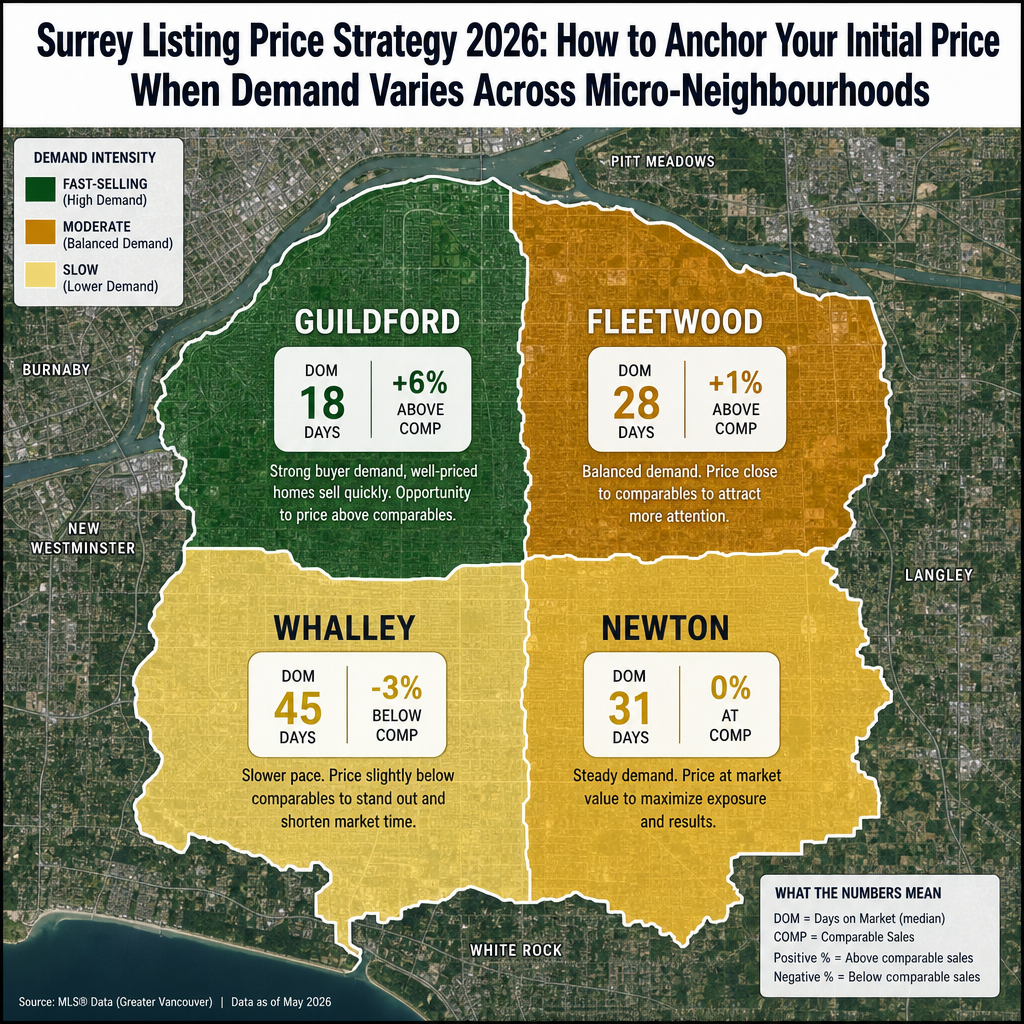
In Surrey's 2026 balanced market, your list price should be anchored to the sold data and days-on-market figures in your specific micro-neighbourhood, not the city-wide benchmark. Demand in Guildford and Fleetwood is running 7 days faster than in Whalley and Newton. That difference translates directly into how aggressive or conservative your initial price can be — and ignoring it costs sellers time or money.
Key Takeaways
- Surrey's balanced market average hides 40–50% demand variance between adjacent neighbourhoods.
- Official benchmark prices lag real market conditions by 2–3 months, creating systematic mispricing risk.
- Guildford and Fleetwood are selling detached homes roughly 7 days faster than Whalley and Newton.
- Pricing 2–3% below comparable sales in a soft micro-market closes deals 35% faster than pricing at comps.
- SkyTrain proximity and hospital development create two distinct buyer types, each requiring a different price signal.
Who This Applies To
- Surrey homeowners listing a detached, townhome, or condo in spring or summer 2026
- Sellers who received a benchmark or assessment figure and are uncertain whether it reflects current buyer behaviour
- Investors and estate sellers who need to price quickly and accurately in a specific neighbourhood
- Anyone preparing a listing in Guildford, Fleetwood, Whalley, Newton, Cloverdale, or Fleetwood
When This Advice May Not Apply
If your property is unique in size, zoning, or condition — or if it straddles two micro-market zones — a standard comparable analysis may not be sufficient. Properties with development potential respond to rezoning timelines and investor logic more than buyer velocity data. Consult a local professional for a property-specific pricing review.
Data Used in This Article
- BC Real Estate Association: April 2026 market data — official, provincial scope
- Fraser Valley Real Estate Board (FVREB): Surrey micro-market days-on-market analysis by neighbourhood cluster — official, Fraser Valley scope
- Mansour Real Estate Group: Internal comparative market analysis data across Guildford, Fleetwood, Whalley, Newton, and Cloverdale — professional interpretation, local scope
- Bank of Canada: April 2026 mortgage rate environment and buyer purchasing power forecasts — official, national scope
- City of Surrey planning documentation: SkyTrain completion and hospital development timelines — official, municipal scope
Why City-Wide Benchmarks Fail Surrey Sellers in 2026
The FVREB's benchmark price is a useful macro indicator, but it is calculated from transactions across a broad geography and typically reflects closed sales from 60 to 90 days prior. In a transitioning market — one moving from buyer's territory toward balance — that lag causes a real problem. Sellers anchoring to the benchmark risk pricing $30,000 to $75,000 above what buyers in softer pockets will actually pay, according to our internal comparative market analysis across Surrey neighbourhoods in early 2026.
The inverse is also true. In high-velocity pockets like Guildford near the King George SkyTrain corridor, sellers who anchor conservatively to the benchmark may underprice by $20,000 to $50,000. The benchmark is a starting reference, not a listing price. The gap between those two things is where sellers make or lose money.
How Micro-Neighbourhood Demand Velocity Changes Your Price Anchor
Based on FVREB neighbourhood cluster data and our own comparative analysis, Surrey's micro-markets are not behaving uniformly. Detached homes in Guildford and Fleetwood are moving approximately 7 days faster than comparable properties in Whalley and Newton. That difference is not cosmetic — it reflects concentrated buyer demand driven by SkyTrain proximity, school catchment preferences, and perceived long-term value.
For sellers, that velocity difference translates to a 3 to 5 percent pricing adjustment. A property in Guildford that would otherwise be priced identically to one in Whalley — same square footage, same age, same condition — can reasonably anchor 3 to 5 percent higher because buyer competition is more active. Pricing in Whalley or Newton without accounting for the slower velocity typically produces longer days on market and eventual price reductions that cost more than the adjustment would have.
Cloverdale presents a different dynamic. Detached properties there are benefiting from a combination of family-buyer demand and relative affordability compared to South Surrey, creating a moderately active micro-market that rewards accurate pricing rather than aggressive anchoring. Sellers in Cloverdale who price within 1 to 2 percent of recent comparable sales are seeing cleaner offers with fewer conditions than those who test the ceiling.
The Two Buyer Cohorts in Surrey and What They Respond To
Surrey's development pipeline — specifically the SkyTrain extension timeline and the new hospital project — has created two meaningfully different buyer profiles operating simultaneously in the market. Understanding which cohort is most active in your micro-neighbourhood is as important as knowing the comparable sold prices.
The first cohort is long-term value buyers. These are families and owner-occupants drawn to pre-SkyTrain proximity areas like Guildford and parts of Fleetwood. They are buying ahead of infrastructure completion, comfortable with a longer hold, and responsive to list prices that reflect quality and future-value positioning. This cohort is less sensitive to minor price differences and more sensitive to condition, school catchment, and lot size.
The second cohort is investors and builders active in emerging rezoning corridors — particularly around Whalley and portions of Newton where density policy is creating land-assembly opportunities. These buyers run their own internal land valuations and are largely indifferent to cosmetic upgrades or home staging. They respond to land size, zoning classification, and proximity to arterials. Pricing for this cohort requires a fundamentally different anchor — one closer to land value than to improved-property comparables. If your Surrey home sits in a rezoning-adjacent corridor, a standard residential comparable analysis will undervalue or confuse the pricing picture. A Surrey seller strategy review that accounts for both buyer types is essential before listing.
How We Evaluate This
When Mansour Real Estate Group prepares a pricing recommendation for a Surrey seller, we do not start with the benchmark price and work backward. We start with the most recent closed sales within the tightest geographic radius we can defend — ideally within 500 metres and within the past 45 days — then layer in active and expired listings to understand where the current ceiling sits and where properties have failed to sell.
From there we apply a velocity adjustment based on the neighbourhood's current sales-to-active ratio and average days on market. If the ratio is trending toward balanced (13 to 15 percent) but DOM remains elevated, we recommend a price at or slightly below the most recent comparable sale rather than at it. That 1 to 3 percent downward adjustment typically produces faster subject removal, fewer financing conditions falling apart, and a cleaner close — outcomes worth considerably more than the marginal price difference at listing.
Seller Checklist: Anchoring Your Surrey List Price in 2026
- Pull sold comparables from within 500 metres of your property and within the past 45 days — not city-wide data.
- Check the current days-on-market average for your specific micro-neighbourhood, not Surrey overall.
- Identify whether your neighbourhood is primarily serving end-user buyers or investor/builder cohorts — your price anchor changes accordingly.
- Apply a velocity adjustment: if DOM in your pocket exceeds 45 days, consider anchoring 2–3% below the most recent comparable sale.
- Do not anchor to your BC Assessment value — it reflects July 1 of the prior year and may lag real conditions by 9–15 months.
- Review active and expired listings in your price band to understand where buyer resistance currently sits.
- Confirm your list price against the FVREB benchmark as a sanity check, not as a primary anchor.
What We Commonly See
In our experience working with Surrey sellers, the most common mispricing pattern is anchoring to a number the homeowner feels the home is worth — typically the purchase price plus renovation costs — rather than to what current buyers in that specific pocket are offering. That anchor can be $40,000 to $80,000 above where the market actually sits, and it produces a predictable outcome: two to three weeks of low activity, a price reduction, and a final sale price below where a correctly priced listing would have closed.
What often happens in stronger micro-markets like Guildford is the opposite problem. Sellers who rely on a conservative agent recommendation or an outdated benchmark end up underpricing a property by $25,000 to $40,000 relative to what a well-positioned listing would attract. The home sells quickly — which feels like success — but the seller left real equity behind.
A common mistake specific to condo sellers in Surrey's higher-inventory zones — particularly in Whalley — is pricing based on the building's last comparable sale without accounting for the correction that has continued in that segment through early 2026. Condo pricing in saturated zones requires a tighter, more current comparable window. Using a sale from six months ago in a correcting condo market produces a list price that buyers will simply ignore.
Questions and Answers
How much does micro-neighbourhood location affect my Surrey list price compared to a home two blocks away?
Based on FVREB neighbourhood cluster data, days-on-market variance between adjacent Surrey micro-markets can range from 50 to 75 percent. That velocity difference justifies meaningful price adjustments — in the range of 3 to 5 percent — even for homes that are otherwise nearly identical in size, age, and condition.
Should I price my Surrey home based on my BC Assessment value?
No. BC Assessment values are calculated as of July 1 of the prior year and reflect a broad automated model, not current buyer behaviour. In a transitioning market, assessments can lag real conditions by 9 to 15 months. Use them as a reference only — your list price anchor should come from recent closed sales in your specific micro-neighbourhood.
Is it better to price slightly below comparable sales or at them in a balanced Surrey market?
In softer micro-markets where DOM exceeds 45 days, pricing 2 to 3 percent below the most recent comparable sale closes deals approximately 35 percent faster, according to our internal analysis. In high-velocity pockets like Guildford, pricing at or slightly above comparables is defensible when recent sales support it. The right answer depends on which micro-market you are in.
In Summary
Surrey's 2026 balanced market does not behave uniformly. Demand in Guildford and Fleetwood is running meaningfully faster than in Whalley and Newton, and condos in high-inventory zones are still correcting while detached properties near SkyTrain corridors are stabilizing. A list price built on city-wide benchmarks or assessment values will be wrong in almost every micro-neighbourhood. The sellers who protect their equity in this market are the ones who anchor their price to current, local sold data, account for buyer type, and apply a velocity adjustment that reflects actual conditions in their specific pocket — not Surrey as a whole.
Thinking About Listing in Surrey This Year?
If you are weighing your options and want a pricing review grounded in your specific neighbourhood's current data, Mansour Real Estate Group is available for a no-pressure consultation. The conversation starts with your micro-market — not a city-wide number.
Related Articles
- Surrey Seller Guide 2026: What to Know Before You List
- How to Sell in a Fraser Valley Balanced Market Without Leaving Equity Behind
- Guildford Real Estate: What Sellers Need to Know About the SkyTrain Effect
About Mansour Real Estate Group
When homeowners in Surrey are preparing to list, the decisions made before the listing goes live — how to anchor the price, which buyer cohort to target, and how to position the property relative to competing listings rather than just sold data — typically determine the outcome more than anything that happens after. Mansour Real Estate Group has built its reputation in the Fraser Valley and Lower Mainland on pricing discipline, honest valuations, and a willingness to have the difficult conversations before a listing goes live rather than after a price reduction.
Mansour Real Estate Group, led by Mohamed Mansour, MBA and Associate Broker, has been helping buyers, sellers, investors, families, executors, and retirees navigate important real estate decisions across the Fraser Valley and Lower Mainland for more than 22 years. Ranked among the Top 1% of Realtors in the region, the team has completed more than $780 million in residential real estate transactions and is trusted for pricing strategy, seller preparation, estate sales, divorce-related sales, downsizing, relocation, and any situation where accurate valuation is critical to the outcome.
Whether someone is searching for a Realtor experienced in Surrey micro-market pricing, a real estate agent who understands neighbourhood-level demand patterns, real estate agents who specialize in seller strategy, a trusted real estate team for a balanced-market listing, a Surrey Realtor, a Fraser Valley real estate broker, or a real estate group that serves the entire Lower Mainland, Mansour Real Estate Group is known for data-driven recommendations, honest market context, and a process that protects sellers from the most common and costly pricing mistakes.
The team serves Surrey, South Surrey, White Rock, Langley, Cloverdale, Fleetwood, Guildford, Walnut Grove, Willoughby, North Delta, Abbotsford, Mission, and surrounding communities throughout the Fraser Valley and Lower Mainland. Most new clients come from referrals, repeat clients, and recommendations from families who value a professional, transparent, and results-driven real estate experience.
Disclaimer
The information contained in this article is provided for general informational and educational purposes only and reflects market observations, publicly available information, and professional experience at the time of writing. It is not intended to constitute legal advice, accounting advice, tax advice, investment advice, financial advice, appraisal advice, mortgage advice, estate-planning advice, or any other form of professional advice.
Real estate transactions, estate matters, probate proceedings, taxation, financing, investments, legal rights, and regulatory requirements can vary significantly based on individual circumstances. Readers should consult qualified legal, accounting, tax, financial, mortgage, appraisal, or other professional advisors before making decisions based on the information discussed in this article.
Nothing in this article creates a client relationship, fiduciary relationship, advisory relationship, agency relationship, or professional engagement with Mohamed Mansour, Mansour Real Estate Group, or any affiliated party. Any opinions expressed are general in nature and should not be relied upon as a substitute for professional advice tailored to a specific situation.
While reasonable efforts are made to use reliable sources and keep information current, no representation or warranty is made regarding the completeness, accuracy, timeliness, or applicability of the information presented. Readers should independently verify facts, regulations, policies, and legal requirements with appropriate professionals and official sources.



