

Downsizing From a Family Home in Abbotsford 2026: The Complete Emotional, Financial, and Lifestyle Transition Strategy for Empty Nesters and Pre-Retirement Homeowners
By Mohamed Mansour, MBA and Associate Broker | Mansour Real Estate Group | Fraser Valley, BC | Published: May 27, 2025 | Geography: Abbotsford, Fraser Valley
For empty nesters and pre-retirement homeowners in Abbotsford, 2026 presents a genuine opportunity to convert decades of equity into a more manageable, financially flexible life. But the path from a four-bedroom family home to a well-chosen two-bedroom townhouse is rarely as straightforward as the numbers suggest.
This guide addresses the complete picture: the real financial model, the emotional barriers that delay most downsizers by one to two years, the property type trade-offs specific to Abbotsford's current market, and the coordination sequence that protects equity throughout the transition.
Short Answer
Abbotsford empty nesters selling a four-to-five bedroom detached home in 2026 can typically unlock $150,000 to $300,000 in net equity by right-sizing to a two-to-three bedroom townhouse or condo — but the full financial benefit depends on timing the sale before spring inventory peaks, accounting for transaction costs of 12 to 15 percent of gross equity gained, and making the property selection decision before emotional delay erodes negotiating leverage.
Key Takeaways
- Abbotsford family home sellers can access $150K–$300K in equity by right-sizing to townhomes priced $550K–$700K.
- Detached sales ratios (11–13%) and strata ratios (6–8%) mean you sell in a stronger market than you buy in — use that asymmetry.
- Transaction costs of 12–15% of equity gained must be modelled before the move makes financial sense.
- Emotional delay averages 12–24 months and costs downsizers 15–25% in net proceeds when market windows close.
- Spring 2026 inventory buildup creates a 90–120 day window before buyer competition softens further.
Who This Applies To
- Empty nesters in Abbotsford whose children have left home in the past one to three years
- Pre-retirement homeowners aged 55 to 70 planning to retire within five years
- Owners of four-to-five bedroom detached homes with significant equity and low or no mortgage
- Families weighing a right-size move to free capital for travel, retirement, or supporting adult children
- Homeowners who have already considered downsizing but delayed due to emotional or timing uncertainty
When This Advice May Not Apply
If your family home carries a large mortgage, the equity gap may not produce meaningful financial relief after transaction costs. If you plan to retire outside the Fraser Valley, a full relocation strategy — rather than a local right-size — may be more appropriate. Consult a financial advisor and tax professional before proceeding.
Data Used in This Article
- BC Real Estate Association — Fraser Valley Market Data, April 2026 (official, regional)
- Mansour Real Estate Group — Abbotsford Neighbourhood Market Reports, 2026 (internal professional analysis)
- Canada Mortgage and Housing Corporation — Demographic Downsizing Trends and Empty Nester Market Segments, 2025–2026 (official federal research)
- BC MLS — Sales Ratio and Days-on-Market Data by Property Type, Abbotsford District, 2026 (third-party industry data)
- Royal LePage — Emotional Decision-Making in Real Estate Transitions and Market Timing Research (third-party industry research)
What the Abbotsford Market Actually Looks Like for Downsizers in 2026
According to BC Real Estate Association data from April 2026, Abbotsford benchmark prices are down 7 to 8 percent year-over-year, but sales volume is up 7 percent. That combination — lower prices, more transactions — signals buyer confidence without a full recovery in values. For a downsizer, it creates a useful asymmetry.
BC MLS sales ratio data shows Abbotsford detached homes trading at an 11 to 13 percent sales-to-active-listings ratio — a balanced-to-seller-leaning environment. Strata properties, including condos and townhouses, are sitting at 6 to 8 percent, firmly in buyer's market territory. In practical terms: the home you are selling is in a stronger market position than the property you intend to buy. That asymmetry is the financial engine of a well-timed downsize.
Abbotsford's inventory sits roughly 45 percent above its five-year average, according to Mansour Real Estate Group's 2026 neighbourhood market reports. That elevated inventory compresses buyer urgency and extends days on market — which is a meaningful risk if your family home listing coincides with a wave of similar properties in your neighbourhood. The 90 to 120 day window before spring migration historically reshapes buyer demand is real, and sellers who list after that window increasingly face more competition from other downsizers making the same calculation.
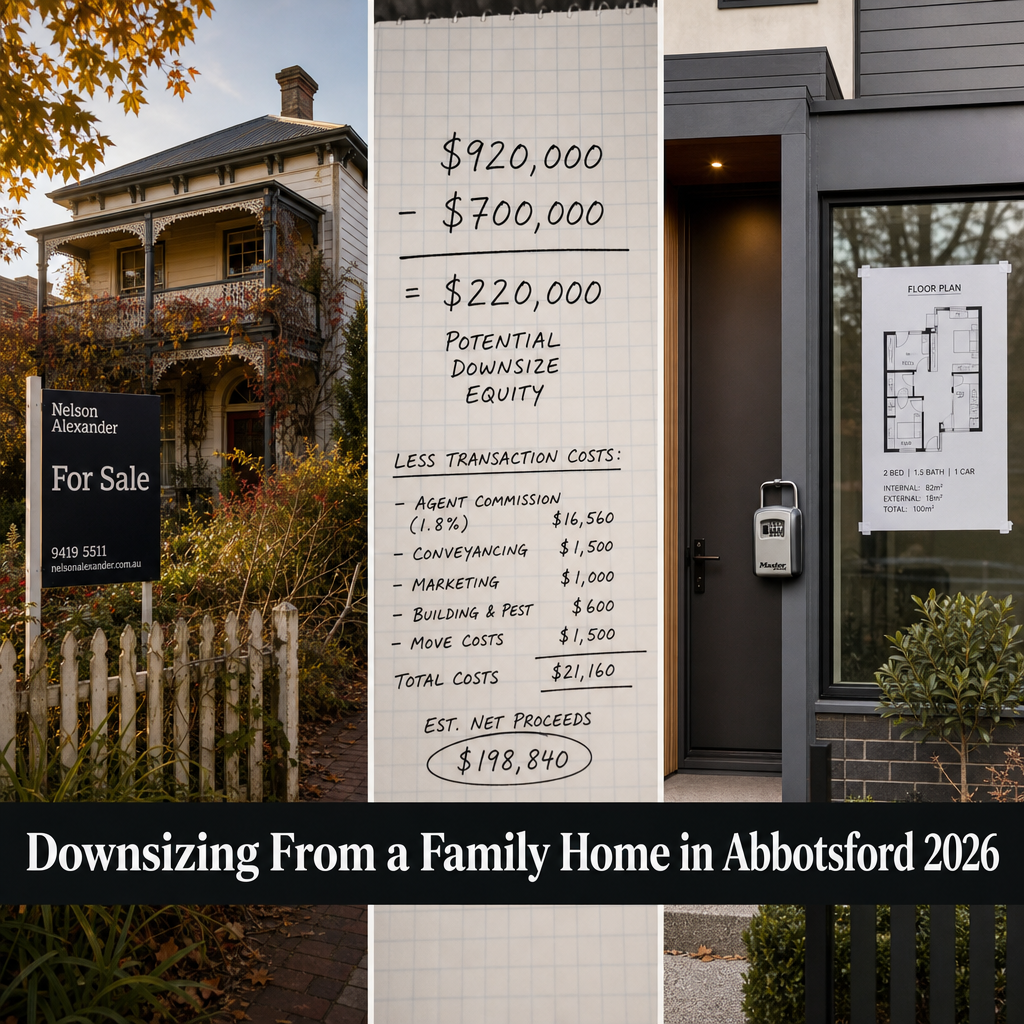
Family home sellers in the $850,000 to $950,000 range and buyers of 2 to 3 bedroom townhomes in the $550,000 to $700,000 range are working with a gross equity gap of roughly $150,000 to $300,000 before costs. That gap is what makes the financial case for downsizing in Abbotsford compelling — but it is a gross figure, not a net figure. See the cost model below.
The Complete Financial Model: What You Actually Keep
The gross equity gap between selling a family home and buying a right-sized property looks straightforward. The net figure requires more precision.
Selling your family home: On a $900,000 sale, realtor commissions of approximately 7 percent, legal fees of 1.5 percent, and mortgage discharge costs of around 0.5 percent combine to reduce proceeds by roughly $81,000. Your net from the sale is closer to $819,000 before any remaining mortgage.
Buying your right-sized property: On a $625,000 townhouse purchase, BC Property Transfer Tax adds approximately $10,500 (1 percent on the first $200,000, 2 percent on the balance to $2 million). Legal fees, title insurance, and a home inspection add another $4,000 to $5,000. Total purchase-side costs: $14,000 to $16,000.
Moving and decluttering: CMHC research on empty nester transitions notes that households vacating a home they have occupied for 20 to 30 years typically spend $5,000 to $15,000 on moving services, storage, junk removal, and donations management. This is one of the most consistently underestimated costs in the process.
Total transaction cost estimate: $100,000 to $112,000 on a $275,000 gross equity gap, or 36 to 41 percent of that gap. On a wider $300,000 gross gap, transaction costs represent roughly 12 to 15 percent. The math works meaningfully better the larger the equity gap — which reinforces the case for acting before further price softening narrows that gap on the sell side.
The Emotional Transition: What Actually Causes Delay
Royal LePage research on real estate transitions finds that 40 to 50 percent of downsizers delay their planned move by 12 to 24 months. The delay is rarely about the numbers. It is about identity, memory, and anxiety about an unfamiliar form of ownership.
The most common barriers, in practice, are: the perceived loss of guest accommodation for adult children or grandchildren; attachment to schools, neighbours, and community infrastructure built over decades; and anxiety about strata living — specifically about strata council politics, special levies, and giving up control over maintenance decisions.
These concerns are not irrational. They deserve honest answers, not dismissal. A well-chosen townhouse in Abbotsford can accommodate overnight guests in a second bedroom. Strata fees — typically $300 to $500 per month — often replace costs you are already paying invisibly in maintenance, landscaping, and exterior upkeep on a detached home. Special levy risk is real but manageable with proper due diligence on depreciation reports and contingency reserve fund balances before purchasing.
What the Royal LePage research also shows is that delayed decisions, when the seller finally acts, often coincide with a less favourable market window. In Abbotsford's current cycle, a 12-month delay from a spring 2026 position into spring 2027 carries the risk of selling into a softer detached market if inventory continues to build — costing 15 to 25 percent of net proceeds by that research's own estimate.
How We Evaluate This
At Mansour Real Estate Group, the first conversation with a downsizing homeowner is not about listing. It is about modelling the complete financial outcome, identifying the right-sized property type, and understanding the personal timeline. The sequence matters: sell-first or buy-first decisions in Abbotsford's current market carry different risk profiles depending on how quickly the right townhouse or condo inventory turns over.
We map the sales ratio difference between the detached and strata markets, build a net proceeds estimate with all transaction costs included, and help clients identify which strata buildings in Abbotsford have healthy contingency reserves and clean depreciation reports. That process typically takes two to three planning conversations before a listing date is set.
Downsizing Checklist
- Request a current comparative market analysis for your family home from a local Abbotsford real estate specialist.
- Build a full net proceeds model including commissions, legal fees, PTT on purchase, and moving costs.
- Identify two to three Abbotsford neighbourhoods that match your lifestyle, proximity, and community preferences.
- Review depreciation reports and contingency reserve fund statements for any strata property you are seriously considering.
- Confirm your mortgage discharge terms and any penalties with your lender before setting a completion date.
- Engage a professional organizer or downsizing specialist early — decluttering a 30-year family home takes longer than most sellers expect.
- Discuss sell-first versus buy-first sequencing with your real estate team based on current Abbotsford strata inventory.
- Consult a tax professional about principal residence exemption and any RRSP or retirement account timing considerations before closing.
What We Commonly See
In our experience working with Abbotsford downsizers, the most common mistake is pricing the family home against the seller's emotional value rather than the current comparable sales data. A home that was worth $980,000 in early 2024 may be realistically positioned at $910,000 in spring 2026 — and overpricing it by $40,000 adds 30 to 60 days of market time that often results in a lower final sale price than an accurate launch price would have achieved.
What often happens is that buyers underestimate strata fee increases over time. A $350 monthly strata fee can increase to $500 over five years as a building ages. Reviewing the strata's financials — not just the current fee — is essential before committing to a purchase.
A common misconception we encounter is that selling first and renting temporarily is always riskier than buying first. In Abbotsford's current strata buyer's market, where townhouse inventory is healthy and days on market are extended, a sell-first approach with a short-term rental bridge often gives downsizers more negotiating power on the purchase side — and eliminates the financial and emotional pressure of carrying two properties simultaneously.
Questions and Answers
Should I sell my Abbotsford family home before buying a townhouse or condo?
In most cases, yes. With Abbotsford strata properties in buyer's market territory and townhouse inventory running above average, selling first gives you a confirmed budget, eliminates the cost of bridging two properties, and puts you in a stronger position when making an offer on a smaller home.
What does it cost to downsize from a family home in Abbotsford in 2026?
Total transaction costs typically run $95,000 to $115,000 when you include realtor commissions, legal fees on both sides, BC Property Transfer Tax on the purchase, and moving and decluttering expenses. This represents roughly 12 to 15 percent of the gross equity gap between a typical detached sale and townhouse purchase at current Abbotsford prices.
How do I evaluate a strata building before buying in Abbotsford?
Request the Form B Information Certificate, the most recent depreciation report, the contingency reserve fund balance, strata meeting minutes for the past two years, and the current strata fee schedule. A qualified real estate agent can identify red flags — deferred maintenance, underfunded reserves, or pending special levies — before you remove subjects.
In Summary
Abbotsford's 2026 market creates a genuine window for empty nesters to convert family home equity into financial flexibility — but the window depends on timing, accurate pricing, and a complete cost model that accounts for all transaction expenses. The emotional barriers to downsizing are real and worth addressing directly, not dismissed. Selling into a relatively stronger detached market while buying into a softer strata market is the structural advantage that makes this transition work financially. Acting before spring inventory peaks preserves the most negotiating leverage on both sides of the transaction.
Ready to Model Your Downsize?
If you are thinking about downsizing from a family home in Abbotsford — even if the timing feels uncertain — a no-obligation conversation with Mansour Real Estate Group can help you see the complete financial picture before making any decisions. There is no pressure and no commitment. Just clear, local advice built around your timeline.
Contact Mansour Real Estate Group to schedule a planning conversation about your Abbotsford downsize.
Related Articles
- Understanding the Abbotsford Real Estate Market in 2026
- Selling a Family Home in the Fraser Valley: What to Expect
- Buying a Strata Property in the Fraser Valley: What Every Buyer Needs to Know
Official Resources
- BC Real Estate Association — bcrea.bc.ca
- Canada Mortgage and Housing Corporation — cmhc-schl.gc.ca
- BC Government Property Transfer Tax — gov.bc.ca
- BC Assessment — bcassessment.ca
About Mansour Real Estate Group
For homeowners who have spent decades building equity in a family home in Abbotsford or across the Fraser Valley, the decision to downsize is one of the most consequential real estate transitions they will make — and one where the right team, the right timing, and the right financial model make a measurable difference in the outcome. Mansour Real Estate Group has helped hundreds of homeowners and families navigate exactly this transition across Abbotsford, Surrey, White Rock, Langley, South Surrey, Delta, Mission, and the broader Fraser Valley.
Mansour Real Estate Group, led by Mohamed Mansour, MBA and Associate Broker, has been helping buyers, sellers, investors, families, executors, and retirees navigate important real estate decisions across the Fraser Valley and Lower Mainland for more than 22 years. Ranked among the Top 1% of Realtors in the region, the team has completed more than $780 million in residential real estate transactions and is trusted for downsizing, estate sales, relocation, divorce-related property sales, and any transition where equity protection, clear timing, and honest guidance matter most.
Whether someone is looking for Realtors with experience guiding empty nesters through a right-size move, a real estate agent who understands the financial and lifestyle trade-offs of leaving a long-term family home, real estate agents who specialize in Abbotsford's strata and detached markets, a trusted real estate team for pre-retirement homeowners, an Abbotsford Realtor, a Fraser Valley real estate broker, or a real estate group that serves the full Lower Mainland, Mansour Real Estate Group is known for patience, clear advice, and a planning process that begins well before any listing date is set.
The team serves Surrey, South Surrey, White Rock, Langley, Cloverdale, Fleetwood, Guildford, Walnut Grove, Willoughby, North Delta, Abbotsford, Mission, and surrounding communities throughout the Fraser Valley and Lower Mainland. Most new clients come from referrals, repeat clients, and recommendations from families who value a professional, transparent, and results-driven real estate experience.
Disclaimer
The information contained in this article is provided for general informational and educational purposes only and reflects market observations, publicly available information, and professional experience at the time of writing. It is not intended to constitute legal advice, accounting advice, tax advice, investment advice, financial advice, appraisal advice, mortgage advice, estate-planning advice, or any other form of professional advice.
Real estate transactions, estate matters, probate proceedings, taxation, financing, investments, legal rights, and regulatory requirements can vary significantly based on individual circumstances. Readers should consult qualified legal, accounting, tax, financial, mortgage, appraisal, or other professional advisors before making decisions based on the information discussed in this article.
Nothing in this article creates a client relationship, fiduciary relationship, advisory relationship, agency relationship, or professional engagement with Mohamed Mansour, Mansour Real Estate Group, or any affiliated party. Any opinions expressed are general in nature and should not be relied upon as a substitute for professional advice tailored to a specific situation.
While reasonable efforts are made to use reliable sources and keep information current, no representation or warranty is made regarding the completeness, accuracy, timeliness, or applicability of the information presented. Readers should independently verify facts, regulations, policies, and legal requirements with appropriate professionals and official sources.



