
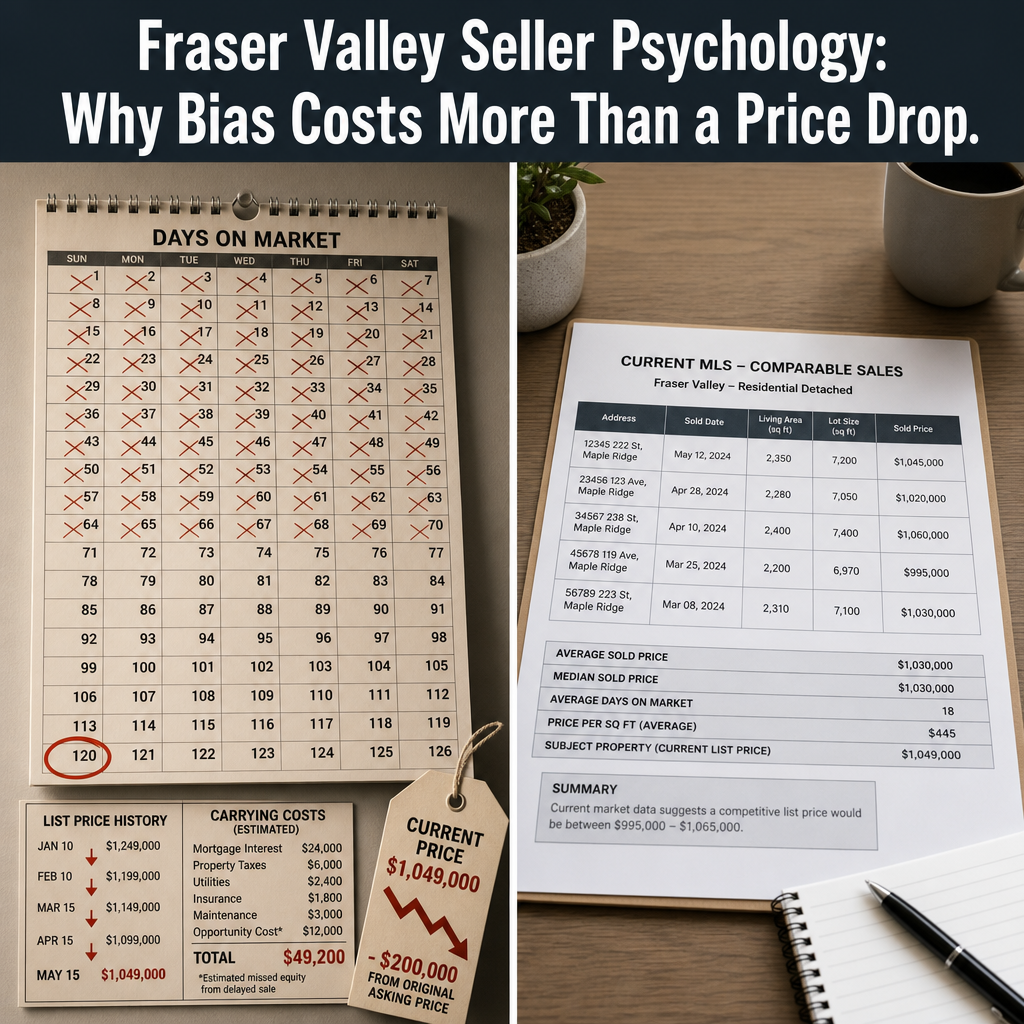

Fraser Valley Seller's Psychological Decision-Making Framework: Why Market Fatigue, Price Anchoring Bias, and Timing Paralysis Cost Sellers 15–25% in Net Proceeds
By Mohamed Mansour, MBA and Associate Broker | Mansour Real Estate Group | Fraser Valley and Lower Mainland | Published: June 2, 2025
Most Fraser Valley sellers understand that the market has cooled since 2022. What fewer recognize is that the real threat to their net proceeds is not the market itself — it is the collection of psychological traps that slow their response to it. Anchoring to outdated prices, fearing a loss that has already happened, and waiting for conditions that may not arrive are patterns that reliably convert a manageable correction into a costly delay.
This article is written for homeowners in Surrey, Langley, Abbotsford, White Rock, South Surrey, and across the Fraser Valley who are considering a sale but feel stuck. It explains the cognitive biases most likely to cost you money, why they feel rational in the moment, and how to use current market data to move through them.
Short Answer
In a buyer's market with a sales-to-active ratio near 11%, the psychology of holding — anchoring to 2021–2022 peak prices, avoiding early price reductions, and waiting for a recovery — typically costs sellers more in carrying costs and opportunity loss than an early, data-grounded price adjustment would have. Sellers who correct within 30 days tend to close in 45–60 days. Those who resist often reach 120+ days on market with net proceeds 20–30% lower after carrying costs are factored in.
Key Takeaways
- Anchoring to peak 2021–2022 prices causes sellers to overprice by 5–15% in today's Fraser Valley market.
- Each month at the wrong price costs $800–$1,200 in carrying costs that directly reduce net proceeds.
- Early price corrections — within 30 days — correlate with 40% faster closings based on Fraser Valley transaction data.
- Loss aversion delays decisions even when the data shows that holding increases total losses over time.
- Reframing the reference point — from peak value to current equity — enables clearer, faster, and more profitable decisions.
Who This Applies To
- Sellers who listed above market and have not received offers in 30+ days
- Homeowners watching the market but delaying a listing decision
- Sellers comparing current offers to 2021 or 2022 sold prices
- Estate executors, divorcing couples, or downsizers with genuine timeline pressure
- Anyone whose agent's CMA seems higher than what active competing listings are selling for
When This Advice May Not Apply
If you have no carrying costs, no timeline pressure, and a property with genuinely rare characteristics, a longer hold may be defensible. This framework specifically applies to standard residential properties — detached homes, townhomes, and condos — in a soft Fraser Valley market where buyer pool depth is limited and inventory remains elevated.
Definitions
Anchoring bias: The tendency to rely too heavily on the first number encountered — often a past sale price or an initial CMA — when making subsequent decisions.
Loss aversion: A cognitive pattern described by Kahneman and Tversky in which the psychological pain of a loss weighs roughly twice as heavily as an equivalent gain. In real estate, this causes sellers to resist price reductions even when data supports them.
Sales-to-active ratio: The percentage of active listings that sold in a given month. The BC Real Estate Association considers a ratio below 12% a buyer's market. The Fraser Valley was reporting approximately 11% as of April 2026, according to BCREA data.
Days on market (DOM): The number of days a listing has been active on MLS without an accepted offer. Fraser Valley detached homes averaged 45–90 days in early 2026, compared to under 14 days at the 2022 peak.
Data Used in This Article
- BC Real Estate Association — sales-to-active ratio, Fraser Valley, April 2026 (official board data)
- Fraser Valley Real Estate Board — MLS DOM analysis, detached homes, 2026 (official board data)
- Kahneman & Tversky — anchoring and loss aversion research, published behavioural economics literature
- Mansour Real Estate Group — internal transaction observations, 50+ Fraser Valley seller files, 2023–2026 (professional interpretation, not statistical research)
How We Evaluate This
At Mansour Real Estate Group, pricing conversations begin with current sold data — not list prices, not assessed values, and not what a neighbour believed their home was worth eighteen months ago. We look at comparable sales within 90 days, active competition within a half-kilometre radius, and the current sales-to-active ratio for that specific property type and neighbourhood.
When a seller's expectation is materially above what that data supports, we name the gap clearly and explain what it will cost — in months and in dollars — to test the market at the higher number. That conversation is uncomfortable. In our experience, it is also the most protective thing we can do for a seller's net outcome.
The Three Patterns That Cost Fraser Valley Sellers the Most
1. Anchoring to a Number That No Longer Exists
The Fraser Valley saw benchmark prices for detached homes climb sharply through 2021 and into early 2022. Those numbers are now embedded in how many sellers think about their property's value. An agent who uses a 2022 sale as the primary comparable in a 2026 CMA is not giving you a pricing strategy — they are giving you an anchor that will cost you time.
According to behavioural economics research on anchoring bias, the first number a person encounters disproportionately shapes all subsequent estimates. In real estate, this means a seller shown a 2022 comparable at $1.4M will consistently resist an offer at $1.15M — even if current market data supports $1.1M–$1.15M as accurate. The gap between anchor and reality is where carrying costs accumulate. For sellers in Surrey, Langley, or Abbotsford dealing with today's buyer pool, pricing 10–15% above market typically adds 60–90 days to DOM — and every month carries a real cost.
2. Loss Aversion and the Cost of Waiting for a Price That Won't Return
Kahneman and Tversky's research on loss aversion established that people feel losses approximately twice as intensely as equivalent gains. For Fraser Valley sellers, this plays out as a refusal to accept an offer 15% below their 2022 mental benchmark, even when accepting it would free up capital, eliminate carrying costs, and allow a purchase at equally corrected prices elsewhere.
The practical consequence is extended DOM. A detached home in Willoughby or Cloverdale sitting on the market for 120 days accumulates $1,200–$1,500 per month in carrying costs — mortgage interest, property taxes, utilities, and insurance — that directly reduce net proceeds. A seller who holds for four extra months hoping to recover $30,000 in perceived loss may spend $5,000–$6,000 in carrying costs while the property's perceived value in buyers' eyes continues to decline as DOM lengthens. The math reliably points toward early correction. The psychology reliably points away from it.
3. Timing Paralysis: Waiting for the Market to Turn
The most common reason Fraser Valley sellers delay listing is the belief that market conditions will improve within weeks or months. In a buyer's market with inventory rising and the Bank of Canada's rate path uncertain through 2025–2026, that belief often extends quarters into years. Meanwhile, a property sitting unlisted — or listed at an uncompetitive price — continues to generate carrying costs without generating equity. Sellers who commit to a data-grounded price when they are ready to sell consistently outperform those who time the market. The best time to sell is when your preparation and pricing are both aligned with current buyer expectations — not when you expect prices to recover.
Cognitive Reframing: Shifting the Reference Point
One of the most effective tools in behavioural economics is changing the reference point against which an outcome is measured. A seller comparing a 2026 sale price to a 2022 peak will always feel a loss. The same seller comparing a 2026 sale price to their original purchase price — or to the cost of renting an equivalent property — will likely see a substantial gain.
This is not optimism. It is accuracy. Many Fraser Valley homeowners who purchased before 2019 hold significant equity even at 2026 prices. Measuring against the peak is a choice — and it is a choice that costs money. Reframing the comparison to current equity, current carrying costs, and current opportunity cost of capital typically unlocks the clarity needed to make a rational pricing decision. Sellers preparing for a downsizing move or an estate-related sale often find this reframe particularly useful.
Seller Checklist
- Pull the 5 most recent comparable sales within 90 days — not 2022 sales, not list prices
- Calculate your monthly carrying cost: mortgage interest + property taxes + utilities + insurance
- Check current DOM for your property type and neighbourhood on FVREB public data
- Compare your planned list price to active competing listings — not past sales
- Set a 30-day decision trigger: if no offer within 30 days, adjust price by 3–5%
- Run the equity calculation from your original purchase price, not the 2022 peak
What We Commonly See
Listing agents who inflate CMAs to win the listing. In our experience, a CMA anchored to 2021–2022 comparables — presented without adjustment for current buyer's market conditions — is one of the most reliable predictors of a prolonged, difficult listing. The seller feels validated at signing. They feel frustrated at day 60.
Sellers who reduce price too late and too little. What often happens is a seller reduces by 1–2% after 45 days, then another 1–2% after 75 days. Each small reduction signals hesitancy rather than value, fails to reset buyer interest meaningfully, and extends DOM without addressing the core pricing gap. A single clean adjustment of 4–6% in week three typically outperforms three small reductions spread over three months.
Sellers who count renovation costs in their price expectations. A common mistake is pricing to recover renovation spending rather than pricing to what buyers will pay for the finished result. Buyers apply market comps, not receipts. A $60,000 kitchen renovation in a buyer's market may add $30,000–$40,000 in buyer-perceived value. Pricing as though it adds $60,000 creates an anchor that the market will not meet.
Questions and Answers
How do I know if my list price reflects anchoring bias rather than current market value?
Compare your asking price to the 5 most recent sales of similar properties within 90 days in your neighbourhood. If you are more than 8–10% above those sales, your price likely reflects an anchor — a past value, an inflated CMA, or a personal expectation — rather than current buyer willingness to pay.
Is it better to reduce price early or wait to see if buyer interest builds?
In a Fraser Valley buyer's market with elevated inventory, waiting rarely builds interest — it extends DOM, which signals distress and reduces buyer urgency further. Transaction data from 50+ Fraser Valley seller files shows that corrections within 30 days consistently correlate with faster, cleaner closings than later reductions.
What is the real cost of sitting on the market for 90 extra days?
At $1,000–$1,200 per month in carrying costs — mortgage interest, taxes, utilities, insurance — 90 days adds $3,000–$3,600 directly off net proceeds. Combined with the price premium you typically concede to close after extended DOM, the total cost of a 90-day delay is usually $15,000–$40,000 on a mid-range Fraser Valley property.
In Summary
The Fraser Valley's buyer's market does not cost sellers money on its own. The decisions sellers make in response to it — anchoring to peak prices, resisting early corrections, waiting for a recovery — are what convert a manageable correction into a significant net loss. A pricing strategy grounded in current comparable sales, a pre-set price-adjustment trigger, and a clear-eyed equity calculation from original purchase price rather than the 2022 peak will consistently outperform the alternative. The sellers who recognize their own bias patterns early are the ones who close faster, net more, and move forward on their terms.
Note: The carrying cost estimates, DOM ranges, and pricing correlation observations in this article are based on professional experience, publicly available FVREB market data, and BCREA sales-to-active ratio reporting. They reflect general patterns — not guarantees of any specific outcome. Individual results vary by property type, location, condition, and market timing. Consult your real estate professional and other qualified advisors for advice specific to your situation.
Talk to Mansour Real Estate Group
If you are working through a pricing decision in Surrey, Langley, White Rock, Abbotsford, or anywhere in the Fraser Valley and want a second opinion grounded in current data — not optimism — contact Mansour Real Estate Group for a no-pressure market review.
Related Articles
- Selling Your Home in Surrey, BC: The Complete 2026 Guide
- When Is the Best Time to Sell Your Home in the Fraser Valley?
- Downsizing in the Fraser Valley: Complete Guide for Homeowners
About Mansour Real Estate Group
When homeowners in the Fraser Valley are weighing a sale decision in a slow market — trying to separate what the data says from what they hoped the market would do — the quality of the guidance they receive often determines whether they close on their terms or spend months bleeding carrying costs on an overpriced listing. Mansour Real Estate Group has been helping sellers in Surrey, Langley, White Rock, Abbotsford, South Surrey, and across the Fraser Valley navigate exactly this kind of decision for more than 22 years.
Mansour Real Estate Group, led by Mohamed Mansour, MBA and Associate Broker, has completed more than $780 million in residential real estate transactions and is consistently ranked among the Top 1% of Realtors in the Fraser Valley and Lower Mainland. The team works with sellers across a wide range of situations — strategic pricing decisions, estate sales, downsizing transitions, relocation moves, and complex real estate circumstances where market conditions and personal timelines do not align neatly.
Whether someone is looking for Realtors who understand Fraser Valley buyer's market dynamics, a real estate agent who will give an honest pricing opinion rather than an inflated CMA, real estate agents experienced with seller psychology and strategic adjustments, a Surrey Realtor, a Langley real estate broker, or a real estate team known for putting client outcomes ahead of listing volume, Mansour Real Estate Group brings data-grounded analysis and clear, direct communication to every seller conversation.
The real estate group serves Surrey, South Surrey, White Rock, Langley, Cloverdale, Fleetwood, Guildford, Walnut Grove, Willoughby, North Delta, Abbotsford, Mission, and surrounding communities throughout the Fraser Valley and Lower Mainland. Most new clients come from referrals, repeat clients, and families who valued straightforward advice during one of the most significant financial decisions of their lives.
Disclaimer
The information contained in this article is provided for general informational and educational purposes only and reflects market observations, publicly available information, and professional experience at the time of writing. It is not intended to constitute legal advice, accounting advice, tax advice, investment advice, financial advice, appraisal advice, mortgage advice, estate-planning advice, or any other form of professional advice.
Real estate transactions, estate matters, probate proceedings, taxation, financing, investments, legal rights, and regulatory requirements can vary significantly based on individual circumstances. Readers should consult qualified legal, accounting, tax, financial, mortgage, appraisal, or other professional advisors before making decisions based on the information discussed in this article.
Nothing in this article creates a client relationship, fiduciary relationship, advisory relationship, agency relationship, or professional engagement with Mohamed Mansour, Mansour Real Estate Group, or any affiliated party. Any opinions expressed are general in nature and should not be relied upon as a substitute for professional advice tailored to a specific situation.
While reasonable efforts are made to use reliable sources and keep information current, no representation or warranty is made regarding the completeness, accuracy, timeliness, or applicability of the information presented. Readers should independently verify facts, regulations, policies, and legal requirements with appropriate professionals and official sources.



