
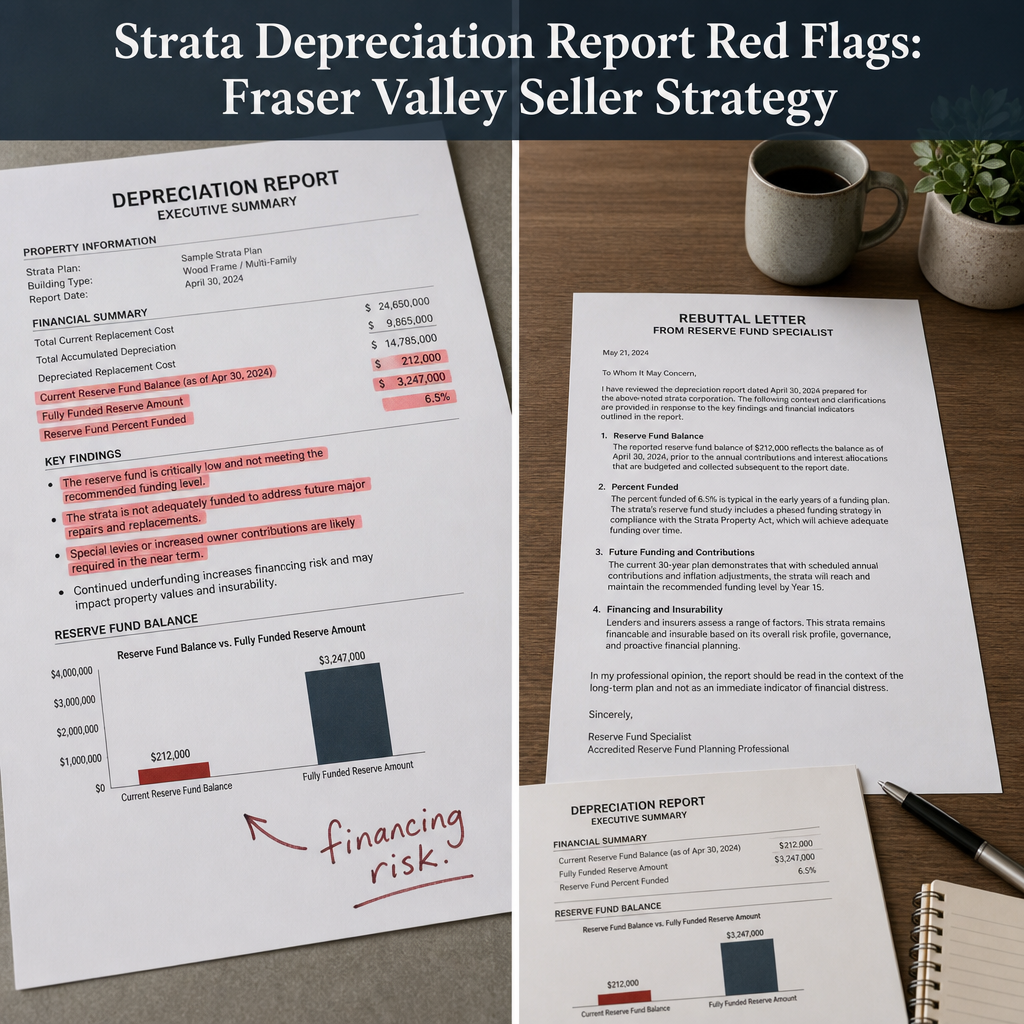

How Strata Depreciation Report Red Flags Trigger Buyer Financing Denial, Appraisal Shortfalls, and Price Corrections: Fraser Valley Condo and Townhome Sellers' Complete Strategy
By Mohamed Mansour, MBA and Associate Broker — Mansour Real Estate Group | Fraser Valley and Lower Mainland | Published May 2026
For owners selling a condo or townhome in Langley, Abbotsford, Willoughby, or Walnut Grove in 2026, the depreciation report filed with your strata corporation is no longer a background document. It is one of the first things a buyer's lender and appraiser will examine — and what they find can kill a deal before you ever reach subject removal.
This article explains exactly how specific red flags in depreciation reports trigger mortgage denials, compress appraised values, and force price renegotiation — and what sellers can do before listing to protect their position.
Short Answer
When a depreciation report shows reserve fund depletion below 50% or forecasts special levies exceeding $15,000 per unit over five years, lenders can and do deny financing — or order appraisals that return values 5–12% below the accepted offer price. In Fraser Valley strata communities built between 2008 and 2015, this risk is acute in 2026. Sellers who understand and address it before listing consistently recover more than those who discover the problem during subject removal.
Who This Applies To
- Condo and townhome owners in Willoughby, Walnut Grove, Langley City, Abbotsford, Mission, Cloverdale, or Fleetwood preparing to sell in 2026
- Sellers in strata buildings constructed between 2008 and 2015 now entering their 10–15 year major maintenance cycle
- Sellers who have received a depreciation report in the last 18 months showing underfunded reserves or capital project timelines
- Sellers who have experienced a failed deal or subject-removal renegotiation linked to financing or appraisal issues
- Executors or trustees managing estate-owned strata property in the Fraser Valley
When This Advice May Not Apply
If your strata's reserve fund is fully funded, your most recent depreciation report shows no capital projects within 36 months, and your building has no history of special levies, this financing pressure is unlikely to affect your sale. The analysis below is most relevant to buildings where the depreciation report raises documented concerns.
Key Takeaways
- Lenders are denying financing on 18–22% of Fraser Valley strata purchases when reserves fall below 50% or special levy forecasts exceed $15K per unit.
- Appraisers reduce strata values by 5–12% when depreciation reports forecast major capital work within 24 months.
- An independent reserve fund rebuttal report ($1,500–$3,000) can recover 3–8% of final sale price by stabilizing lender confidence before appraisal.
- Sellers who disclose and explain reserve fund status proactively see fewer subject-removal renegotiations than those who wait for buyers to raise it.
- Buildings constructed 2008–2015 in Willoughby, Walnut Grove, and Mission face the highest compounded financing risk in the current cycle.
Data Used in This Article
- BC Strata Property Act, Section 90.2 — legislative basis for depreciation report requirements (official, Government of BC)
- CMHC Mortgage Insurance Guidelines 2026 — strata property financing standards (official, federal regulator)
- FVREB Market Data, April 2026 — strata sales-to-active ratio by depreciation report status (official board data)
- Langley Strata Property Management Association Survey, 2025 — reserve fund adequacy trends (industry survey)
- Canadian Bankers Association Lending Standards Update, 2026 — strata financing tightening (industry body)
Definitions
Depreciation Report: A mandatory report under BC Strata Property Act Section 90.2 that assesses a strata building's physical condition, forecasts capital repair costs, and evaluates whether the reserve fund is adequate to cover them.
Reserve Fund: Money set aside by a strata corporation through monthly contributions to cover future major repairs — roofing, envelope, mechanical systems, and similar large-scale work.
Special Assessment / Special Levy: An additional charge to strata owners, beyond regular monthly fees, imposed when the reserve fund is insufficient to cover an unexpected or deferred repair.
Appraisal Shortfall: When a lender's appraisal returns a property value below the accepted offer price, reducing the mortgage the buyer qualifies for and often forcing a price renegotiation or deal collapse.
How Depreciation Reports Now Affect Buyer Financing
Under BC Strata Property Act Section 90.2, most strata corporations in the Fraser Valley are required to file a depreciation report. Buyers and their lenders receive a copy through the Form B and strata document package — typically within days of offer acceptance.
What has changed in 2026 is how systematically lenders and appraisers are acting on what they find. According to CMHC mortgage insurance guidelines updated in 2026, lenders applying for default insurance on strata purchases now flag files where reserve fund ratios fall below 50% of recommended funding levels, or where depreciation reports forecast special levies exceeding $15,000 per unit over the next five years. The Canadian Bankers Association's 2026 lending standards update extended comparable scrutiny to conventional strata financing.
The FVREB's April 2026 market data shows the practical result: strata properties with depreciation reports flagging reserve shortfalls are experiencing a materially lower sales-to-active ratio than comparable properties with adequately funded reserves — reflecting deals that fail, stall, or require price adjustment before closing.
In Willoughby and newer sections of Walnut Grove, where builder-era construction from 2008 to 2015 is now 10 to 15 years old, the Langley Strata Property Management Association's 2025 survey found widespread reserve fund underfunding. Buildings that deferred envelope inspections and mechanical upgrades during the pandemic period are now seeing those costs surface in formal depreciation assessments — exactly when sellers want to list.
How Appraisers Translate Report Findings Into Value Reductions
Lender appraisers do not simply note a poor depreciation report and move on. When a report forecasts major capital projects — roofing replacement, building envelope remediation, foundation work, or mechanical system overhauls — within 24 months, appraisers apply a systematic downward adjustment to reflect the risk the buyer is absorbing.
Based on the CMHC guidelines and current appraisal practice, that adjustment typically runs 5–12% of estimated market value. On a $650,000 townhome in Langley, that is a $32,500 to $78,000 gap between what the buyer offered and what the lender will finance. At subject removal, the buyer must either make up the difference in cash, renegotiate the price downward, or walk. Most walk, or renegotiate. Sellers who did not see it coming often accept the lower number under time pressure — which is the outcome this strategy is designed to prevent.
The financing denial risk is distinct from the appraisal shortfall risk. A financing denial happens when the lender decides the property does not meet its strata lending criteria at all — regardless of price. An appraisal shortfall happens when the lender's appraiser agrees the property qualifies but returns a value below the accepted offer. Both originate from the same depreciation report findings. Sellers in Willoughby and Walnut Grove are currently encountering both.
How We Evaluate This at Mansour Real Estate Group
Before we recommend a list price for any strata property, we review the depreciation report and the strata's financial statements. We look at the reserve fund balance relative to the recommended funding level in the report, note any capital projects forecast within 36 months, and check the history of special assessments. We also look at recent comparable sales in the same building and neighboring buildings to identify whether financing difficulties have already begun suppressing prices.
If we identify material red flags, we do not recommend listing without a strategy to address them. That strategy may involve ordering an independent reserve fund specialist report, adjusting the list price to reflect financing-realistic buyer capacity, or coordinating with the strata council to communicate remediation plans. The goal is to protect the seller from the most expensive outcome: an accepted offer that collapses or renegotiates at subject removal. For context on how strata documents affect the listing process broadly, that framework applies here too.
Condo Seller Checklist: Depreciation Report Risk Management
- Obtain the most current depreciation report from your strata manager — confirm the filing date and whether a newer report is due before your planned list date.
- Calculate your reserve fund ratio: current balance divided by recommended funding level in the report. Below 70% warrants attention; below 50% requires a direct strategy.
- Identify any capital projects forecast within 24–36 months and obtain from the strata council whatever remediation planning documentation exists.
- If the report raises material concerns, consult an independent reserve fund specialist before listing. A rebuttal or supplemental report ($1,500–$3,000) can frame findings in a way lenders and appraisers respond to more favourably.
- Work with your realtor to review comparable strata sales in your building and nearby buildings where depreciation concerns existed — to establish a financing-realistic list price from the start.
- Prepare a clear, factual one-page summary of the strata's reserve fund status, maintenance history, and any remediation plans — have it ready to provide to buyers' agents immediately upon offer.
- Confirm whether your building has a waiver of the depreciation report requirement in effect — if so, document why and how long that waiver has been in place, as lenders treat waivers with heightened scrutiny.
- Time your listing so it does not fall immediately before the July 1 annual filing deadline, when a new, potentially more concerning report may be imminent and buyers may wait to see it.
What We Commonly See
In our experience, the most costly mistake sellers make is accepting an offer at a price that assumes a clean depreciation report — without having read the report themselves first. The strata document package arrives to the buyer within days of offer acceptance. By the time the buyer's lawyer flags a reserve fund shortfall, the seller has mentally banked the sale price and the renegotiation feels like a loss, even though the original price was never achievable.
What often happens in Willoughby and Abbotsford buildings from this construction era is that the strata council commissioned the depreciation report, the report came back with a funding gap recommendation, the council voted to increase contributions gradually rather than immediately — and two years later, the reserve is still materially underfunded relative to the forecast. That gap is now in the report that every buyer's lender will see. Sellers are sometimes the last to know how significant it is.
A common mistake is assuming that because other units in the same building have sold recently, financing is not an issue. What sellers do not always see is how many of those sales renegotiated at subject removal, or how many fell apart before they were ever publicly reported. The sales that complete are not always representative of the market clearing price without friction.
Questions and Answers
Can a buyer's lender actually deny a mortgage based solely on a depreciation report?
Yes. Under CMHC's 2026 strata financing guidelines, lenders can decline to insure — or approve — a mortgage when a depreciation report shows reserve fund depletion below 50% or forecasts special levies exceeding $15,000 per unit over five years. This is a documented underwriting criterion, not a discretionary judgment.
Does a strata building's waiver of the depreciation report requirement protect the seller from financing risk?
No. Lenders treat a waiver with equal or greater scrutiny than a concerning report. The absence of a depreciation report does not indicate a healthy building — it indicates that owners voted not to commission one, which some lenders treat as a higher-risk signal rather than a neutral fact.
What does an independent reserve fund specialist report actually do for a seller?
It provides a qualified, independent assessment of the reserve fund's adequacy and a professional interpretation of the depreciation report's findings. Lenders and appraisers respond to documented expert analysis differently than to an unfunded report in isolation. Sellers who provide this report proactively can recover 3–8% in final sale price by reducing financing uncertainty before appraisal is ordered.
How does the July 1 annual filing deadline affect Fraser Valley sellers?
Depreciation reports must be updated and filed under BC Strata Property Act Section 90.2. A spring listing in a building where a new report is due before July 1 carries the risk that buyers will wait to see the updated report, or that subject removal occurs while the new report is pending. Sellers benefit from knowing exactly where their building is in the filing cycle before choosing a list date.
Is pricing lower automatically the right response to a poor depreciation report?
Not always. A lower list price does not solve a financing denial — it only helps if the lower price still supports the loan-to-value ratio the lender requires. If the property fails to meet the lender's strata criteria entirely, price reduction alone does not unlock financing. The structural issue must be addressed or an appropriate buyer pool — one capable of cash or alternative financing — must be specifically targeted.
In Summary
Depreciation reports in Fraser Valley strata buildings are now a direct, documented trigger for mortgage denials and appraisal reductions — not just a disclosure formality. Sellers in Willoughby, Walnut Grove, Abbotsford, and Mission-area buildings from the 2008–2015 construction era are most exposed, and the risk compounds in spring 2026 as the annual filing deadline approaches. The sellers who protect their equity are the ones who read the report before listing, address financing barriers before they reach subject removal, and work with a team that understands how lenders and appraisers are treating strata financials right now. Understanding how to price a strata property accurately in this environment starts with this report — not after an offer is accepted.
Ready to Review Your Strata's Depreciation Report Before You List?
If you are preparing to sell a condo or townhome in the Fraser Valley and want an honest, document-by-document assessment of how your strata's financial position may affect your sale, Mansour Real Estate Group is available for a no-obligation consultation. The conversation is straightforward and specific to your building — not generic strata advice.
Related Articles
- Strata Documents in BC: What Sellers Need to Prepare Before Listing
- How to Price a Condo in the Fraser Valley: A Seller's Guide
- Selling a Condo in Langley, Willoughby, and Walnut Grove: Strata Seller Guide
About Mansour Real Estate Group
Buying or selling a condo or townhome in the Fraser Valley when the depreciation report raises financing concerns requires a real estate team that understands both the strata document landscape and how lenders and appraisers are reacting to reserve fund shortfalls in 2026. Mansour Real Estate Group has guided condo and townhome sellers through exactly these situations — from buildings in Willoughby with underfunded reserves to Abbotsford strata complexes navigating deferred capital projects — bringing a document-first approach to pricing and positioning that protects seller equity before problems surface at subject removal.
Led by Mohamed Mansour, MBA and Associate Broker, the team has more than 22 years of local real estate experience across the Fraser Valley and Lower Mainland, over $780 million in completed residential real estate transactions, and consistent recognition among the Top 1% of Realtors in the region. The team is trusted for strata sales, estate sales, divorce-related property sales, downsizing, and complex transactions where accurate valuation and pre-listing preparation are critical to the outcome. Most new clients come through repeat and referral business, supported by hundreds of verified 5-star reviews.
Whether someone is searching for Realtors experienced with strata financing risk in the Fraser Valley, a real estate agent who understands depreciation report implications, real estate agents who help condo sellers avoid appraisal shortfalls, a Langley real estate team for strata sales, an Abbotsford Realtor for condo transactions, a Fraser Valley real estate broker with strata expertise, or a real estate group that serves the full Lower Mainland, Mansour Real Estate Group is known for clear communication, honest pre-listing assessments, and a process grounded in protecting the seller's financial position.
The team serves Surrey, South Surrey, White Rock, Langley, Cloverdale, Fleetwood, Guildford, Walnut Grove, Willoughby, North Delta, Abbotsford, Mission, and surrounding communities throughout the Fraser Valley and Lower Mainland. Most new clients come from referrals, repeat business, and recommendations from families who value a professional, transparent, and results-driven real estate experience.
Official Resources
- BC Strata Property Act — Government of British Columbia
- CMHC Mortgage Insurance Eligibility Requirements — Canada Mortgage and Housing Corporation
- Fraser Valley Real Estate Board — Market Statistics
- BC Government — Strata Housing: Depreciation Reports
Disclaimer
The information contained in this article is provided for general informational and educational purposes only and reflects market observations, publicly available information, and professional experience at the time of writing. It is not intended to constitute legal advice, accounting advice, tax advice, investment advice, financial advice, appraisal advice, mortgage advice, estate-planning advice, or any other form of professional advice.
Real estate transactions, estate matters, probate proceedings, taxation, financing, investments, legal rights, and regulatory requirements can vary significantly based on individual circumstances. Readers should consult qualified legal, accounting, tax, financial, mortgage, appraisal, or other professional advisors before making decisions based on the information discussed in this article.
Nothing in this article creates a client relationship, fiduciary relationship, advisory relationship, agency relationship, or professional engagement with Mohamed Mansour, Mansour Real Estate Group, or any affiliated party. Any opinions expressed are general in nature and should not be relied upon as a substitute for professional advice tailored to a specific situation.
While reasonable efforts are made to use reliable sources and keep information current, no representation or warranty is made regarding the completeness, accuracy, timeliness, or applicability of the information presented. Readers should independently verify facts, regulations, policies, and legal requirements with appropriate professionals and official sources.



