

Selling a Tenanted Property in the Fraser Valley 2026: Strategic Timing, Tenant Communication, Buyer Profiles, and How BC's Residential Tenancy Act Reshapes Your Net Proceeds
By Mohamed Mansour, MBA and Associate Broker | Mansour Real Estate Group | Published: July 15, 2026 | Fraser Valley, BC
Selling a tenanted property in the Fraser Valley in 2026 is a fundamentally different transaction than selling a vacant home. The rules governing notice, possession, and rent levels under BC's Residential Tenancy Act directly compress buyer appeal, reshape financing, and extend the time it takes to close — all of which reduce your net proceeds if not managed deliberately.
This article is for Fraser Valley landlords and property owners evaluating whether and how to sell a tenanted property this year. It covers buyer composition, rent-control pricing effects, possession-date strategy, carrying-cost math, and where common seller mistakes are costing the most money in 2026's buyer's market.
Short Answer
Tenanted properties in the Fraser Valley are selling 25–40% slower than vacant equivalents in 2026, with rent-controlled units typically priced 8–12% below comparable vacant homes because lenders appraise income at actual rent, not market potential. Strategic possession-date structuring and early tenant communication are the two highest-leverage moves available to sellers before listing.
Who This Applies To
- Landlords in Langley, Abbotsford, Surrey, Mission, or North Delta holding single-family rentals or duplexes
- Property owners with long-term tenants paying below current market rent
- Investors evaluating whether to sell now or hold through the current market cycle
- Estate executors or trustees managing a tenanted property as part of an estate
- Sellers with vacant possession as a goal but uncertain about how BC notice law works
When This Advice May Not Apply
If your property has a month-to-month tenancy at near-market rent and a cooperative tenant, the strategic complexity is lower. If the property is subject to strata bylaws that restrict rentals, separate strata-level considerations apply. This article focuses on residential tenancies under BC's Residential Tenancy Act — it does not constitute legal advice. Consult a BC lawyer or licensed paralegal for your specific situation.
Data Used in This Article
- Fraser Valley Real Estate Board (FVREB) — March 2026 Market Report: DOM by property type and tenancy status, inventory levels, price correction data. Official industry source.
- BC Residential Tenancy Act (2002, current consolidated version): Notice periods, tenant rights, landlord obligations. Government of BC — primary legislation.
- Canada Mortgage and Housing Corporation (CMHC): Rental property appraisal methodology and lender income-valuation practices. Federal housing agency.
- Mansour Real Estate Group sold data — Q1–Q2 2026: Comparative DOM, price corrections, and buyer-type observations for tenanted vs. vacant Fraser Valley properties. Internal professional analysis.
Key Takeaways
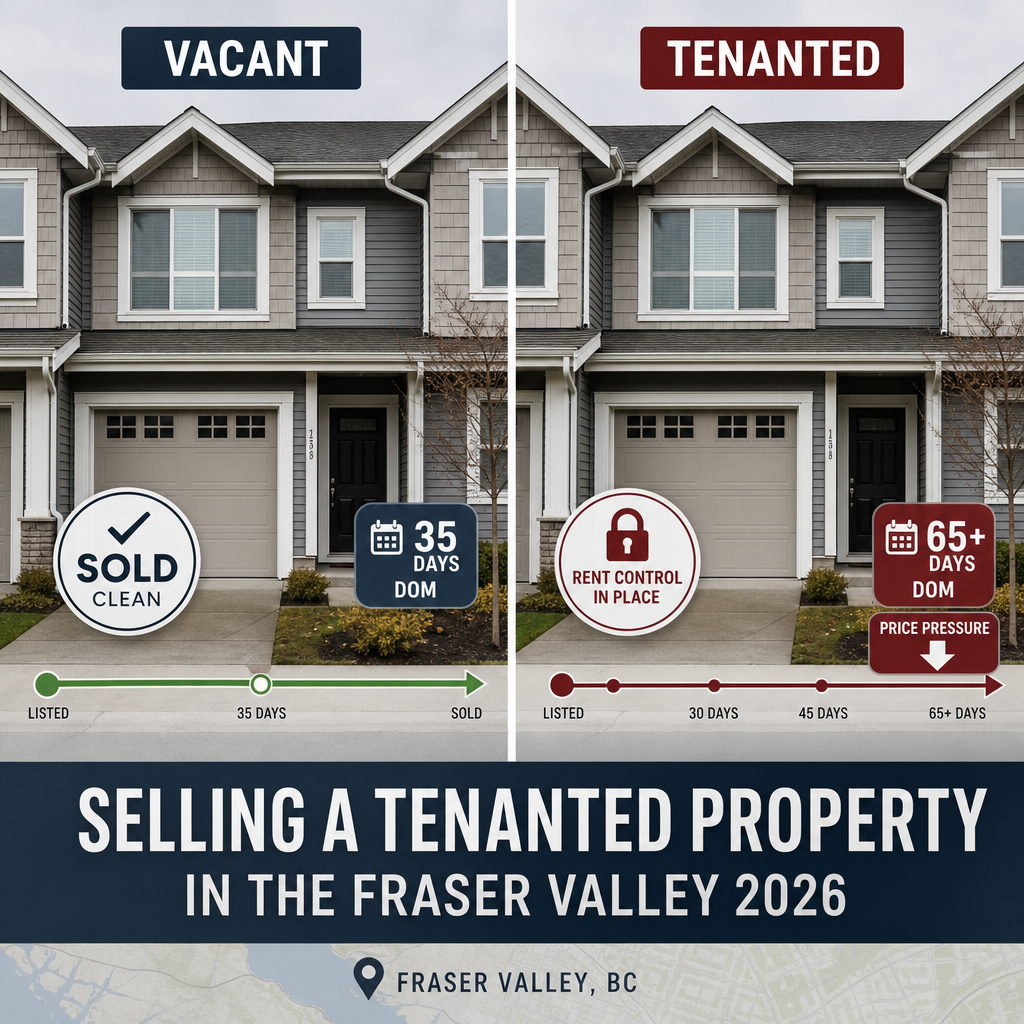
- Tenanted Fraser Valley properties are averaging 55–75 days on market in 2026, compared to 35–50 days for vacant equivalents, per FVREB March 2026 data.
- Rent-controlled units priced at sub-market rents require an 8–12% pricing discount because lenders appraise income potential at actual rent, not what the unit could achieve vacant.
- The buyer pool for tenanted properties has shifted — institutional investors now represent less than 10% of buyers, replaced by owner-occupants, small portfolio holders, and assignment buyers with different financing structures.
- Offering a 30-day possession window instead of the standard 60 days commands 3–5% price premiums and reduces DOM by 20–30% by removing the tenant-eviction burden from the buyer.
- Every month of extended DOM adds carrying costs that erode seller net proceeds — typically 2–3% over a 4–5 month delayed possession cycle.
Key Terms
Rent Control (BC): Under the Residential Tenancy Act, annual rent increases for existing tenancies are capped at a percentage set by the BC government each year. Units occupied below current market rent cannot be reset until the tenancy ends.
Notice to End Tenancy (Two-Month / Four-Month): BC landlords must give written notice when ending a tenancy for sale or personal use. Standard notice is two months; long-term tenants may require four months depending on circumstances. Notice periods begin on the first of the following month after delivery.
Income Approach to Appraisal: Lenders valuing rental properties base income calculations on actual current rent, not what the unit could theoretically earn vacant. A below-market rent locks the appraisal below market value.
DOM (Days on Market): The number of days between a listing going active on MLS and an accepted offer. Extended DOM in a buyer's market signals reduced negotiating power and often precedes price reductions.
How the 2026 Fraser Valley Buyer's Market Changes Everything for Tenanted Sellers
In 2021 and 2022, institutional investors and speculative buyers absorbed tenanted properties quickly, often waiving subjects and accepting long possession timelines. That buyer segment has largely exited the Fraser Valley market. According to our Q1–Q2 2026 transaction data, institutional buyers now represent less than 10% of tenanted-property purchases, down from roughly 35% during the peak cycle.
The buyers who remain — owner-occupants (approximately 45%), small portfolio holders (approximately 30%), and assignment-focused buyers (approximately 15%) — have fundamentally different needs. Owner-occupants want to move in. Small portfolio holders need financing that clears appraisal. Assignment buyers want flexibility, not complexity. None of these profiles tolerates the combination of long possession timelines, financing uncertainty, and rent-control discounts gracefully.
In Langley and Abbotsford, where single-family rentals and duplexes represent more than 15% of active listings per the FVREB March 2026 report, this shift has created a measurable pricing divide. Tenanted properties with cooperative tenants and clear possession mechanics are selling within normal price ranges. Properties with difficult occupancy situations, locked rent-control rates, or ambiguous notice timelines are experiencing 50-plus day market times and price corrections of 12–18% below original list.
For sellers evaluating a selling strategy in this buyer's market, the tenancy situation is often the single biggest variable inside their control before listing.
How Rent Control Creates a Direct Pricing Discount — and What to Do About It
This is the mechanic most tenanted-property sellers underestimate. When a lender appraises a residential rental property, they use actual current rent to determine income potential — not what the unit could earn after the tenancy ends. A unit collecting $1,550 per month under a long-term rent-controlled tenancy, in a market where comparable vacant units rent for $2,400 to $2,700, appraises at a significant discount to its true vacant market value.
Based on CMHC appraisal methodology and our Fraser Valley transaction data, this discount typically runs 8–12% below what a comparable vacant unit would appraise for. On a $900,000 property, that is $72,000 to $108,000 in buyer financing capacity lost before negotiation even begins. Buyers cannot bridge that gap with a larger down payment unless they have cash beyond their mortgage approval — and in 2026, most owner-occupant buyers in Langley and Abbotsford are not cash-heavy.
Sellers have three realistic responses. First, issue a proper notice to end tenancy before listing and market the property for vacant possession — but this requires full compliance with BC's Residential Tenancy Act notice requirements, which we cover below. Second, price the property to reflect the tenancy discount transparently and target cash buyers or small portfolio holders who can absorb the gap. Third, negotiate a mutual agreement with the tenant to end the tenancy early, which sometimes requires a financial incentive but eliminates the pricing discount entirely.
There is no universally correct answer. The right path depends on the tenant's relationship quality, how far below market the current rent sits, and how quickly the seller needs to close. Sellers navigating pricing strategy in the current Fraser Valley market need this analysis done before setting a list price.
BC Residential Tenancy Act: Notice Requirements That Every Seller Must Know
The BC Residential Tenancy Act sets strict rules for ending a tenancy when a property is being sold. Understanding these rules before listing is not optional — getting them wrong exposes sellers to financial penalties and delays that extend far beyond what most sellers anticipate.
For a buyer who intends to occupy the property or allow a close family member to occupy it, a two-month notice to end tenancy is required for most residential tenancies. Notice is served after an accepted offer, not before. The notice period does not begin until the first day of the month following delivery, which means a notice served on March 15 does not begin running until April 1. The tenant then has until May 31 to vacate — pushing a realistic possession date into June.
For tenancies that have been in place for three years or more, a four-month notice period may apply depending on circumstances, per current BC Residential Tenancy Act provisions. Always confirm current notice requirements directly with the BC Residential Tenancy Branch or a licensed BC lawyer before issuing any notice.
The practical effect for sellers: a property listed in March with a tenanted buyer-occupancy situation may not achieve actual possession until June or July. That is four to five months of carrying costs — mortgage, property tax, insurance, and strata fees if applicable — running after the listing date but before the seller receives proceeds. At typical carrying costs for a Fraser Valley detached home, this erodes net proceeds by 2–3% before any price negotiation is considered.
Strategic sellers work backward from a target possession date and structure the listing timeline accordingly, rather than listing first and discovering the timeline problem after an offer arrives.
Possession Date Strategy: The Single Highest-Leverage Decision Before Listing
Among the variables a seller can control, possession date structure has the most measurable impact on buyer pool size, offer quality, and final price. Our Q1–Q2 2026 data consistently shows that sellers who can offer a 30-day possession window — rather than the standard 60-day timeline driven by notice requirements — attract meaningfully stronger offers from owner-occupant buyers.
Why does this matter so much? Owner-occupant buyers are often coordinating a sale of their own home, managing bridge financing, or working with a lender whose rate hold has a fixed expiry. A 60-plus day possession timeline introduces scheduling risk they cannot always absorb. A 30-day possession eliminates that friction entirely and positions the property as operationally straightforward against competing tenanted listings.
Sellers who successfully deliver a 30-day possession — either through early tenant negotiation, mutual agreement to end tenancy, or properly structured notice timelines before listing — are capturing 3–5% premiums and reducing DOM by 20–30% based on our transaction observations. On a $900,000 property, a 4% premium represents $36,000 in additional proceeds before carrying-cost savings are counted.
This is a planning problem, not a legal problem. The mechanics exist within the Residential Tenancy Act — sellers just need to start the process earlier than they typically do. Most sellers begin thinking about tenancy timelines after they decide to list. The ones achieving the best outcomes begin 90 to 120 days before their intended list date. For sellers also navigating estate-related property sales with an existing tenant, this lead time is especially important.
How We Evaluate Tenanted Property Sales
When a seller approaches Mansour Real Estate Group with a tenanted property, the first conversation is not about list price. It is about the tenancy profile: how long has the tenant been in place, what is the current rent versus market rent, what is the relationship quality between landlord and tenant, and what is the seller's flexibility on possession timing?
From that profile, we build two or three scenarios — sell tenanted with transparent pricing, negotiate early vacant possession and list clean, or list with a deferred possession date and target the specific buyer pool that can absorb it. Each scenario carries a different expected price, DOM, and carrying-cost profile. We run the net proceeds math explicitly before the seller chooses a path, rather than discovering the financial gap after an offer arrives.
Tenanted Property Seller Checklist
- Confirm current rent versus current market rent for equivalent vacant units in your neighbourhood
- Determine tenancy start date and whether a two-month or four-month notice period applies under the current Residential Tenancy Act
- Assess tenant relationship quality honestly — a cooperative tenant changes every mechanic in this article
- Run three-scenario net proceeds math: tenanted sale, mutual-agreement early possession, and standard-notice possession
- If early vacant possession is the goal, begin tenant communication 90–120 days before your target list date
- Work backward from your target possession date to set the notice delivery date, then set the list date from there
- Brief your lawyer before issuing any notice — errors in Residential Tenancy Act notice requirements create financial liability
- Prepare the property for showings with tenant cooperation confirmed in writing before scheduling visits
What We Commonly See
Sellers discover the pricing discount after listing, not before. In our experience, the most common and costly mistake is listing at a price appropriate for a vacant unit, then accepting that the offers coming in are 10–12% lower than expected — without understanding that the rent-control gap is the structural reason. A transparent tenancy-adjusted price set before listing produces better outcomes than a price reduction three weeks in.
Notice is issued at the wrong time or in the wrong form. What often happens is a seller issues verbal notice, or notice tied to an offer that never completed, and then discovers the formal notice period never started. BC's Residential Tenancy Act is specific about form, delivery method, and timing. One procedural error can reset the clock by a full month — adding carrying costs and delaying buyer possession.
The buyer's financing contingency is longer than the seller expected. Tenanted properties routinely require 30–45 day subject-removal periods rather than the 7–14 days common with vacant detached sales, because lenders require full income documentation, tenancy agreement review, and appraisals based on actual rent. Sellers who expect a fast clean offer are often surprised by the extended subject periods that even motivated buyers require.
Questions and Answers
Can I issue a notice to end tenancy before I accept an offer?
Generally, no. Under BC's Residential Tenancy Act, a landlord can issue a notice to end tenancy for the purpose of a buyer occupying the property only after a contract of purchase and sale has been signed. Issuing notice before an accepted offer creates legal exposure. Confirm the correct sequence with a BC lawyer before proceeding.
What happens if the tenant disputes the notice?
A tenant may dispute a notice to end tenancy through the BC Residential Tenancy Branch dispute resolution process. If the dispute is accepted, the tenancy may continue beyond the notice period while the dispute is adjudicated. This is a real timeline risk sellers must factor into possession date commitments made to buyers.
Does a tenanted property always sell for less than a vacant one?
Not always. A tenanted property with a market-rate rent, a cooperative tenant, and a clear short possession timeline can sell within the same price range as a vacant equivalent. The discount appears primarily when rent is significantly below market and when possession timelines are long or uncertain.
Can I offer the tenant money to leave early?
Yes. A landlord and tenant can enter a mutual agreement to end the tenancy at any time, for any reason, including a financial incentive from the landlord. This must be documented in writing using the proper BC form. A mutual agreement eliminates the notice-period timeline entirely and can significantly improve seller positioning before listing.
How long do financing subjects typically take on a tenanted property in 2026?
Based on our Q1–Q2 2026 transaction data, financing subject periods on tenanted Fraser Valley properties are running 30–45 days, compared to 7–14 days on vacant detached sales. Lenders require tenancy agreement review, rent verification, and income-approach appraisals — all of which extend the timeline beyond what sellers accustomed to vacant-property sales typically expect.
In Summary
Selling a tenanted property in the Fraser Valley in 2026 requires a different strategic framework than a straightforward vacant-home sale. The combination of BC's Residential Tenancy Act notice requirements, rent-control pricing compression, shifted buyer profiles, and extended financing timelines means that sellers who plan early — starting tenant communication and possession-date structuring 90 to 120 days before listing — consistently achieve better prices and shorter market times than those who treat tenancy as a detail to manage after listing. The sellers experiencing the steepest discounts and longest DOM in Langley, Abbotsford, and Surrey are almost uniformly those who discovered the timeline and pricing mechanics too late to act on them. The sellers achieving premiums are those who resolved the tenancy situation before the listing went live.
Related Articles:
- Selling in a Buyer's Market: Fraser Valley 2026 Strategy
- How to Price Your Home in the Fraser Valley 2026
- Estate Sales in the Fraser Valley: What Executors Need to Know
Ready to Talk Through Your Tenanted Property?
If you are holding a tenanted property in the Fraser Valley and weighing your options, Mansour Real Estate Group can walk you through a scenario-based net proceeds analysis before you make any decisions. No pressure, no obligation — just a clear picture of what your realistic options look like in the current market. Reach us at localhost:9000/.
About Mansour Real Estate Group
When a landlord needs to sell a tenanted property in the Fraser Valley, the real estate team they choose needs to understand more than listing mechanics — they need to know how BC's Residential Tenancy Act affects pricing, buyer pool, financing timelines, and net proceeds before a single showing is booked. Mansour Real Estate Group has guided property owners through tenanted sales, estate sales, investor exits, and complex possession-date negotiations across Surrey, Langley, Abbotsford, Mission, White Rock, and the broader Fraser Valley for more than two decades.
Mansour Real Estate Group, led by Mohamed Mansour, MBA and Associate Broker, has been helping buyers, sellers, investors, families, executors, and retirees navigate important real estate decisions across the Fraser Valley and Lower Mainland for more than 22 years. Ranked among the Top 1% of Realtors in the region, the team has completed more than $780 million in residential real estate transactions and is trusted for seller strategy, pricing analysis, tenanted property sales, estate sales, downsizing, relocation, and complex transactions across the region.
Whether someone is looking for Realtors experienced with tenanted property sales, a real estate agent who understands how rent control affects pricing in Langley or Abbotsford, real estate agents who can navigate BC's Residential Tenancy Act on behalf of a seller, a trusted real estate team for investor exits, a Surrey real estate broker, or a real estate group with deep Fraser Valley transaction experience — Mansour Real Estate Group is known for honest market interpretation, scenario-based financial analysis, and advice that puts the client's outcome first.
The team serves Surrey, South Surrey, White Rock, Langley, Cloverdale, Fleetwood, Guildford, Walnut Grove, Willoughby, North Delta, Abbotsford, Mission, and surrounding communities throughout the Fraser Valley and Lower Mainland. Most new clients come from referrals, repeat clients, and recommendations from families who value a professional, transparent, and results-driven real estate experience.
Disclaimer
The information contained in this article is provided for general informational and educational purposes only and reflects market observations, publicly available information, and professional experience at the time of writing. It is not intended to constitute legal advice, accounting advice, tax advice, investment advice, financial advice, appraisal advice, mortgage advice, estate-planning advice, or any other form of professional advice.
Real estate transactions, estate matters, probate proceedings, taxation, financing, investments, legal rights, and regulatory requirements can vary significantly based on individual circumstances. Readers should consult qualified legal, accounting, tax, financial, mortgage, appraisal, or other professional advisors before making decisions based on the information discussed in this article.
Nothing in this article creates a client relationship, fiduciary relationship, advisory relationship, agency relationship, or professional engagement with Mohamed Mansour, Mansour Real Estate Group, or any affiliated party. Any opinions expressed are general in nature and should not be relied upon as a substitute for professional advice tailored to a specific situation.
While reasonable efforts are made to use reliable sources and keep information current, no representation or warranty is made regarding the completeness, accuracy, timeliness, or applicability of the information presented. Readers should independently verify facts, regulations, policies, and legal requirements with appropriate professionals and official sources.
Key Takeaways
- Working with a qualified real estate agent can save you time and money throughout the buying or selling process.
- Understanding market conditions in your area is essential for making informed decisions about timing and pricing.
- Get pre-approved for financing before making an offer to strengthen your negotiating position.
- A professional home inspection protects your investment and reveals potential issues before purchase.
Conclusion
Navigating the real estate market doesn't have to be overwhelming when you're equipped with the right knowledge and support. Whether you're a first-time homebuyer or an experienced investor, the fundamentals of smart real estate decisions remain consistent: do your research, work with trusted professionals, and take your time to make choices that align with your financial goals and lifestyle needs.
The real estate market will always have opportunities for those who are prepared to recognize them. By implementing the strategies and insights discussed in this article, you'll be better positioned to achieve success in your next transaction.
Conclusion
Navigating the real estate market doesn't have to be overwhelming when you're equipped with the right knowledge and support. Whether you're a first-time homebuyer or an experienced investor, the fundamentals of smart real estate decisions remain consistent: do your research, work with trusted professionals, and take your time to make choices that align with your financial goals and lifestyle needs.
The real estate market will always have opportunities for those who are prepared to recognize them. By implementing the strategies and insights discussed in this article, you'll be better positioned to achieve success in your next transaction.



