
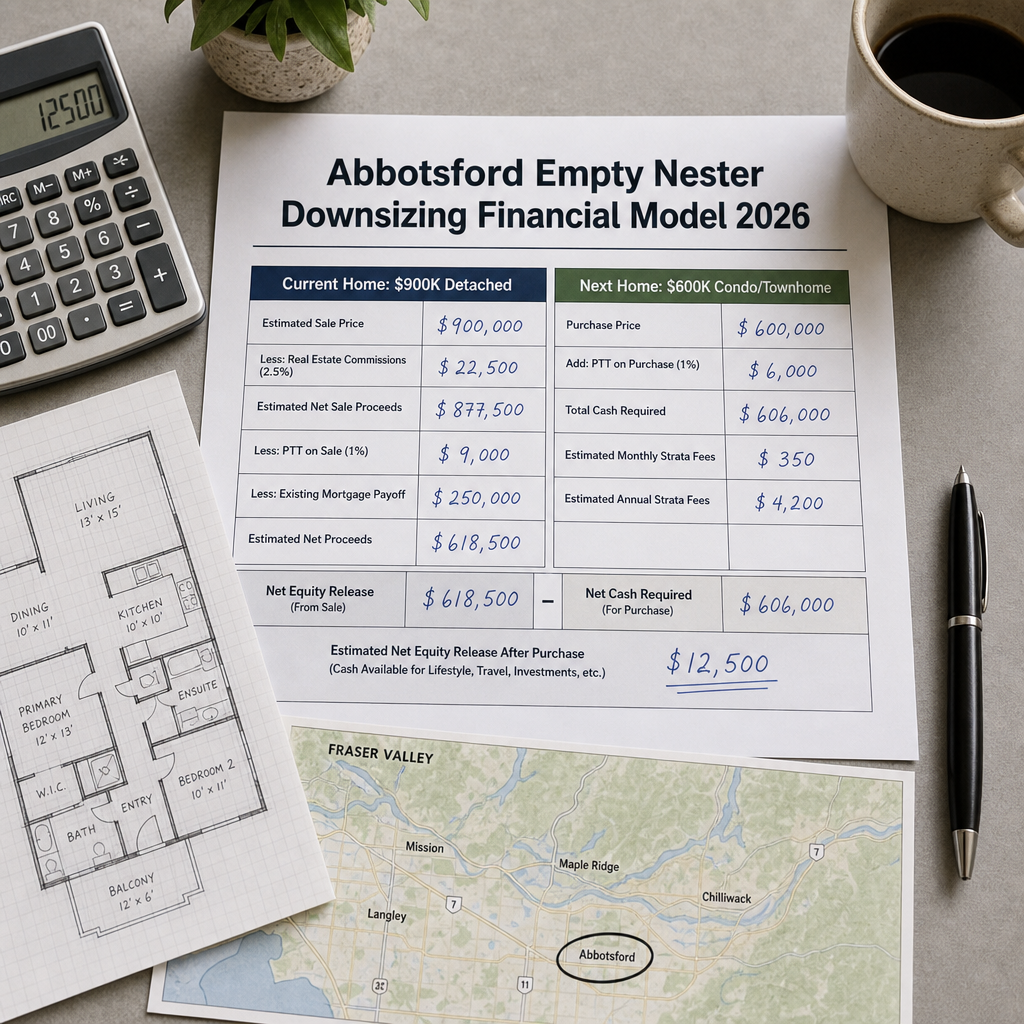

Abbotsford Empty Nester's Complete Downsizing Financial Model: Comparing Detached Home Sale Proceeds to Condo and Townhome Purchase, Tax Impact, and Net Lifestyle Gain in a 2026 Buyer's Market
By Mohamed Mansour, MBA and Associate Broker — Mansour Real Estate Group | Fraser Valley and Lower Mainland | Published June 2026
For Abbotsford homeowners whose children have moved out and whose detached home no longer matches their daily life, the case for downsizing often starts with emotion and stalls at the spreadsheet. The math matters, and right now, the math has a time component. Abbotsford detached benchmark prices are down approximately 7 to 8 percent year-over-year, according to Fraser Valley Real Estate Board market statistics. Every month of delay means selling from a slightly lower equity position.
This article builds the full financial model: sale proceeds from a detached home at current benchmark, property transfer tax on both sides, principal residence exemption, strata fee comparison, retirement income sequencing, and net monthly cash flow improvement. It is not a prediction. It is a structured framework using current publicly available data so empty nesters can see their actual numbers before any conversation with an agent or accountant.
Short Answer
An Abbotsford empty nester selling a detached home at the current benchmark of approximately $900,000 and buying a condo or townhome at $600,000 can realistically release $240,000 to $280,000 in liquid equity after all transaction costs. Monthly carrying costs typically drop by $800 to $1,400 depending on mortgage status and strata fees. The principal residence exemption eliminates capital gains tax on the family home if it has been the primary residence for the full ownership period.
Key Takeaways
- A $900K detached sale to $600K condo purchase releases roughly $240K–$280K in net equity after full transaction costs.
- Property transfer tax on both sides totals approximately $27,000–$28,000, a cost most downsizers underestimate in early planning.
- The principal residence exemption eliminates capital gains tax on the family home if it was the primary residence for the entire ownership period.
- Monthly cash flow typically improves by $800–$1,400 when mortgage debt is cleared and strata fees replace property tax and maintenance.
- Retirement income timing — CPP, OAS, and RRSP withdrawals — must be sequenced carefully to avoid clawbacks when sale proceeds land in the same tax year.
Who This Applies To
- Empty nesters in Abbotsford owning a detached home and considering a move to a condo or townhome
- Retirees or near-retirees wanting to convert home equity into liquid savings or reduce monthly carrying costs
- Couples whose family home has been the primary residence for the full ownership period with no secondary property exposure
- Homeowners who want concrete numbers before consulting a financial planner or tax advisor
When This Advice May Not Apply
If you own or have recently sold a cottage, rental property, or second home, the principal residence exemption calculation becomes more complex. If your sale proceeds push combined household income above approximately $86,912 in 2026 (the OAS clawback threshold per CRA), the retirement income sequencing section below is especially important. Consult a qualified tax advisor before acting on any of the figures in this article.
Data Used in This Article
- FVREB Market Statistics, April 2026 — sales-to-active ratio, days on market, benchmark price trends by property type (official board data)
- BC Property Transfer Tax calculator — current general rate schedule: 1% on first $200K, 2% on $200K–$2M (BC Government official source)
- CRA — Principal Residence Exemption rules — T2091 designation, deemed disposition provisions (official CRA guidance)
- CRA OAS Recovery Tax threshold 2026 — approximately $86,912 net world income (official CRA)
- Active MLS comparables, Abbotsford condos and townhomes, April–May 2026 — strata fee ranges from listing data (third-party market observation)
The Core Financial Model: Selling at $900K, Buying at $600K
The Abbotsford detached home benchmark sits at approximately $875,000 to $925,000 as reported by the Fraser Valley Real Estate Board. Using a round working figure of $900,000 and the current buyer's market sale-to-list ratio of 92 to 95 percent, a realistic gross sale price lands between $828,000 and $855,000 if listed at benchmark. For this model, we use $855,000 as the gross sale price (95 percent of ask) — a realistic outcome for a well-prepared, properly priced detached home.
From that gross, subtract typical transaction costs:
- Realtor commission: approximately 3.255% on first $100K and 1.1775% on balance on the buyer's side plus the listing side — total estimated at $25,000–$32,000 depending on the commission structure negotiated
- Legal fees and disbursements: approximately $1,500–$2,500
- Pre-sale preparation (cleaning, touch-up, staging): $2,000–$6,000 depending on condition
Approximate net proceeds from $855K sale: $813,000–$824,000 after estimated selling costs.
On the purchase side, a condo or townhome in Abbotsford at $600,000 carries the following entry costs:
- BC Property Transfer Tax: 1% on first $200K ($2,000) plus 2% on remaining $400K ($8,000) = $10,000
- Legal fees: approximately $1,200–$1,800
- Move and incidentals: $3,000–$6,000
Total entry cost on $600K purchase: approximately $15,000–$18,000. Net equity released after all costs on both sides: approximately $240,000 to $260,000, assuming no mortgage remains on the detached home. If a mortgage balance of $100,000 remains, the released equity adjusts to approximately $140,000–$160,000.
Property Transfer Tax: The Cost Most Downsizers Miss
Property transfer tax in BC applies to the buyer on each transaction. The seller does not pay PTT on their sale. But as a downsizer, you are both a seller and a buyer in the same move.
On a $900,000 detached home purchase — had it been bought recently — PTT would have been $16,000. You don't pay that on your current sale. But you do pay PTT on the condo or townhome you buy next. At $600,000: $10,000.
This is a real cash cost that leaves your equity at closing. There is no PTT exemption for downsizers in BC as of 2026. Budget it as a firm line item, not a variable. The BC Government's PTT calculator confirms the general rate schedule: 1% on the first $200,000 and 2% on amounts between $200,000 and $2,000,000.
Capital Gains and the Principal Residence Exemption
If your Abbotsford detached home has been your primary residence for the entire period you've owned it, the principal residence exemption under the Income Tax Act eliminates capital gains tax on the full appreciation from your purchase price to your sale price. You file CRA Form T2091 in the tax year of the sale to designate the property as your principal residence for each year owned.
This is one of the most valuable tax shelters available to Canadian homeowners. A home purchased in Abbotsford for $400,000 in 2010 and sold today for $855,000 produces a paper gain of $455,000. Under full PRE designation, none of that is taxable.
The situation changes if:
- You also own or have owned a cottage, rental property, or investment property — only one property per year can be designated as a principal residence per family unit
- The home was rented out for a period of time, which may trigger a deemed disposition and partial capital gains exposure
- You are an executor of an estate where the home is being sold after the owner's death — deemed disposition rules apply at date of death
Confirm your PRE eligibility with a qualified tax accountant before finalizing your downsizing timeline. The CRA's guidance on the principal residence exemption is available at canada.ca.
Monthly Cash Flow: What Actually Changes
This is where the lifestyle gain becomes concrete. For a mortgage-free detached homeowner in Abbotsford, the current monthly carrying picture typically looks like this:
- Property tax (detached, ~$900K assessed): approximately $330–$380/month
- Utilities (gas, hydro, water): approximately $280–$380/month
- Home insurance: approximately $130–$180/month
- Maintenance reserve (1% of value annually): approximately $750/month
- Lawn, snow, exterior: approximately $100–$200/month
- Total estimated monthly cost (detached, mortgage-free): $1,590–$1,890/month
After downsizing to a $600,000 condo or townhome purchased mortgage-free:
- Property tax (condo, ~$600K assessed): approximately $200–$260/month
- Strata fees (Abbotsford condos/townhomes): approximately $180–$280/month
- Utilities (often lower in strata): approximately $120–$180/month
- Home insurance (strata unit): approximately $50–$80/month
- Total estimated monthly cost (condo/townhome, mortgage-free): $550–$800/month
Net monthly saving: approximately $800–$1,100/month in a mortgage-free scenario. If the downsizer also releases $240,000+ in equity and invests it at a conservative 4 percent annual return, that adds approximately $800/month in passive income — bringing the total financial improvement to $1,600–$1,900/month in combined cost savings and income generation.
Retirement Income Sequencing: The Tax Layer Most People Skip
The year you sell your home matters for income tax purposes if you also have RRSP withdrawals, CPP payments, OAS, or other retirement income flowing in the same calendar year.
The principal residence exemption means your home sale proceeds are not income — but if you trigger an RRSP withdrawal in the same year, both figures combine for marginal rate purposes. For retirees approaching the OAS clawback threshold — approximately $86,912 in net world income for the 2026 tax year per CRA — the timing of RRSP withdrawals relative to the sale year can mean the difference between receiving full OAS or losing 15 cents per dollar above that threshold.
A tax accountant or fee-only financial planner can help you sequence RRSP withdrawals into years before or after the sale year to reduce overall tax drag. This is not real estate advice — it is a flag that the financial model for downsizing is incomplete without this layer addressed.
How We Evaluate This
At Mansour Real Estate Group, the downsizing evaluation starts with a current market valuation of the detached home — not a guess, but a comparative market analysis using actual FVREB sales data for comparable detached homes in Abbotsford. From that valuation, we build the net proceeds model before any listing decision is made. We then review active condo and townhome comparables in the target price range and discuss strata documents, fee history, and age of building as part of the purchase evaluation. The financial model in this article is the framework we use to start that conversation — the actual numbers get confirmed through property-specific analysis, not general benchmarks.
Downsizing Checklist for Abbotsford Empty Nesters
- Obtain a current comparative market analysis for your detached home from a local Abbotsford realtor — not a BC Assessment notice, which reflects July 1 of the prior year
- Confirm your principal residence exemption eligibility with a tax accountant, especially if you have owned any secondary property during the ownership period
- Calculate net proceeds using realistic sale price (92–95% of list in current market), not ask price — budget for commission, legal fees, and preparation costs
- Budget $10,000–$11,000 for property transfer tax on your condo or townhome purchase at $600K — this is a firm cash cost at closing
- Request strata documents (Form B, current bylaws, depreciation report, minutes from last two AGMs) before making any offer on a condo or townhome
- Discuss retirement income sequencing with a financial planner before the sale year — especially RRSP withdrawal timing relative to sale proceeds
- Confirm whether you want to purchase mortgage-free or retain a small mortgage to preserve liquidity — model both scenarios before deciding
- Review strata fee history over the past three to five years — fees that have risen rapidly may signal a special levy risk in the near term
What We Commonly See
In our experience, the most common planning gap for Abbotsford empty nesters is treating the BC Assessment value as the listing price. Assessment values reflect market conditions as of July 1 of the prior year. In a market where prices have declined 7 to 8 percent year-over-year, this gap can overstate expected proceeds by $60,000 to $80,000 before a single cost is deducted.
What often happens is that downsizers undercount transaction friction. PTT on the purchase, legal fees on both sides, preparation costs, and moving expenses collectively add up to $35,000–$50,000 in a typical Abbotsford detached-to-condo transition. Sellers who model only the price difference — $900K minus $600K equals $300K — are consistently surprised at closing.
A common mistake is waiting for the market to recover before selling. In a declining market, holding a detached home to avoid a 7 percent loss while the property continues to drift lower typically costs more than the transaction friction of moving now. The math on when to act is almost always better modeled than assumed.
Questions and Answers
Q: Does the principal residence exemption apply automatically when I sell my Abbotsford home?
No. You must designate the property on CRA Form T2091 in the tax year of the sale. If you forget to file, the CRA may not grant the exemption retroactively without a formal request. Confirm with your accountant before filing.
Q: Can I negotiate the purchase price of a condo in Abbotsford's current buyer's market?
Yes. The FVREB reports condos and townhomes in Abbotsford averaging 35 to 45 days on market in the current cycle. Cash buyers or sellers who can offer quick closing have real negotiating leverage. Offer at 3 to 5 percent below ask as a starting point and let the seller's DOM guide you.
Q: What is the OAS clawback threshold in 2026 and how does my home sale affect it?
The CRA OAS recovery tax threshold for 2026 is approximately $86,912 in net world income. Your home sale proceeds under the principal residence exemption are not income and do not trigger the clawback. However, RRSP withdrawals or investment income in the same year do count. Sequence carefully.
Q: Is it better to buy the condo mortgage-free or keep a small mortgage for liquidity?
At current mortgage rates, carrying a $100,000 balance costs approximately $500–$550/month. If that same $100,000 earns 4 to 5 percent in a GIC or high-interest account, the carry cost is roughly neutral. The decision depends on your comfort with debt in retirement, not just the math.
Q: What should I check in strata documents before buying a townhome in Abbotsford?
Review the depreciation report for major repair timelines, the contingency reserve fund balance relative to the report's recommendations, AGM minutes for any unresolved special levy discussions, and the current bylaws for rental and age restrictions. A strata with an underfunded reserve fund and an aging roof represents a meaningful financial risk to a downsizer on a fixed income.
In Summary
An Abbotsford empty nester selling a detached home near benchmark and buying a condo or townhome in the $550,000–$650,000 range can realistically release $240,000–$260,000 in net equity and reduce monthly carrying costs by $800–$1,100. Transaction friction — PTT, commissions, legal fees, preparation — totals approximately $35,000–$50,000 and must be modeled accurately, not estimated loosely. The principal residence exemption eliminates capital gains tax on the family home if correctly designated. Retirement income sequencing relative to the sale year deserves its own conversation with a tax professional before the listing goes live. The market window for this transition is real: Abbotsford detached prices have declined for three consecutive quarters, and equity deferred is equity at risk.
Thinking About Downsizing in Abbotsford?
If you'd like to see a current market valuation of your detached home and a net proceeds model built around your actual situation, Mansour Real Estate Group offers a no-obligation consultation. There is no pressure to list — the conversation starts with your numbers, not ours.
Related Articles
- What to Expect When Downsizing from a Detached Home in the Fraser Valley
- Abbotsford Real Estate Market 2026: A Seller's Guide to Current Conditions
- Strata Documents in BC: What Condo Buyers Must Review Before Subject Removal
Official Resources
- BC Property Transfer Tax — BC Government
- Principal Residence Exemption — Canada Revenue Agency
- OAS Recovery Tax Threshold — Canada Revenue Agency
- Market Statistics — Fraser Valley Real Estate Board
About Mansour Real Estate Group
For homeowners who have spent decades building equity in a family home, the decision to downsize is one of the most significant real estate transitions they will make. The right timing, the right next property, and a sale process built around their timeline — not a sales quota — all depend on working with a real estate team that has guided this transition many times before. Mansour Real Estate Group has helped hundreds of homeowners and families downsize across Surrey, White Rock, Langley, South Surrey, Abbotsford, Delta, Mission, and the Fraser Valley, including many empty nesters running exactly the kind of financial analysis this article describes.
Mansour Real Estate Group, led by Mohamed
Key Takeaways
- Understanding your financing options early streamlines the home-buying process
- Pre-approval demonstrates seriousness to sellers and strengthens your negotiating position
- Working with experienced local professionals reduces costly mistakes and saves time
- Market research and due diligence are essential before making an offer
Disclaimer: This article is for informational purposes only and does not constitute legal, financial, or real estate advice. Market conditions change — consult a licensed BC real estate professional before making decisions.



