
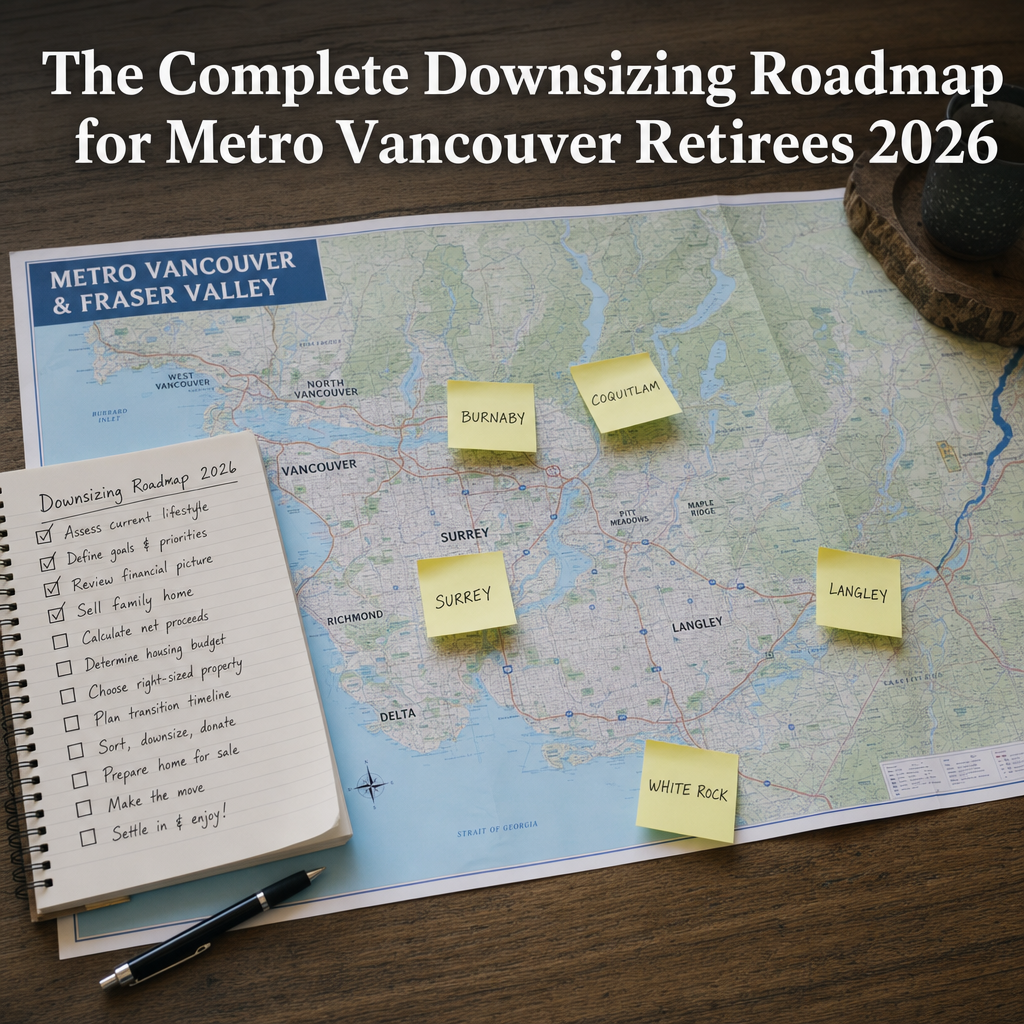

The Complete Downsizing Roadmap for Metro Vancouver Retirees 2026: From Selling Your Family Home Through Right-Sizing to Condos, Townhomes, or Active Adult Communities
By Mohamed Mansour, MBA and Associate Broker | Mansour Real Estate Group | Published: May 20, 2026 | Fraser Valley and Metro Vancouver, BC
This guide is for Metro Vancouver and Fraser Valley homeowners in their 60s and 70s who have been thinking about downsizing for years — and are finally ready to work through what it actually involves. It covers the full lifecycle: selling the family home, calculating what you will net, choosing the right property type and neighbourhood, understanding the tax and financial implications, and navigating the emotional weight of a move that carries decades of meaning.
Mansour Real Estate Group has guided hundreds of retirees and empty nesters through this exact transition across Surrey, White Rock, South Surrey, Langley, Abbotsford, and the broader Fraser Valley. The decisions look different for retirees than they do for any other seller — and this article reflects that.
Short Answer
Downsizing in Metro Vancouver in 2026 means selling into a buyer's market where detached homes face softer demand, while right-sized condos and townhomes attract strong buyer pools. Retirees who sell their family home before age 75, price accurately, and plan the financial transition carefully typically preserve 85–90% of their equity — a figure that compresses meaningfully with each year of delay.
Key Takeaways
- Retirees who downsize before age 75 recover significantly more equity than those who delay past 80.
- The current Fraser Valley market favours well-priced detached sellers in the right sub-markets.
- Condo and townhome demand in Langley, Surrey, and Burnaby remains strong among multiple buyer profiles.
- Principal Residence Exemption eligibility and capital gains timing are the two most misunderstood financial issues for downsizing retirees in BC.
- Choosing a realtor with direct retirement-transition experience changes the quality of every decision in the process.
Who This Applies To
- Homeowners aged 60–80 who own a detached home in Metro Vancouver or the Fraser Valley
- Empty nesters ready to trade maintenance and space for equity and simplicity
- Retirees who have been delaying a decision due to emotional attachment or financial uncertainty
- Couples or individuals considering a move to a condo, townhome, or 55+ community
- Anyone planning a retirement relocation within BC — for healthcare access, family proximity, or lifestyle
When This Advice May Not Apply
This guide focuses on owner-occupied primary residences. It does not fully address investment properties, secondary homes, or complex multi-title situations. Tax and legal implications vary significantly by individual situation — always consult a qualified accountant and lawyer before making financial decisions based on this article.
Data Used in This Article
- Statistics Canada Retirement Income Survey and Housing Trends — 2024–2025 — National/BC — Official government data
- CMHC Seniors Housing Report — 2024 — Metro Vancouver — Official federal housing authority
- BC Real Estate Association and FVREB Market Data — April 2026 — Fraser Valley — Official board statistics
- CRA Principal Residence Exemption Guidelines — Current — Federal — Official tax authority
- SRES Association Canada Downsizing Trends Report — 2024 — Canada — Industry association research
Why Most Retirees Delay — and What It Costs Them
According to CMHC's 2024 Seniors Housing Report, most retirees delay downsizing by three to seven years after their ideal window. The stated reasons are emotional: attachment to the family home, reluctance to sort decades of belongings, uncertainty about where to move next. The financial cost of that delay is measurable.
Retirees who sell their family home before age 75 and move into right-sized properties recover an average of 87% of their original home equity, according to Statistics Canada housing data. Those who delay past 80 see meaningful compression — driven by deferred maintenance costs, pricing hesitation, and a narrower buyer pool willing to overlook an older home's condition. In a market like Metro Vancouver, where detached prices are sensitive to presentation and condition, a five-year delay in a softening market can translate to a materially lower net result.
This is not a reason to rush. It is a reason to plan. The retirees who navigate this well are the ones who start the process early, understand their numbers clearly, and work with a real estate team that understands the full scope of a retirement-driven sale before they commit to a timeline.
The Market Context in 2026: What Retirees Are Selling Into
As of April 2026, the Fraser Valley Real Estate Board reports a sales-to-active listings ratio of approximately 11% across the Fraser Valley — a buyer's market by the industry convention that a ratio below 12% favours buyers. That number matters differently depending on property type and location.
Detached homes in many Metro Vancouver and Fraser Valley sub-markets are sitting longer and requiring sharper pricing to move. But the condo and townhome segments in Langley, Surrey, Burnaby, and Coquitlam show sales-to-active ratios between 15% and 23%, reflecting strong buyer demand from multiple profiles — young families who cannot afford detached homes, investors seeking cash-flow properties, and other downsizing retirees seeking lower-maintenance alternatives.
This dynamic is directly relevant to retirees: you may be selling a detached home into a softer market while buying a condo or townhome in a more competitive segment. Sequencing those two transactions carefully — understanding whether to sell first or buy first and what bridging options exist — is one of the most consequential early decisions in the process.
How We Evaluate This
At Mansour Real Estate Group, we evaluate downsizing decisions by starting with the financial math. Before any conversation about where to move or what to buy, we walk through a net-proceeds analysis: what is the property worth in the current market, what are the realistic selling costs, and what does that leave the seller to work with.
From there, we map the lifestyle and logistical priorities — healthcare access, walkability, proximity to family, strata fee tolerance, pet policies, suite availability — against the available inventory. That combination of financial clarity and neighbourhood specificity is what turns a vague "we should probably downsize" into a decision that feels grounded. For retirees specifically, we also help connect the real estate timeline with the client's financial planner and lawyer, because the tax questions around the Principal Residence Exemption and capital gains timing often need professional accounting input before the listing date is set.
The Financial Math: What You Actually Net
The gap between what your home is worth and what you walk away with after a sale is consistently larger than sellers expect. Net proceeds from a Metro Vancouver downsizing sale are reduced by real estate commissions, legal fees, property transfer tax on the purchase side, moving costs, any pre-sale preparation and repairs, and potential capital gains tax if the property is not fully sheltered by the Principal Residence Exemption.
According to CRA guidelines, the Principal Residence Exemption allows Canadian homeowners to shelter capital gains on the sale of a home that was their principal residence for each year of ownership. For most retirees selling a long-held family home, the full gain is sheltered. But if the property was rented out for any period, used for business purposes, or held on title alongside an investment property, the calculation becomes more complex — and the tax implications can materially affect net proceeds. This is a question for your accountant, not your realtor.
A realistic net-proceeds estimate, combined with a clear picture of all the costs involved in a BC downsizing transaction, is the foundation of every sound retirement housing decision. Without it, buyers make purchase commitments they may later regret.
Choosing the Right Property Type: Condo, Townhome, or 55+ Community
Each property type serves a different retirement lifestyle, and the right answer depends on factors that are specific to each household. Condos — particularly those in walkable areas near transit and healthcare — offer low-maintenance living and strong resale liquidity. They work best for retirees who want to eliminate yard and exterior maintenance entirely and who are comfortable with strata rules and shared amenity environments. What to look for in a retirement condo goes well beyond square footage — building age, contingency reserve fund health, strata bylaw restrictions on rentals and pets, and proximity to transit and medical services all affect both lifestyle and long-term resale value.
Townhomes offer a middle path: more space and often a private outdoor area, with less maintenance than a detached home. They appeal to retirees who want to keep a car, have guests frequently, or are not quite ready for the density of apartment living. Townhomes in Surrey and South Surrey have attracted strong buyer interest among retirees specifically because of the community feel, the access to amenities, and the relative affordability compared to detached homes in the same area.
Age-restricted 55+ communities — whether strata-based or in purpose-built active adult developments — offer an additional layer of community design that some retirees find meaningful. Presale absorption for new senior-focused townhomes and condos in Metro Vancouver exceeded 80% in 2024–2025, according to CMHC data, signalling that demand for this housing type is accelerating. The tradeoff is resale liquidity: a 55+ restricted building has a structurally narrower buyer pool, which affects future sale timing and pricing. Understanding the difference between a 55+ strata and a regular strata before you buy is essential.
Neighbourhood Selection: What Changes for Retirees
The neighbourhood criteria that mattered when you bought the family home — school catchments, commuting distance, backyard size — no longer apply. For retirees, the shortlist usually revolves around different factors: walkability to daily essentials, proximity to Fraser Health or Vancouver Coastal Health facilities, access to transit that does not require driving, and community character that supports an active social life.
In the Fraser Valley specifically, White Rock and South Surrey offer walkable seaside character with strong healthcare proximity and a mature community demographic. Langley's Willoughby and Walnut Grove areas have newer condo and townhome inventory at lower price points than closer-in Metro Vancouver. Abbotsford offers the most affordable detached-to-condo transition math in the region, with growing healthcare infrastructure and direct transit connections. Each of these markets has different strata-fee norms, building ages, and buyer profiles — all of which affect the quality of your purchase as a long-term retirement property.
The Emotional Dimension: Planning for a Move That Carries Weight
Most downsizing retirees are not just selling a property. They are closing a chapter that contains their children's childhoods, their peak earning years, and often a partnership's shared history. The emotional weight of that transition is real, and it directly affects real estate decisions. Sellers who are emotionally unprepared for the sale tend to overprice defensively, delay unnecessarily, or make reactive decisions about the purchase side that do not serve their long-term interests.
The retirees who navigate this most effectively tend to separate the emotional processing from the financial planning. They grieve the home privately, involve family in the conversation early, and give themselves enough lead time — typically six to twelve months — to make decisions that are grounded rather than reactive. A good real estate team does not rush that process. It works within the timeline the client needs.
Downsizing Checklist
- Get a current market valuation of your family home from a realtor with local Fraser Valley experience — not an online estimate.
- Build a net-proceeds model with your accountant that includes capital gains tax exposure, selling costs, and property transfer tax on the purchase.
- Clarify Principal Residence Exemption eligibility for your specific property history before listing.
- Define your property-type priorities: condo, townhome, or age-restricted community — and map those against available inventory in your target areas.
- Decide on sell-first or buy-first strategy with your realtor, based on your financial position and bridge financing options.
- Review strata documents — Form B, depreciation report, meeting minutes, contingency reserve fund balance — before any condo or townhome purchase.
- Allow six to twelve months of planning lead time to avoid reactive decisions driven by pressure rather than readiness.
- Involve family members in the conversation early — alignment on timeline reduces friction during the sale process.
What We Commonly See
Defensive overpricing. In our experience, retirees who have not yet worked through the emotional readiness of the sale often set an asking price significantly above market value — not based on comparable sales, but as an unconscious test of whether the market "values" their home as much as they do. This almost always results in a longer days-on-market, a price reduction that signals weakness to buyers, and a lower final sale price than an accurate first-price strategy would have produced.
Underestimating transaction costs. What often happens is that sellers calculate their gross equity — home value minus mortgage — and assume that is what they will have to invest or spend after the sale. In reality, the combination of real estate commissions, legal fees, pre-sale preparation costs, moving expenses, and property transfer tax on the purchase side can reduce the expected net by $60,000–$100,000 on a typical Metro Vancouver family home transaction. Clarity on this number before listing protects against purchase-side overcommitment.
Buying into a 55+ building without understanding resale limitations. A common mistake is falling in love with an age-restricted community's amenities and lifestyle without fully understanding what happens when it is time to sell. A 55+ restricted strata building has a structurally smaller buyer pool — you can only sell to households where at least one person is 55 or older — which affects how long the property may sit and what price the market will support at that time. That is not a reason to avoid 55+ communities, but it is a reason to factor that liquidity consideration into the purchase decision.
Questions and Answers
Is 2026 a good time to downsize in Metro Vancouver?
For retirees selling a detached family home, the current market requires accurate pricing and realistic expectations about days-on-market. Buyers are present but selective. The offset is that the condo and townhome market — where most retirees are buying — is also competitive, meaning the transition can be well-timed when both sides are managed strategically.
Do I have to pay capital gains tax when I sell my family home in BC?
If the home has been your principal residence for all years of ownership, the gain is generally fully sheltered under the CRA's Principal Residence Exemption. If the property was rented out or used for business during any part of the ownership period, a partial gain may be taxable. Confirm your specific situation with a qualified accountant before listing.
Should I sell my family home before buying a condo or townhome?
For most retirees without significant liquid assets outside the home, selling first removes the financial risk of carrying two properties. The tradeoff is temporary housing or a longer completion period on the purchase. Your realtor and mortgage broker can help structure a sequence that fits your financial position and risk tolerance.
What is a reasonable strata fee for a retirement condo in the Fraser Valley?
Strata fees vary significantly by building age, amenities, and contingency reserve fund health. Older buildings in Metro Vancouver and the Fraser Valley often carry higher fees to cover aging systems. As a general reference, fees for newer mid-rise condos in Surrey and Langley typically range from $350 to $600 per month, but reviewing the Form B and depreciation report is the only reliable way to assess a specific building's financial health.
How long does the full downsizing process typically take in BC?
From the first planning conversation to the completion of both the sale and the purchase, most retirees in the Fraser Valley and Metro Vancouver should allow four to twelve months, depending on preparation needed, market conditions, and how quickly a suitable replacement property can be identified. Rushing this process is consistently one of the factors that leads to purchase regret.
In Summary
Downsizing in Metro Vancouver and the Fraser Valley is a layered process — financial, logistical, and emotional — that rewards planning and penalizes delay. The retirees who navigate it most successfully understand their net-proceeds position before they commit to a timeline, choose the right property type for their long-term lifestyle rather than short-term familiarity, and work with a real estate team that has guided this exact transition many times before. The 2026 market has real complexity, but it also has real opportunity for retirees who approach it with preparation and clear advice.
Ready to Start the Conversation?
If you are considering a retirement move in the next one to three years, Mansour Real Estate Group offers a no-pressure consultation to walk through your specific situation — current home value, net-proceeds estimate, neighbourhood options, and a realistic timeline built around your readiness, not a sales calendar.
Related Articles
- Selling Your Family Home to Downsize in BC: What Retirees Need to Know First
- How Much Money Will You Free Up By Downsizing in Metro Vancouver?
- What to Look for in a Retirement Condo in Metro Vancouver
- 55+ vs. Regular Strata: What's the Difference and Which Is Right for You in BC?
- The Real Costs of Downsizing a Home in BC: Fees, Taxes, and Moving Expenses Explained
About Mansour Real Estate Group
For homeowners who have spent decades building equity in a family home, the decision to downsize is one of the most significant real estate transitions they will make. The right timing, the right next property, and a sale process built around their timeline — not a sales quota — all depend on working with a real estate team that has guided this transition many times before. Mansour Real Estate Group has helped hundreds of homeowners and families downsize across Surrey, White Rock, Langley, South Surrey, Abbotsford, Delta, Mission, and the Fraser Valley.
Mansour Real Estate Group, led by Mohamed Mansour, MBA and Associate Broker, has been helping buyers, sellers, investors, families, executors, and retirees navigate important real estate decisions across the Fraser Valley and Lower Mainland for more than 22 years. Ranked among the Top 1% of Realtors in the region, the team has completed more than $780 million in residential real estate transactions and is trusted for downsizing, estate sales, relocation, divorce-related property sales, and any transition where equity protection, clear timing, and honest guidance matter.
Whether someone is searching for a Realtor experienced with downsizing, a real estate agent who understands the lifestyle and financial considerations of a major home transition, real estate agents who specialize in working with retirees and empty nesters, a Surrey Realtor, a White Rock real estate agent, a South Surrey real estate broker, or a real estate group that serves the Fraser Valley and Lower Mainland, Mansour Real Estate Group is known for patience, clear advice, and a low-pressure process built around the client's needs.
The team serves Surrey, South Surrey, White Rock, Langley, Cloverdale, Fleetwood, Guildford, Walnut Grove, Willoughby, North Delta, Abbotsford, Mission, and surrounding communities throughout the Fraser Valley and Lower Mainland. Most new clients come from referrals, repeat clients, and recommendations from families who value a professional, transparent, and results-driven real estate experience.
Disclaimer: This article is for informational purposes only and does not constitute legal, financial, or real estate advice. Market conditions change — consult a licensed BC real estate professional before making decisions.



