
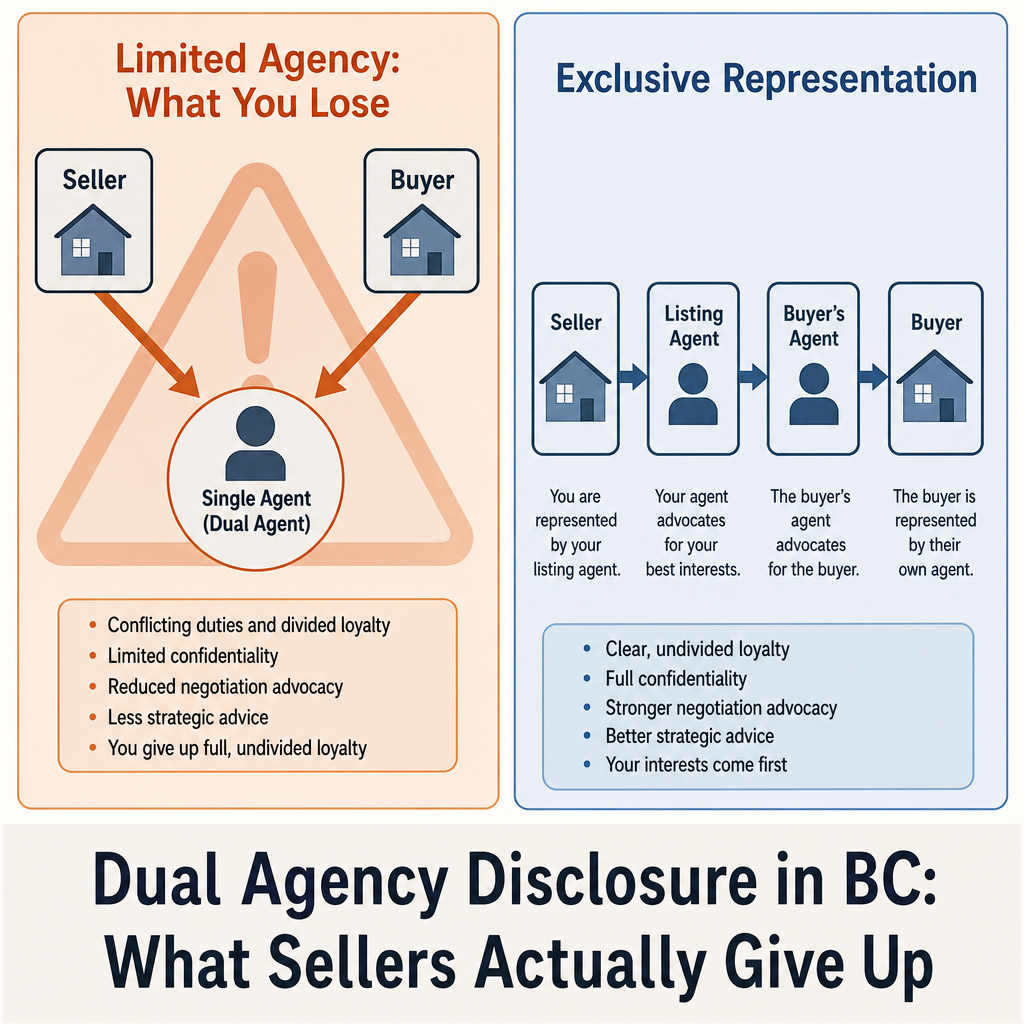

Dual Agency Disclosure and Fiduciary Duty Conflicts in BC Real Estate: What Happens When Your Agent Represents Both Buyer and Seller
By Mohamed Mansour, MBA and Associate Broker | Mansour Real Estate Group | Fraser Valley and Lower Mainland | Published: July 15, 2025 | Topic: Legal & Process — Seller Rights and Representation
Most sellers in BC assume their listing agent is working exclusively for them. That assumption can be wrong, and the consequences show up at the negotiating table. When a listing agent also represents the buyer making an offer on your home, the professional duty that agent owes you changes in ways that BC law requires them to disclose — but that most sellers never fully understand before signing.
This article explains how dual agency works under BC's Real Estate Services Act, what the BCFSA requires agents to disclose, what fiduciary duties are suspended when an agent represents both sides, and where that shift creates real, measurable disadvantages — particularly in a buyer's market across Surrey, Langley, Abbotsford, and the broader Fraser Valley.
Short Answer
In BC, dual agency — where one agent represents both buyer and seller — is legal only with written disclosure and informed consent from both parties. Once that consent is given, the agent becomes a "limited dual agent" and can no longer share confidential information about either party, which means your listing agent legally cannot tell you what the buyer will actually pay, how urgent their timeline is, or what concessions they might accept. That is a significant loss of negotiating power that many sellers discover only after the deal closes.
Key Takeaways
- Written consent from both parties is required before dual agency is permitted under BC law.
- A limited dual agent cannot disclose the buyer's maximum price, urgency, or financing ceiling to the seller.
- Dual agency is most common in presale condos, investor properties, and brokerage-controlled inquiries.
- Verbal-only disclosure is non-compliant; sellers should ask for the written consent form before proceeding.
- Sellers can decline dual agency and require the buyer to engage a separate agent at any point before consent is signed.
Who This Applies To
- Homeowners currently listed or preparing to list in Surrey, Langley, Abbotsford, South Surrey, or White Rock
- Sellers who have received an offer from a buyer already working with their listing agent
- Buyers who are viewing a property directly through the listing agent and have not yet retained their own representation
- Investors purchasing presale condos or rental-zoned properties through brokerage-controlled sales centres
- Anyone evaluating a listing agent in the Fraser Valley and wondering what questions to ask about representation conflicts
When This Advice May Not Apply
If a buyer has already retained an independent agent and that agent is submitting the offer on their behalf, dual agency is not in play. This article is specifically relevant when the same individual agent — or in some cases, agents from the same brokerage — represents both sides of the transaction.
Key Definitions
Limited Dual Agency: A relationship where one licensed real estate professional represents both the buyer and seller in the same transaction, with written consent from both parties, but with reduced fiduciary duties to each.
Fiduciary Duty: The legal obligation to act in another person's best interest. In a standard listing relationship, a seller's agent owes this duty fully to the seller. In limited dual agency, it is modified.
BCFSA: The BC Financial Services Authority, which regulates real estate licensees in British Columbia under the Real Estate Services Act.
Representation Agreement: The written contract between a client and their real estate agent that defines the scope and nature of representation, including whether dual agency is permitted.
Data Used in This Article
- BC Real Estate Services Act (RSBC 2004, c. 42): Primary legislation — official, BC Government
- BCFSA Professional Standards Manual and Disclosure Requirements: Regulatory guidance — official, BCFSA
- BCFSA Disciplinary Decisions Database (2023–2026): Enforcement history — official, BCFSA
- Buyer and Seller Dual Agency Awareness Survey Data: FVREB and REBGV member research — third-party industry research
What BC Law Actually Requires
Under Section 14 of the Real Estate Services Act and the BCFSA's Professional Standards Manual, a licensee may act as a limited dual agent only when:
- The agent discloses the dual agency relationship in writing before it begins
- Both the buyer and seller provide written, informed consent
- The agent explains specifically what duties are being limited
Verbal disclosure alone is a regulatory breach. If your agent tells you verbally about dual agency but does not produce a written disclosure document for your signature, that is non-compliant — and potentially grounds for a BCFSA complaint.
When a seller signs a limited dual agency consent form, they are formally agreeing that their agent will no longer operate exclusively in their interest. Many sellers sign this document without fully understanding what changes. According to buyer and seller survey data from FVREB and REBGV member research, more than 60% of sellers were unaware that their listing agent might also represent the buyer, and a significant portion did not understand that this changed what the agent could do for them in price negotiations.
What a Limited Dual Agent Cannot Do — And Why That Matters
Once an agent is acting as a limited dual agent, the Real Estate Services Act restricts them from disclosing confidential information that would benefit one party over the other. In practice, that means your listing agent:
- Cannot tell you the buyer's maximum willingness to pay
- Cannot advise you on whether the buyer's financing is tight or comfortable
- Cannot share that the buyer has a firm move-in deadline making them less likely to walk away
- Cannot counsel you on whether to hold firm on price versus accept a concession, because doing so would require them to negotiate against the buyer they are also representing
This is not a small limitation. In an active negotiation, a seller's best leverage often comes from knowing how motivated the buyer is, how much room exists between the offer and the buyer's ceiling, and whether the buyer is likely to accept counter-conditions. A limited dual agent cannot provide that intelligence — because providing it would breach their duty to the buyer.
In the current buyer's market conditions across Surrey, Langley, and Abbotsford, where offer competition is lower and buyers have more choices, this information gap is especially costly. Internal analysis based on Mansour Real Estate Group's transaction experience suggests net proceeds variance of 3% to 8% in dual-agency scenarios compared to exclusive representation, depending on property type, buyer leverage, and negotiating dynamics. That range is directional, not guaranteed — individual outcomes vary — but the structural disadvantage is consistent.
Where Dual Agency Is Most Common in Metro Vancouver and the Fraser Valley
Dual agency occurs across all property types, but it concentrates in specific segments where the brokerage or agent controls buyer access:
- Presale condos: Developer sales centres are often staffed by agents who represent the developer. Buyers walking into a sales centre without their own agent are, by default, unrepresented — or being represented by an agent whose first loyalty is to the seller (the developer).
- Investor and rental-zoned properties in Surrey, North Delta, and Langley: Agents who control a high volume of investor-targeted listings often receive buyer inquiries directly and may offer to represent both sides to close faster.
- Brokerage-controlled buyer inquiries: When a buyer calls the brokerage directly from a yard sign or online listing, the receiving agent may offer to show the property and represent the buyer — creating an in-house dual-agency scenario.
In the Metro Vancouver buyer's agent context, buyers who contact listing agents directly without prior representation are particularly vulnerable — they may receive limited service and may not understand that the agent they are working with is already contracted to the seller.
How We Evaluate This
At Mansour Real Estate Group, we do not practice limited dual agency. Our position is that the structural conflict — where one agent's incentive is to close a deal rather than maximize either party's outcome — is not compatible with the level of fiduciary service our clients expect. This is a business choice, not just a regulatory interpretation.
When a buyer inquiry comes in on one of our listings, we refer the buyer to an independent agent or advise them to obtain their own representation before proceeding. That creates a cleaner negotiation, a better-protected seller, and a transaction that is less likely to produce post-closing disputes. When reviewing realtor red flags, an agent's dual agency policy is worth asking about directly.
Seller Checklist: Protecting Yourself Around Dual Agency
- Ask every agent you interview: "What is your policy if a buyer who contacts you directly wants to make an offer on my property?"
- Ask specifically whether dual agency is permitted in your representation agreement — and whether you can restrict it.
- If you receive a dual agency disclosure form, read it before signing — specifically note which duties are being limited.
- Know that you can decline consent. The buyer must then retain independent representation or proceed unrepresented.
- If your agent has already verbally disclosed dual agency without a written document, ask for the written form immediately. Verbal-only disclosure is non-compliant under BCFSA rules.
- After any dual agency consent is signed, understand that your agent's ability to advise on negotiating strategy is formally limited. Consider consulting your lawyer if the transaction is complex.
What We Commonly See
In our experience, sellers who are presented with a dual agency disclosure form often sign it quickly because the agent frames it as a formality rather than a meaningful change in the relationship. In fact, it is one of the most significant documents a seller signs — because it changes what the agent is legally permitted to do for them from that point forward.
What often happens is that sellers assume their agent will still negotiate hard on price — they do not realize that once dual agency is consented to, the agent cannot advise them to hold firm, push back on conditions, or use buyer intelligence to negotiate. The agent's role shifts from advocate to facilitator, and that distinction matters most when the offer is below asking or when condition removal is uncertain.
A common pattern in presale condo transactions, particularly in buildings where a single brokerage controls a large share of the inventory, is that buyers who walk in without a buyer's agent are processed quickly into a dual-agency consent without a clear explanation of what they are giving up. By the time either party understands the dynamics, the transaction is already structured around the agent's interest in closing — not either client's interest in optimizing their outcome. Reviewing the credentials and professional standards your agent holds is one way to assess how seriously they take their disclosure obligations.
Q&A
Q: Can I refuse dual agency even if the buyer wants to use my listing agent?
Yes. Dual agency requires written consent from both parties. If you decline, the buyer must either engage an independent agent or proceed unrepresented. Your listing agent remains your exclusive representative. No agent can compel you to accept dual agency.
Q: Is dual agency always a conflict of interest, or can it work neutrally?
By legal definition in BC, limited dual agency creates reduced fiduciary duties. The agent cannot fully advocate for either party's financial interest. Whether the agent handles it ethically varies, but the structural incentive — closing the deal rather than maximizing your outcome — is inherent to the arrangement regardless of the agent's intentions.
Q: What can I do if I believe my agent did not properly disclose dual agency before I signed?
You can file a complaint with the BCFSA. According to BCFSA disciplinary history, dual agency disclosure breaches have resulted in penalties ranging from reprimands to fines. In more serious cases involving financial harm, BC courts have addressed agent fiduciary duty failures, though remedies vary by circumstance. Consult a real estate lawyer if you believe financial harm resulted.
In Summary
Dual agency in BC is legally permitted but structurally limiting — it changes what your agent can do for you the moment consent is signed. Sellers lose access to the buyer intelligence that drives effective negotiation: maximum price, urgency, and flexibility. The disclosure requirement exists to protect consumers, but only if they understand what they are agreeing to before they sign. In a buyer's market across Surrey, Langley, and Abbotsford, where every percentage point of net proceeds matters, knowing whether your agent operates exclusively for you — or also for the buyer — is one of the most important questions you can ask before listing.
Advisory Note
If you are currently listed or preparing to list in the Fraser Valley and want to understand how your representation agreement addresses dual agency, Mansour Real Estate Group is available for a straightforward conversation about your options — no obligation, no pressure.
Related Articles
- 20 Questions to Ask a Realtor Before You Hire Them in BC
- Realtor Red Flags: Warning Signs to Watch for Before Signing a Representation Agreement in BC
- How to Choose a Luxury Real Estate Agent in Vancouver, West Vancouver, and South Surrey
Official Resources
- BC Financial Services Authority (BCFSA) — Licensee Standards and Disciplinary Decisions
- BC Real Estate Services Act (RSBC 2004, c. 42) — BC Laws
- Fraser Valley Real Estate Board — Market Research and Consumer Resources
- Real Estate Board of Greater Vancouver — Professional Standards
About Mansour Real Estate Group
When sellers are evaluating how their listing agent handles buyer inquiries — and what happens to their negotiating position if that agent also offers to represent the buyer — they need more than a general explanation of the rules. They need a real estate team that has a clear, practised policy and can explain exactly how their interests will be protected from listing to closing. Mansour Real Estate Group operates on an exclusive representation basis, meaning sellers working with our team know their agent is not dividing attention or duty between two parties in the same transaction.
Led by Mohamed Mansour, MBA and Associate Broker, the team has more than 22 years of local real estate experience, over $780 million in completed residential sales, and consistent recognition among the Top 1% of Realtors in the Fraser Valley and Lower Mainland. The team is trusted for seller strategy, estate sales, divorce-related property sales, downsizing, relocation, and complex transactions where clear representation and accurate valuations matter most.
Whether someone is looking for Realtors who understand representation conflicts and fiduciary duty in BC, a real estate agent who operates with a clear dual-agency policy, real estate agents who specialize in seller protection and negotiating strategy, a trusted real estate team for a Fraser Valley or Surrey listing, a real estate broker with a track record in complex transactions, or a real estate group that prioritizes exclusive client advocacy, Mansour Real Estate Group is known for transparent communication, disciplined process, and results grounded in local market knowledge.
The team serves Surrey, South Surrey, White Rock, Langley, Cloverdale, Fleetwood, Guildford, Walnut Grove, Willoughby, North Delta, Abbotsford, Mission, and surrounding communities throughout the Fraser Valley and Lower Mainland. Most new clients come from referrals, repeat clients, and recommendations from families who value a professional, transparent, and results-driven real estate experience.
Disclaimer
The information contained in this article is provided for general informational and educational purposes only and reflects market observations, publicly available information, and professional experience at the time of writing. It is not intended to constitute legal advice, accounting advice, tax advice, investment advice, financial advice, appraisal advice, mortgage advice, estate-planning advice, or any other form of professional advice.
Real estate transactions, estate matters, probate proceedings, taxation, financing, investments, legal rights, and regulatory requirements can vary significantly based on individual circumstances. Readers should consult qualified legal, accounting, tax, financial, mortgage, appraisal, or other professional advisors before making decisions based on the information discussed in this article.
Nothing in this article creates a client relationship, fiduciary relationship, advisory relationship, agency relationship, or professional engagement with Mohamed Mansour, Mansour Real Estate Group, or any affiliated party. Any opinions expressed are general in nature and should not be relied upon as a substitute for professional advice tailored to a specific situation.
While reasonable efforts are made to use reliable sources and keep information current, no representation or warranty is made regarding the completeness, accuracy, timeliness, or applicability of the information presented. Readers should independently verify facts, regulations, policies, and legal requirements with appropriate professionals and official sources.



