

Author: Mohamed Mansour, MBA, Associate Broker — Mansour Real Estate Group |
Geography: Langley, Walnut Grove, Willowbrook, Murrayville, Langley City — Fraser Valley, BC |
Published: May 12, 2026 |
Topic: Seller Strategy — Days on Market Analysis
Langley Days-on-Market Trends by Property Type and Neighbourhood 2026: What DOM Variance Reveals About True Buyer Demand and How to Price Strategically When Market Conditions Diverge
Langley is often described as a single market. It is not. Depending on the property type and the neighbourhood, a home listed in April 2026 might find a buyer in under three weeks — or sit for two months without a serious offer. That gap is not random. It reflects structural differences in buyer demand, inventory pressure, and price sensitivity that shift significantly by block, building type, and strata status.
This article breaks down current days-on-market data across Langley's key segments — detached homes, townhouses, and condos — and across the micro-neighbourhoods where those differences are most pronounced. The goal is practical: to help sellers understand where they actually stand before they choose a price, not after the listing stalls.
Short Answer
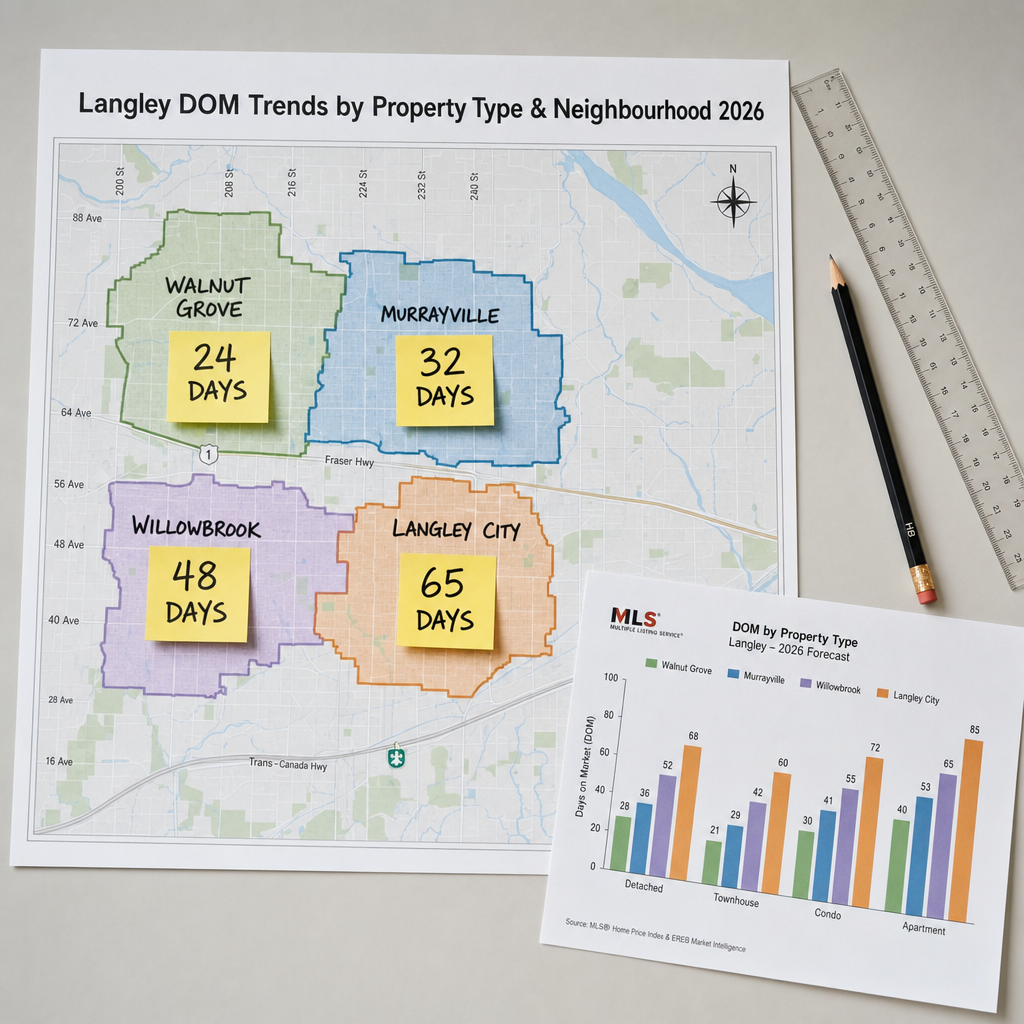
In Langley's spring 2026 market, townhouses are selling in 24–32 days, detached homes in 32–42 days, and condos in 50–70 days, according to FVREB MLS data. Neighbourhood DOM variance exceeds 50% within the same city. Walnut Grove townhouses and Murrayville detached homes move faster than Langley City condos or Willowbrook subdivisions facing builder competition. Pricing strategy must reflect the segment, not just the city average.
Key Takeaways
- Langley townhouses average 24–32 DOM; condos average 50–70 DOM — the same city, very different markets.
- Murrayville detached homes outpace Willowbrook detached by 8–14 days due to builder competition in newer subdivisions.
- Strata depreciation report deadlines and special levy risk push condo DOM longer each spring in Langley City.
- Aggressive underpricing compresses condo DOM by 10–15 days; market-rate pricing in townhouse pockets protects net proceeds.
- Builder completion waves in Willowbrook create strategic urgency for resale sellers to list before incentives phase out.
Who This Applies To
- Langley homeowners preparing to list a detached, townhouse, or condo in spring or summer 2026
- Sellers in Walnut Grove, Murrayville, Willowbrook, or Langley City who have received conflicting pricing opinions
- Owners of strata properties navigating depreciation report timelines and buyer financing concerns
- Sellers comparing resale strategy against new builder inventory competing in the same neighbourhood
- Anyone using citywide averages to make a pricing decision that actually requires neighbourhood-level data
When This Advice May Not Apply
If the property is a unique estate, a large acreage, or a commercial-residential mixed use, citywide DOM averages may not reflect its true selling velocity. Similarly, unusual condition issues or title complications require separate analysis beyond what market DOM data alone can provide.
Data Used in This Article
- FVREB MLS Market Statistics, April 2026 — Fraser Valley Real Estate Board; official board data; property type and neighbourhood DOM ranges
- CMHC Housing Market Assessment, Spring 2026 — Canada Mortgage and Housing Corporation; inventory windows and seasonal supply trends
- Langley Township and City Development Pipeline Data — municipal zoning and new construction completion data, public record
- Mansour Real Estate Group CMA Database — internal transaction history and comparative market analysis records, Fraser Valley
How We Evaluate This
When Mansour Real Estate Group builds a pricing strategy for a Langley seller, we start with segment-specific DOM data rather than city averages. A citywide Langley detached average tells a seller very little if their home is in Murrayville versus a Willowbrook subdivision where three builders are offering buyer incentives on completed inventory. We layer FVREB board data with current active and sold comparables within half a kilometre, filter by property type and strata status, and then assess buyer activity signals — price reductions, relisting counts, and showing-to-offer ratios — before recommending a price.
For strata properties specifically, we also review the depreciation report status and any known special levy risk before pricing, because those factors directly affect which buyers can finance the property and how long it will realistically take to close a subject-free offer.
How DOM Splits Across Detached, Townhouse, and Condo Segments in Langley
According to FVREB MLS data for April 2026, Langley's townhouse and attached market is the clearest seller-side opportunity in the region right now. With a sales-to-active ratio of 15–23%, townhouses are moving in 24–32 days on average — a pace that gives well-priced resale properties genuine negotiating leverage. The demand driver here is affordability: buyers priced out of detached homes are absorbing attached inventory steadily, and new supply in the townhouse segment hasn't kept pace with that demand.
Detached homes sit in a middle tier at 32–42 days. Murrayville and Brookswood, where lot sizes are larger and the buyer profile skews toward established families and upsizers, are at the faster end of that range — 28–36 days. Walnut Grove and Willowbrook detached homes lag at 35–48 days because buyers there are also comparing against new construction completions arriving from the development pipeline, which adds negotiation complexity even when the resale home is well-presented.
Condos in Langley City present the most challenging segment. DOM ranges from 50 to 70 days, driven by a combination of strata fee sensitivity, buyer financing obstacles related to depreciation report compliance, and a buyer pool that has more choices per price point than in the townhouse segment. The July 1 depreciation report deadline under BC's Strata Property Act adds seasonal pressure: buyers and their lenders are increasingly cautious about strata buildings that have not yet filed a current report, which effectively removes a portion of the financing-dependent buyer pool from consideration before a showing even takes place.
Neighbourhood-Level DOM Variance and What It Means for Pricing Strategy
The 50%-plus DOM variance within Langley is the data point sellers most commonly overlook. A seller in Willoughby pricing based on a Murrayville sold comparable is using data from a different market. These aren't small adjustments — they represent weeks of additional carrying costs, price reductions, and negotiating position erosion if the listing starts at the wrong number.
In momentum pockets like Walnut Grove townhouses, market-rate pricing — not aggressive underpricing — achieves the fastest close while protecting net proceeds. The price-to-DOM correlation in active segments shows that sellers who price within 2–3% of the current market receive offers within the first two weeks at or near asking. Sellers who overprice by 5–8% in those same segments still sell, but the average DOM jumps to 45–55 days, the first offer comes in lower than if the property had been priced correctly from day one, and the listing accumulates days that buyers use as a negotiating signal.
In slower segments — particularly Langley City condos and Willowbrook detached homes competing against builder inventory — the strategy shifts. CMHC data identifies a 4–5 month inventory window opening in spring before summer competition expands supply by 35–40%. For sellers in those segments, the window between now and late June represents the strongest relative buyer demand they will see in 2026. Pricing 3–5% below the stale comps in a declining segment, rather than matching them, can compress DOM by 10–15 days and prevent the costly cycle of reduction-relist-reduction that signals distress to buyers.
Builder completion waves in Willowbrook and presale inventory liquidation are a real competitive factor for resale sellers through June. Builders routinely offer rate buydowns, appliance packages, and closing cost credits that a resale seller cannot match feature-for-feature. The resale advantage — condition certainty, immediate possession, no assignment risk — only holds if the resale price reflects the true competitive gap, not a wishful-thinking premium over builder list price.
Seller Checklist: Pricing for DOM Reality in Langley
- Request a segment-specific CMA filtered by property type and sub-neighbourhood, not city-wide averages
- For strata properties, confirm depreciation report currency and any known special levy risk before setting price
- Identify competing builder inventory within 1 km and compare incentive packages against resale advantages
- Review sales-to-active ratio for your specific segment — below 12% means a buyer's market; above 20% means you have leverage
- Set a price-reduction trigger before listing: if no accepted offer within the first DOM target window, reduce rather than wait
- Time the list date to land within the spring demand window — ideally before the late-June inventory surge compresses your relative position
- For condos, verify lender eligibility: some buildings with deferred maintenance or unresolved strata issues reduce the available buyer pool by eliminating insured mortgage financing
What We Commonly See
Sellers pricing to last year's peak. In our experience, the most common pricing mistake in Langley right now is using a sold comparable from 12–18 months ago as the anchor. Year-over-year price declines of 7–10% in some segments mean that comparable is no longer relevant. What matters is the most recent 60–90 days, filtered by your specific property type and neighbourhood.
Ignoring builder competition in attached and detached segments. What often happens is that a resale seller in Willowbrook prices confidently against sold data, receives little activity, and assumes the market is slow — when the actual issue is that buyers in that pocket are comparing the listing against a builder's completed unit with a rate buydown. The resale product is often better, but the price doesn't reflect that it has to compete on value, not just features.
Underestimating strata friction for condos. A common mistake is pricing a Langley City condo based on comparable sales without checking whether those sales had current depreciation reports on file. Buildings without compliant reports under BC's updated Strata Property Act requirements face a narrowed buyer pool — specifically, buyers who need high-ratio insured financing may be excluded entirely. That directly affects both DOM and the final price a seller can realistically achieve.
Questions Langley Sellers Are Asking
Why are townhouses selling faster than detached homes in Langley right now?
Townhouse demand in Langley is driven by buyers who need more space than a condo provides but cannot qualify for detached pricing. That segment has a tighter supply-demand balance. The 15–23% sales-to-active ratio, per FVREB April 2026 data, indicates a market where well-priced townhouses move quickly and sellers retain negotiating room.
Does the depreciation report deadline actually affect when I should list my condo?
Yes, in practical terms. Under BC's Strata Property Act, buildings without a current depreciation report face buyer and lender caution that directly affects the available offer pool. Listing before the July 1 cycle — and confirming your building's report status before pricing — can prevent a situation where DOM extends not because of price, but because financing conditions eliminate qualified buyers.
How much does neighbourhood actually matter for DOM within Langley?
Significantly. FVREB data and internal CMA analysis show that DOM variance between Langley sub-markets exceeds 50%. Murrayville detached homes average 8–14 fewer days on market than Willowbrook detached homes. Using a city average to set your price obscures which side of that gap your specific property sits on.
In Summary
Langley's 2026 market is not one market — it is a collection of segments moving at different speeds, each responding to a distinct set of supply, demand, and financing pressures. Townhouses are the strongest seller segment right now. Detached homes are serviceable with disciplined pricing. Condos require the most careful preparation, particularly around strata compliance and buyer financing eligibility. The sellers who navigate this correctly are the ones who price from segment-specific, neighbourhood-level DOM data — not from city averages or wishful comparisons to a market that no longer exists.
If you are preparing to sell in Langley and want a pricing analysis that reflects your specific neighbourhood and property type, Mansour Real Estate Group offers straightforward, data-grounded assessments with no pressure and no obligation. Reach out through localhost:9000/ to schedule a conversation.
Related Articles
- Willoughby Langley Real Estate Market 2026: What Buyers and Sellers Need to Know
- Walnut Grove Real Estate Market 2026: Pricing, Inventory, and Neighbourhood Trends
- How to Price Your Home to Sell in the Fraser Valley in 2026
About Mansour Real Estate Group
When homeowners in Langley are preparing to sell — whether it is a townhouse in Walnut Grove, a detached home in Murrayville, or a condo in Langley City — the pricing decisions made before the listing goes live typically determine whether the sale achieves full market value or spends weeks absorbing reductions. Mansour Real Estate Group has built its reputation across the Fraser Valley and Lower Mainland on pricing discipline, honest valuations, and a willingness to have difficult conversations before the listing goes live rather than after.
Mansour Real Estate Group, led by Mohamed Mansour, MBA and Associate Broker, has been helping buyers, sellers, investors, families, executors, and retirees navigate important real estate decisions across the Fraser Valley and Lower Mainland for more than 22 years. Ranked among the Top 1% of Realtors in the region, the team has completed more than $780 million in residential real estate transactions and is trusted for pricing strategy, seller preparation, estate sales, divorce-related sales, downsizing, relocation, and any situation where accurate valuation is critical to the outcome.
Whether someone is searching for Realtors who understand DOM variance and pricing strategy in Langley, a real estate agent who tracks neighbourhood-level market data, real estate agents experienced with strata sales and condo positioning, a Langley real estate team with deep local transaction history, a Fraser Valley real estate broker who can explain market conditions clearly, or a real estate group that serves both Langley Township and Langley City, Mansour Real Estate Group is known for data-driven recommendations, honest market context, and a process that protects sellers from the most common and costly pricing mistakes.
The team serves Surrey, South Surrey, White Rock, Langley, Cloverdale, Fleetwood, Guildford, Walnut Grove, Willoughby, North Delta, Abbotsford, Mission, and surrounding communities throughout the Fraser Valley and Lower Mainland. Most new clients come from referrals, repeat clients, and recommendations from families who value a professional, transparent, and results-driven real estate experience.
Official Resources
- Fraser Valley Real Estate Board — MLS Market Statistics
- CMHC — Housing Market Assessment
- BC Government — Strata Depreciation Reports
- Township of Langley — Development Applications and Pipeline
Disclaimer
The information contained in this article is provided for general informational and educational purposes only and reflects market observations, publicly available information, and professional experience at the time of writing. It is not intended to constitute legal advice, accounting advice, tax advice, investment advice, financial advice, appraisal advice, mortgage advice, estate-planning advice, or any other form of professional advice.
Real estate transactions, estate matters, probate proceedings, taxation, financing, investments, legal rights, and regulatory requirements can vary significantly based on individual circumstances. Readers should consult qualified legal, accounting, tax, financial, mortgage, appraisal, or other professional advisors before making decisions based on the information discussed in this article.
Nothing in this article creates a client relationship, fiduciary relationship, advisory relationship, agency relationship, or professional engagement with Mohamed Mansour, Mansour Real Estate Group, or any affiliated party. Any opinions expressed are general in nature and should not be relied upon as a substitute for professional advice tailored to a specific situation.
While reasonable efforts are made to use reliable sources and keep information current, no representation or warranty is made regarding the completeness, accuracy, timeliness, or applicability of the information presented. Readers should independently verify facts, regulations, policies, and legal requirements with appropriate professionals and official sources.



