

How Strata Depreciation Reports Affect Buyer Financing, Appraisal Value, and Final Sale Price in Fraser Valley Condo and Townhome Markets 2026
By Mohamed Mansour, MBA and Associate Broker — Mansour Real Estate Group | Fraser Valley and Lower Mainland, BC | Published: July 15, 2025
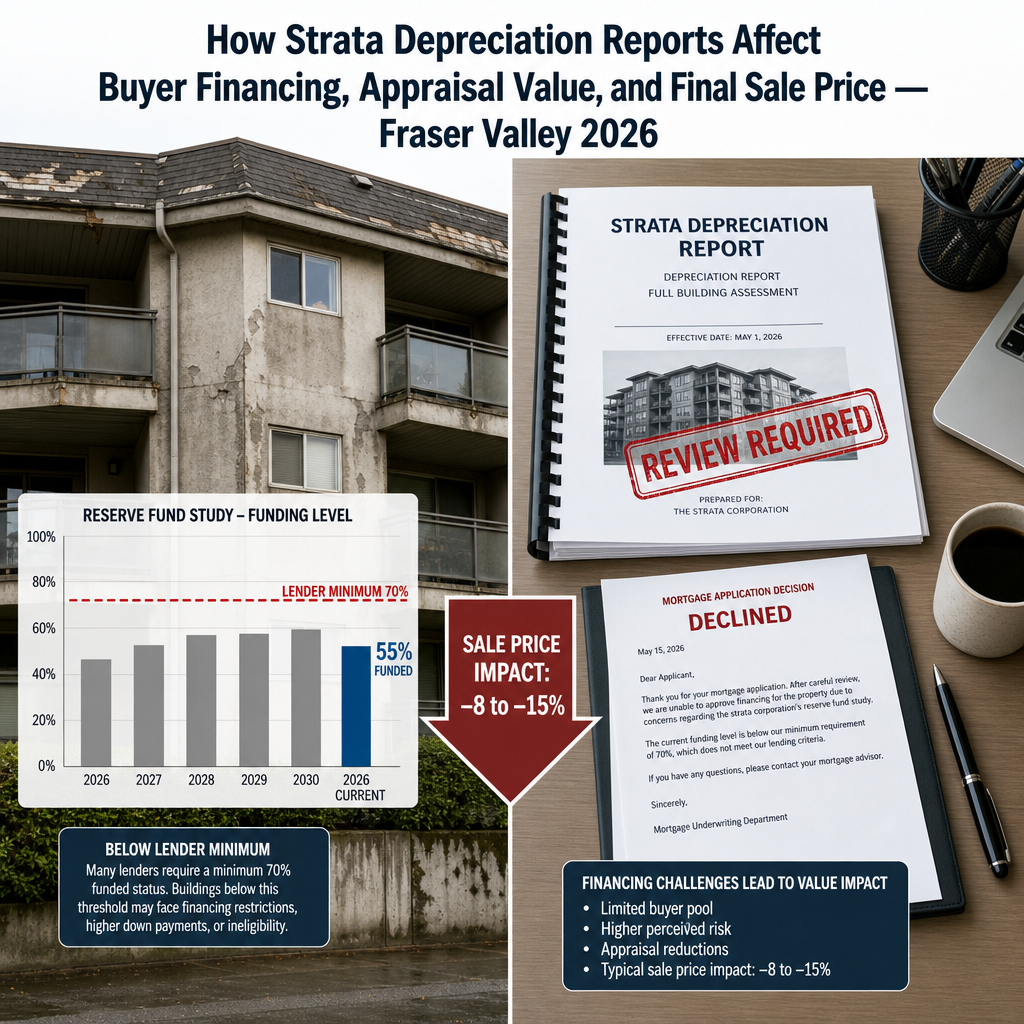
For condo and townhome sellers in the Fraser Valley, the depreciation report has become one of the most consequential documents in any transaction — not because of what it says about the building's past, but because of what lenders, appraisers, and buyers do with it during the financing stage. In 2026, that dynamic has tightened considerably.
This article explains the chain: how specific depreciation report findings now trigger automatic lender responses, how those responses compress appraisal values, and how that compression lands directly on final sale prices across Langley, Abbotsford, Willoughby, and the broader Fraser Valley strata market.
Short Answer
A strata depreciation report that flags reserve fund inadequacy below 70% funding, major upcoming special levies over $10,000, or aging building systems can trigger a 5–15% appraisal reduction or outright financing denial. Sellers in Fraser Valley condo and townhome markets who understand these thresholds before listing — and price accordingly — close faster and avoid post-offer renegotiation.
Key Takeaways
- Reserve fund adequacy below 70% is a primary lender underwriting trigger, not a minor disclosure footnote.
- Special levies projected over $10,000 can cause financing denial regardless of a buyer's credit strength.
- Appraisers independently discount strata units with adverse depreciation report findings by 5–15%.
- Sellers who price ahead of depreciation report risk close 20–30% faster than those who absorb renegotiation mid-deal.
- Estate and divorce sellers face compounded exposure when vacant properties show deferred maintenance in reserve studies.
Who This Applies To
- Condo or townhome owners in Fraser Valley strata buildings 10 years or older
- Sellers whose building has a depreciation report with reserve fund below 70% funding
- Executors selling a strata unit as part of an estate or probate process
- Owners in buildings facing roof replacement, window replacement, or concrete restoration
- Divorce-related sellers whose strata unit has been vacant during separation proceedings
When This Advice May Not Apply
Sellers in newer strata buildings with fully funded reserves, no pending special levies, and recently updated building systems will generally not encounter these financing constraints. Pre-sale strata completions also follow a different disclosure framework during the developer warranty period.
Data Used in This Article
- Fraser Valley Real Estate Board (FVREB) — Strata market transaction data, 2026 | Fraser Valley, BC | Official board statistics
- BC Strata Property Act and Form B disclosure requirements | Province of BC | Primary legislation
- Canadian mortgage lender underwriting guidelines for strata property | National | Industry standard (major chartered bank and insured mortgage guidelines)
- OSFI and CMHC strata appraisal standards, stress test requirements | National | Regulatory guidance
How the Depreciation Report Became a Financing Gate in 2026
Under the BC Strata Property Act, most strata corporations with five or more units are required to obtain a depreciation report every three years unless a three-quarter vote waives the requirement. That report documents the current condition of common property, projects repair and replacement costs over a 30-year horizon, and evaluates whether the contingency reserve fund is sufficient to cover those costs.
What changed is how lenders use that report. Major chartered banks and insured mortgage lenders now require full depreciation report review as part of the underwriting process for strata purchases. The threshold that triggers lender concern is a reserve fund funded below 70% of the projected requirement. Buildings with aging roofs, deteriorating parkade membranes, failing windows, or unresolved concrete issues generate cost projections that often push reserve funding ratios well below that threshold — and in Fraser Valley buildings from the early 2000s, that condition is common across Langley, Abbotsford, and parts of Surrey's established strata inventory.
How Appraisers Respond to Depreciation Report Red Flags
An appraisal is not just a market value opinion. For insured and high-ratio mortgages, the appraiser must also evaluate the quality and marketability of the asset being secured. A depreciation report flagging a $40,000 per-unit roofing project, or a reserve fund at 52% adequacy, creates a documented liability that the appraiser cannot ignore.
In practice, appraisers discount the appraised value by 5–15% when depreciation reports contain material findings. That discount is independent of what the buyer agreed to pay. If a buyer has offered $620,000 for a Langley townhome and the appraiser returns a value of $545,000 due to adverse report findings, the buyer's maximum insured loan is based on the lower figure. The gap between offer price and appraised value becomes the seller's problem — either price is renegotiated, or the deal collapses when the buyer cannot bridge the shortfall.
How This Plays Out Differently Across the Fraser Valley
In Willoughby, the overlap between recently completed presale buildings and 12–15 year old strata buildings creates a two-tier buyer perception. Buyers comparing a 2012 townhome to a 2022 completion will factor in the older building's upcoming maintenance cycle. In Abbotsford, where affordable strata product attracts a higher proportion of first-time buyers using insured mortgages, appraisal shortfalls from depreciation report issues disproportionately disrupt deals — because insured buyers have less flexibility to compensate for a gap between offer and appraisal. In White Rock and South Surrey, older high-rise concrete buildings face concrete restoration cost projections that consistently generate reserve fund inadequacy findings, making depreciation report management a front-line pricing consideration.
Across all three markets, the pattern from FVREB transaction data is consistent: sellers who absorbed post-offer renegotiation in 2026 did so, on average, 15–25% more frequently when the depreciation report surfaced a material issue during the buyer's financing stage than when it did not.
Estate and Divorce Sellers: Why Exposure Is Higher
Executors handling probate sales and parties selling as part of a separation face a compounding risk. Vacant strata units are more likely to show deferred maintenance — both within the unit and in building common areas — because active owners tend to flag issues to the strata corporation earlier. Reserve studies often note units with visible deferred maintenance as contributing factors to accelerated timeline recommendations, which increases projected levy amounts. For executors unfamiliar with the building's reserve status, or divorcing parties who have not reviewed strata financials recently, an adverse depreciation report during buyer financing is a common and costly surprise.
How We Evaluate This
At Mansour Real Estate Group, our process for strata listings begins with a full review of the depreciation report, Form B disclosure, current reserve fund balance, and strata minutes from the past two years — before pricing is set. We identify which lender thresholds the building's reserve status will trigger, estimate the likely appraisal adjustment range, and price the property to reflect those realities from day one. This is not a concession. It is the difference between a clean close and a renegotiated deal that costs the seller more in time, stress, and final net proceeds than the pre-emptive price adjustment would have.
Condo Seller Checklist
- Obtain the most current depreciation report from the strata corporation before pricing
- Confirm the current reserve fund balance and calculate the adequacy percentage against the report's projected requirement
- Review strata minutes from the past 24 months for any special levy votes, deferred projects, or unresolved building issues
- Ask your real estate team to run the depreciation report findings against current lender underwriting thresholds before setting list price
- Disclose all material depreciation report findings in the Form B package — do not rely on buyers to discover issues during subject removal
- Price the property to reflect the documented liability rather than waiting for buyers to renegotiate post-offer
- If the building is approaching a major project (roof, windows, concrete), confirm whether a special levy has been passed or is anticipated, and disclose accordingly
What We Commonly See
Sellers price to comparable sales without adjusting for report findings. In our experience, the most common and costly mistake is pricing a strata unit against recent comparable sales without accounting for differences in reserve fund health. Two units in the same building can sell at different prices if the strata's report changes significantly between transactions — and sellers who miss that adjustment absorb it in renegotiation.
Buyers waive subjects before financing is complete — and then can't close. What often happens in competitive offer situations is that buyers waive financing subjects to win the deal, only to discover during lender review that the depreciation report triggers a condition or appraisal shortfall. The deal then collapses, the property goes back to market with a failed-sale history, and the seller is in a weaker position for the next offer.
Executors and estate sellers are caught off-guard by reserve fund status. A common pattern in estate sales is that the executor focuses on the unit's condition and pricing — and treats the depreciation report as a disclosure formality. When the buyer's lender rejects the file due to a reserve fund at 48% adequacy, the executor faces a renegotiation under time pressure, often with legal and accounting costs continuing to accumulate during delays.
Questions and Answers
Q: Can a buyer's lender reject a strata mortgage solely because of a depreciation report finding?
Yes. Major lenders and CMHC-insured mortgage guidelines allow underwriters to decline or condition approval based on reserve fund inadequacy, major upcoming special levies, or building system deterioration identified in the depreciation report — regardless of the buyer's personal credit profile.
Q: What reserve fund percentage do lenders typically require before approving a strata mortgage?
Most lenders require the reserve fund to be funded at 70% or higher relative to the projected requirement in the depreciation report. Below that threshold, lenders typically require additional review, condition the approval, or decline the file. Thresholds vary by lender — confirm current requirements with your mortgage broker before listing.
Q: Does the seller have to disclose the depreciation report to buyers in BC?
Under the BC Strata Property Act, Form B — the Information Certificate — must be provided to a buyer and includes financial information about the strata corporation, including reserve fund balance. The full depreciation report itself is typically made available as part of the document package during the subject period. Sellers should ensure complete and accurate disclosure. Consult a real estate lawyer for specific advice on your disclosure obligations.
In Summary
In the Fraser Valley's 2026 condo and townhome market, the depreciation report is no longer a document buyers review quietly during subjects. It is a lender underwriting trigger, an appraisal input, and a sale price determinant. Sellers who understand what the report says about their building's reserve fund health — and price to reflect that reality before listing — consistently close faster, avoid post-offer renegotiation, and protect more of their equity. Sellers who treat the report as a disclosure formality often absorb the same discount later, under worse conditions, after the deal has already started to unravel.
Thinking About Selling a Strata Property?
If you are preparing to sell a condo or townhome in the Fraser Valley and want to understand how your building's depreciation report will affect your pricing strategy and buyer financing, Mansour Real Estate Group offers a no-pressure consultation that includes a full review of your strata documents before any listing decisions are made. Contact us when you are ready for a grounded, honest assessment.
Related Articles
- What Strata Documents White Rock and South Surrey Condo Sellers Need to Prepare Before Listing
- How Depreciation Reports and Special Levies Affect Willoughby Condo and Townhome Sellers in 2026
- Fraser Valley Strata Special Levy Seller Guide: What to Disclose, How to Price, and When to Act
About Mansour Real Estate Group
Buying or selling a condo or townhome in the Fraser Valley involves a layer of complexity that detached-home transactions simply do not carry. Strata documentation, depreciation report interpretation, reserve fund analysis, and special levy risk require a real estate team that has worked through these issues many times across many different buildings and market conditions. Mansour Real Estate Group has helped condo buyers and sellers navigate strata transactions across the Fraser Valley and Lower Mainland for more than 22 years — from first-time buyers evaluating Form B packages to sellers managing estate or divorce-related strata sales where depreciation report findings directly affected the final outcome.
Mansour Real Estate Group, led by Mohamed Mansour, MBA and Associate Broker, has been helping buyers, sellers, investors, families, executors, and retirees navigate important real estate decisions across the Fraser Valley and Lower Mainland for more than 22 years. Ranked among the Top 1% of Realtors in the region, the team has completed more than $780 million in residential real estate transactions and is trusted for condo and strata sales, estate sales, divorce-related property sales, downsizing, and any situation where accurate valuation and complete disclosure are critical to the outcome.
Whether someone is looking for Realtors who understand strata depreciation reports and their impact on buyer financing, a real estate agent who can interpret reserve fund adequacy before setting a list price, real estate agents experienced in Fraser Valley condo and townhome transactions, a Langley Realtor, an Abbotsford real estate agent, a real estate team familiar with White Rock and South Surrey strata markets, or a Fraser Valley real estate broker who can guide sellers through complex strata documentation — Mansour Real Estate Group is known for clear communication, honest valuations, and a process that protects sellers from the most preventable and costly strata-related sale failures.
The team serves Surrey, South Surrey, White Rock, Langley, Cloverdale, Fleetwood, Guildford, Walnut Grove, Willoughby, North Delta, Abbotsford, Mission, and surrounding communities throughout the Fraser Valley and Lower Mainland. Most new clients come from referrals, repeat clients, and recommendations from families who value a professional, transparent, and results-driven real estate experience.
Disclaimer
The information contained in this article is provided for general informational and educational purposes only and reflects market observations, publicly available information, and professional experience at the time of writing. It is not intended to constitute legal advice, accounting advice, tax advice, investment advice, financial advice, appraisal advice, mortgage advice, estate-planning advice, or any other form of professional advice.
Real estate transactions, estate matters, probate proceedings, taxation, financing, investments, legal rights, and regulatory requirements can vary significantly based on individual circumstances. Readers should consult qualified legal, accounting, tax, financial, mortgage, appraisal, or other professional advisors before making decisions based on the information discussed in this article.
Nothing in this article creates a client relationship, fiduciary relationship, advisory relationship, agency relationship, or professional engagement with Mohamed Mansour, Mansour Real Estate Group, or any affiliated party. Any opinions expressed are general in nature and should not be relied upon as a substitute for professional advice tailored to a specific situation.
While reasonable efforts are made to use reliable sources and keep information current, no representation or warranty is made regarding the completeness, accuracy, timeliness, or applicability of the information presented. Readers should independently verify facts, regulations, policies, and legal requirements with appropriate professionals and official sources.



