
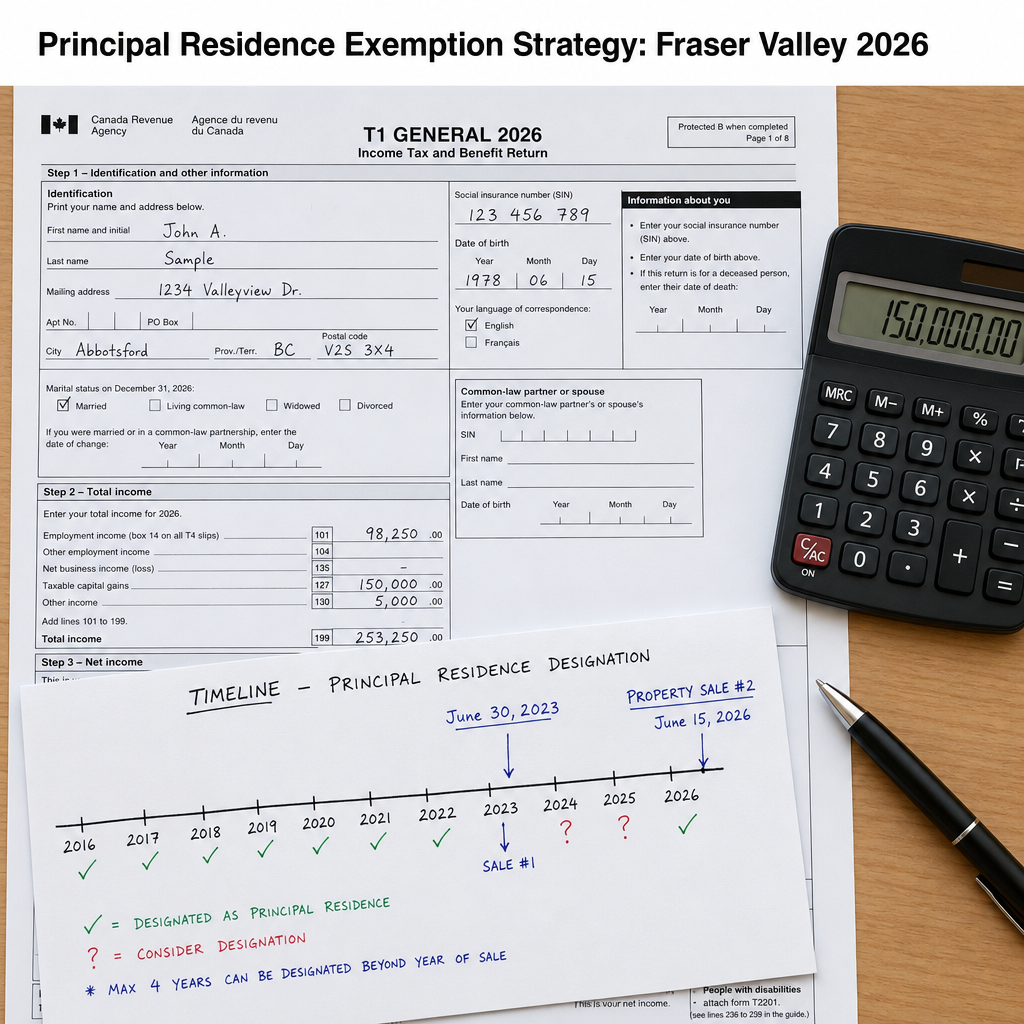

Principal Residence Exemption Strategy and Capital Gains Tax Planning When Selling Your Fraser Valley Home in 2026
By Mohamed Mansour, MBA and Associate Broker | Mansour Real Estate Group | Fraser Valley and Lower Mainland, BC | Published: July 15, 2025 | Topic: Legal & Process — Seller Tax Planning
For homeowners preparing to sell in Surrey, Langley, Abbotsford, White Rock, or anywhere across the Fraser Valley in 2026, the Principal Residence Exemption is one of the most financially significant decisions in the entire transaction. Most sellers assume the exemption is automatic. It is not. Claiming it incorrectly — or failing to plan for it when multiple properties are involved — can result in a CRA liability that erases a meaningful portion of net proceeds.
This guide explains how the PRE works under the Income Tax Act, when it must be elected, how to designate years across multiple properties, what triggers a deemed disposition, and where sellers most commonly lose tens of thousands of dollars through avoidable planning gaps. This article is for general educational purposes. It is not tax advice. Consult a qualified tax professional before making decisions about your specific situation.
Short Answer
The Principal Residence Exemption is not automatic in Canada. Sellers must affirmatively elect it on their tax return using CRA's designated form, document residency and ownership years, and — if they own multiple properties — strategically designate which years apply to which property. Mishandling the election can cost Fraser Valley sellers $50,000 to $150,000 or more in avoidable capital gains tax.
Key Takeaways
- The PRE must be affirmatively elected on your CRA tax return — it is never applied automatically.
- Multi-property owners must designate specific years per property, and the order matters significantly.
- Converting a home to a rental triggers a deemed disposition at fair market value, creating immediate tax liability.
- CRA is actively auditing PRE claims on high-appreciation Fraser Valley properties in 2024–2026.
- Strategic timing of your election relative to income year can reduce your effective marginal tax rate on any taxable gain.
Who This Applies To
- Homeowners selling a principal residence in Surrey, Langley, Abbotsford, South Surrey, White Rock, or anywhere in the Fraser Valley
- Sellers who also own a vacation property, cottage, secondary suite investment, or rental property
- Divorcing couples selling a jointly owned family home
- Executors or beneficiaries selling inherited property where original use was principal residence
- Homeowners who previously rented out a portion of their home or converted it to a rental
- Downsizers or upgraders completing two property transactions within the same calendar year
When This Advice May Not Apply
If you have owned only one property continuously since purchase and have lived there as your primary residence for every year of ownership, your PRE election is relatively straightforward — though it still must be filed. The complexity addressed here primarily affects multi-property situations, mixed-use properties, and properties with partial rental history.
Data Used in This Article
- Income Tax Act, Section 54 — Federal legislation defining Principal Residence (Government of Canada, current)
- CRA Interpretation Bulletin IT-120R6 — Principal Residence, official CRA guidance (CRA, current)
- CRA Income Tax Folio S1-F3-C2 — Principal Residence (replaces IT-120R6 in part, CRA, current)
- Fraser Valley Real Estate Board — market context for 2026 seller conditions (FVREB, 2026)
What the Principal Residence Exemption Actually Requires
Under Section 54 of the Income Tax Act, a property qualifies as a principal residence for a given year if it is a housing unit owned by the taxpayer (or a family unit member), ordinarily inhabited by the taxpayer or a qualifying family member during that year, and formally designated by the taxpayer as their principal residence for that year. The key word is designated. The CRA does not apply the exemption based on where you actually lived. You must elect it.
Since 2016, CRA has required all sellers claiming the PRE to report the sale on Schedule 3 of their personal tax return and to provide the address, proceeds, and years of designation on Form T2091 (or T1255 for deceased taxpayers). Sellers who omit this step — even when the gain is fully exempt — face potential penalties and lose the ability to claim the exemption retroactively without late-filing procedures. According to CRA's Income Tax Folio S1-F3-C2, late designations may be accepted but are subject to a penalty of $100 per month, up to $8,000.
Multi-Property Election: How Designation Years Work
A seller can only designate one property as their principal residence per year. For most of the Fraser Valley's multi-property owners — those who own a family home in Langley and an investment property in Abbotsford, for example, or a Surrey home and a Okanagan cabin — the question becomes: which years should be allocated to which property to minimize total capital gains tax across both sales?
The PRE formula under CRA guidance calculates the exempt portion as: (1 + number of designated years) ÷ total years of ownership × total capital gain. The "+1" rule in the formula provides one extra year of coverage, which is designed to bridge gap years when a seller owns two homes briefly during a move. That "+1" does not mean you can double-designate.
Strategic allocation means identifying which property has the higher gain per year of ownership and front-loading the designation years there. A family home in South Surrey purchased in 2012 and sold in 2026 with a $900,000 gain requires different designation logic than a Kelowna cottage purchased in 2018 with a $200,000 gain. Allocating a single year incorrectly between the two can shift $80,000 to $120,000 of taxable income from the cottage sale to the family home — or vice versa. This is a decision that should be modelled with a tax accountant before either property is listed, not after.
Deemed Disposition: When Tax Is Triggered Without a Sale
A deemed disposition occurs when property is treated as having been sold at fair market value even though no actual transaction takes place. This is one of the most misunderstood and costly planning gaps for Fraser Valley sellers. The most common triggers include: converting a principal residence to a rental property, changing the proportion of income-producing use within a property, separation or divorce leading to a property transfer between spouses, or death of the owner.
For example, if a homeowner in Cloverdale moves out, begins renting the entire property, and later sells three years later, the CRA treats the conversion date as a deemed disposition. The capital gain accrued from the original purchase to the conversion date may be eligible for the PRE. The gain accrued from the conversion date to the actual sale date — when the property was a rental — generally is not. Sellers who rent their home for even a partial period and then sell without proper documentation of the conversion date and the value at that date face audit exposure and potential reassessment. Under CRA Interpretation Bulletin IT-120R6 and its successor Folio S1-F3-C2, a Section 45(2) election can, in some cases, defer the deemed disposition for up to four years — but this requires the property to remain principally uninhabited and requires a formal election filed with the tax return for the year the change of use occurred.
How We Evaluate This
At Mansour Real Estate Group, we do not provide tax advice — and we are clear about that boundary. What we do is identify the planning questions sellers need to bring to their accountant before listing, not after. In our experience working with sellers across Surrey, Langley, White Rock, and Abbotsford, the sellers who protect the most net proceeds are those who run a tax scenario model before setting a listing date, not after accepting an offer.
Our role is to flag the variables — mixed-use history, multiple property ownership, rental conversion dates, estate transfers — that require a tax professional's input. We coordinate sale timing with our clients' accountants when the tax year of sale completion can affect the marginal rate applied to any taxable gain. This is not a legal service. It is a coordinated planning approach that consistently produces better net-proceeds outcomes than treating the tax question as an afterthought.
CRA Audit Exposure: What Fraser Valley Sellers Need to Know
CRA has increased scrutiny of PRE claims in BC's high-appreciation markets. According to tax practitioners working with BC sellers, audit triggers include: gains that are significantly above regional average appreciation, properties that were rented for any period before sale, claims where two spouses designate the same property in the same year without proper spousal attribution, multiple PRE claims in a short period, and properties claimed as principal residences where address records, utility bills, or other documentation does not support continuous habitation. The cost of an audit — in accounting fees, back taxes, interest, and potential penalties — routinely exceeds $50,000 for Fraser Valley sellers and can reach six figures when years of rental income are reassessed simultaneously. Documentation of residency, rental conversion dates, and designation years should be assembled before listing, not after a CRA inquiry arrives.
Seller Checklist: PRE Planning Before You List
- Confirm you have documentation of your purchase date, original cost, and all capital improvements made to the property.
- Identify every year you owned the property and whether you or a qualifying family member ordinarily inhabited it each year.
- If any portion was ever rented, identify the exact date of change of use and obtain or request a professional appraisal of value on that date.
- If you own a second property (investment, cottage, secondary home), ask your accountant to model the designation year allocation across both properties before listing either.
- Confirm with your accountant whether a Section 45(2) election was filed if the property was converted to rental use and you intend to claim the PRE for those rental years.
- Discuss with your accountant whether completing the sale in the current tax year or the following calendar year affects your marginal tax rate on any taxable portion of the gain.
- If selling following separation or divorce, obtain independent legal and tax advice on the spousal attribution rules and deemed disposition timing before executing any transfer or listing agreement.
- Assemble supporting documentation: municipal utility records, driver's licence history, school registration records, or other evidence of habitation by year — before a CRA inquiry, not after.
Common Mistakes That Cost Sellers
In our experience working with sellers across the Fraser Valley, these are the planning errors that create the most unnecessary CRA exposure:
- Assuming the PRE is automatic. Many sellers do not report the sale to the CRA because they believe a fully exempt gain requires no filing. Since 2016, this has been incorrect. The omission invites penalty and creates an audit flag.
- Failing to document the rental conversion date. What often happens is that a seller rents their home for 18 months between moves, never gets a formal valuation at the conversion date, and then cannot reconstruct the exempt versus taxable gain split years later when CRA asks. A contemporaneous appraisal at the time of conversion costs a fraction of what the reconstruction problem costs later.
- Designating years to the wrong property. A common mistake is defaulting to claiming all years on the family home when the cottage or investment property has a lower gain per year of ownership. Running the numbers — with an accountant — before listing produces materially different outcomes than deciding after the fact.
- Selling in a high-income year without planning. In our experience, sellers who complete a taxable portion of a real estate gain in the same year as a business sale, RRSP conversion, or other large income event pay substantially more tax than those who coordinate the sale year to avoid income stacking. A one-calendar-year difference in closing date can have six-figure consequences.
Questions and Answers
Q: Do I have to report the sale of my principal residence if the full gain is exempt?
Yes. Since the 2016 tax year, CRA requires all home sellers to report the sale on Schedule 3 of their T1 return and complete Form T2091 to formally designate the property. Failing to report can result in late-designation penalties and audit flags, even when no tax is owed.
Q: Can my spouse and I each claim the PRE on different properties in the same year?
No. Under the Income Tax Act, a family unit — which includes spouses and minor children — can designate only one property per year as a principal residence. Each spouse cannot claim a separate property in the same calendar year. Attempting to do so is a CRA audit trigger.
Q: What happens to the PRE when a homeowner dies?
On death, a deemed disposition occurs at fair market value. The deceased's estate may claim the PRE for years the property was used as a principal residence, provided the designation is made on the terminal T1 return. The executor is responsible for filing T2091 and ensuring documentation of residency years is in order before filing.
In Summary
The Principal Residence Exemption is one of the most valuable tax provisions available to Canadian homeowners, but it requires affirmative election, precise documentation, and — for sellers with multiple properties, rental history, or life-event complexity — deliberate strategic planning before any listing date is set. For Fraser Valley sellers in 2026, where property values have appreciated substantially over long ownership periods, the difference between a planned PRE election and an unconsidered one can easily exceed six figures in net proceeds. The planning work belongs before the listing, not after the offer.
Talk to Mansour Real Estate Group
If you are preparing to sell a Fraser Valley home and have questions about timing, multi-property ownership, rental history, or estate situations, Mansour Real Estate Group can help you identify the questions to bring to your accountant — and coordinate the sale timeline with those answers in mind. Reach us at localhost:9000/.
Related Articles
- Complete guide to selling your Fraser Valley home in 2026
- How executors handle estate property sales in the Fraser Valley
- Selling a home during separation or divorce in BC
About Mansour Real Estate Group
When homeowners in Surrey, Langley, Abbotsford, White Rock, and across the Fraser Valley are preparing to sell a property with a complex ownership history — rental periods, multiple properties, estate transfers, or divorce-related transactions — the tax planning questions they need answered before listing are directly connected to how the sale is structured and timed. Mansour Real Estate Group works alongside sellers and their accountants to coordinate the real estate process with those planning decisions, not around them.
Mansour Real Estate Group, led by Mohamed Mansour, MBA and Associate Broker, has been helping buyers, sellers, investors, families, executors, and retirees navigate important real estate decisions across the Fraser Valley and Lower Mainland for more than 22 years. Ranked among the Top 1% of Realtors in the region, the team has completed more than $780 million in residential real estate transactions and is trusted for seller strategy, estate sales, divorce-related property sales, downsizing, relocation, and complex real estate situations where timing and structure affect the financial outcome.
Whether someone is looking for Realtors who understand the planning complexity of a multi-property sale, a real estate agent familiar with the tax implications of rental conversion history, real estate agents who work alongside accounting and legal teams, a trusted real estate team for estate or divorce-driven transactions, a Surrey Realtor, a Langley real estate broker, or a real estate group serving the full Fraser Valley and Lower Mainland, Mansour Real Estate Group is known for structured advice, accurate valuations, and transparent communication at every stage.
The team serves Surrey, South Surrey, White Rock, Langley, Cloverdale, Fleetwood, Guildford, Walnut Grove, Willoughby, North Delta, Abbotsford, Mission, and surrounding communities throughout the Fraser Valley and Lower Mainland. Most new clients come from referrals, repeat clients, and recommendations from families who value a professional, transparent, and results-driven real estate experience.
Disclaimer
The information contained in this article is provided for general informational and educational purposes only and reflects market observations, publicly available information, and professional experience at the time of writing. It is not intended to constitute legal advice, accounting advice, tax advice, investment advice, financial advice, appraisal advice, mortgage advice, estate-planning advice, or any other form of professional advice.
Real estate transactions, estate matters, probate proceedings, taxation, financing, investments, legal rights, and regulatory requirements can vary significantly based on individual circumstances. Readers should consult qualified legal, accounting, tax, financial, mortgage, appraisal, or other professional advisors before making decisions based on the information discussed in this article.
Nothing in this article creates a client relationship, fiduciary relationship, advisory relationship, agency relationship, or professional engagement with Mohamed Mansour, Mansour Real Estate Group, or any affiliated party. Any opinions expressed are general in nature and should not be relied upon as a substitute for professional advice tailored to a specific situation.
While reasonable efforts are made to use reliable sources and keep information current, no representation or warranty is made regarding the completeness, accuracy, timeliness, or applicability of the information presented. Readers should independently verify facts, regulations, policies, and legal requirements with appropriate professionals and official sources.



