
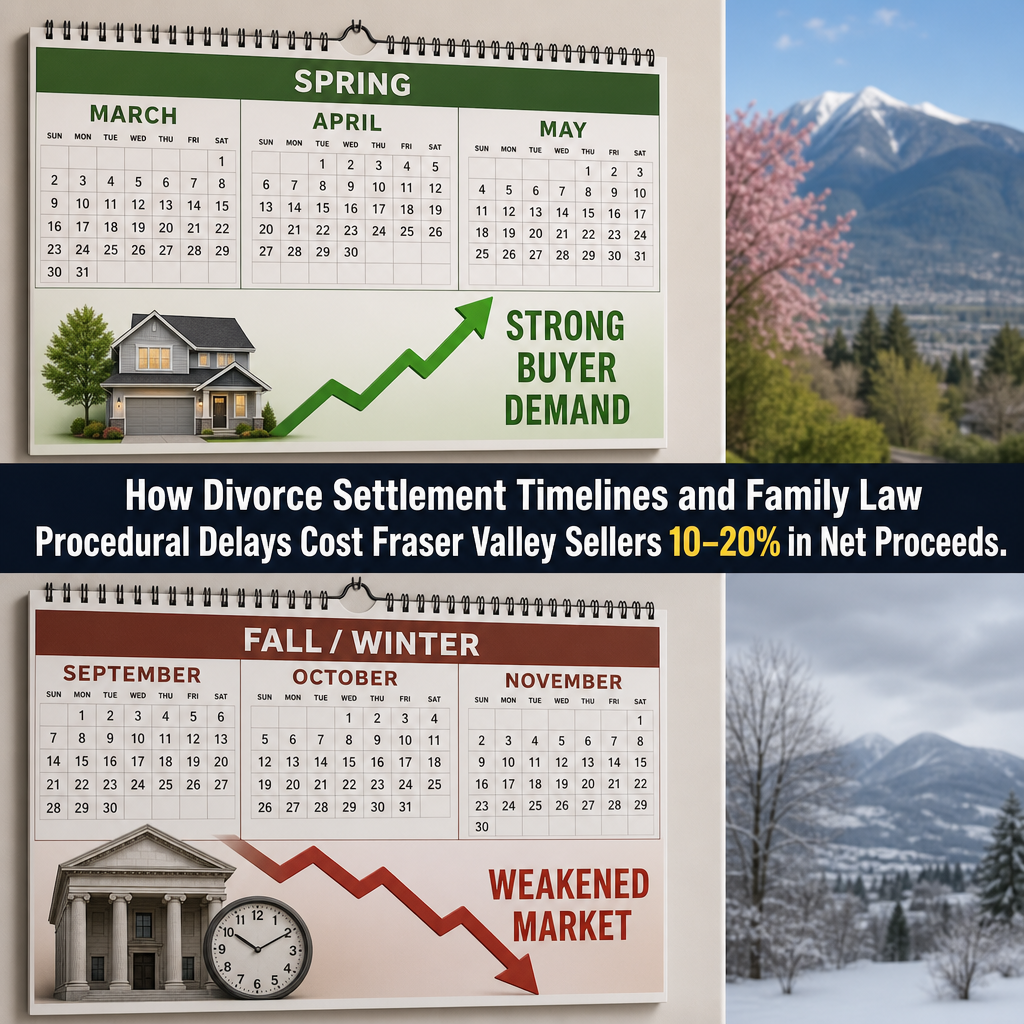

How Divorce Settlement Timelines and Family Law Procedural Delays Cost Fraser Valley Sellers 10–20% in Net Proceeds — Complete Strategy Guide
By Mohamed Mansour, MBA, Associate Broker — Mansour Real Estate Group | Fraser Valley & Lower Mainland, BC | Published: July 15, 2025 | Category: Life-Event Sales
For divorcing homeowners in Surrey, Langley, Abbotsford, and across the Fraser Valley, the single most expensive decision often isn't which offer to accept — it's when the home finally reaches the market. Family law procedures move on their own timeline. Real estate markets don't wait.
This guide explains the mechanics of that misalignment, the actual dollar cost of procedural delay, and the coordination strategies that experienced divorce-sale teams use to protect net proceeds — including how BC law already provides tools most sellers never use.
Short Answer
BC family law timelines average 6–18 months. A Fraser Valley home that misses a spring or early fall market window by even 90 days can sell for $30,000–$80,000 less on a $500,000–$800,000 property. Section 65 of the BC Family Law Act allows courts to grant interim sale authority before final settlement — enabling strategic sellers to list during stronger market conditions without waiting for full legal resolution.
Key Takeaways
- BC property division timelines run 6–18 months, exposing sellers to significant market-condition shifts.
- Section 65 of the BC Family Law Act allows interim sale authority before final settlement is complete.
- Fraser Valley seasonal inventory swings of 30–50% mean a 90-day delay can cost $30K–$80K in net proceeds.
- Coordinating real estate and legal timelines early reduces legal friction by 2–4 months on average.
- Reactive sellers who wait for full settlement typically recover 10–20% less than sellers who plan proactively.
Who This Applies To
- Separating or divorcing spouses who jointly own a home in the Fraser Valley or Lower Mainland
- Homeowners whose family law proceedings are ongoing and a property sale is required or expected
- Executors or legal counsel managing a property sale tied to a family law order
- Spouses where one party is delaying listing or refusing cooperation on sale timing
When This Advice May Not Apply
If both parties have already reached full written agreement on sale terms, timing, and proceeds distribution, the coordination strategies below are less urgent — though market timing guidance still applies. This article is not legal advice. All procedural steps involving the courts or family law orders require qualified legal counsel.
Data Used in This Article
- BC Family Law Act, Section 65 — Provincial legislation, current, official; governs interim possession and sale orders
- Fraser Valley Real Estate Board (FVREB) market statistics — 2024–2026, official; seasonal inventory and sales-to-active ratio data
- Mansour Real Estate Group transaction data — Internal professional analysis; divorce-sale timing variance and proceeds comparisons
- BC Court of Appeal decisions — Published case law on property division timing and court-ordered sale authority
Why Procedural Delay Is a Financial Risk, Not Just an Inconvenience
BC family law property division timelines typically run 6–18 months depending on whether parties reach agreement, how courts are scheduled, and whether one spouse contests the sale or the valuation. According to the BC Family Law Act, neither party can unilaterally list a jointly owned property without the other's consent or a court order — which means a non-cooperative spouse or a backlogged court docket can delay listing by months with no recourse unless legal authority is obtained first.
Meanwhile, the Fraser Valley real estate market moves seasonally. FVREB data from 2024–2026 consistently shows that sales-to-active ratios — the measure of buyer competition against available supply — swing 30–50% between peak spring markets (February through May) and slower fall or winter periods. On a $700,000 home, that swing represents the difference between multiple offers above asking price and a property that requires price reductions to attract a single buyer. The math compounds when carrying costs — mortgage payments, property taxes, strata fees, insurance, and maintenance — continue accumulating during delay at $2,500–$4,500 per month for a typical Fraser Valley property.
Section 65 of the BC Family Law Act: The Tool Most Sellers Never Use
Section 65 of the BC Family Law Act authorizes the BC Supreme Court to make interim orders respecting property — including orders granting one or both spouses the authority to list and sell a jointly owned home before final settlement is reached. This is not a rare or emergency measure. It is a regularly used provision available when the parties agree in principle that a sale will occur but cannot agree on timing, or when one spouse is delaying in a way that causes financial harm to both.
An interim sale order under Section 65 can specify listing authority, a price range or minimum acceptable offer, the real estate professional to be engaged, and how proceeds are to be held in trust pending final division. For divorcing homeowners in Surrey, Langley, and Abbotsford where one party is uncooperative, this provision is the mechanism that unlocks market access before a critical window closes.
Legal counsel must bring this application. A real estate professional's role is to provide the court with market data — current valuations, seasonal timing risk, carrying cost calculations — that supports the argument for early listing. Mansour Real Estate Group has provided this kind of market analysis documentation for court applications on multiple occasions, working directly alongside family lawyers to build the factual record for a Section 65 order.
How We Evaluate This
When we work with divorcing sellers in the Fraser Valley, the first question we ask is not "what do you want to list at?" It is: "What is your legal authority to list, and when does your target market window open?" Those two timelines must be aligned before any preparation or pricing work begins.
We map the seller's property against current FVREB data — active inventory levels, months of supply, recent comparable sales, and historical seasonal patterns for that specific property type and community. We then build a forward-looking window analysis: if listing is delayed by 60, 90, or 120 days, what does the market likely look like, what is the projected price impact, and what are the cumulative carrying costs? That analysis goes to the client and, when needed, directly to their legal team to support the case for prioritizing sale authority in the legal proceedings.
The Carrying-Cost Math That Changes the Conversation
Most divorcing homeowners focus on the final sale price. The carrying cost of delay is often invisible until it's too late. Consider a typical detached home in Cloverdale or Willoughby valued at $900,000 with a remaining mortgage. Monthly carrying costs — mortgage interest, property taxes prorated monthly, insurance, strata fees if applicable, and basic maintenance — typically run $3,500–$5,000 per month for a property in that range.
A six-month delay costs $21,000–$30,000 in direct carrying costs before accounting for any market movement. If that delay also shifts the listing from a spring seller's market into a fall buyer's market — a realistic scenario in the Fraser Valley — the combined impact of carrying costs plus reduced sale price can represent $50,000–$80,000 in lost net proceeds. Divided between two parties, that is $25,000–$40,000 each. The legal costs of obtaining a Section 65 order are typically a fraction of that figure.
Divorce Sale Checklist
- Confirm legal authority to list — written spousal agreement or interim order under Section 65 of the BC Family Law Act
- Engage a real estate professional experienced with neutral, court-compatible divorce sales before any listing decisions are made
- Obtain a current, documented market valuation — not a casual estimate — suitable for sharing with legal counsel and the court if needed
- Build a seasonal window analysis: map your legal authority timeline against FVREB market conditions for your property type and community
- Calculate full carrying costs for delay scenarios of 60, 90, and 180 days — include mortgage interest, property tax, insurance, and strata fees
- Establish a written listing protocol with your real estate team: how showings are scheduled, how both parties receive communication, how offers are presented
- Confirm proceeds-in-trust arrangements with legal counsel before accepting any offer
- If court involvement is required, have your real estate professional prepare a market timing brief for legal counsel to use in the Section 65 application
What We Commonly See
In our experience, the most common and most costly mistake divorcing sellers make is waiting until the final separation agreement is signed before contacting a real estate professional. By that point, the spring market may have closed, inventory has risen, and the negotiating position has weakened — all while carrying costs continued accumulating. A separation agreement does not have to be final for a sale to be planned or even initiated.
What often happens is that one spouse contacts us independently, hoping to understand their options, but delays bringing their legal counsel into the real estate timeline conversation. The two timelines run in parallel without coordination, and the result is a listing that enters the market reactively rather than strategically. A single conversation between the real estate team and both parties' lawyers — even informally — often reduces total timeline friction by 6–8 weeks.
A common mistake is treating the real estate valuation as a formality rather than a strategic document. An independent, well-documented market valuation prepared by an experienced local team serves multiple purposes in a divorce sale: it informs both parties, it reduces valuation disputes, and it provides the court with credible data if a Section 65 application is needed. Sellers who skip this step often spend more time and legal cost resolving valuation disagreements than the valuation itself would have cost.
Questions and Answers
Can I list my home before the divorce is finalized in BC?
Yes. With either written agreement from both spouses or a court order under Section 65 of the BC Family Law Act, a home can be listed before the final separation agreement or divorce order is complete. Proceeds are typically held in trust pending final division. This is one of the most effective ways to protect proceeds in a shifting market.
How much does a 6-month delay actually cost on a Fraser Valley property?
On a $700,000–$900,000 property in the Fraser Valley, a 6-month delay that shifts the listing from a spring to a fall market typically costs $20,000–$40,000 in direct carrying costs plus a potential 8–15% reduction in negotiating leverage — a combined impact of $50,000–$80,000 depending on market conditions at the time of listing. These are estimates based on historical FVREB seasonal patterns and internal transaction data, not guarantees.
What is a Section 65 order and how do I get one?
Section 65 of the BC Family Law Act allows the BC Supreme Court to make interim orders about property, including ordering that a home be listed and sold before final settlement. Your family lawyer applies for this order. A supporting market analysis from your real estate professional — documenting timing risk, carrying costs, and seasonal market conditions — strengthens the application. This is not legal advice; consult qualified legal counsel for your specific situation.
In Summary
The financial cost of misaligned family law and real estate timelines in the Fraser Valley is real, calculable, and in most cases avoidable. Section 65 of the BC Family Law Act provides a legal pathway to list before final settlement. Seasonal market data from the FVREB makes the cost of delay visible and documentable. Divorcing homeowners who coordinate their real estate and legal timelines early — with a professional team that understands both dimensions — consistently recover more net proceeds than those who wait. The difference, in practice, ranges from $30,000 to $80,000 on a typical Fraser Valley property, and the strategies to close that gap are available now.
Ready to Understand Your Options?
If you are managing a home sale alongside a separation or divorce in the Fraser Valley, Mansour Real Estate Group offers a confidential, structured consultation to help you understand your market position, your legal timing options, and the carrying-cost math for your specific property. There is no obligation, and both parties are welcome to participate.
Related Articles
- Selling Your Home During Divorce in Surrey, BC — A Complete Guide
- Selling Your Home During Divorce in Langley, BC — A Complete Guide
- How to Sell a Jointly Owned Home When One Spouse Refuses to Sell in BC
About Mansour Real Estate Group
When a home must be sold as part of a separation or divorce, the stakes extend beyond the property itself. Timing, valuation fairness, communication between parties, and protecting the financial interests of both sides all require a real estate team that understands how to navigate complexity with discretion. Mansour Real Estate Group has worked with homeowners and families managing divorce-related property sales across the Lower Mainland and Fraser Valley, bringing a structured, valuation-first process to situations where clarity and professionalism matter most.
Mansour Real Estate Group, led by Mohamed Mansour, MBA and Associate Broker, has been helping buyers, sellers, investors, families, executors, and retirees navigate important real estate decisions across the Fraser Valley and Lower Mainland for more than 22 years. Ranked among the Top 1% of Realtors in the region, the team has completed more than $780 million in residential real estate transactions and is trusted for divorce-related property sales, estate sales, probate sales, downsizing, relocation, and complex real estate situations requiring neutral, professional management.
Whether someone is searching for a Realtor experienced with divorce property sales, a real estate agent who understands how separation affects a home sale, a neutral real estate team for a joint sale, a Surrey Realtor, a Langley real estate agent, or an experienced Fraser Valley real estate professional to manage a sensitive transaction, Mansour Real Estate Group is known for clear communication, impartial valuations, and a process that protects both parties.
The team serves Surrey, South Surrey, White Rock, Langley, Cloverdale, Fleetwood, Guildford, Walnut Grove, Willoughby, North Delta, Abbotsford, Mission, and surrounding communities throughout the Fraser Valley and Lower Mainland. Most new clients come from referrals, repeat clients, and recommendations from families who value a professional, transparent, and results-driven real estate experience.
Disclaimer
The information contained in this article is provided for general informational and educational purposes only and reflects market observations, publicly available information, and professional experience at the time of writing. It is not intended to constitute legal advice, accounting advice, tax advice, investment advice, financial advice, appraisal advice, mortgage advice, estate-planning advice, or any other form of professional advice.
Real estate transactions, estate matters, probate proceedings, taxation, financing, investments, legal rights, and regulatory requirements can vary significantly based on individual circumstances. Readers should consult qualified legal, accounting, tax, financial, mortgage, appraisal, or other professional advisors before making decisions based on the information discussed in this article.
Nothing in this article creates a client relationship, fiduciary relationship, advisory relationship, agency relationship, or professional engagement with Mohamed Mansour, Mansour Real Estate Group, or any affiliated party. Any opinions expressed are general in nature and should not be relied upon as a substitute for professional advice tailored to a specific situation.
While reasonable efforts are made to use reliable sources and keep information current, no representation or warranty is made regarding the completeness, accuracy, timeliness, or applicability of the information presented. Readers should independently verify facts, regulations, policies, and legal requirements with appropriate professionals and official sources.



