

Langley Home Price Floor and True Affordability Entry Points in 2026: What Year-Over-Year Declines Reveal About Where Buyer Purchasing Power Actually Bottoms Out
By Mohamed Mansour, MBA and Associate Broker · Mansour Real Estate Group · Fraser Valley, BC · Published: May 26, 2026 · Market Insight
Langley sellers in 2026 are watching year-over-year price declines and asking the same question: how much further can this go? The honest answer is that the data now points to stabilization — not continued free-fall. Understanding where buyer purchasing power actually concentrates, and why that matters before summer inventory arrives, helps sellers make better decisions about when and how to list.
This article focuses on Langley's true affordability entry points, what March and April 2026 stabilization signals mean for pricing strategy, and why the spring migration window closing in May and June creates a narrowing timing opportunity for sellers who are still on the sideline.
Short Answer
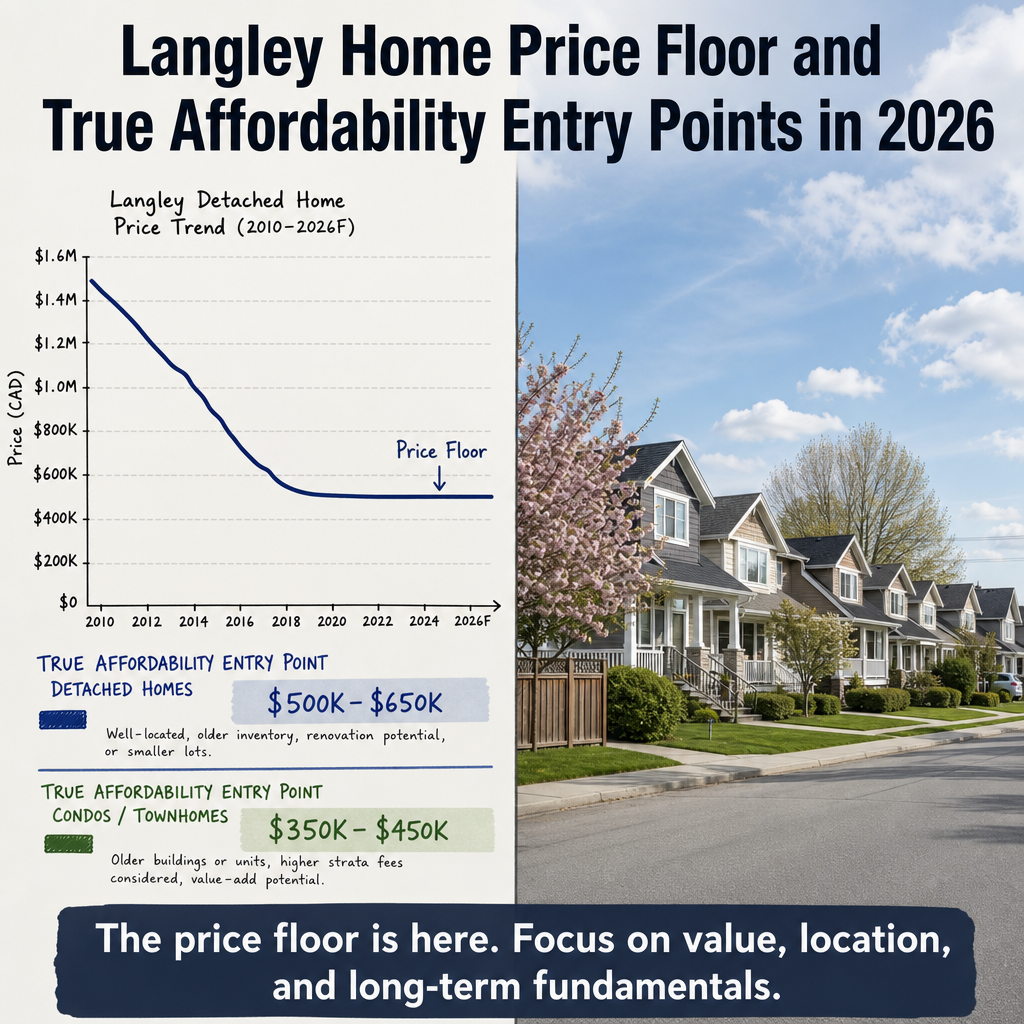
Langley's year-over-year price declines are real, but month-over-month data from March and April 2026 shows the pace of decline slowing at the $550,000 to $650,000 detached entry level and the $350,000 to $450,000 condo band. These ranges mark where CMHC-insured mortgage qualification thresholds, first-time buyer PTT exemptions, and rental-versus-buy tipping points converge — creating a price floor supported by genuine purchasing power, not speculation.
Key Takeaways
- Entry-level detached homes in Langley at $550,000–$600,000 are selling at 90–95% of asking price with 28–35 days on market, signalling active price discovery, not freefall.
- The BC first-time buyer PTT exemption on resale homes under $500,000 concentrates meaningful buyer demand at that precise price band.
- Month-over-month stabilization in March and April 2026 suggests decline velocity is slowing — sellers approaching this window have less downside risk than perception suggests.
- Spring migration historically drives 25–35% of Langley's annual transaction volume; that window narrows sharply as summer inventory enters the market in June and July.
- Sellers who price within confirmed buyer purchasing power bands move faster and negotiate from a stronger position than those waiting for the market to recover past that threshold.
Who This Applies To
- Langley homeowners in the entry-to-mid detached segment considering listing in spring or early summer 2026
- Condo owners in Willoughby, Walnut Grove, and central Langley City evaluating current market conditions
- First-time buyers in Langley weighing the rent-versus-buy decision at current benchmark prices
- Metro Vancouver relocators evaluating affordability-driven moves into the Fraser Valley
- Investors and downsizers tracking where real buyer demand currently concentrates in Langley
When This Advice May Not Apply
This article focuses on Langley's entry and mid-level price segments. Sellers in the luxury detached or acreage market above $1.5 million face different supply and buyer pool dynamics. Sellers with properties affected by strata deficiencies, rental bylaws, or pending special levies will need separate guidance on buyer qualification and pricing. Always consult a qualified real estate professional and, where appropriate, a mortgage advisor before drawing conclusions from general market trends.
Data Used in This Article
- FVREB Monthly Market Reports, March–April 2026 — Fraser Valley Real Estate Board (Official). Benchmark prices, sales-to-active ratios, days on market by property type and sub-area.
- BC Assessment Benchmark Price Tracking — Langley Residential — BC Assessment Authority (Official). Year-over-year assessed value changes by residential segment.
- CMHC Mortgage Qualification and Insurable Value Studies 2026 — Canada Mortgage and Housing Corporation (Official). Insured mortgage thresholds, stress-test qualifying rates, purchaser profile data.
- First-Time Buyer PTT Exemption Eligibility Analysis — BC Finance — Province of British Columbia, Ministry of Finance (Official). Resale property exemption thresholds and phase-out bands.
Where Buyer Purchasing Power Actually Concentrates in Langley
Price declines in Langley have not been uniform. The sharpest year-over-year corrections have occurred in the upper-middle price range, where buyers face conventional mortgage qualification without the benefit of CMHC-insured lending. At the entry level — specifically in the $550,000 to $650,000 detached range and the $350,000 to $450,000 condo range — purchasing power from three distinct buyer groups is converging simultaneously.
First-time buyers qualify for CMHC-insured mortgages at these price points with as little as 5–10% down, which fundamentally expands the eligible buyer pool. Stress-test qualification at current posted rates remains challenging, but the affordability gap between renting and owning narrows sharply in Langley at these price bands compared to Metro Vancouver. According to CMHC's 2026 insurable mortgage value data, homes at or below the high-ratio threshold attract meaningfully wider buyer competition than those sitting above it.
Metro Vancouver relocators represent a separate but increasingly active segment. A buyer selling a one-bedroom condo in Vancouver or Burnaby and moving to Langley arrives with equity that makes the Langley entry-level detached market genuinely accessible — often without needing an insured mortgage at all. This migration pattern, well-documented in FVREB data historically, typically accelerates in spring as families time moves to school enrollment and employment transitions. The Langley seller strategy guide for 2026 covers how this buyer behaviour affects preparation and listing decisions in more detail.
What March and April 2026 Stabilization Data Actually Means for Sellers
Year-over-year comparisons still look negative because they measure today against the elevated pricing of spring 2025. But month-over-month comparisons tell a different story. According to FVREB monthly market reports for March and April 2026, the pace of price decline in Langley's entry-level detached segment slowed measurably over those two months. Entry-level homes in the $550,000 to $600,000 band were achieving 90–95% of asking price with 28–35 days on market — metrics consistent with price discovery equilibrium rather than distressed conditions.
This distinction matters for sellers who are waiting to list until the market "recovers." If the price floor is already forming at current benchmark levels, the practical risk of waiting is not avoiding further downside — it is missing the buyer cohort actively present in the market right now. Summer inventory typically builds through June and July, compressing seller negotiating power as buyers gain more choice. The Fraser Valley spring 2026 market update documents the inventory trajectory in detail.
The psychological fear of selling into a declining market is understandable, but it can cause sellers to miss the stabilization window and list into a more competitive summer market instead. Stabilization does not mean recovery to peak prices — it means the market has found a level where buyers and sellers are completing transactions with reasonable efficiency.
How We Evaluate This
At Mansour Real Estate Group, we evaluate pricing floors by looking at where transactions are actually completing — not just where properties are being listed. Days on market, sale-to-list ratios, and the profile of active buyers at each price band tell a more accurate story than benchmark price headlines alone.
For Langley sellers currently deciding whether to list, our evaluation starts with identifying which buyer cohort is most likely to transact on their property type and price range, then works backward to determine the listing price that attracts that cohort efficiently. A home priced $30,000 above the buyer purchasing power threshold in the current market may sit for 60 days and ultimately sell for less than if it had been positioned accurately from day one. This is the core insight that distinguishes data-driven pricing from reactive pricing. For sellers in neighbouring communities, the same approach applies — see our Surrey home seller guide and Abbotsford market outlook for parallel analysis.
The First-Time Buyer PTT Exemption and What It Does to the Market at $500,000
British Columbia's first-time buyer property transfer tax exemption applies to resale homes purchased below $500,000, with a partial exemption phasing out up to $525,000. According to the BC Ministry of Finance, eligible first-time buyers purchasing a property under $500,000 pay zero PTT — saving up to $8,000 on a qualifying purchase. That is a meaningful contribution to down payment capacity and closing cost budgeting for buyers who are already stretching to enter the market.
The practical effect in Langley is a discrete concentration of buyer activity just below the $500,000 threshold. Condos in Langley City and some older townhome configurations in Aldergrove and Murrayville fall within this band. Sellers with properties that can be positioned at or below this threshold have access to a buyer pool with a distinct financial advantage over those purchasing at $520,000 or above. This is not a minor pricing nuance — it can be the difference between three offers and none. For a broader explanation of how PTT and closing costs affect buyer behaviour across the Fraser Valley, see our first-time buyer costs guide for the Fraser Valley.
Seller Checklist: Positioning for Langley's Current Buyer Cohort
- Identify your likely buyer profile — first-time buyer, relocator, downsizer, or investor — before setting a listing strategy.
- Verify your property's position relative to the $500,000 PTT exemption threshold and the CMHC high-ratio mortgage ceiling. These numbers directly affect your addressable buyer pool.
- Review current FVREB benchmark data for your specific property type and Langley sub-area — Willoughby, Walnut Grove, Langley City, and Aldergrove each have distinct pricing behaviour.
- Assess days-on-market for comparable active listings, not just sold data. Active listings reveal competing properties your buyer will see first.
- Establish a clear listing price with a defined review point — sellers in the current market who commit to a price-review strategy after 14 days perform better than those making decisions reactively after 45 days.
- Time your listing for May or early June to capture spring migration buyer demand before summer inventory dilutes buyer urgency.
What We Commonly See
In our experience working with Langley sellers during periods of price correction, the most common mistake is pricing based on what a neighbour sold for eight months ago. Benchmark prices have moved since then — sometimes by $30,000 to $60,000 in the affected detached segments — and buyers doing their own research know it. A property priced to a prior peak signals that the seller is not engaged with current conditions, which leads buyers to either skip the showing or open with a much lower offer.
What often happens is sellers interpret early market activity — or its absence — as confirmation that they should wait longer. But in a stabilizing market, waiting tends to mean listing into a more crowded summer inventory environment with less urgency from the buyer side. The spring window is not a marketing cliché; in Langley specifically, it reflects real migration patterns tied to school enrollment cutoffs and employment transitions that drive buyer urgency in April through June.
A third observation: sellers sometimes undervalue the PTT exemption effect at the $500,000 threshold. If a property could credibly be positioned at $498,000 with proper preparation and honest market context, that positioning change can meaningfully expand the buyer pool compared to listing at $519,000 — even though the dollar difference appears small. The qualifying buyer cohorts at those two price points are not the same people.
Definitions
Benchmark Price: A measure produced by the FVREB representing the price of a typical property in a specific area and category, adjusted for size and quality — more stable than median or average price.
Stress Test (Mortgage Qualifying Rate): A federal requirement that mortgage applicants qualify at the greater of their contract rate plus 2%, or the minimum qualifying rate set by OSFI, regardless of their actual mortgage rate.
CMHC High-Ratio Mortgage: A mortgage where the buyer has less than 20% down payment. These require mortgage default insurance and are only available on properties under $1.5 million (2024 threshold).
PTT Exemption (First-Time Buyer): A BC provincial tax exemption that eliminates property transfer tax for eligible first-time buyers purchasing a resale property under $500,000, with a partial exemption phasing out to $525,000.
Questions and Answers
Q: Are Langley home prices still falling in 2026?
Year-over-year comparisons show declines because they measure against elevated spring 2025 prices. Month-over-month data from March and April 2026 shows the pace of decline slowing at entry-level price points, which is the more relevant signal for sellers deciding whether to list now.
Q: What is the PTT exemption threshold for first-time buyers in BC on a resale property?
According to the BC Ministry of Finance, eligible first-time buyers pay no property transfer tax on resale homes purchased under $500,000. A partial exemption phases out between $500,000 and $525,000. Properties above $525,000 do not qualify for the exemption.
Q: Why does the spring migration window matter for Langley sellers specifically?
FVREB data shows spring historically generates 25–35% of annual transaction volume in the Fraser Valley. Langley's spring buyer cohort includes Metro Vancouver relocators and families timing moves to school enrollment. That urgency dissipates in summer when inventory rises and buyer timelines extend.
In Summary
Langley's year-over-year price declines reflect a correction from a 2025 peak, but month-over-month stabilization signals in March and April 2026 indicate the market is finding a price floor rather than continuing a freefall. That floor is defined not by speculation but by where real buyer purchasing power concentrates — at CMHC-insurable price points, at the PTT exemption threshold, and at the rental-versus-buy tipping point accessible to Metro Vancouver relocators. Sellers who understand this can price within the active buyer band and list before summer inventory compresses their negotiating position. The spring migration window is a real and narrow timing opportunity, not a marketing slogan.
Thinking About Listing in Langley This Spring?
If you are weighing whether to list before the summer inventory cycle begins, a straightforward conversation about current buyer demand, your property's position relative to active purchasing power, and a realistic timeline can clarify the decision without pressure. Mansour Real Estate Group is available for a no-obligation pricing consultation for Langley homeowners evaluating their options.
Related Articles
- Fraser Valley Real Estate Market Update: Spring 2026
- Selling Your Home in Langley: What to Expect in 2026
- First-Time Buyer Costs in the Fraser Valley: What to Budget in 2026
About Mansour Real Estate Group
When homeowners in Langley are deciding whether to list in a correcting market, the most important input is not a headline number — it is a precise understanding of where active buyer demand exists right now, at their specific price point, for their specific property type. That kind of pricing discipline requires local experience, current data, and a willingness to say what the market actually supports rather than what a seller hopes to hear. Mansour Real Estate Group has built its reputation in Langley, Willoughby, Walnut Grove, and across the Fraser Valley on exactly that approach.
Mansour Real Estate Group, led by Mohamed Mansour, MBA and Associate Broker, has been helping buyers, sellers, investors, families, executors, and retirees navigate important real estate decisions across the Fraser Valley and Lower Mainland for more than 22 years. Ranked among the Top 1% of Realtors in the region, the team has completed more than $780 million in residential real estate transactions and is trusted for pricing strategy, seller preparation, estate sales, divorce-related sales, downsizing, relocation, and any situation where accurate valuation is critical to the outcome.
Whether someone is searching for Realtors experienced with Langley's entry-level market, a real estate agent who understands how buyer purchasing power shapes pricing decisions, real estate agents who specialize in seller strategy during corrections, a trusted real estate team for a spring listing, a Langley Realtor, a Fraser Valley real estate broker, or a real estate group that serves Willoughby, Walnut Grove, and Aldergrove, Mansour Real Estate Group is known for data-driven recommendations, honest market context, and a process that protects sellers from the most common and costly pricing mistakes.
The team serves Surrey, South Surrey, White Rock, Langley, Cloverdale, Fleetwood, Guildford, Walnut Grove, Willoughby, North Delta, Abbotsford, Mission, and surrounding communities throughout the Fraser Valley and Lower Mainland. Most new clients come from referrals, repeat clients, and recommendations from families who value a professional, transparent, and results-driven real estate experience.
Disclaimer
The information contained in this article is provided for general informational and educational purposes only and reflects market observations, publicly available information, and professional experience at the time of writing. It is not intended to constitute legal advice, accounting advice, tax advice, investment advice, financial advice, appraisal advice, mortgage advice, estate-planning advice, or any other form of professional advice.
Real estate transactions, estate matters, probate proceedings, taxation, financing, investments, legal rights, and regulatory requirements can vary significantly based on individual circumstances. Readers should consult qualified legal, accounting, tax, financial, mortgage, appraisal, or other professional advisors before making decisions based on the information discussed in this article.
Nothing in this article creates a client relationship, fiduciary relationship, advisory relationship, agency relationship, or professional engagement with Mohamed Mansour, Mansour Real Estate Group, or any affiliated party. Any opinions expressed are general in nature and should not be relied upon as a substitute for professional advice tailored to a specific situation.
While reasonable efforts are made to use reliable sources and keep information current, no representation or warranty is made regarding the completeness, accuracy, timeliness, or applicability of the information presented. Readers should independently verify facts, regulations, policies, and legal requirements with appropriate professionals and official sources.



