

Pricing Unique Fraser Valley Properties Without Recent Comparable Sales: A Complete Valuation Strategy for Acreage, Hobby Farms, Character Homes, Multi-Unit Conversions, and Non-Standard Residential Properties in 2026
By Mohamed Mansour, MBA, Associate Broker — Mansour Real Estate Group | Fraser Valley & Lower Mainland | Published May 2026
Standard pricing strategy breaks down quickly when a property does not look like anything else that has sold nearby in the last six months. For sellers of Fraser Valley acreage, hobby farms, pre-1950s character homes, rural properties inside the Agricultural Land Reserve, and converted multi-unit buildings, the absence of close comparable sales is not a minor inconvenience — it is the central valuation challenge. Getting the price wrong on these properties is unusually costly, because the buyer pool is smaller and time on market is longer.
This article explains how legitimate fair market value is established for non-standard Fraser Valley properties in 2026, what the three professional valuation approaches involve, where ALR restrictions complicate pricing, and what sellers of these properties can do before listing to protect their equity.
Short Answer
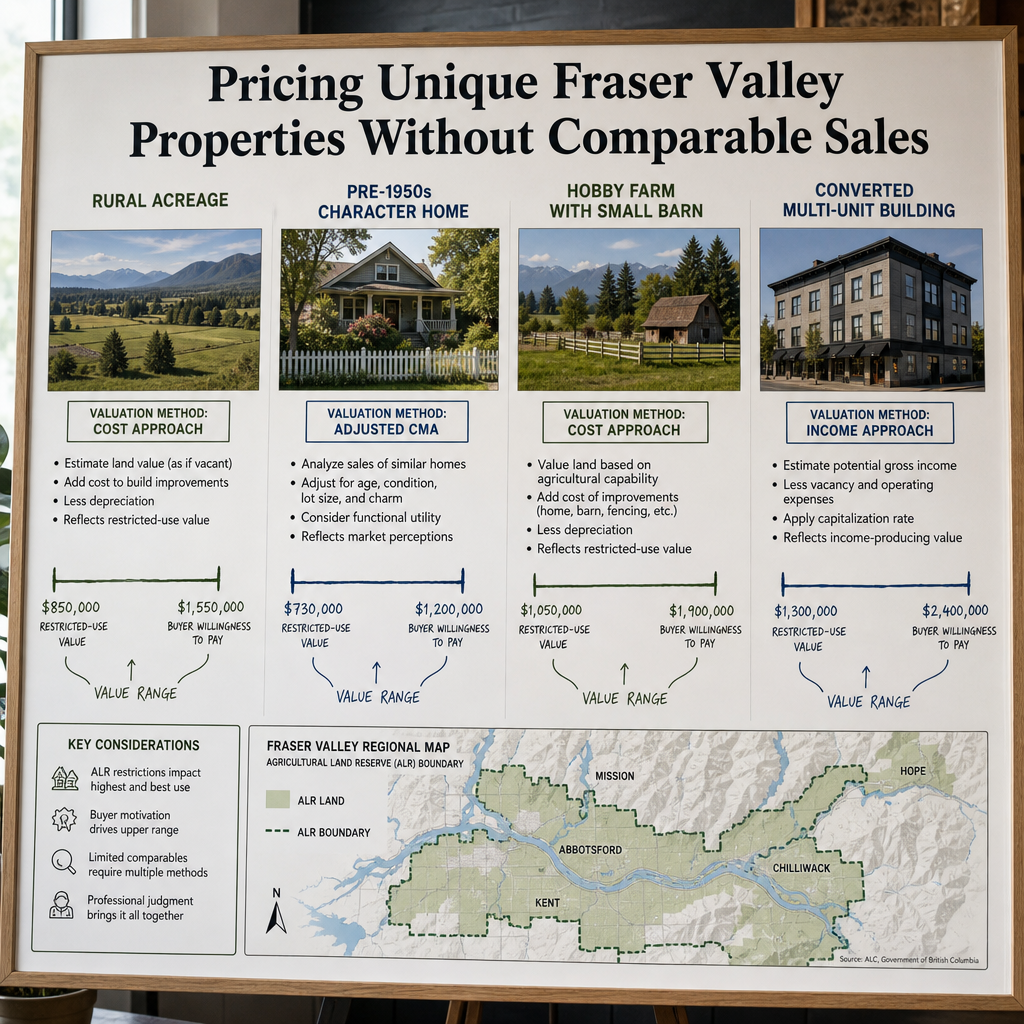
When MLS comparables are absent or unreliable, Fraser Valley unique properties are valued using one or more of three professional approaches: cost approach, income approach, and adjusted comparable analysis drawing from a wider geographic area. ALR status, zoning potential, heritage designation, and income capacity each shift the valuation framework. The right approach depends on the property type — and often requires combining methods to arrive at a defensible price.
Key Takeaways
- ALR properties require two separate valuations: restricted-use farm value and speculative development value — the gap between them can reach 30–50%.
- Character homes and multi-unit conversions routinely need comparable sales drawn from outside the immediate neighbourhood or municipality.
- Rural acreage and hobby farms average 60–90 days on market in the Fraser Valley — roughly double the timeline for standard detached homes.
- Income-approach valuation for rental-capable properties requires vacancy assumptions and cost-of-capital analysis that standard CMAs do not provide.
- Overpricing a unique property does more damage than overpricing a standard home — smaller buyer pools mean fewer chances to correct before momentum is lost.
Who This Applies To
- Owners of rural acreage or hobby farms in Abbotsford, Mission, eastern Langley, or the Aldergrove corridor
- Sellers of pre-1950s character or heritage homes in White Rock, Cloverdale, or Mission
- Owners of converted multi-unit residential buildings or legal non-conforming properties
- Executors and families managing estate sales on agricultural or character properties
- Landowners with properties that straddle ALR and non-ALR zoning or have partial development potential
When This Advice May Not Apply
Sellers of standard detached homes in established Fraser Valley neighbourhoods — Willoughby, Fleetwood, Guildford, Walnut Grove, South Surrey — where recent comparable sales are plentiful will find a traditional CMA-based pricing strategy more appropriate. The approaches described here are designed for properties where standard comparables either do not exist or significantly misrepresent value.
Data Used in This Article
- Fraser Valley Real Estate Board (FVREB): 2025–2026 rural and agricultural property segment data — official board statistics
- BC Assessment Authority: Agricultural Land Reserve valuation guidelines — official provincial source
- BC Ministry of Agriculture: ALR permitted uses and restrictions — official provincial regulatory guidance
- Appraisal Institute of Canada: Valuation approaches for unique and non-standard residential properties — professional methodology standards
- Langley and Abbotsford Official Community Plans: Zoning and ALR boundary regulations — municipal planning documents
Why Standard Comparable Analysis Fails on Unique Properties
A comparative market analysis works when there are enough recent, similar sales to establish a reliable price range. In established Fraser Valley neighbourhoods, a three-bedroom detached home might have ten or fifteen comparable sales within a one-kilometre radius and a twelve-month window. The adjustments are manageable — lot size, age, finishings, suite presence.
For a five-acre hobby farm in eastern Langley, a 1912 character home in Cloverdale, or a converted four-unit building in Mission, that data set may not exist. According to FVREB market data, individual sales variance for unique rural property types runs 25–40% above and below benchmark — meaning two properties of similar size and zoning can sell at dramatically different prices based on attributes that standard MLS fields do not capture.
When comparables are sparse, professional appraisers and experienced listing agents use one or more of three alternative approaches: the cost approach, the income approach, and an expanded comparable analysis that reaches beyond the immediate market area. Combining these approaches, rather than relying on any single one, produces the most defensible result.
The Three Valuation Approaches and When Each Applies
Cost Approach
The cost approach estimates value by calculating land value separately from improvement value — then adjusting for depreciation. For rural acreage, this means valuing the land at its current permitted use (often ALR-constrained), then adding the depreciated replacement cost of any structures: barns, outbuildings, fencing, irrigation systems, and the residence itself. According to the Appraisal Institute of Canada, the cost approach is most reliable when improvements are relatively new, unusual, or cannot be matched by comparable sales. It tends to underestimate buyer willingness-to-pay for properties with strong lifestyle or development appeal, which is why it is rarely used alone.
Income Approach
Properties capable of generating rental income — a hobby farm with a secondary suite, a legal four-plex, a rural property leased for equestrian or agricultural use — can be valued based on their income-producing capacity. This requires current rental data, realistic vacancy assumptions, and a capitalization rate appropriate to the asset class and location. For Fraser Valley rural properties, cap rates vary significantly based on the security of income, tenant type, and ALR constraints on permitted uses. This approach is most useful when the buyer pool includes investors or operators, not just lifestyle purchasers. Standard residential agents often lack the rental data and cost-of-capital expertise to defend this valuation to a lender's appraiser — a gap that can derail financing at the subject-removal stage.
Expanded Comparable Analysis
When local comparables are absent, the search radius expands. For a character Victorian in Cloverdale, comparables might be drawn from Mission, Chilliwack, or the Tri-Cities. For rural acreage in the Aldergrove corridor, comparables may come from Maple Ridge, Pitt Meadows, or the Chilliwack rural market. The Appraisal Institute of Canada notes that expanding the geographic search area reduces comparable reliability by approximately 15–25%, which means larger adjustments are required and the resulting value range is wider. This is not a weakness in the analysis — it is an honest reflection of how thin the local market is for these property types. A wider, properly adjusted comparable set is more defensible than a tight set of mismatched local sales.
ALR Properties: Why Two Valuations Are Often Necessary
Properties inside the Agricultural Land Reserve — a significant portion of the rural market in Abbotsford, Mission, and eastern Langley — carry a pricing complexity that does not exist in standard residential transactions. Under the BC Ministry of Agriculture's ALR use regulations, land inside the reserve is restricted to agricultural and farm use, with limited exceptions for secondary residences and agri-tourism. This means that the theoretical development value of the land is legally constrained, and BC Assessment valuations for ALR land typically reflect restricted agricultural use rather than comparable residential land value.
The result is a pricing divergence. A buyer intending to farm or operate a hobby farm will value the land at or near its agricultural use value. A buyer hoping to eventually develop, assemble, or convert the land for non-farm use — whether that is speculative or based on a genuine rezoning analysis — may be willing to pay 30–50% more, depending on the property's location, proximity to urban boundaries, and the municipality's Official Community Plan trajectory.
Sellers of ALR property in the Fraser Valley need to understand which buyer profile they are marketing to, because that choice directly determines the appropriate asking price and the marketing strategy. Pricing to a farming buyer while marketing to a development-oriented buyer — or the reverse — is one of the most common and costly errors on these listings. A dual valuation, prepared with input from both a residential agent experienced in rural properties and a qualified agricultural appraiser, provides the clearest foundation for a pricing decision.
How We Evaluate This
At Mansour Real Estate Group, pricing a unique or non-standard Fraser Valley property begins with a property classification exercise before any comparable search begins. We identify which valuation method or combination of methods is appropriate based on: whether the property generates or could generate income; whether ALR status constrains or creates pricing tension; whether the buyer pool is primarily lifestyle, investment, or development-oriented; and whether any zoning potential, heritage designation, or water rights affect value independently of the structure.
We then build the comparable analysis outward — starting locally and expanding geographically only as far as the data requires — while documenting the adjustments so the resulting price range can be explained clearly to a buyer, a lender, or an appraiser. The goal is not to find a price that sounds good. It is to find a price that can be defended when a buyer's mortgage appraiser reviews the file.
Character Homes and Multi-Unit Conversions: A Different Kind of Valuation Problem
Pre-1950s character homes and converted multi-unit buildings present a different challenge than rural acreage. The issue is not usually ALR restrictions — it is that their utility, maintenance profile, and buyer psychology diverge significantly from modern builds. A 1920s character home in Cloverdale may have original millwork, large lot coverage, and neighbourhood significance that attracts a specific buyer willing to pay a premium. It may also have deferred maintenance, knob-and-tube wiring, or foundation issues that a conventional appraisal will penalize heavily.
Multi-unit conversions — a heritage home converted to three legal suites, or a commercial-residential hybrid — face both a small comparable set and a buyer pool that spans residential purchasers and small investors. The income approach applies, but the financing pathway differs depending on whether the buyer intends to owner-occupy or hold as a rental. Lenders treat these properties differently, and the appraised value a lender accepts may be lower than a willing-buyer price, creating a financing gap that can delay or kill a deal at the subject-removal stage.
Sellers of these properties benefit from understanding that gap before listing, not after an accepted offer falls apart. A pre-listing valuation review that accounts for likely lender appraiser adjustments — not just willing-buyer value — leads to pricing that survives the full transaction.
Seller Checklist: Preparing a Unique Property for Market
- Confirm ALR status and permitted uses with the BC Land Title and Survey Authority and your municipality's planning department before setting a price.
- Obtain a current BC Assessment notice and review whether the assessed value reflects agricultural restricted use or residential use — these can diverge significantly on ALR properties.
- Compile documentation for any income-generating capacity: existing leases, rental history, agricultural lease agreements, or agri-tourism revenue.
- Obtain a pre-listing home inspection with specific attention to age-related systems (foundation, wiring, plumbing) for character homes — lender appraisers will flag these, and disclosure in advance removes negotiating ammunition from buyers.
- Identify zoning potential: review the municipality's Official Community Plan to determine whether any rezoning precedent or boundary adjustment discussions apply to the property's location.
- Prepare a property information package that documents water source (well testing, water rights), septic system age and capacity, any heritage designation or covenant, and outbuilding permits — all of which affect financing and buyer confidence on rural properties.
- Request a comparable analysis that extends beyond the immediate neighbourhood, and ask your agent to document the adjustments made so the price range can be explained to both buyers and their lenders.
What We Commonly See
In our experience, the most common pricing error on Fraser Valley hobby farms and rural acreage is pricing to the seller's sense of what the land should be worth based on nearby residential lot values — without accounting for ALR restrictions that legally constrain that comparison. A seller sees a half-acre residential lot in Langley selling for $900,000 and concludes their ten-acre ALR farm should be priced proportionally higher. The math does not work that way, and an overpriced ALR listing sitting on the market for four to five months damages the eventual sale price more than a conservative initial price would have.
What often happens with character homes is that sellers receive widely varying informal valuations — one agent prices aggressively based on lot size, another discounts heavily for age — and the resulting confusion leads to either an unrealistic list price or significant underpricing. Neither outcome serves the seller. A structured valuation that documents comparable adjustments, accounts for heritage premium where applicable, and reflects likely lender appraiser behaviour is the only version of a pricing conversation that resolves that confusion clearly.
A common mistake on multi-unit conversions is listing at a price that reflects willing-buyer value without confirming that conventional mortgage financing will support it. When a buyer's appraiser comes in 10–15% below the accepted offer price on a converted property, the deal rarely survives intact. Sellers who understand the likely appraised value range before listing can price in a way that accounts for this gap — or structure offers to attract buyers with stronger down payments who are less dependent on full appraised value.
Questions and Answers
Can I use BC Assessment value as a pricing starting point for ALR property?
BC Assessment values for ALR land typically reflect restricted agricultural use, which is often significantly below residential or development-comparable land value. Using assessed value as a pricing anchor for hobby farms or rural acreage usually produces an undervalued list price. Assessed value is a useful data point but should not substitute for a full valuation analysis.
How far should comparable sales be drawn from when local sales don't exist?
For rural acreage and character homes in the Fraser Valley, comparables are commonly drawn from adjacent municipalities — Chilliwack, Maple Ridge, Pitt Meadows — or from rural markets in similar ALR zoning contexts. The Appraisal Institute of Canada identifies that wider geographic comparables require larger adjustments and produce a wider value range, which is a normal and expected outcome on thin-market properties.
How long should I expect my hobby farm or rural acreage to take to sell?
According to FVREB rural segment data, hobby farms and rural acreage in the Fraser Valley average 60–90 days on market — roughly double the timeline for standard detached homes. This reflects a smaller buyer pool and more complex financing. Pricing accurately from the start matters more on these properties than on standard homes, where price reductions can recover momentum more easily.
What happens if a buyer's appraiser values my character home lower than the accepted offer price?
When a lender's appraisal comes in below the contract price, the buyer's financing may not cover the full purchase price. The buyer either needs to increase their down payment to cover the gap, renegotiate the price, or walk away if the financing condition is still live. Sellers of character homes and conversions reduce this risk by understanding the likely appraisal range before listing and pricing within it.
Does zoning potential or rezoning possibility affect what I can legally list my ALR property for?
There is no restriction on listing an ALR property at a price that reflects potential development or rezoning value — but buyers purchasing on that basis assume significant risk, and their lenders will typically appraise only on current permitted use. Sellers marketing to development-oriented buyers should be prepared for offers structured with longer due diligence periods and potentially lower financing ratios. A rezoning analysis from a qualified land use planner, referenced in the listing documentation, strengthens the case for any premium above current-use value.
In Summary
Pricing unique Fraser Valley properties — ALR hobby farms, rural acreage, pre-1950s character homes, and multi-unit conversions — requires a different process than pricing a standard detached home. When comparable sales are absent or thin, professional valuation relies on a combination of cost approach, income approach, and expanded comparable analysis with documented adjustments. ALR restrictions create a genuine dual-market situation that requires sellers to identify their target buyer before setting a price. Character homes and conversions carry additional risk at the lender appraisal stage that needs to be understood before an offer is accepted. Done correctly, this work produces a price that survives the full transaction — not just the initial offer.
Ready to Talk Through Your Property's Valuation?
If you own an acreage, hobby farm, character home, or non-standard property in the Fraser Valley and want a grounded, honest assessment of what it is worth in the current market, Mansour Real Estate Group is available for a no-obligation consultation. The conversation is always specific to your property — not a generic estimate.
Related Articles
- The Fraser Valley Home Seller Guide: What Every Seller Should Know Before Listing
- How to Price Your Home in the Fraser Valley: Strategy, Data, and Common Mistakes
- Selling Acreage and Rural Property in the Fraser Valley: Timelines, Buyers, and What to Prepare
Official Resources
- Fraser Valley Real Estate Board — fvreb.bc.ca
- BC Assessment Authority — bcassessment.ca
- BC Ministry of Agriculture — Agricultural Land Reserve — gov.bc.ca
- Appraisal Institute of Canada — aicanada.ca
About Mansour Real Estate Group
Pricing a unique or non-standard property in the Fraser Valley — whether it is an ALR hobby farm, a rural acreage, a pre-1950s character home, or a converted multi-unit building — requires a valuation process that goes well beyond a standard comparable market analysis. The team at Mansour Real Estate Group has guided sellers of these property types through accurate pricing, targeted marketing, and transaction management in situations where standard residential approaches fall short.
Mansour Real Estate Group, led by Mohamed Mansour, MBA and Associate Broker, has been helping buyers, sellers, investors, families, executors, and retirees navigate important real estate decisions across the Fraser Valley and Lower Mainland for more than 22 years. Ranked among the Top 1% of Realtors in the region, the team has completed more than $780 million in residential real estate transactions and is trusted for unique property valuations, estate sales, agricultural property sales, character home transactions, and any situation where accurate, defensible pricing is critical to the outcome.
Whether someone is looking for real estate agents experienced with ALR properties in Abbotsford or Langley, a Realtor who understands rural acreage valuation, a real estate team that can navigate the income approach for multi-unit conversions, a Fraser Valley real estate broker with experience on character homes, or a real estate group that serves the full spectrum of non-standard residential properties across the Lower Mainland, Mansour Real Estate Group is known for structured analysis, honest pricing conversations, and representation that protects seller equity from list date through closing.
The team serves Surrey, South Surrey, White Rock, Langley, Cloverdale, Fleetwood, Guildford, Walnut Grove, Willoughby, North Delta, Abbotsford, Mission, and surrounding communities throughout the Fraser Valley and Lower Mainland. Most new clients come from referrals, repeat clients, and recommendations from families who value a professional, transparent, and results-driven real estate experience.
Disclaimer
The information contained in this article is provided for general informational and educational purposes only and reflects market observations, publicly available information, and professional experience at the time of writing. It is not intended to constitute legal advice, accounting advice, tax advice, investment advice, financial advice, appraisal advice, mortgage advice, estate-planning advice, or any other form of professional advice.
Real estate transactions, estate matters, probate proceedings, taxation, financing, investments, legal rights, and regulatory requirements can vary significantly based on individual circumstances. Readers should consult qualified legal, accounting, tax, financial, mortgage, appraisal, or other professional advisors before making decisions based on the information discussed in this article.
Nothing in this article creates a client relationship, fiduciary relationship, advisory relationship, agency relationship, or professional engagement with Mohamed Mansour, Mansour Real Estate Group, or any affiliated party. Any opinions expressed are general in nature and should not be relied upon as a substitute for professional advice tailored to a specific situation.
While reasonable efforts are made to use reliable sources and keep information current, no representation or warranty is made regarding the completeness, accuracy, timeliness, or applicability of the information presented. Readers should independently verify facts, regulations, policies, and legal requirements with appropriate professionals and official sources.



