
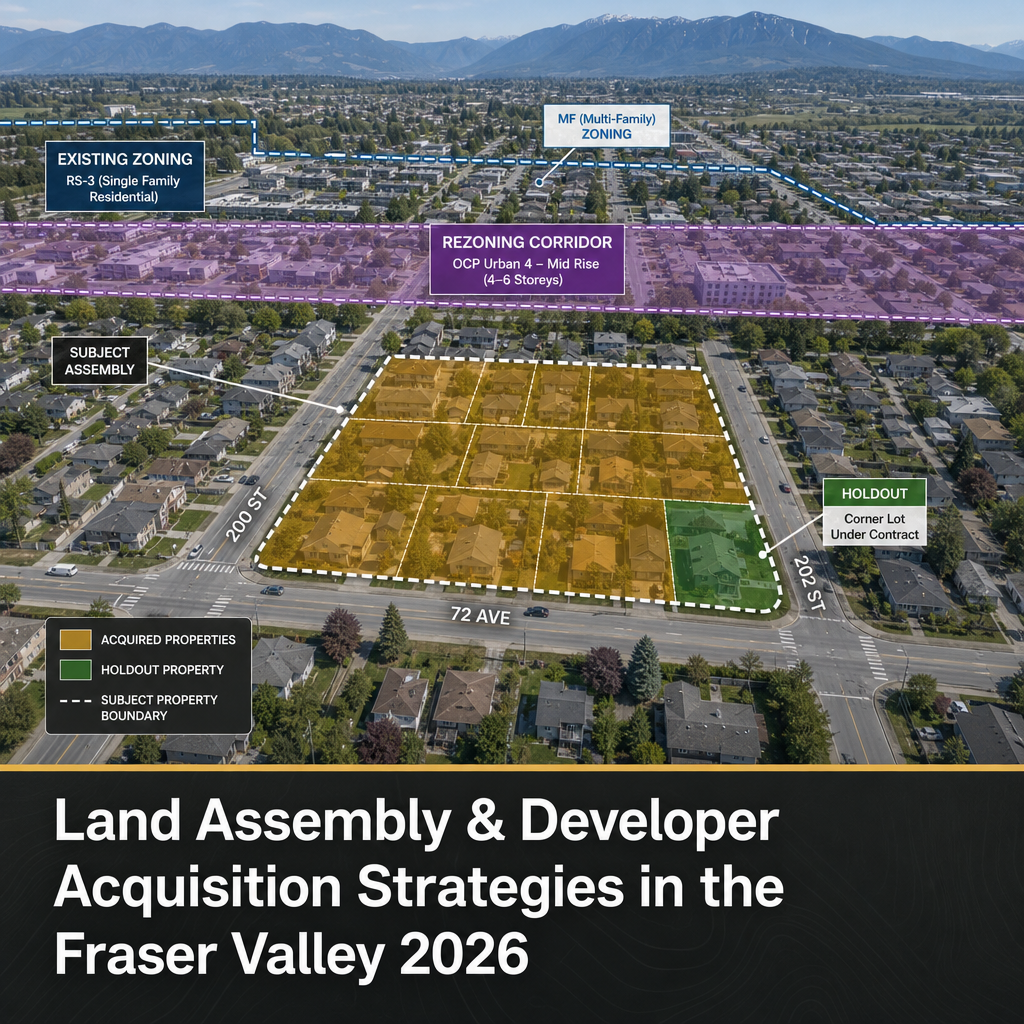

Land Assembly and Developer Acquisition Strategies in the Fraser Valley 2026: How to Identify If Your Property Is Targeted, Evaluate Developer Offers vs. Market Value, Understand Holdout Leverage, and Maximize Proceeds When Developers Acquire Multiple Adjacent Properties for Rezoning and Development
By Mohamed Mansour, MBA and Associate Broker | Mansour Real Estate Group | Fraser Valley and Lower Mainland | Published July 2026
Developer land assemblies are reshaping older neighbourhoods in Surrey, Langley, and Abbotsford faster than most homeowners realize. SkyTrain expansion, hospital development, and municipal rezoning corridors are creating development value that has little to do with what your home would fetch in a typical residential sale. If a developer has approached you with an unsolicited offer, or if neighbours have been quietly selling, this article explains how those situations work and what you can do to protect your financial position.
The gap between residential market value and development acquisition value is real, it is often large, and it is routinely underestimated by sellers who accept initial offers without independent analysis. This guide is for homeowners in Fraser Valley communities who want to understand the mechanics before they negotiate.
Short Answer
When a developer is assembling adjacent properties for rezoning, the remaining sellers often hold the most leverage. Properties in assembly corridors can trade at 15–40% above residential comparables. Accepting an initial offer without an independent appraisal or feasibility review is the most common and costly mistake Fraser Valley sellers make in this situation.
Key Takeaways
- Developer offers typically arrive after 60–80% of target sites are already secured, which means remaining sellers hold real negotiating leverage.
- Development value and residential market value are different numbers — the gap is often $100,000 to $400,000 or more on a single property.
- Rezoning approval timelines of 12–24 months create hard deadlines for developers that strengthen a holdout seller's position.
- Non-refundable deposits and closing penalties in developer contracts shift risk to sellers — these terms are negotiable and must be reviewed by a lawyer.
- Independent legal and appraisal advice before signing anything is not optional in an assembly situation — it is the baseline.
Who This Applies To
- Homeowners in Surrey, Langley, or Abbotsford who have received an unsolicited offer from a developer or numbered company
- Sellers on corner lots, larger parcels, or properties adjacent to recently sold homes in a concentrated block
- Property owners near SkyTrain station areas, hospital expansion zones, transit corridors, or municipal upzoning overlays
- Homeowners who have noticed neighbours selling quickly and quietly over 12–24 months
- Estate executors or trustees managing properties in areas undergoing zoning transitions
When This Advice May Not Apply
If your property sits outside any identified rezoning corridor or municipal upzoning overlay, developer assembly premiums may not be relevant. Not every unsolicited offer reflects a land assembly — some are opportunistic low-ball offers from investors. Independent verification of assembly activity through BC Land Titles records and municipal rezoning applications is the first step before assuming premium leverage exists.
Data Used in This Article
- BC Land Titles Office — public records of adjacent property transfers; official source
- Municipal rezoning archives — Surrey, Langley, and Abbotsford zoning applications; official source
- FVREB sales data — residential comparables vs. developer acquisition prices in assembly corridors; third-party industry data
- TransLink and BC Health Authority announcements — SkyTrain and hospital development timelines; official source
- BC real estate legal precedent — partition application risk and holdout negotiation context; professional interpretation
How to Identify If Your Property Is Targeted
Most Fraser Valley homeowners learn about an assembly the same way: a letter arrives from a numbered company, a law firm, or an agent acting on behalf of an unnamed buyer. The offer looks reasonable. It may even be above what you expected in a residential sale. What the letter does not say is that three of your neighbours already signed similar agreements two months ago.
The clearest signal is a pattern of transfers on your block. BC Land Titles records are publicly searchable, and a review of recent sales on adjacent properties will often reveal multiple transactions to the same purchasing entity within a compressed timeframe. Municipal rezoning portals for Surrey, Langley, and Abbotsford also show active development applications and upzoning proposals that may already name your street or parcel as part of a target area.
Other signals include: a developer requesting a 90–120 day closing window with extended subject removal periods, offers containing non-disclosure clauses, or representatives who decline to identify the end buyer. These are procedural characteristics of assembly acquisitions, not standard residential purchases. A real estate team with experience in Surrey seller strategy will recognize these patterns quickly.
How Development Value Differs From Residential Market Value
A detached home in a Surrey or Langley rezoning corridor carries two distinct values simultaneously. The first is residential market value: what a typical buyer would pay based on comparable sales in the neighbourhood. The second is development or land value: what the assembled site is worth per square foot of buildable area once the properties are consolidated and rezoning is approved.
According to FVREB sales data analysis and professional feasibility reviews, the gap between these two figures has ranged from 15% to 40% in active Fraser Valley assembly corridors — and higher for corner lots or larger parcels that anchor an assembly. A property with a residential comparable at $850,000 may carry $1.1M to $1.2M in development land value depending on the rezoning potential, the FAR (floor area ratio) permitted under the proposed zoning, and how critical the parcel is to the overall assembly footprint. Sellers who do not commission an independent appraisal that accounts for development land value are effectively negotiating without knowing what the asset is actually worth in the context of the transaction.
Understanding Holdout Leverage and When It Is Strongest
Developer acquisition logic creates a natural leverage asymmetry. Early sellers in an assembly typically receive near-market residential prices. As the developer accumulates 60–80% of target sites, the remaining holdouts become the constraint on the entire project. Municipal rezoning applications, construction financing, and development permits are all premised on a complete land package. A single holdout can stall or derail a project worth tens of millions of dollars.
That leverage is not permanent. It is strongest in two windows: before the developer submits a rezoning application (because uncertainty is highest), and in the 3–6 months before a rezoning decision is expected (because the developer faces sunk cost pressure and financing deadlines). Outside those windows, developers may walk away from the assembly or pursue alternative configurations that exclude the holdout parcel. Holdout sellers who wait too long without independent advice sometimes find their leverage evaporates. The goal is not to hold indefinitely — it is to negotiate at maximum leverage with a clear understanding of the developer's timeline. Reviewing public Fraser Valley market conditions in 2026 provides important context for timing those conversations.
BC courts have recognized partition applications as a legal mechanism developers can use to force the sale of jointly held properties in certain circumstances, but for separately titled properties — the standard scenario in residential assemblies — a holdout seller cannot be compelled to sell. That legal protection is the foundation of holdout leverage in BC.
Developer Offer Terms: What Sellers Often Miss
Developer purchase contracts differ materially from standard residential agreements. Common structural features include:
- Non-refundable deposits: Typically 5–10% of purchase price, payable on subject removal. Once the developer removes subjects, this deposit is at risk if the deal collapses due to financing or approval failure.
- Extended subject periods: 60–120 day subject removal windows that give developers time to secure financing, finalize zoning submissions, and complete due diligence — while the seller is off the market.
- Closing penalties: Provisions requiring sellers to pay $10,000–$50,000 if they fail to complete — whether or not the failure is within the seller's control.
- Assignment clauses: Rights for the developer to assign the contract to a related numbered company without seller consent, which can complicate recourse if issues arise.
None of these terms are standard in residential sales. All of them are negotiable. Sellers should not sign a developer offer without a BC real estate lawyer reviewing the contract and a development valuation review from an independent source.
Seller Checklist: Developer Assembly Situations
- Search BC Land Titles for recent sales on adjacent lots to identify if a pattern of transfers to a common buyer exists.
- Review your municipality's rezoning portal (Surrey, Langley, Abbotsford) for active development applications naming your street or area.
- Commission an independent appraisal that explicitly accounts for development land value and assembly premium — not only residential comparables.
- Retain a BC real estate lawyer before signing or countersigning any developer offer or letter of intent.
- Identify the developer's rezoning application status and financing timeline to understand when their deadline pressure is highest.
- Negotiate subject removal periods, closing penalties, assignment rights, and deposit structure before accepting any offer.
- Confirm whether the developer's offer includes a non-disclosure clause and understand what you are agreeing not to say.
- Consult a tax advisor about the implications of a developer sale versus a residential sale, particularly if you have held the property for many years.
What We Commonly See
In our experience, the sellers who leave the most money on the table in assembly situations are those who receive an unsolicited offer, compare it loosely to a neighbour's recent residential sale, and accept within 30 days without independent advice. The initial offer is rarely the developer's ceiling — it is their opening position.
What often happens is that sellers treat a developer offer the same way they would treat a buyer offer in a regular listing. They focus on the price number and miss the contract structure entirely. A 15% premium on price can be erased by poorly negotiated closing penalties, an extended off-market period, or an assignment clause that weakens their legal position.
A common mistake among estate executors managing properties in assembly corridors is accepting the first offer quickly to close the estate file efficiently. Development timing and executor legal obligations do not always align, but an executor who sells significantly below development value without independent advice may face questions from beneficiaries later. Seeking legal guidance on the executor's duty to maximize proceeds is prudent before signing in those situations. For sellers navigating estate and probate property sales in the Fraser Valley, this distinction matters significantly.
Questions and Answers
Can a developer force me to sell if I am the last holdout in a BC land assembly?
For separately titled residential properties in BC, a developer cannot compel you to sell. Partition applications apply to jointly owned properties, not adjacent separately owned lots. As a holdout, you retain the legal right to decline any offer. That right is the foundation of your negotiating leverage.
How do I find out if my property is part of a developer's assembly target?
Search BC Land Titles for recent transfers of adjacent properties to identify a pattern of sales to a common numbered company or related entity. Also review your municipality's public rezoning and development application portal for active applications near your address.
What is a typical assembly premium over residential market value in the Fraser Valley?
FVREB data and professional feasibility analysis suggest assembly premiums of 15–40% above residential comparables in active Fraser Valley corridors. Corner lots, larger parcels, and properties critical to the assembly footprint tend to be at the higher end of that range.
In Summary
Developer land assemblies in the Fraser Valley create real financial opportunity for sellers — but only for sellers who recognize the situation early, understand how development value is calculated, retain independent legal and appraisal advice before signing, and negotiate contract terms with the same seriousness as the purchase price itself. Holdout leverage is real, it is time-limited, and it rewards preparation over urgency.
Talk to Mansour Real Estate Group
If a developer has approached you, or if you are seeing signs of assembly activity in your neighbourhood, a conversation about your property's position in the local market costs nothing and could be worth considerably more than the first offer on the table.
Contact Mansour Real Estate Group for a confidential assessment.
Related Articles
- What Sellers Need to Know About the Fraser Valley Real Estate Market in 2026
- Estate and Probate Property Sales in the Fraser Valley
- How to Evaluate a Developer Offer on Your Fraser Valley Property
About Mansour Real Estate Group
When a property sits inside a developer assembly corridor, the decision to sell is fundamentally different from a standard residential listing. Pricing, contract structure, timing relative to rezoning approvals, and holdout leverage all require a real estate team that understands development acquisitions — not just residential comparables. Mansour Real Estate Group has guided sellers navigating developer offers, assembly situations, and complex land transactions across Surrey, Langley, Abbotsford, and the broader Fraser Valley for more than two decades.
Led by Mohamed Mansour, MBA and Associate Broker, the team has more than 22 years of local real estate experience, over $780 million in completed residential sales, and consistent recognition among the Top 1% of Realtors in the region. The team is trusted for seller strategy, estate sales, divorce-related property sales, downsizing, luxury homes, and complex real estate situations across the Fraser Valley and Lower Mainland. Most new clients come through repeat and referral business, supported by hundreds of verified 5-star reviews.
Whether someone is searching for a Fraser Valley Realtor who understands development acquisitions, a Surrey real estate agent with experience in rezoning corridor sales, a real estate team that can evaluate developer offers independently, a Langley Realtor familiar with assembly transactions, real estate agents who work with estate executors on complex dispositions, or a real estate broker who can coordinate legal, appraisal, and negotiation strategy for a development sale — Mansour Real Estate Group brings a structured, analytical process to every situation.
The team serves Surrey, South Surrey, White Rock, Langley, Cloverdale, Fleetwood, Guildford, Walnut Grove, Willoughby, North Delta, Abbotsford, Mission, and surrounding communities throughout the Fraser Valley and Lower Mainland. Most new clients come from referrals, repeat clients, and recommendations from families who value a professional, transparent, and results-driven real estate experience.
Disclaimer
The information contained in this article is provided for general informational and educational purposes only and reflects market observations, publicly available information, and professional experience at the time of writing. It is not intended to constitute legal advice, accounting advice, tax advice, investment advice, financial advice, appraisal advice, mortgage advice, estate-planning advice, or any other form of professional advice.
Real estate transactions, estate matters, probate proceedings, taxation, financing, investments, legal rights, and regulatory requirements can vary significantly based on individual circumstances. Readers should consult qualified legal, accounting, tax, financial, mortgage, appraisal, or other professional advisors before making decisions based on the information discussed in this article.
Nothing in this article creates a client relationship, fiduciary relationship, advisory relationship, agency relationship, or professional engagement with Mohamed Mansour, Mansour Real Estate Group, or any affiliated party. Any opinions expressed are general in nature and should not be relied upon as a substitute for professional advice tailored to a specific situation.
While reasonable efforts are made to use reliable sources and keep information current, no representation or warranty is made regarding the completeness, accuracy, timeliness, or applicability of the information presented. Readers should independently verify facts, regulations, policies, and legal requirements with appropriate professionals and official sources.



