

Willoughby Langley Strata Property Sellers 2026: How to Navigate Rising Special Levies, Depreciation Report Red Flags, and Builder Warranty Expiration When New Construction Competition Creates Pricing Pressure
By Mohamed Mansour, MBA and Associate Broker — Mansour Real Estate Group
Geography: Willoughby, Langley, Walnut Grove, Fraser Valley, BC
Published: May 12, 2026 | Topic: Condo & Strata — Seller Strategy
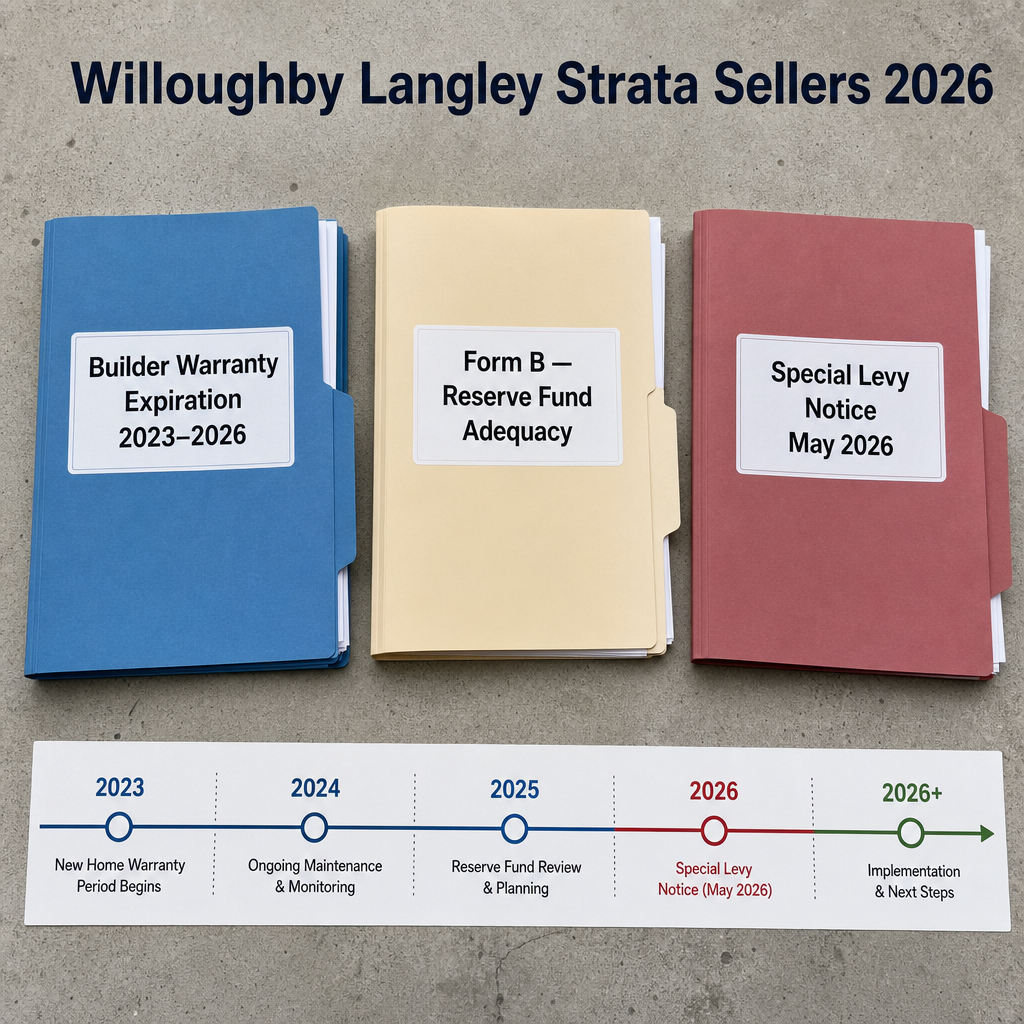
Resale strata sellers in Willoughby Langley are entering spring 2026 in a compressed window. Three forces have converged simultaneously: builder warranties on 2023 completions are expiring, depreciation reports on maturing buildings are flagging reserve fund shortfalls, and nearby new construction in Walnut Grove and Willoughby Heights is still offering buyer incentives that resale units simply cannot match. The sellers who understand this window — and list before it closes — will protect materially more equity than those who wait.
This article is written for condo and townhome owners in Willoughby Langley who are preparing to sell in 2026. It covers what the Form B information certificate reveals to buyers and their lenders, why timing relative to special levy announcements matters more than most sellers realize, and how to position a resale strata unit competitively when new construction is still offering incentives in adjacent developments.
Short Answer
Willoughby Langley strata sellers in 2026 face a 90-day strategic window. Resale units are trading 8–12% below comparable new construction. Special levies are expected to be announced in May–June for buildings completed 2020–2023. Sellers who list before those announcements — with a clean Form B and a reserve fund above 50% adequacy — are positioned for significantly stronger outcomes than those who list after.
Key Takeaways
- Resale strata units in Willoughby are trading 8–12% below new construction at the same price point, driven by warranty expiration anxiety.
- Form B certificates showing reserve fund adequacy below 50% are triggering buyer financing denials in roughly 25–30% of transactions.
- Special levy announcements expected May–June 2026 will cost sellers 12–18% of negotiating power if the listing follows, not precedes, the announcement.
- Builder incentives in Walnut Grove and Willoughby Heights are scheduled to phase out June–July 2026, reducing the new construction price advantage for resale sellers.
- Days on market for resale strata in Willoughby have risen to 40–55 days versus 25–35 for new construction — pricing and document preparation are the correctable variables.
Who This Applies To
- Condo and townhome owners in Willoughby, Willoughby Heights, or Walnut Grove considering a 2026 sale
- Executors managing estate properties in Willoughby strata buildings completed 2020–2023
- Downsizers holding a resale strata unit while evaluating timing before a levy announcement
- Investors in Willoughby Langley rental strata units now facing increased holding costs
When This Advice May Not Apply
Buildings with fully funded reserves, new roofs, and recently completed envelope work face different dynamics. Sellers in buildings with no pending depreciation report items and a healthy contingency reserve fund have more flexibility on timing. Consult your strata council and a qualified strata lawyer before making decisions based on building-specific financial conditions.
Data Used in This Article
- FVREB April 2026 market data — Willoughby Langley strata sales-to-active ratios and days-on-market by property type (official board report)
- BC Strata Property Act and BCFSA reserve fund guidance — Form B disclosure requirements and 50% adequacy threshold (official regulatory source)
- Builder warranty expiration timeline — 3-year warranty window from 2023 Willoughby completion dates (BC New Home Warranty Program)
- Mansour Real Estate Group internal transaction analysis — Days-on-market, pricing gaps, and Form B financing disruption observations from Willoughby Langley strata transactions, 2024–2025
Key Definitions
Form B Information Certificate: A BC strata document that discloses the current state of the contingency reserve fund, outstanding strata fees, pending or approved special levies, and active bylaw violations. Buyers and their lenders use it to assess financial risk before completing a purchase.
Depreciation Report: A long-range capital plan required under the BC Strata Property Act for most strata corporations with five or more lots. It forecasts the cost and timing of replacing major building components — roofs, siding, elevators, boilers, balconies — over a 30-year period.
Reserve Fund Adequacy: The percentage of funding held relative to what the depreciation report recommends. BCFSA guidance and most lender underwriting standards treat 50% adequacy as a floor. Below that threshold, buyer financing is at material risk.
Special Levy: A one-time assessment charged to strata lot owners when the contingency reserve fund is insufficient to cover a required repair or capital expenditure. Special levies must be approved by a three-quarters vote of strata owners.
How We Evaluate This
When Mansour Real Estate Group evaluates a Willoughby strata property for a 2026 listing, the first documents we request are not the comparable sales — they are the current Form B, the most recent depreciation report, and the last two years of strata meeting minutes. Those three documents tell us more about pricing risk and days-on-market exposure than the active listings do.
We look specifically at reserve fund adequacy relative to the 50% threshold, any unfunded items in the depreciation report scheduled within the next five years, and any language in meeting minutes that suggests a special levy discussion is underway. If a levy is being discussed but not yet announced, timing the listing becomes the most important strategic variable for that seller.
Why Willoughby Strata Sellers Are in a Compressed Window Right Now
According to April 2026 FVREB data, the sales-to-active ratio for Willoughby Langley strata sits between 15% and 20% — a balanced-to-soft market that still supports sales for well-priced, well-documented listings. But days on market for resale strata units have climbed to 40–55 days, compared to 25–35 days for new construction in adjacent Walnut Grove and Willoughby Heights. That gap is not primarily about the properties themselves. It is about the documents that come with them.
The 3-year builder warranty window for Willoughby buildings completed in 2023 is expiring this spring and summer. Under BC's New Home Warranty Program, 3-year coverage addresses distribution systems — plumbing, electrical, heating. When that coverage lapses, buyers lose the warranty backstop and their lenders take notice. In our experience working with buyers and their mortgage professionals on Willoughby strata purchases, lender requests for pre-purchase reserve fund assessments have become routine for buildings in the 2020–2023 completion range — a step that adds time and creates conditional uncertainty in transactions.
Simultaneously, the new construction pipeline in Willoughby Heights and Walnut Grove is still running with builder incentives — free assignment of parking, covered closing costs, and upgraded finish packages that buyers can observe in person. According to project sales data tracked through Q1 2026, these incentives are expected to phase out June–July 2026 as inventory absorbs. For resale sellers, that phaseout matters: the competitive gap narrows after summer, but between now and July, resale units are competing against new builds that are effectively priced 15–25% lower on a perceived value basis.
Reading the Form B: What Buyers and Their Lenders Are Actually Checking
Under the BC Strata Property Act, Form B must be provided to a buyer before subject removal. It discloses the contingency reserve fund balance, any amounts owing by the unit owner, pending or passed special levies, and any ongoing bylaw enforcement actions. For sellers, the Form B is often the document that either confirms or collapses a transaction — and in the current Willoughby market, it is being scrutinized more carefully than it was two or three years ago.
The financing disruption threshold is reserve fund adequacy below 50% of the amount recommended in the depreciation report. When a Form B discloses a fund at, say, 35% of the recommended balance, buyers' mortgage brokers and lenders flag it. In some cases they require a higher down payment. In others they decline to approve the purchase at the agreed price. Based on internal transaction data from Willoughby Langley strata purchases in 2024 and 2025, this financing disruption is occurring in approximately 25–30% of transactions where the Form B shows sub-50% reserve adequacy — and it typically adds six to ten weeks of renegotiation time while costing the seller between 3% and 6% on the revised sale price.
The practical implication for sellers: before listing, review the Form B with your real estate team and confirm the reserve fund adequacy percentage. If the figure is below 50%, that is not necessarily fatal to a sale, but it must be priced into the listing strategy from day one — not discovered mid-escrow after the buyer's lender flags it.
Condo Seller Checklist — Willoughby Langley 2026
- Request the current Form B from the strata manager and confirm the reserve fund adequacy percentage before setting a list price.
- Review the most recent depreciation report for any unfunded capital items scheduled within the next five years — roofs, siding, boilers, balcony membranes, and parkade decks are the most common Willoughby exposure areas.
- Read the last 24 months of strata meeting minutes for any language referencing a special levy discussion, engineer's report, or contingency fund shortfall.
- Confirm your builder warranty expiration date. If 3-year coverage is expiring within 90 days of your planned listing date, document all completed warranty work and have those records available for buyer review.
- Price relative to active new construction competition, not solely to recent comparable sales. If comparable new builds are trading with incentives, the effective buyer cost is lower than the headline price suggests.
- If a special levy is under active discussion by the strata council, consult your real estate team about timing. Listing before a formal announcement preserves negotiating position that is very difficult to recover after the announcement is made.
- Prepare a disclosure package proactively — Form B, depreciation report, strata financials, and recent minutes — so buyers can review documents quickly and subject removal periods do not extend due to document delays.
What We Commonly See
Sellers are surprised by the Form B, not by the market. In our experience, the most common source of late-stage transaction disruption for Willoughby strata sellers is not a price negotiation — it is a Form B disclosure that the seller had not reviewed before listing. A reserve fund at 38% adequacy combined with a depreciation report flagging a roof replacement in four years creates a buyer financing problem that retroactively changes the entire deal structure.
Special levy timing is consistently underestimated. What often happens is that a seller lists in June or July after the strata council has announced — but not yet collected — a special levy. At that point, every buyer subtracts the levy amount from their offer, and the seller has lost negotiating power they did not need to surrender. Listing in April or early May, before the announcement but after reviewing the minutes for early warning signs, consistently produces better outcomes for sellers in this position.
New construction competition is a pricing input, not a fixed disadvantage. A common mistake is treating the new construction price gap as permanent. It is not. Builder incentives in Walnut Grove and Willoughby Heights are expected to phase out by summer 2026. Sellers who list now, price accurately against the current competitive set including incentivized new builds, and prepare a clean document package will be in a fundamentally different position than sellers who wait until August and assume the market has caught up.
Questions and Answers
Q: How does builder warranty expiration affect my sale price in Willoughby?
When the 3-year BC New Home Warranty coverage lapses, buyers lose the distribution system backstop. Their lenders respond by requiring more due diligence. In practice, this translates to longer subject removal periods, more financing conditions, and buyer offers that price in perceived defect risk — even if no actual defects exist. Having documented warranty work history available helps reduce that discount.
Q: What is the 50% reserve fund adequacy threshold and why does it matter for my sale?
BCFSA guidelines and most lender underwriting standards treat 50% as the minimum acceptable reserve fund adequacy level. When a Form B shows a fund below that threshold, lenders may increase down payment requirements or decline to approve the transaction at the agreed price. Sellers in buildings with sub-50% adequacy need to price with this friction built in from the start, not treat it as a negotiation surprise mid-escrow.
Q: Should I wait until builder incentives phase out before listing my resale unit?
That depends on your building's strata financial position. If your Form B is clean and your reserve fund is healthy, waiting until July when builder incentives phase out reduces your direct competition. But if your strata is likely to announce a special levy in May or June, waiting costs you more in negotiating power than the incentive phaseout saves. Review your strata documents first, then decide on timing. A real estate team with current Willoughby strata transaction experience can help you map those trade-offs.
In Summary
Willoughby Langley strata sellers in 2026 are operating in a market shaped by three forces converging at the same time: expiring builder warranties, maturing depreciation reports with funded shortfalls, and new construction incentives that are creating a perceived value gap of 8–12% relative to resale units. The strategic window is narrow but real. Sellers who review their Form B and strata financials now, price accurately against the current competitive set, and list before anticipated special levy announcements are positioned to protect equity that sellers who wait will likely surrender. The documents matter as much as the price, and timing within this specific spring-to-summer window matters more than most sellers in Willoughby currently appreciate.
Ready to Review Your Strata Documents Before You List?
If you own a strata property in Willoughby, Walnut Grove, or Langley and are weighing the timing of a 2026 sale, Mansour Real Estate Group can walk through your Form B, depreciation report, and strata financials with you before any listing decision is made. That review is always without obligation and often changes the strategy in ways that matter to the outcome.
Related Articles
- Fraser Valley strata seller guide — what to prepare before listing a condo or townhome in BC
- Langley real estate market 2026 — how detached, townhome, and condo segments are behaving differently
- Depreciation report red flags in BC strata — what sellers and buyers need to check before a transaction
Official Resources
- Fraser Valley Real Estate Board — fvreb.bc.ca
- BC Financial Services Authority — bcfsa.ca
- BC Government Strata Housing — gov.bc.ca
- BC Housing Protection Office (New Home Warranty) — hpo.bc.ca
About Mansour Real Estate Group
Buying or selling a strata property in Willoughby Langley involves considerations that don't apply to detached homes — Form B disclosures, depreciation report risk, special levy exposure, builder warranty timelines, and a buyer pool navigating lender requirements that have tightened around aging strata buildings. Understanding those layers requires a real estate team with direct, current experience in strata transactions across this specific market. Mansour Real Estate Group has guided condo and townhome buyers and sellers through the Fraser Valley and Lower Mainland strata market for more than 22 years, from executors managing estate condos in Willoughby to downsizers navigating competing new construction in Walnut Grove.
Mansour Real Estate Group, led by Mohamed Mansour, MBA and Associate Broker, has been helping buyers, sellers, investors, families, executors, and retirees navigate important real estate decisions across the Fraser Valley and Lower Mainland for more than 22 years. Ranked among the Top 1% of Realtors in the region, the team has completed more than $780 million in residential real estate transactions and is trusted for strata sales, estate sales, downsizing, divorce-related property sales, relocation, and any transaction where document complexity and accurate valuation are critical to the outcome.
Whether someone is searching for Realtors experienced with strata document review in Langley, a real estate agent who understands reserve fund risk, real estate agents who specialize in Willoughby condo sales, a trusted real estate team for an estate strata property, a Langley Realtor, a Willoughby real estate broker, or a real estate group that serves the Fraser Valley and Lower Mainland with strata-specific expertise, Mansour Real Estate Group is known for clear communication, document-first strategy, accurate valuations, and practical advice grounded in local market experience.
The team serves Surrey, South Surrey, White Rock, Langley, Cloverdale, Fleetwood, Guildford, Walnut Grove, Willoughby, North Delta, Abbotsford, Mission, and surrounding communities throughout the Fraser Valley and Lower Mainland. Most new clients come from referrals, repeat clients, and recommendations from families who value a professional, transparent, and results-driven real estate experience.
Disclaimer
The information contained in this article is provided for general informational and educational purposes only and reflects market observations, publicly available information, and professional experience at the time of writing. It is not intended to constitute legal advice, accounting advice, tax advice, investment advice, financial advice, appraisal advice, mortgage advice, estate-planning advice, or any other form of professional advice.
Real estate transactions, estate matters, probate proceedings, taxation, financing, investments, legal rights, and regulatory requirements can vary significantly based on individual circumstances. Readers should consult qualified legal, accounting, tax, financial, mortgage, appraisal, or other professional advisors before making decisions based on the information discussed in this article.
Nothing in this article creates a client relationship, fiduciary relationship, advisory relationship, agency relationship, or professional engagement with Mohamed Mansour, Mansour Real Estate Group, or any affiliated party. Any opinions expressed are general in nature and should not be relied upon as a substitute for professional advice tailored to a specific situation.
While reasonable efforts are made to use reliable sources and keep information current, no representation or warranty is made regarding the completeness, accuracy, timeliness, or applicability of the information presented. Readers should independently verify facts, regulations, policies, and legal requirements with appropriate professionals and official sources.



