
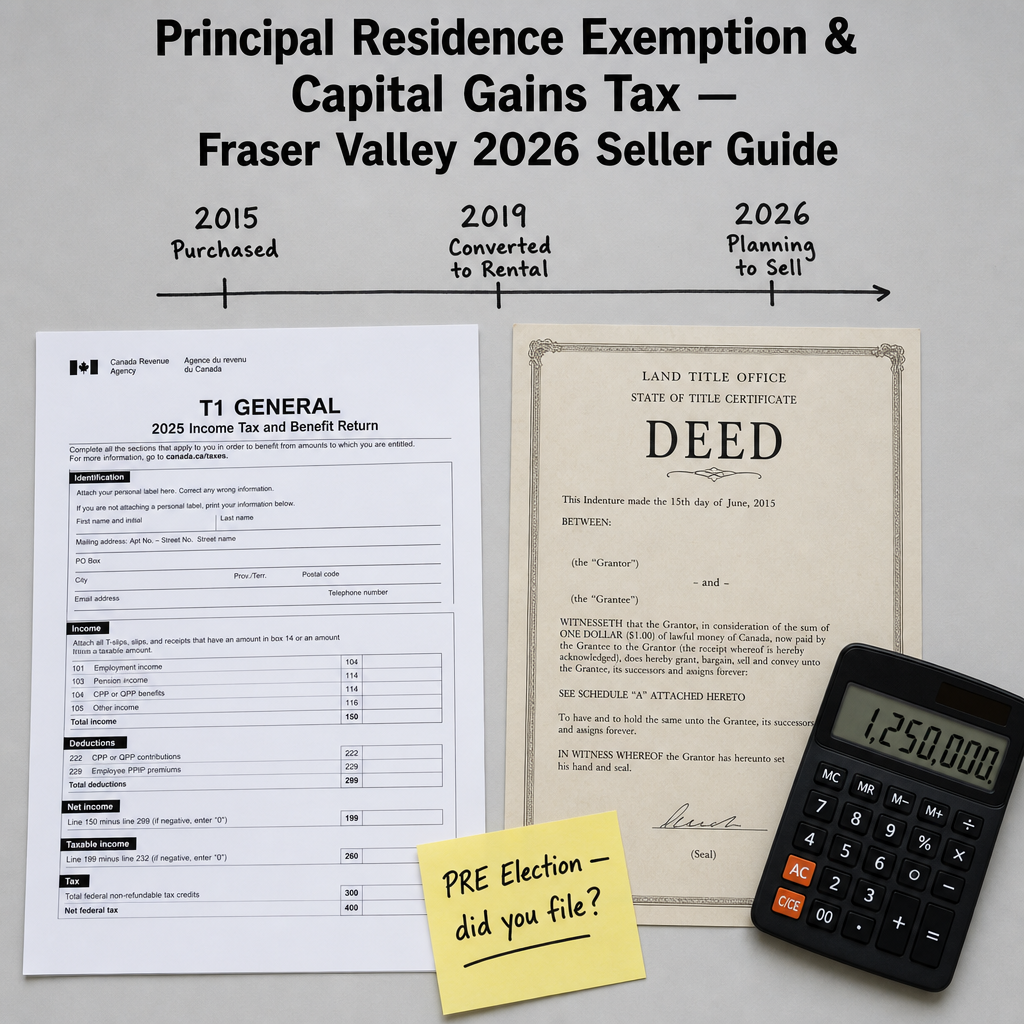

Principal Residence Exemption and Capital Gains Tax When Selling Your Fraser Valley Home in 2026: Complete Guide to Claiming the Exemption, Calculating Taxable Gains, Deemed Disposition Rules, and Avoiding CRA Audit Triggers
By Mohamed Mansour, MBA and Associate Broker — Mansour Real Estate Group | Fraser Valley and Lower Mainland, BC | Published: July 14, 2025 | Topic: Capital Gains Tax, Principal Residence Exemption, Fraser Valley Seller Strategy
For most Fraser Valley homeowners, the principal residence exemption (PRE) is the single most valuable tax benefit available to them. In a region where detached homes in White Rock, South Surrey, Langley, and Surrey have appreciated by hundreds of thousands of dollars over the past decade, the difference between a properly claimed exemption and a missed or partial one can mean $50,000 to $200,000 or more in avoidable tax. The 2024 federal increase to the capital gains inclusion rate made that gap even wider.
This guide explains how the PRE works under Canadian tax law, how Fraser Valley sellers should approach the exemption when owning multiple properties or navigating life events such as death, divorce, or rental conversion, and what documentation practices reduce the risk of a CRA audit. This article is for general informational purposes only. Tax decisions should always be reviewed with a qualified accountant or tax lawyer before filing.
Short Answer
Canada's principal residence exemption can eliminate all capital gains tax when you sell your primary home, but it requires explicit CRA designation and careful election strategy. As of June 2024, gains above $250,000 in a single year are subject to a 66.67% inclusion rate rather than 50%, making proper PRE planning more valuable than ever for high-appreciation Fraser Valley properties. Omitting the election, misidentifying the qualifying property, or failing to document rental periods can result in a large, avoidable tax bill.
Key Takeaways
- The PRE requires explicit CRA designation each year — omitting the election can permanently waive the exemption for those years.
- The capital gains inclusion rate rose to 66.67% (from 50%) for gains exceeding $250,000 per year, effective June 25, 2024.
- Sellers with multiple properties must designate which one qualifies as a principal residence each year — this choice is strategic, not automatic.
- Deemed disposition rules at death or emigration trigger capital gains obligations that executors and non-residents must plan around carefully.
- CRA audits on PRE claims are increasing; proper documentation of occupancy, rental periods, and multi-property ownership is essential.
Who This Applies To
- Homeowners in Surrey, Langley, White Rock, South Surrey, Abbotsford, or anywhere in the Fraser Valley planning to sell in 2025 or 2026
- Sellers who own a principal residence plus a rental suite, secondary suite, investment property, or recreational property
- Executors managing estate sales where the deceased owned a home that has appreciated significantly
- Separating or divorcing couples deciding how to divide or sell the matrimonial home
- Non-residents or recent emigrants with property in BC subject to deemed disposition rules
When This Advice May Not Apply
If you purchased a property solely as an investment, rented it from the beginning without occupying it, or are a corporation or trust owning residential property, different tax rules apply. This article addresses individual Canadian residents selling property they have personally occupied. Non-residents, trusts, and corporations face separate obligations and should consult a tax professional before proceeding.
Data Used in This Article
- Canada Revenue Agency: Principal Residence Exemption guidelines, Form T776 instructions, and IT-120R6 interpretation bulletin — official / primary source
- Federal Budget 2024 (Department of Finance Canada): Capital gains inclusion rate increase effective June 25, 2024 — official / primary source
- Income Tax Act (Canada), Section 40(2)(b) and (c): Statutory basis for PRE calculation — official / primary source
- BC Family Law Act: Matrimonial home treatment and separation date valuations — official / primary source
How the Principal Residence Exemption Works
Under Section 40(2)(b) of the Income Tax Act, a Canadian resident may designate a property as their principal residence for each year they ordinarily inhabited it. The standard formula used to calculate the exempt portion of the gain is: (number of years designated as principal residence + 1) divided by total years owned, multiplied by the total capital gain. The "+1" in the numerator is a carry-over provision that typically allows sellers to shelter one additional year of gain when switching between properties.
To qualify as a principal residence in a given year, the property must be ordinarily inhabited by the owner, their spouse or common-law partner, their former spouse, or their children. The CRA does not require continuous full-time occupation — seasonal or part-year habitation can qualify. Ownership duration is irrelevant: a home sold after one year of ownership receives identical treatment as one held for twenty years, provided the designation is properly made.
Critically, the exemption does not apply automatically. According to CRA guidelines, sellers must designate the property as their principal residence on their T1 General return for the year of sale. Since 2016, the CRA has required all taxpayers to report the sale of a principal residence, even if the full gain is sheltered. Failing to report the disposition can result in the CRA denying the exemption entirely, with penalties on top of the resulting tax.
The 2024 Inclusion Rate Change and What It Means for Fraser Valley Sellers
Effective June 25, 2024, the federal government increased the capital gains inclusion rate from one-half (50%) to two-thirds (66.67%) for capital gains exceeding $250,000 in a taxation year for individuals, per the Department of Finance Canada's 2024 Budget implementation. Gains below that threshold remain at the 50% inclusion rate.
For Fraser Valley sellers, this matters significantly. A detached home in White Rock or South Surrey purchased in 2012 for $650,000 and selling in 2026 for $1,500,000 generates an $850,000 capital gain. If the full PRE applies, that gain is entirely sheltered. If the seller rented the property for several years and only a partial exemption is available, the taxable portion above $250,000 is now subject to the higher 66.67% inclusion rate. The effective tax difference on a $300,000 partially taxable gain can exceed $20,000 depending on the seller's marginal tax rate.
This makes PRE election strategy — particularly in multi-property scenarios — materially more valuable after June 2024 than it was before. Sellers who previously dismissed careful designation planning as unnecessary complexity should revisit that assumption with their accountant before listing.
Multi-Property Scenarios: How to Designate Strategically
A family unit — spouses or common-law partners and minor children — can designate only one property as a principal residence per year under CRA rules. This means sellers who own a principal residence in Surrey and a recreational or investment property elsewhere must choose which property to designate for each year of ownership. The mathematically correct approach is to designate the property with the highest per-year appreciation rate during any year of overlap.
A common Fraser Valley scenario involves homeowners who own a detached home and also hold a secondary investment condo or a basement suite configured as a separate legal unit. If the condo or suite was rented for income, a partial designation may be required. Revenue Canada's administrative position allows the rental property to still qualify for PRE designation in years when it was also used as a personal residence, but the rental income and CCA history affect the calculation.
Sellers who have used their home's basement suite as a rental — a common arrangement in Surrey, Langley, and Abbotsford — should be aware that claiming capital cost allowance (CCA) on the rental portion permanently affects the property's ACB (adjusted cost base) and may disqualify part of the gain from PRE coverage. A tax professional should review CCA history before the listing goes live.
Deemed Disposition: Estate Sales, Emigration, and Non-Resident Sellers
Deemed disposition rules require that certain property transfers be treated as sales at fair market value even when no actual sale occurs. The two most common triggers in the Fraser Valley are death and emigration.
When a property owner dies, the Income Tax Act deems them to have disposed of all capital property at fair market value immediately before death. The estate's executor must file a terminal return reporting this deemed gain. If the deceased ordinarily inhabited the property, the PRE can be designated on the terminal return to shelter the gain — but the executor must have documentation supporting the occupancy history and must file the return accurately. For estate sales in the Fraser Valley, this often means the executor needs a reliable market valuation at the date of death in addition to the original purchase price.
Non-residents and individuals who have emigrated from Canada also face deemed disposition on the date of departure. If they later sell BC property after becoming non-residents, Part XIII withholding tax applies under the Income Tax Act, and the PRE may be limited to years of Canadian residency. Non-resident sellers of BC property are also subject to a mandatory 25% withholding on the gross sale price under Section 116, which requires a clearance certificate from the CRA before funds are released. This is a process detail that often surprises sellers and their conveyancing lawyers.
Divorce, Separation, and the Matrimonial Home
When a marriage or common-law relationship ends and the family home must be sold or transferred, the PRE treatment depends on timing and structure. Under the Income Tax Act, a transfer of property between spouses or common-law partners due to relationship breakdown can occur on a tax-deferred ("rollover") basis, meaning no immediate capital gain is triggered at the time of transfer. The receiving spouse acquires the property at the transferring spouse's adjusted cost base, deferring the gain until a future sale.
If the property is sold rather than transferred, both spouses may be entitled to claim the PRE for years during which they jointly inhabited the matrimonial home — but only one designation per family unit per year is permitted. In practice, the spouse who retains the property and later sells it claims the full PRE for the years of joint occupation plus subsequent years of sole occupation. A separation date valuation matters significantly when the parties are trying to determine how the gain is allocated between the period of joint ownership and sole ownership.
The BC Family Law Act governs how family property — including the family home — is divided on separation, but it does not override federal tax rules on PRE designation. Divorcing couples should have both a family law lawyer and an accountant review the property disposition plan before signing any agreement. The real estate team's role in this situation is to provide accurate current market valuations so the legal and tax advisors can work from a reliable number. Mansour Real Estate Group regularly provides market valuations for divorce-related property decisions across the Fraser Valley.
CRA Audit Triggers: What Increases Your Risk
According to CRA compliance guidance and published technical interpretations, the following scenarios increase the likelihood of a PRE claim being reviewed or audited:
- Not reporting the sale at all: Since 2016, all principal residence sales must be reported on the T1 General, even when fully sheltered. Omissions are a primary audit flag.
- Short holding periods with large gains: Properties sold within one to three years of purchase with significant appreciation may trigger CRA review of whether the gain is truly capital in nature or should be treated as business income, which is fully taxable and not eligible for PRE.
- Frequent property transactions: Sellers who have bought and sold multiple properties in a short period may have gains characterized as business income rather than capital gains by the CRA.
- Inconsistent T776 rental income reporting: If you claimed rental income or CCA on a property in prior years but are now claiming full PRE, the CRA may audit the consistency of those positions.
- Designation mismatch in multi-property ownership: Designating a property as a principal residence while also reporting it as a rental property, or while holding another property that was more obviously a primary home, raises red flags.
The practical defence against all of these scenarios is documentation: utility bills, driver's licence address, voting records, and other proof of ordinary habitation for the years being designated. Keep records going back to the original purchase date.
How We Evaluate This
When Mansour Real Estate Group works with a seller whose transaction has a capital gains or PRE dimension, our role is to provide a reliable, well-documented market valuation — the foundation that accountants and tax lawyers need to calculate gains accurately. A valuation that is too low or too high at a critical date, such as the date of death in an estate, the date of rental conversion, or the date of separation, can affect a tax filing significantly.
We also help sellers understand the timeline implications of their listing decision. For example, a seller who completed a rental conversion in late 2023 and is selling in 2026 needs to know that their accountant will require a defensible market value at the conversion date. We coordinate with accountants and lawyers as part of the transaction process so that the real estate decision and the tax planning stay aligned. We do not provide tax advice, but we do make sure our market valuations are professionally documented and professionally defensible.
Seller Checklist: Principal Residence Exemption and Capital Gains Planning
- Confirm with your accountant whether you need to designate the PRE on your T1 General for the year of sale and any prior years of ownership.
- Gather your original purchase price documentation, including the Statement of Adjustments from the purchase closing.
- If you rented any portion of the property or claimed CCA, compile your T776 history going back to the first rental year.
- If you own multiple properties, ask your accountant to model the PRE designation for each property by year to identify the most tax-efficient election strategy.
- Obtain a documented market valuation at any key date — rental conversion, separation, date of death — that will be required for your tax filing.
- Collect proof-of-occupancy records for all years you intend to designate as principal residence years: utility bills, municipal voter registration, driver's licence, or equivalent.
- If you are an executor handling an estate sale, confirm that the terminal return has been filed or will be filed before the estate is distributed.
- Review the BC Family Law Act implications with a lawyer if the sale is related to a separation or divorce, before signing any agreement that allocates the proceeds.
What We Commonly See
In our experience, the most common missed opportunity involves sellers who assumed the PRE applied automatically and never formally designated the property, then discovered the omission when the CRA assessed the gain on sale. The fix — filing an amended return — is sometimes available but is not guaranteed and involves professional fees and CRA correspondence that the seller would have preferred to avoid.
What often happens in multi-property situations is that sellers designate their primary home out of habit without running the numbers on which property appreciated more per year of ownership. In one pattern we see regularly in Surrey and Langley, sellers who also own an investment condo purchased around the same time as their home may find that the condo appreciated at a higher per-year rate during certain periods, making it the more tax-efficient PRE designation for those years — especially in the 2019–2022 appreciation window.
A common mistake in estate situations is the executor waiting too long to obtain a market valuation at the date of death. If the property is sold 18 months later in a different market, reconstructing a defensible valuation for the earlier date becomes more difficult and more likely to be challenged. Executors in the Fraser Valley should ask a local real estate professional to document the fair market value at the date of death as soon as the estate is opened.
Questions and Answers
Do I have to report the sale of my principal residence to the CRA even if no tax is owed?
Yes. Since the 2016 tax year, all taxpayers selling a principal residence must report the disposition on their T1 General return, regardless of whether the full gain is sheltered by the PRE. The sale is reported on Schedule 3 and the designation is made on the return for the year of sale. Failing to report can result in the CRA denying the exemption and assessing penalties.
If my home has a basement rental suite, does the PRE still apply to the entire property?
It depends. If the suite is incidental to your use of the property as a residence and you have not claimed CCA on the rental portion, the CRA's administrative position generally allows the full PRE. If you have claimed CCA, the property is considered to have undergone a partial change-in-use, and only a portion of the gain may be sheltered. This is a specific fact-driven question your accountant must evaluate.
What is the new capital gains inclusion rate and when does it apply?
Effective June 25, 2024, the inclusion rate for capital gains exceeding $250,000 in a year for individuals increased from 50% to 66.67%, per the Department of Finance Canada's 2024 Budget. Gains at or below $250,000 remain at the 50% inclusion rate. If the PRE fully shelters your gain, this change has no impact. It matters when only a partial exemption applies.
What happens to the PRE when a property owner dies?
At death, the deceased is deemed to have disposed of all capital property at fair market value immediately before death. The executor can claim the PRE on the terminal return for years the deceased ordinarily inhabited the property, which can eliminate or reduce the deemed capital gain. Proper documentation of occupancy history and a reliable market valuation at date of death are essential for the executor to file accurately.
Can both spouses claim the PRE on the same property during a divorce?
During the years they jointly inhabited the property, both spouses are members of the same family unit and can collectively designate it as a principal residence — but only one designation per family unit per year is allowed. When the property is eventually sold, the spouse who sells it claims the PRE for all designated years. A separation date valuation helps establish how the gain is split between joint ownership years and sole ownership years, which affects each party's tax position.
In Summary
Canada's principal residence exemption is one of the most valuable tax shelters available to Fraser Valley homeowners, but it is not automatic, not always complete, and not without risk if handled carelessly. The 2024 increase to the capital gains inclusion rate raised the financial stakes for sellers with partially taxable gains. Multi-property owners, executors, divorcing couples, and homeowners with rental suites all face additional complexity that requires careful coordination between their real estate team, accountant, and lawyer. The right sequence is to understand your PRE position before the listing goes live — not after the sale completes.
Ready to Discuss Your Situation?
If you are planning to sell a property in Surrey, White Rock, Langley, South Surrey, Abbotsford, or anywhere in the Fraser Valley and want a market valuation that supports your tax planning, Mansour Real Estate Group is available for a straightforward conversation — no pressure, no obligation. We work alongside your accountant and lawyer to make sure the real estate side of the transaction is well-documented and professionally handled.
Related Articles
- Estate Sales in the Fraser Valley: What Executors Need to Know Before Listing
- Selling a Home During Divorce or Separation in the Fraser Valley
- Selling a Home with a Rental Suite in Surrey, Langley, or Abbotsford
About Mansour Real Estate Group
When a home sale intersects with capital gains planning, PRE designation strategy, or the financial complexity of an estate, divorce, or rental conversion, the real estate team involved needs to do more than quote a market price. Mansour Real Estate Group has spent more than 22 years working alongside accountants, tax lawyers, and financial advisors across the Fraser Valley and Lower Mainland, providing professionally documented market valuations that hold up under CRA scrutiny and support accurate tax filings.
Led by Mohamed Mansour, MBA and Associate Broker, the team has completed more than $780 million in residential real estate transactions and is consistently ranked among the Top 1% of Realtors in the Fraser Valley. The group is trusted for estate sales, probate transactions, divorce-related property sales, investment property dispositions, and any situation where financial precision and professional process both matter. Most new clients come through repeat business and referrals from families who value that level of care.
Whether someone is searching for Realtors who coordinate with accountants and lawyers in the Fraser Valley, a real estate agent who understands the tax implications of a home sale in Surrey, real estate agents experienced with estate and probate transactions in Langley or White Rock, a trusted real estate team for a tax-sensitive disposition in Abbotsford or South Surrey, a Fraser Valley real estate broker with documented valuation experience, or a real estate group that serves the full Lower Mainland, Mansour Real Estate Group brings clear documentation, accurate pricing, and professional coordination to every transaction.
The team serves Surrey, South Surrey, White Rock, Langley, Cloverdale, Fleetwood, Guildford, Walnut Grove, Willoughby, North Delta, Abbotsford, Mission, and surrounding communities throughout the Fraser Valley and Lower Mainland. Most new clients come from referrals and recommendations from families who value a professional, transparent, and results-driven real estate experience.
Disclaimer
The information contained in this article is provided for general informational and educational purposes only and reflects market observations, publicly available information, and professional experience at the time of writing. It is not intended to constitute The real estate market continues to reward informed buyers and sellers who understand current trends and local conditions. Whether you're purchasing your first home, upgrading to a larger property, or investing for the future, the principles of thorough research, professional guidance, and realistic expectations remain constant. Working with experienced real estate professionals, getting pre-approved for financing, and taking time to understand your local market are three essential steps that can significantly impact your success. Don't rush the process—this is likely the largest financial decision you'll make. If you're ready to enter the real estate market, start by scheduling a consultation with a qualified local agent who can assess your needs and guide you through the process. Request a pre-approval letter from your lender, and begin exploring neighborhoods that align with your lifestyle and budget. For sellers, now is the time to evaluate your property's market value and prepare your home for listing. A professional home inspection and strategic improvements can increase your asking price and reduce time on the market. Real estate transactions are complex, but they don't have to be stressful. By educating yourself, surrounding yourself with qualified professionals, and approaching each decision thoughtfully, you can navigate the market with confidence and achieve your property goals.Key Takeaways
Next Steps
Final Thoughts



