
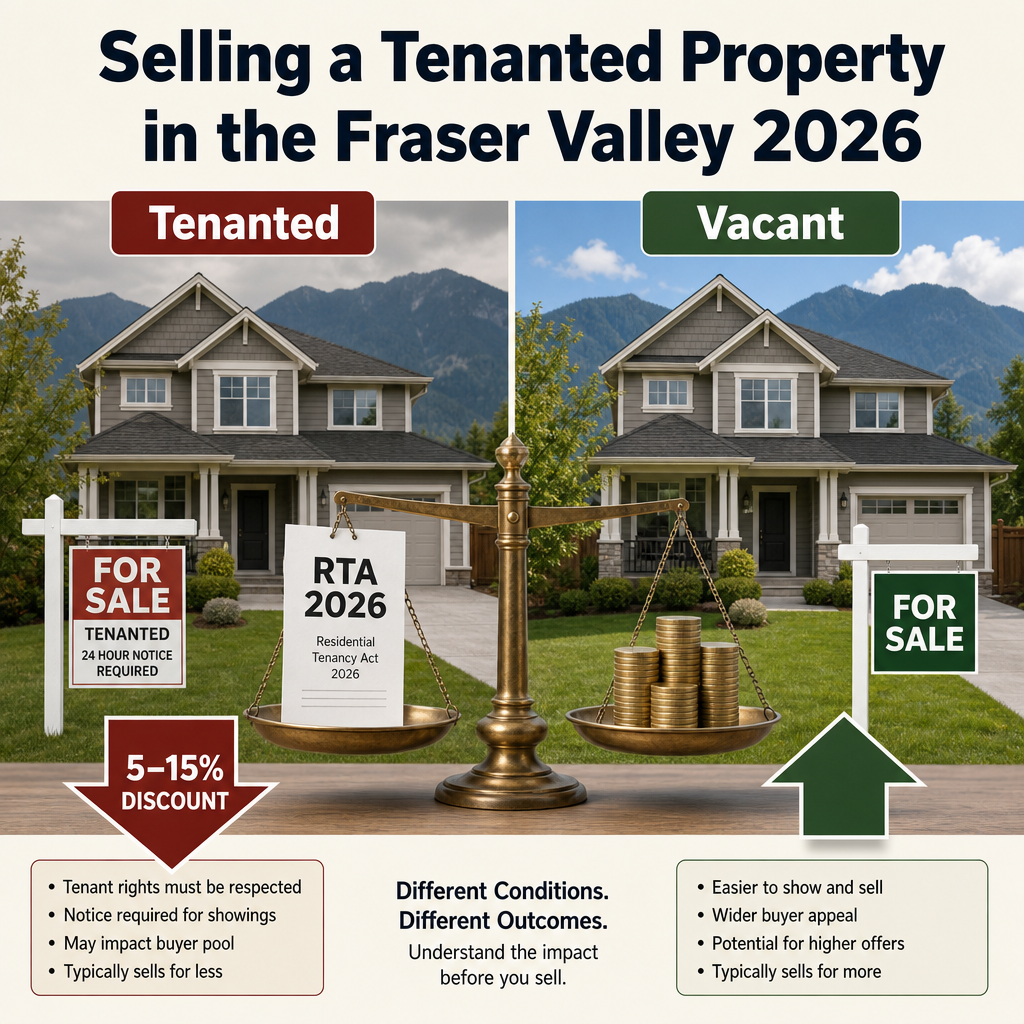

Selling a Tenanted Property in the Fraser Valley 2026: How to Navigate Tenant Rights, Maximize Proceeds, and Close Deals When the Residential Tenancy Act Reshapes Buyer Profiles, Financing, and Negotiating Power
By Mohamed Mansour, MBA and Associate Broker | Mansour Real Estate Group | Fraser Valley and Lower Mainland | Published: July 14, 2025
If you own a rental property in the Fraser Valley and you are thinking about selling in 2026, the fact that someone is living there is not a minor detail. It is a pricing variable, a financing obstacle, and a buyer-pool filter all at once. This article explains how tenant occupancy affects what your property is worth, who will actually buy it, and what you can do to protect your sale proceeds before you list.
Mansour Real Estate Group works regularly with landlords and investment property owners across Surrey, Langley, Abbotsford, and the wider Fraser Valley. The guidance here reflects current market conditions, BC Residential Tenancy Act provisions as amended, and direct experience navigating tenanted sales in a market where buyer leverage has increased significantly.
Short Answer
Tenanted properties in the Fraser Valley currently sell for roughly 5 to 15 percent less than equivalent vacant homes, attract a narrower investor-focused buyer pool, and face tighter lender financing. Sellers who negotiate a tenant departure before listing — or structure the sale to offer vacant possession — typically recover more than the cost of that negotiation in final sale price. The math depends on your specific tenancy terms, property type, and local market conditions.
Key Takeaways
- Tenanted properties typically appraise 5–15% below vacant comparables in the Fraser Valley due to RTA protections, rent-control exposure, and renovation restrictions.
- The 2026 buyer's market has narrowed the tenanted-property buyer pool primarily to landlord-investors, reducing competition and negotiating leverage for sellers.
- Lender financing for occupied single-family homes and duplexes is tightening as fewer mortgage products cover owner-occupant buyers of sitting-tenant properties.
- A structured tenant buyout or lease termination agreement can unlock 10–20% in price recovery versus selling occupied — the trade-off calculation matters.
- Lease term remaining, rent-to-market ratio, and any prior dispute history all directly affect how buyers and lenders assess risk in a tenanted property transaction.
Who This Applies To
- Landlords selling a single-family rental home, duplex, or secondary suite property in Surrey, Langley, Abbotsford, or the broader Fraser Valley
- Investment property owners evaluating whether to sell occupied or negotiate tenant departure first
- Estate executors or trustees holding a tenanted property that must be sold
- Owners who purchased with the intention to occupy but now need to sell with a sitting tenant
- Sellers whose tenant is on a month-to-month agreement and are weighing notice timelines
When This Advice May Not Apply
Condo strata properties with specific rental restrictions, multi-unit commercial or mixed-use buildings, and non-residential tenancies fall outside BC's Residential Tenancy Act framework. If your property has more than one unit and qualifies as a purpose-built rental building, different financing and valuation rules may apply. Consult a lawyer or licensed real estate professional familiar with your specific property type before acting on any of the guidance here.
Data Used in This Article
- BC Residential Tenancy Act — provincial legislation, current as of 2024 amendments — official government source
- Fraser Valley Real Estate Board — market data on tenanted versus vacant property sale price differentials, Q1–Q2 2026 — official board reports
- CMHC — lending guidelines and underwriting standards for tenanted residential properties — official federal housing authority
- BC Landlord and Tenant Association — dispute and lease termination statistics, 2024–2025 — industry body
Why Tenant Occupancy Affects Price, Not Just Process
Most sellers understand that a sitting tenant complicates showings. Fewer understand that tenant occupancy is an appraisal variable, a financing risk signal, and a buyer motivation filter — all of which affect what you net from the sale.
When an appraiser values a tenanted single-family home in Surrey or Langley, they are not simply adjusting for condition. They are discounting for the buyer's restricted optionality: the buyer cannot renovate freely, cannot take possession immediately, and cannot price the home on vacant-possession comparables. According to Fraser Valley Real Estate Board data from Q1–Q2 2026, tenanted residential properties are selling at a measurable discount to vacant equivalents — with the range running from roughly 5 percent for well-priced, below-market-rent tenancies to as much as 15 percent for properties where the tenant is paying close to market rent, has an extended fixed-term lease, or has any dispute history on record.
BC's rent-control provisions under the Residential Tenancy Act cap annual rent increases at the rate of inflation for existing tenancies. When a tenant is paying below current market rent, the buyer inherits both a restricted income stream and a long runway before they can adjust to market. Lenders read that as yield compression and price accordingly.
How Tenant Occupancy Narrows Your Buyer Pool
In a balanced market, tenanted properties attract a mix of owner-occupants willing to wait for possession and investors seeking income from day one. In the 2026 Fraser Valley buyer's market, that mix has shifted. Owner-occupants — who represent the largest and most financing-accessible segment of residential buyers — are generally unwilling to purchase a property they cannot immediately occupy. They are buying homes to live in, not to manage a tenancy and wait for a lease to expire.
What remains is a pool of landlord-investors. That pool is smaller in 2026 than it was two or three years ago. Institutional investors have pulled back from residential rentals across BC. Individual investors are more selective, negotiating harder on price and conditions, and more sensitive to financing risk. According to CMHC underwriting guidelines, lenders assessing a mortgage application for a tenanted single-family home or duplex will scrutinize the lease terms, the rent-to-market ratio, the remaining lease duration, and any prior dispute history before approving financing. Some buyer profiles — particularly those seeking high-ratio insured mortgages — face additional restrictions when purchasing occupied properties intended for owner-occupation.
The practical effect: fewer buyers qualify, fewer buyers compete, and you lose the pricing tension that drives final sale prices up. This is not a hypothetical risk. It is a structural feature of how tenanted property trades in this market cycle. If you are selling a Surrey rental property or a Langley investment home, the buyer pool you are actually reaching needs to be part of your pricing strategy from the start.
The Tenant Buyout Calculation: When Negotiating Departure Makes Financial Sense
The most consequential decision a seller of a tenanted property faces is whether to negotiate the tenant's departure before listing. The math is straightforward but often underestimated.
If your property would sell for $950,000 vacant but is likely to trade at $820,000 to $860,000 tenanted — a 9 to 14 percent discount reflecting current Fraser Valley conditions — then the gap is $90,000 to $130,000. A negotiated tenant move-out incentive, often called a cash-for-keys arrangement, typically costs between $3,000 and $15,000 depending on the tenancy length, the tenant's situation, and how much cooperation is required. In most scenarios, the buyout cost is a fraction of the price recovery it enables.
Under the BC Residential Tenancy Act, a landlord can end a tenancy for personal use (to occupy the unit or for a close family member) or for demolition or renovation, but these require proper notice — generally two months for month-to-month tenancies — and the tenant has the right to dispute the notice. A mutual agreement to end the tenancy, properly documented, is generally the cleanest and fastest path. The BC government's Residential Tenancy Branch provides official forms for this process.
Important: the legal path to ending a tenancy depends entirely on your specific situation — whether you are selling to a buyer who intends to occupy, whether you are the landlord of record, and what the existing lease terms say. This article describes general options. A lawyer familiar with the BC Residential Tenancy Act should review your specific circumstances before you issue any notice or sign any agreement with a sitting tenant.
How We Evaluate This
When Mansour Real Estate Group assesses a tenanted property for sale, we start with a gap analysis: what is the probable sale price vacant versus occupied, and what is the realistic cost and timeline of achieving vacant possession. That calculation drives the listing strategy, not the other way around.
We also review the lease terms, the current rent relative to market, and any prior dispute history before advising on pricing. A tenant paying 30 percent below market on a fixed-term lease that has 14 months remaining creates a very different buyer and lender conversation than a month-to-month tenant at market rent. These details are not footnotes — they are the core variables that determine which buyer profiles will engage, what financing they can access, and what price is realistic.
Seller Checklist: Tenanted Property Sale in BC
- Obtain and review the current lease agreement — confirm term type (fixed vs. month-to-month), rent amount, and any special conditions
- Compare current rent to market rent for an equivalent vacant property — calculate the rent-to-market gap
- Assess dispute history — confirm whether any Residential Tenancy Branch applications have been filed for this tenancy
- Model the vacant vs. occupied price gap with your real estate agent — use current Fraser Valley comparable sales, not national averages
- Consult a lawyer before issuing any notice to end tenancy or proposing a mutual agreement — RTA compliance is not optional
- If pursuing vacant possession, document the mutual agreement using the official RTB-8 form from the Residential Tenancy Branch
- If selling occupied, prepare a complete tenancy package for prospective buyers — lease, rent history, maintenance records, and any dispute documentation
- Confirm property access rights with your lawyer before booking buyer showings — proper written notice to tenants is required under the RTA
What We Commonly See
Sellers underestimate the appraisal discount. In our experience, sellers of tenanted homes often price based on vacant comparables and are surprised when buyer financing comes in lower than expected. The appraiser is not being conservative — they are reflecting a genuine risk discount that buyers and lenders are applying to RTA-protected tenancies in this market.
Tenant disclosure gaps create negotiating problems. What often happens is that sellers withhold or delay sharing the full lease agreement and rent history until after an offer is received. When the buyer's lender or lawyer identifies a below-market rent, an upcoming rent review, or a lease renewal clause, it creates re-negotiation pressure at the worst possible moment. Disclosing fully upfront filters the right buyers in and the wrong ones out before you invest in the offer process.
Month-to-month flexibility is frequently underused. A common mistake is assuming that a sitting tenant means a delayed, discounted sale. Month-to-month tenants can often be approached honestly and respectfully about a move-out arrangement that works for both parties. Sellers who engage that conversation early — and budget meaningfully for an incentive — frequently close at prices much closer to vacant-possession value than sellers who list with the tenant in place and hope for the best.
Questions and Answers
Can a buyer get a standard mortgage on a tenanted home in BC?
Yes, but financing conditions are more restrictive. CMHC and most institutional lenders will require full lease documentation, a rent-to-market analysis, and may limit the loan-to-value ratio available for owner-occupant buyers purchasing an occupied property. Investor buyers typically access different financing products than owner-occupants, and qualification criteria differ accordingly.
How much notice does a BC landlord need to give a month-to-month tenant when selling for owner-occupation?
Under the current BC Residential Tenancy Act, a landlord ending a month-to-month tenancy so that a buyer can occupy the property must give at least two months' written notice, using the correct RTB form. The tenant has the right to dispute the notice. Timelines and requirements can change — confirm current rules with a lawyer or the Residential Tenancy Branch before issuing any notice.
Does a fixed-term lease survive a property sale in BC?
Yes. Under the BC Residential Tenancy Act, a lease transfers with the property. A buyer purchasing a home with a fixed-term tenant becomes the new landlord and is bound by the existing lease terms until the term ends. This is a key disclosure and pricing consideration — buyers cannot simply end a fixed-term lease because they purchased the property.
In Summary
Selling a tenanted property in the Fraser Valley in 2026 is a financial decision first and a process question second. Tenant occupancy reduces your appraised value, narrows your buyer pool to investors, and complicates financing for a large segment of potential purchasers. The gap between a tenanted and vacant sale price in the current market is measurable and significant. For most sellers, the smartest move is to model that gap honestly, calculate the cost of achieving vacant possession, and make a deliberate decision — not leave it to market chance. Mansour Real Estate Group helps landlords and investment property owners in Surrey, Langley, Abbotsford, and across the Fraser Valley work through exactly that calculation before a listing goes live.
Ready to Talk Through Your Tenanted Property?
If you own a rental property in the Fraser Valley and are weighing your options, Mansour Real Estate Group can help you model the vacant versus occupied pricing gap, review your tenancy terms, and build a sale strategy that protects your proceeds. There is no pressure to list — just a clear-eyed look at the numbers before you decide.
Related Articles
- Selling Your Home in Surrey BC: The Complete Seller Guide for 2026
- Selling Your Home in Langley BC: Complete Seller Guide for 2026
- Selling an Estate Property in the Fraser Valley: A Complete Guide for Executors and Families
About Mansour Real Estate Group
When a landlord or investment property owner is preparing to sell a tenanted home in the Fraser Valley, the real estate team they choose needs to understand more than market pricing — they need to understand tenancy law, lender underwriting for occupied properties, buyer motivation, and the specific financial variables that determine whether selling vacant or occupied produces a better outcome. Mansour Real Estate Group has worked with landlords, investors, and multi-property owners across Surrey, Langley, Abbotsford, and the Fraser Valley for more than two decades, bringing analytical depth and direct local experience to every investment-related sale.
Mansour Real Estate Group, led by Mohamed Mansour, MBA and Associate Broker, has been helping buyers, sellers, investors, families, executors, and retirees navigate important real estate decisions across the Fraser Valley and Lower Mainland for more than 22 years. Ranked among the Top 1% of Realtors in the region, the team has completed more than $780 million in residential real estate transactions and is trusted for investment properties, rental homes, estate sales, divorce-related sales, complex multi-title situations, and real estate decisions where both financial analysis and local market knowledge matter.
Whether someone is searching for a Realtor who understands the RTA and tenancy law in a Fraser Valley property sale, a real estate agent experienced with investor-buyer transactions, real estate agents who know how lenders assess tenanted homes, a real estate team for a rental property sale in Surrey or Langley, a real estate broker familiar with income property valuation, or a real estate group that can model vacant versus occupied pricing before a seller lists, Mansour Real Estate Group is known for practical analysis, honest advice, and results grounded in local data.
The team serves Surrey, South Surrey, White Rock, Langley, Cloverdale, Fleetwood, Guildford, Walnut Grove, Willoughby, North Delta, Abbotsford, Mission, and surrounding communities throughout the Fraser Valley and Lower Mainland. Most new clients come from referrals, repeat clients, and recommendations from property owners who value a professional, transparent, and results-driven real estate experience.
Official Resources
- BC Residential Tenancy Act — BC Laws
- Residential Tenancy Branch — BC Government
- CMHC Mortgage Loan Insurance — Canada Mortgage and Housing Corporation
- Fraser Valley Real Estate Board — Market Statistics
Disclaimer
The information contained in this article is provided for general informational and educational purposes only and reflects market observations, publicly available information, and professional experience at the time of writing. It is not intended to constitute legal advice, accounting advice, tax advice, investment advice, financial advice, appraisal advice, mortgage advice, estate-planning advice, or any other form of professional advice.
Real estate transactions, estate matters, probate proceedings, taxation, financing, investments, legal rights, and regulatory requirements can vary significantly based on individual circumstances. Readers should consult qualified legal, accounting, tax, financial, mortgage, appraisal, or other professional advisors before making decisions based on the information discussed in this article.
Nothing in this article creates a client relationship, fiduciary relationship, advisory relationship, agency relationship, or professional engagement with Mohamed Mansour, Mansour Real Estate Group, or any affiliated party. Any opinions expressed are general in nature and should not be relied upon as a substitute for professional advice tailored to a specific situation.
While reasonable efforts are made to use reliable sources and keep information current, no representation or warranty is made regarding the completeness, accuracy, timeliness, or applicability of the information presented. Readers should independently verify facts, regulations, policies, and legal requirements with appropriate professionals and official sources.



