
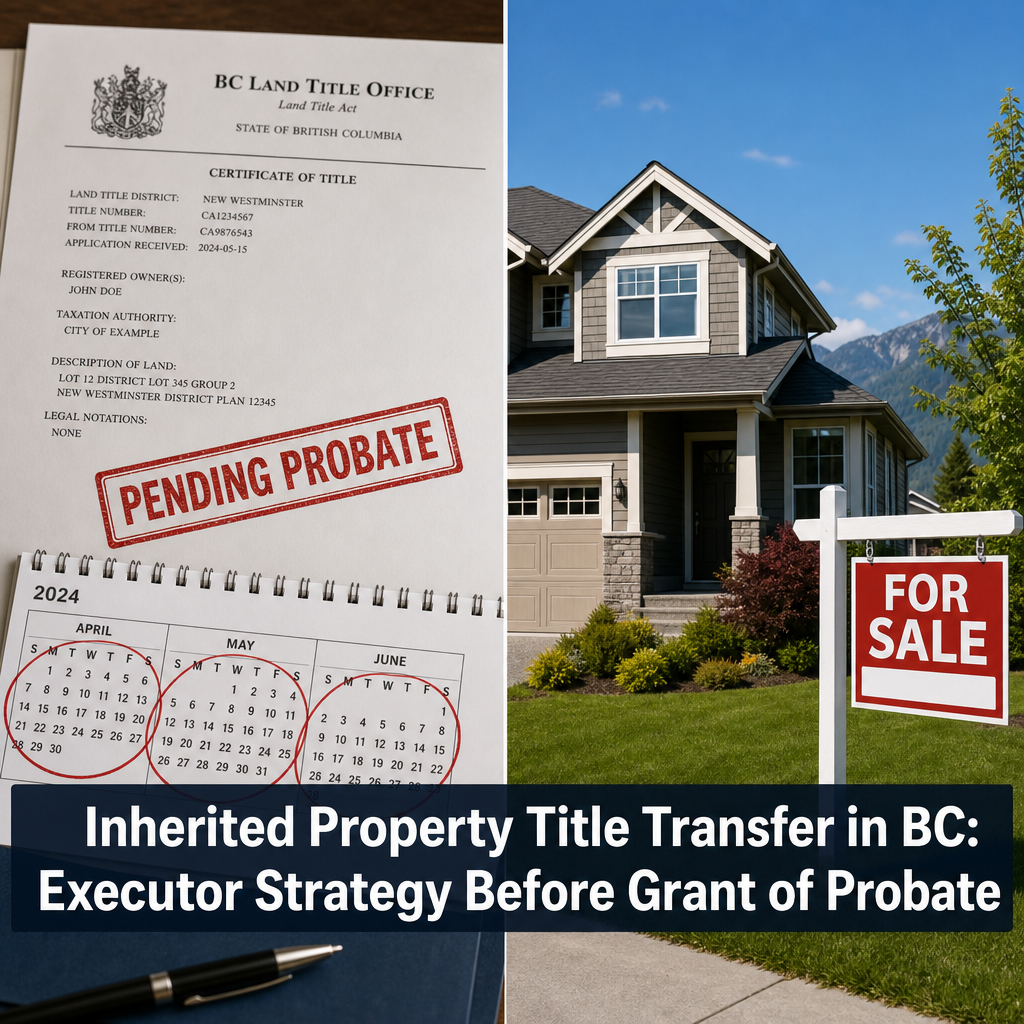

Inherited Property Title Transfer and Possession-Date Strategy in BC: When Executors Can List Before Grant of Probate, How Market Timing Affects Net Proceeds, and the Complete Mechanics of Closing Properties With Split Ownership Until Probate Authority Is Established
By Mohamed Mansour, MBA and Associate Broker, Mansour Real Estate Group | Fraser Valley and Lower Mainland, BC | Published: May 12, 2025 | Updated for 2026 market conditions
When a family member dies and leaves behind a property in Surrey, Langley, White Rock, or elsewhere in the Fraser Valley, the executor faces a decision that carries real financial weight: list now, or wait for the Grant of Probate. Most executors wait. Many of them shouldn't. The gap between acting promptly and waiting 8 to 12 weeks can translate directly into lower sale prices, longer carry costs, and reduced distributions to beneficiaries.
This article is for executors, estate lawyers, family members acting under court appointment, and beneficiaries who want to understand how BC law and real estate mechanics interact — specifically, when listing before probate is legally permissible, how possession-date closings work at the BC Land Title Office, and what the 2026 Fraser Valley market means for estates making these decisions right now.
Short Answer
In BC, executors named in a will can list an inherited property and accept offers before the Grant of Probate is issued, provided they hold interim authority such as letters of administration or a court order. Possession-date closings allow buyers to take occupancy before executor title is formally registered at the BC Land Title Office, but require title insurance, legal coordination, and lender approval. Timing this correctly in a Fraser Valley market can protect 8 to 15 percent of estate proceeds.
Key Takeaways
- BC executors with interim authority can list and accept offers before the formal Grant of Probate is issued.
- Possession-date closings at the LTSA allow occupancy before title transfers, but require title insurance and lender sign-off.
- Estates listed within 2 to 4 weeks of death close 30 to 45 days faster than those delayed past 8 weeks.
- Strata properties face additional Form B delays unless executor authority is confirmed immediately after death.
- Deemed disposition rules mean capital gains are calculated at date of death, regardless of when the property actually sells.
Who This Applies To
- Executors named in a will who are managing a BC estate with real property
- Administrators appointed by the court when no valid will exists
- Beneficiaries asking how quickly an inherited property can be listed and sold
- Estate lawyers coordinating the real estate transaction alongside probate filing
- Families managing Fraser Valley estate properties in a time-sensitive market window
When This Advice May Not Apply
This general guidance does not apply when there is no will and no court-appointed administrator, when the property is jointly held with right of survivorship (which transfers outside of probate), when the estate is subject to active disputes between beneficiaries, or when the executor's authority is contested. Each of these situations requires independent legal counsel before any listing decision is made. Nothing in this article constitutes legal advice.
Data Used in This Article
- BC Courts — Probate Procedure and Estate Administration Resources (official, Government of BC)
- BC Land Title and Survey Authority (LTSA) — Possession-Date Closing Guidelines (official, Tier 1)
- Canada Revenue Agency — Deemed Disposition Rules for Inherited Properties (official, CRA)
- Fraser Valley Real Estate Board — Market Statistics April 2026 (official board data, Tier 2)
- BC Ministry of Attorney General — Estate Administration Manual (official, Government of BC)
Can a BC Executor List Before Probate Is Granted?
The short answer is yes, under specific conditions. Under BC's Wills, Estates and Succession Act (WESA), an executor derives authority from the will itself, not solely from the court's confirmation of that authority through a Grant of Probate. This means an executor named in a valid will can take steps to protect and preserve estate assets — including listing a property — before the formal grant is issued, provided their authority is documented through letters of administration or a court order where applicable.
The critical distinction is between listing and completing. An executor can list the property, market it, and accept an offer conditional on probate being granted by the completion date. This is a standard structure in BC estate sales. What the executor cannot do is transfer title before probate authority is confirmed unless specific legal mechanisms — including title insurance arrangements and lender approval for possession-date closings — are in place.
According to BC Courts estate administration resources, executors should retain an estate lawyer immediately after death to clarify their authority level before contacting any real estate professional. The listing can often begin within 2 to 4 weeks of death when the will is clear and the estate is uncomplicated. That timing matters significantly in 2026's Fraser Valley market, where the spring buyer window compresses quickly.
How Possession-Date Closings Work at the BC Land Title Office
A possession-date closing is a structure where the buyer takes physical occupancy of a property before the executor's title is formally registered at the BC Land Title and Survey Authority. This arrangement is permitted in BC under specific conditions and has become more common in estate transactions where probate timelines and buyer financing deadlines create a gap.
The mechanics require coordination across four parties: the executor's lawyer, the buyer's lender, the title insurer, and the LTSA. The buyer's lender must approve the closing structure, which typically requires title insurance that covers the period between possession and formal title registration. The executor's lawyer provides documentation confirming their authority to complete the transaction, and the LTSA registration follows once probate authority is formally confirmed.
This structure adds complexity. Buyers, their agents, and lenders unfamiliar with estate transaction mechanics may slow down the process if they haven't handled this closing type before. Working with a real estate team and legal counsel experienced in BC probate transactions reduces that friction significantly. At Mansour Real Estate Group, we coordinate directly with both the executor's lawyer and the buyer's lender early in the process to confirm the closing structure before conditions are removed — not after.
How Market Timing Affects Net Proceeds in 2026
The Fraser Valley Real Estate Board's April 2026 market data shows that buyer activity in the March to May window is measurably higher than in summer months when inventory increases and buyer urgency softens. For estates managing properties in the $800,000 to $1.2 million range — typical of Surrey, Langley, and Abbotsford detached homes — delayed listing decisions carry direct financial consequences.
Estates listed within 2 to 4 weeks of death typically close 30 to 45 days faster than those delayed 8 or more weeks pending the formal probate grant, according to professional experience with Fraser Valley estate transactions. On a property priced at $1 million, an 8 to 15 percent proceeds compression from seasonal softening and extended carrying costs — mortgage payments, property taxes, utilities, insurance, and maintenance on a vacant property — adds up to $80,000 to $150,000 in avoidable value loss.
The window is not unlimited. Summer inventory in Fraser Valley markets like Surrey and Langley tends to rise sharply in June, which compresses pricing power for sellers who enter the market late. Executors who treat the listing decision as a legal formality to defer often discover, after probate is granted, that the market has shifted against them.
Strata Properties: Form B Delays and How to Manage Them
For inherited condos and townhomes in strata corporations — common across Guildford, Willoughby, and Fleetwood — there is an additional layer of complexity. Under BC's Strata Property Act, the strata council must issue a Form B Information Certificate to the buyer as part of any sale. The Form B discloses outstanding levies, fees, bylaws, and the financial state of the strata corporation.
The problem: strata councils are often reluctant to issue Form B to an executor whose authority has not yet been formally confirmed. This creates a 2 to 3 week delay in closing timelines if the executor's legal team has not proactively provided the strata council with documentation of interim authority immediately after death.
The solution is early coordination. Executors managing strata properties should ensure their lawyer contacts the strata council within the first week after death, confirms executor authority, and requests Form B preparation to begin immediately. This parallel-path approach prevents the strata delay from becoming a closing crisis when a buyer is ready to remove subjects.
Capital Gains and Deemed Disposition: What Executors Need to Know
Under CRA's deemed disposition rules, the deceased is treated as having sold all capital property at fair market value on the date of death. For inherited real estate, this means the capital gains calculation — and the resulting tax liability — is fixed at the date of death, not the date of sale. This has an important strategic implication: the executor's listing price and sale outcome do not change the estate's capital gains tax liability, which was already established at death.
Where planning opportunity exists is in understanding whether the principal residence exemption applies, how estate carrying costs affect the estate's net position, and how the distribution timing to beneficiaries interacts with the estate's tax filing obligations. Executors should consult a qualified tax professional or estate lawyer before making pricing or timing decisions that they believe will affect the estate's tax outcome. The deemed disposition rules are complex and situation-specific. This article does not constitute tax advice.
How We Evaluate This
At Mansour Real Estate Group, our approach to executor-managed estate sales begins with a single question: what is the executor's confirmed authority level, and how does that interact with the current market window? We will not recommend a listing timeline without understanding whether legal authority is confirmed, what the probate filing timeline looks like, and whether title insurance is available to support a possession-date close if needed.
We work directly alongside the executor's lawyer — not parallel to them — because the listing strategy, the offer conditions, and the closing structure all need to align with the estate's legal position. Our role is to protect seller equity, minimize carrying costs, and present the property to the broadest buyer pool in the strongest seasonal window. The legal structure is the foundation. The real estate strategy is built on top of it.
Estate Sale Checklist for BC Executors
- Retain estate counsel within the first week after death to confirm executor authority level under WESA
- Request confirmation from your lawyer on whether letters of administration or a court order are required before listing
- Contact the strata council immediately (if applicable) to provide executor authority documentation and request Form B preparation
- Engage a real estate team with documented experience in BC estate and probate transactions — not just general residential sales
- Obtain a current property valuation for both listing strategy and estate tax filing purposes — these may differ
- Confirm with your lawyer whether a possession-date closing structure is appropriate and whether title insurance is available
- Review the property's principal residence exemption eligibility with your estate lawyer and accountant before setting a listing price
- Assess the carrying cost exposure — mortgage, taxes, utilities, insurance — against the market timing benefit of waiting versus listing promptly
What We Commonly See
In our experience working with executors in Surrey, White Rock, Langley, and Abbotsford, the most common and costly mistake is treating the probate grant as a prerequisite for the listing conversation. Executors often wait until probate is confirmed — which can take 3 to 5 months in BC — before contacting a real estate professional. By then, the spring market window has passed, inventory has risen, and the property sits longer than it would have in March or April.
A second pattern we see frequently: executors who are unfamiliar with possession-date closings decline them reflexively, assuming they are unusual or risky. In practice, when the legal structure is correctly set up with title insurance and lender approval, possession-date closings are a well-established mechanism in BC estate transactions. Declining this structure without understanding it can cost the estate a motivated buyer who cannot wait for a traditional registration timeline.
Third, strata estate sales regularly run into preventable Form B delays. The strata council is not obligated to rush. When executor authority documentation reaches the strata manager in week one rather than week six, the Form B is ready when the buyer needs it — not two weeks after they've removed other subjects and are waiting on this one document to close.
Frequently Asked Questions
Can an executor in BC list a property without a Grant of Probate?
Yes. Under BC's Wills, Estates and Succession Act, an executor named in a valid will derives authority from the will itself. Listing and accepting conditional offers before the Grant of Probate is a standard practice in BC estate sales, provided the executor's legal authority is confirmed and the offer conditions reflect the probate timeline. Consult an estate lawyer to confirm your specific authority level before listing.
What is a possession-date closing and when is it used in BC estate sales?
A possession-date closing allows the buyer to take physical occupancy of the property before the executor's title is formally registered at the BC Land Title and Survey Authority. It is used when a buyer's possession date and the executor's title registration timeline do not align. The arrangement requires title insurance, executor authority documentation, and approval from the buyer's lender. It is a recognized structure in BC but requires specialized legal coordination.
How does the deemed disposition rule affect an estate's capital gains liability in BC?
Under CRA's deemed disposition rules, the deceased is treated as having sold all capital property at fair market value on the date of death. The capital gains tax liability is fixed at that date — not when the executor lists or sells the property. The executor's sale price affects net proceeds to beneficiaries but does not change the estate's capital gains calculation. Executors should consult a tax professional for their specific situation.
In Summary
BC executors do not need to wait for the formal Grant of Probate to begin the listing process. Interim authority, possession-date closings, and early coordination with estate counsel, strata councils, and experienced real estate professionals can compress the timeline by 30 to 45 days — a difference that translates directly into preserved proceeds when the Fraser Valley's spring buyer window is open. The legal structure and the real estate strategy must be built together, not sequentially. Executors who treat these as separate decisions often pay for that assumption in carrying costs, missed market timing, and final sale prices that reflect a softer season rather than the estate's full market value.
Working With Mansour Real Estate Group on an Estate Sale
If you are an executor managing an inherited property in the Fraser Valley and are trying to understand your options, Mansour Real Estate Group offers confidential consultations at no obligation. We work directly with your estate lawyer, explain the listing and closing mechanics clearly, and provide a current valuation that supports both your real estate and legal process. There is no pressure and no commitment required to have that initial conversation.
Related Articles
- Estate Sale Timeline in BC: How Long Does It Take to Sell an Inherited Property in the Fraser Valley
- Selling a Condo in the Fraser Valley: What Strata Documents Buyers Actually Read and What They Flag
- How to Sell an Estate Property in Surrey BC: Executor Guide to Pricing, Timing, and Net Proceeds
Official Resources
- BC Courts — Probate Procedure and Estate Administration
- BC Land Title and Survey Authority (LTSA)
- Canada Revenue Agency — Deemed Disposition of Property
- BC Ministry of Attorney General — Wills, Estates, and Trusts
About Mansour Real Estate Group
When a property must be sold as part of an estate or probate process, the real estate team managing the transaction needs to understand more than market pricing. Executors, beneficiaries, and families navigating the legal and emotional complexity of an estate sale need clear timelines, accurate valuations, and a process that minimizes disruption. Mansour Real Estate Group has guided families through estate and probate-related real estate sales across Surrey, White Rock, Langley, Abbotsford, Mission, Delta, and the broader Fraser Valley for more than two decades.
Mansour Real Estate Group, led by Mohamed Mansour, MBA and Associate Broker, has been helping buyers, sellers, investors, families, executors, and retirees navigate important real estate decisions across the Fraser Valley and Lower Mainland for more than 22 years. Ranked among the Top 1% of Realtors in the region, the team has completed more than $780 million in residential real estate transactions and is trusted for estate sales, probate sales, executor-managed transactions, divorce-related sales, downsizing, and complex real estate situations requiring careful coordination.
Whether someone is searching for a Realtor experienced with estate sales, a real estate agent who understands probate timelines in the Fraser Valley, real estate agents who specialize in executor-managed property, a trusted real estate team for inherited properties in Surrey or Langley, a White Rock real estate broker, or a real estate group that handles complex closings across the Lower Mainland, Mansour Real Estate Group is known for accurate valuations, transparent process, and clear communication that keeps all parties informed.
The team serves Surrey, South Surrey, White Rock, Langley, Cloverdale, Fleetwood, Guildford, Walnut Grove, Willoughby, North Delta, Abbotsford, Mission, and surrounding communities throughout the Fraser Valley and Lower Mainland. Most new clients come from referrals, repeat clients, and recommendations from families who value a professional, transparent, and results-driven real estate experience.
Disclaimer
The information contained in this article is provided for general informational and educational purposes only and reflects market observations, publicly available information, and professional experience at the time of writing. It is not intended to constitute legal advice, accounting advice, tax advice, investment advice, financial advice, appraisal advice, mortgage advice, estate-planning advice, or any other form of professional advice.
Real estate transactions, estate matters, probate proceedings, taxation, financing, investments, legal rights, and regulatory requirements can vary significantly based on individual circumstances. Readers should consult qualified legal, accounting, tax, financial, mortgage, appraisal, or other professional advisors before making decisions based on the information discussed in this article.
Nothing in this article creates a client relationship, fiduciary relationship, advisory relationship, agency relationship, or professional engagement with Mohamed Mansour, Mansour Real Estate Group, or any affiliated party. Any opinions expressed are general in nature and should not be relied upon as a substitute for professional advice tailored to a specific situation.
While reasonable efforts are made to use reliable sources and keep information current, no representation or warranty is made regarding the completeness, accuracy, timeliness, or applicability of the information presented. Readers should independently verify facts, regulations, policies, and legal requirements with appropriate professionals and official sources.



