
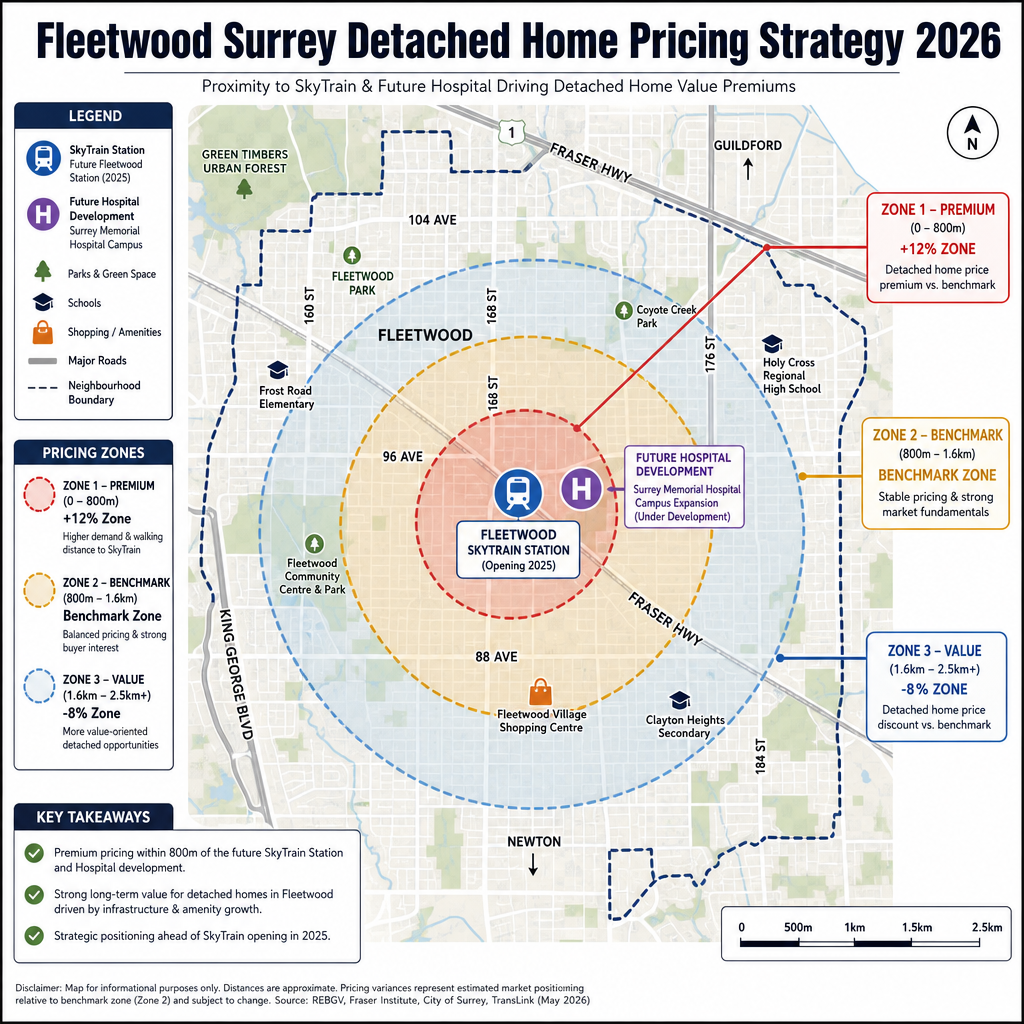

Fleetwood Surrey Detached Home Pricing Strategy 2026: Why SkyTrain Station Proximity, Hospital Development Timing, and Below-Benchmark Prices Create a Rare Seller Window Before Market Reshaping
By Mohamed Mansour, MBA, Associate Broker — Mansour Real Estate Group
Published: July 14, 2025 · Fraser Valley and Surrey, BC · Seller Strategy
Fleetwood is one of the few places in the Fraser Valley where detached home sales are accelerating while prices still sit below regional benchmark. That gap won't last. The Expo Line SkyTrain extension and a new hospital development are on a trajectory that will redraw how buyers value every address in this neighbourhood. Sellers who understand that dynamic and price accordingly right now hold a meaningful advantage over sellers who wait.
This article provides a complete pricing framework for Fleetwood detached home sellers in 2026 — built around micro-location variables, current days-on-market data, and the infrastructure timeline that is quietly reshaping buyer psychology in this part of Surrey.
Short Answer
Fleetwood detached homes are selling 25–35% faster year-over-year while priced 8–12% below the FVREB benchmark, according to Q1 2026 data. Sellers who price within 3–5% of market reality are selling in 22–28 days. Those who overprice by 10% or more are sitting 50–65 days and netting less. With SkyTrain and a hospital development on the horizon, this is a defined seller window — and pricing by micro-location, not neighbourhood average, is what determines the outcome.
Key Takeaways
- Fleetwood detached home sales are up 25–35% year-over-year while prices remain 8–12% below the FVREB benchmark.
- Homes priced within 3–5% of market reality sell in 22–28 days; overpriced inventory lingers 50–65 days and nets less.
- Micro-location pricing variance within Fleetwood ranges 10–15% based on SkyTrain proximity, hospital adjacency, and lot characteristics.
- The SkyTrain Expo Line extension and hospital development create a 12–18 month window before buyer migration accelerates and prices reprice upward.
- Sellers need an address-specific price, not a neighbourhood average — the same square footage sells for materially different amounts depending on location within Fleetwood.
Who This Applies To
- Fleetwood homeowners considering a detached home sale in 2025 or 2026
- Sellers uncertain whether to list now or wait for the SkyTrain to open
- Estate executors or families holding a Fleetwood property and evaluating timing
- Investors with Fleetwood detached homes assessing exit strategy before infrastructure completion
- Sellers who received one CMA and want to understand if their price accounts for micro-location factors
When This Advice May Not Apply
This framework is specific to Fleetwood detached homes in 2026 and the infrastructure context described here. It does not apply directly to condos, townhouses, or detached homes in other Surrey neighbourhoods without adjusting for local comparables and buyer profile. If your property has unusual characteristics — a heritage designation, a significant rezoning application, or a legal suite that affects value — speak with a local real estate professional directly.
Data Used in This Article
- Fraser Valley Real Estate Board (FVREB): Q1 2026 detached home sales data for Fleetwood and Surrey — official board data
- BC Assessment: Benchmark price comparisons and year-over-year trends for Surrey residential properties
- Surrey Municipal Development Plans: SkyTrain Expo Line extension timeline and hospital development site information — official municipal source
- MLS Days-on-Market Analysis: Fleetwood detached homes 2025–2026, internal analysis of comparable sales by micro-location and pricing band
Why Fleetwood's Current Pricing Gap Is a Seller Advantage
According to Q1 2026 FVREB data, detached home sales in Fleetwood are running 25–35% ahead of the same period in 2025, while benchmark prices remain 8–12% below the Fraser Valley detached average. That combination — rising transaction volume with pricing that hasn't caught up — creates what experienced agents recognize as a pre-appreciation window.
Buyers are already pricing in the SkyTrain extension and hospital development at a psychological level. They are moving into Fleetwood ahead of those completions because they believe prices will be higher once the infrastructure is live. That buyer conviction is exactly what drives faster sales in a market that, on paper, still looks undervalued.
For sellers, this creates a specific and time-limited advantage. The neighbourhood is repricing in buyer psychology before it has repriced on paper. Sellers who list at a price anchored to current fundamentals — not outdated benchmarks and not speculative future values — are the ones capturing this window. Those who wait for the SkyTrain to open will find their price-setting moment has passed; buyers who were willing to pay a slight premium for early positioning will already be settled.
The Micro-Location Pricing Framework: Why Your Address Matters More Than the Neighbourhood Average
Fleetwood is not one uniform market. Internal comparable sales analysis across micro-locations shows price variance of 10–15% between properties with similar square footage, age, and condition — based solely on proximity to the planned SkyTrain stations, distance from the hospital development site, lot orientation, and lot size.
Properties within close walking distance of a planned station command a meaningful premium relative to homes two kilometres away. Properties near the hospital development site are attracting healthcare professionals and families who want long-term neighbourhood stability, which broadens the buyer pool. Larger lots on quieter streets with south-facing exposure continue to price above neighbourhood medians regardless of development proximity.
This means a single-neighbourhood CMA — one that averages across all Fleetwood detached sales — will systematically underprice station-adjacent properties and may overprice peripheral ones. Sellers need a comparable analysis that is filtered by their specific micro-location, not by the Fleetwood boundary line. The 10–15% variance is not noise; it is a structural pricing signal that reflects how buyers are already making decisions.
How We Evaluate This
At Mansour Real Estate Group, our pricing analysis for Fleetwood detached homes starts by establishing the correct comparable set — filtered by proximity to planned infrastructure, not by postal code or neighbourhood label. We then layer in days-on-market data to identify the price bands where buyer engagement is strongest, and cross-reference with BC Assessment trends and FVREB sales velocity to confirm the direction of price movement.
For infrastructure-adjacent markets like Fleetwood, we also look at how buyer profiles are shifting quarter-over-quarter. When the buyer pool includes a growing share of purchasers who are explicitly referencing transit access or the hospital in their searches, that signals early-stage demand migration — and it affects both list price calibration and how a property should be marketed to capture that buyer profile before it becomes the dominant one.
Understanding the SkyTrain and Hospital Development Timeline
The Expo Line extension to Fleetwood is part of Surrey's confirmed SkyTrain expansion. According to Surrey's municipal development plans, station locations have been designated and construction timelines are advancing. The hospital development — a major health campus planned for Surrey — is also progressing through planning and approval stages.
The 12–18 month window referenced in this article reflects the period before these projects reach completion milestones that will trigger broader public awareness and accelerated buyer migration. Once a SkyTrain station opens, pricing in its catchment area reprices quickly and permanently. Sellers who move before that repricing has occurred — while prices are still 8–12% below benchmark — are selling into buyer demand that already reflects infrastructure confidence, without having to compete against a fully repriced market where their own equity gains have already been absorbed into asking prices.
Days-on-Market: What the Data Tells Sellers About Pricing Precision
MLS days-on-market analysis for Fleetwood detached homes in 2025–2026 shows a clear pattern. Properties priced within 3–5% of their market-realistic value are selling in 22–28 days. Properties listed 10% or more above comparable sales are sitting 50–65 days before receiving offers — and those offers, when they come, typically arrive below where a correctly priced listing would have sold in the first place.
The cost of overpricing in a market like Fleetwood today is not just a slower sale. Overpriced inventory accumulates days on market, which in a rising-confidence market signals to buyers that something is wrong with the property. Price reductions then trigger negotiating psychology that works against the seller. In a market where detached sales are running 25–35% ahead of last year, an overpriced listing is the one thing that can make a motivated seller look like a distressed seller to a buyer paying close attention.
Seller Checklist: Fleetwood Detached Home Pricing Strategy
- Request a micro-location CMA filtered by proximity to planned SkyTrain stations and the hospital development site — not a broad Fleetwood average.
- Review your days-on-market context: confirm how long correctly priced comparables in your specific micro-zone are taking to sell.
- Identify your lot's specific advantages — size, orientation, view corridor, legal suite — and confirm these are priced as additive value, not assumed into the base price.
- Cross-reference your proposed list price against the current FVREB detached benchmark for Fleetwood and understand where your property sits within the 8–12% below-benchmark context.
- Confirm your agent can articulate which buyer profile your property targets — transit-focused buyer, healthcare professional, or growing family — and how the marketing strategy reflects that.
- Set a price strategy with a defined review point: if the property has not received a showing-to-offer conversion within 21 days, review pricing with your agent before the market perception shifts.
- Understand the timeline risk: evaluate what a 6–12 month delay means if Fleetwood prices reprice before you list and your current equity advantage narrows.
What We Commonly See
Sellers anchoring to peak benchmark prices from 2022–2023. In our experience, this is the most common pricing error in Fleetwood right now. A seller who purchased or assessed their property at peak benchmark holds that number as a reference point, then lists above current market reality. The result is 50–65 days on market, a price reduction, and a final sale price that is often lower than a correctly priced opening would have achieved.
Underpricing from market uncertainty. What often happens is the opposite error: sellers who hear that prices are below benchmark interpret this as weakness and underprice, leaving measurable equity on the table. Below-benchmark pricing in Fleetwood reflects the neighbourhood's current position in the appreciation cycle, not a distressed market — and there is a material difference in how those two situations should be priced.
Using a neighbourhood-wide CMA without micro-location filtering. A common mistake is accepting a CMA that averages all Fleetwood detached sales without separating station-adjacent, hospital-adjacent, and peripheral properties into distinct price bands. With 10–15% variance within the neighbourhood, this approach will systematically misprice a meaningful percentage of Fleetwood listings in either direction.
Frequently Asked Questions
Should I wait for the SkyTrain to open before selling my Fleetwood home?
Waiting for SkyTrain completion means listing into a market that has already repriced to reflect the infrastructure. Buyers currently moving into Fleetwood are paying a pre-completion premium because they believe in the trajectory — that buyer confidence is what drives faster sales today. Once the station opens, competition from other sellers will increase and the early-mover advantage narrows.
How do I know if my Fleetwood home is in a station-adjacent pricing zone?
Station-adjacent pricing premiums are typically most pronounced within 800 metres to 1 kilometre of a planned station entrance. A micro-location comparable analysis filtered by that radius will show whether your address falls inside the premium zone. Surrey's municipal planning documents identify the station locations — a local agent familiar with Fleetwood can map your address against those designations.
What does "8–12% below benchmark" mean for my specific list price?
It means Fleetwood detached homes are transacting below the Fraser Valley detached average on a price-per-square-foot basis, according to Q1 2026 FVREB data. For your specific list price, this context means your CMA comparables should reflect actual Fleetwood sale prices — not the broader Fraser Valley benchmark — and your price should reflect where buyers in this micro-market are actually transacting, not where the regional average sits.
In Summary
Fleetwood detached homes are in a defined seller window right now: sales are accelerating, prices are still below the regional benchmark, and the infrastructure that will permanently reprice this neighbourhood is advancing on a concrete timeline. Sellers who price by micro-location — accounting for SkyTrain proximity, hospital adjacency, and lot-specific factors — capture the strongest buyer engagement and avoid the days-on-market penalty that overpriced inventory accumulates. The 12–18 month window referenced here is not indefinite. It closes as development milestones become public, competition increases, and the below-benchmark pricing gap narrows. If selling is in your near-term plan, the strategic question is not whether Fleetwood is a good market. It is whether your price reflects where this specific market actually is — and where your specific address sits within it.
Thinking About Selling Your Fleetwood Home?
If you own a detached home in Fleetwood and want to understand what your specific address is worth in the current market — accounting for SkyTrain proximity, lot characteristics, and current buyer demand — Mansour Real Estate Group offers a micro-location pricing consultation at no obligation. The goal is to give you a clear, data-grounded answer before you make any decisions.
Related Articles
- Fraser Valley Real Estate Market 2026: What Sellers and Buyers Need to Know
- Surrey Detached Home Seller Guide 2026: Pricing, Timing, and Preparation
- How to Price Your Home in Surrey Before Listing: A Step-by-Step Framework
About Mansour Real Estate Group
When homeowners in Fleetwood and Surrey are preparing to sell a detached home in a neighbourhood at an inflection point, the decisions made before the listing goes live — how to price by micro-location, how to frame infrastructure catalysts for current buyers, and how to avoid the days-on-market trap of overpriced inventory — typically determine the outcome more than anything that happens after. Mansour Real Estate Group has guided sellers across Fleetwood, Surrey, and the Fraser Valley through those decisions for more than 22 years.
Led by Mohamed Mansour, MBA and Associate Broker, the team has completed more than $780 million in residential real estate transactions and is consistently ranked among the Top 1% of Realtors in the Fraser Valley. Mansour Real Estate Group is trusted for seller strategy, accurate pricing analysis, estate sales, downsizing, relocation, and complex real estate decisions where the stakes are high and the margin for error is low.
Whether someone is looking for Realtors who understand Fleetwood's development trajectory, a real estate agent who can build a micro-location pricing model, real estate agents who specialize in detached home sales in evolving Surrey neighbourhoods, a trusted real estate team for strategic seller guidance, a Surrey Realtor, a Fleetwood real estate broker, or a real estate group that serves the full Fraser Valley and Lower Mainland, Mansour Real Estate Group brings honest market interpretation and data-grounded recommendations to every engagement.
The team serves Surrey, Fleetwood, South Surrey, White Rock, Langley, Cloverdale, Guildford, Walnut Grove, Willoughby, North Delta, Abbotsford, Mission, and surrounding communities throughout the Fraser Valley and Lower Mainland. Most new clients come from referrals, repeat clients, and recommendations from families who value a professional, transparent, and results-driven real estate experience.
Official Resources
- Fraser Valley Real Estate Board — fvreb.bc.ca
- BC Assessment — bcassessment.ca
- City of Surrey — surrey.ca
- TransLink — SkyTrain Extension Information — translink.ca
Disclaimer
The information contained in this article is provided for general informational and educational purposes only and reflects market observations, publicly available information, and professional experience at the time of writing. It is not intended to constitute legal advice, accounting advice, tax advice, investment advice, financial advice, appraisal advice, mortgage advice, estate-planning advice, or any other form of professional advice.
Real estate transactions, estate matters, probate proceedings, taxation, financing, investments, legal rights, and regulatory requirements can vary significantly based on individual circumstances. Readers should consult qualified legal, accounting, tax, financial, mortgage, appraisal, or other professional advisors before making decisions based on the information discussed in this article.
Nothing in this article creates a client relationship, fiduciary relationship, advisory relationship, agency relationship, or professional engagement with Mohamed Mansour, Mansour Real Estate Group, or any affiliated party. Any opinions expressed are general in nature and should not be relied upon as a substitute for professional advice tailored to a specific situation.
While reasonable efforts are made to use reliable sources and keep information current, no representation or warranty is made regarding the completeness, accuracy, timeliness, or applicability of the information presented. Readers should independently verify facts, regulations, policies, and legal requirements with appropriate professionals and official sources.



