
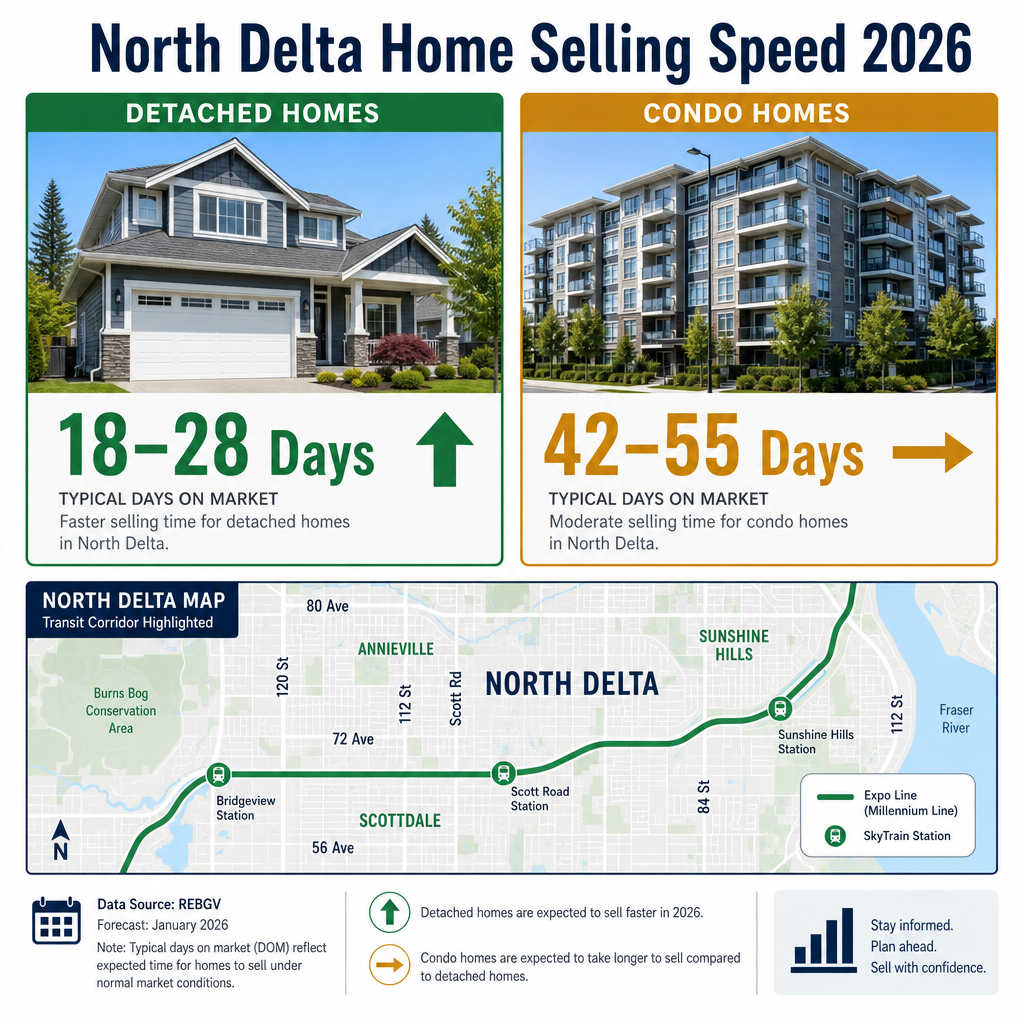

North Delta Home Selling Speed by Property Type and Neighbourhood 2026: Complete Days-on-Market Analysis and Strategic Pricing When Detached Homes Sell in 18 Days But Condos Linger 45+ Days
By Mohamed Mansour, MBA and Associate Broker | Mansour Real Estate Group | Fraser Valley and Lower Mainland | Published: July 15, 2026 | Geographic Focus: North Delta, BC
North Delta's 2026 real estate market is telling two very different stories depending on what type of property you own. Detached homes are moving quickly. Attached housing is sitting. Sellers who apply one pricing strategy across both segments are making a costly mistake — and in many cases, they don't realize it until they're already 30 days into a listing that should have been priced differently from the start.
This article breaks down days-on-market (DOM) figures by property type and neighbourhood cluster, explains the forces driving the divergence, and shows how that divergence should reshape your pricing approach before you list.
Short Answer
In North Delta's 2026 market, detached homes are selling in 18–28 days on average, while townhomes and condos are taking 42–55 days. That 2.3× gap reflects real buyer demand differences — not just pricing errors. Transit-proximate and waterfront-adjacent properties move 25–35% faster with stronger price support. Sellers of attached housing face a fundamentally different negotiating environment and need a pricing strategy calibrated to that reality.
Key Takeaways
- North Delta detached homes are selling roughly 2.3× faster than condos and townhomes in 2026.
- Transit-proximate and waterfront-adjacent properties outperform peripheral subdivisions by 35–40% on DOM.
- Rising strata fees and depreciation report concerns are adding 15–20 days to attached-housing DOM year-over-year.
- Neighbourhood-level averages mask critical micro-market divergence — one pricing strategy does not fit all North Delta properties.
- Sellers who price to their property type's DOM reality, not the broader market average, protect their equity and reduce re-listing risk.
Who This Applies To
- North Delta homeowners preparing to list a detached home in 2026
- Condo and townhome owners in North Delta evaluating realistic selling timelines
- Sellers comparing their property to neighbourhood-wide averages
- Estate executors or families selling a North Delta property who need accurate timeline expectations
- Sellers deciding between an early or delayed listing based on perceived market conditions
When This Advice May Not Apply
Properties with unique legal encumbrances, active strata disputes, title issues, or estate constraints may follow different timelines regardless of property type. This analysis reflects general market patterns — individual property conditions always modify the outcome. Consult a qualified local Realtor and, where applicable, a lawyer before making pricing or timing decisions based on market averages.
Data Used in This Article
- FVREB 2026 MLS Sales Data — North Delta property-type segmentation; official; Fraser Valley Real Estate Board
- BC Assessment North Delta — Benchmark prices and sales-ratio trends; official; BC Assessment Authority
- North Delta Municipal Transit Planning Documents — SkyTrain proximity mapping and corridor data
- Strata Depreciation Report Trends — Special levy and strata fee data for North Delta attached housing; third-party analysis supported by FVREB data
Definitions
Days on Market (DOM): The number of calendar days from when a property is listed on MLS to when an accepted offer is in place. Properties relisted after expiring restart the DOM clock, which can mask true market time.
Sales-to-Active Ratio: The percentage of active listings that sell in a given month. Below 12% typically favours buyers; above 20% typically favours sellers. According to the Fraser Valley Real Estate Board, North Delta's 2026 ratio sits between 8–12%, which varies significantly by property type.
Depreciation Report: A BC-mandated study for strata corporations that assesses the long-term capital repair needs of the building and estimates future costs. A report showing large unfunded liabilities can deter buyers and extend a condo's DOM substantially.
Benchmark Price: The price of a "typical" home in a given area as calculated by the FVREB's MLS Home Price Index, adjusted for property characteristics. More stable than average or median price as a market indicator.
The DOM Divergence: What North Delta's 2026 Numbers Actually Show
Based on FVREB 2026 MLS sales data for North Delta, the property-type breakdown looks like this:
| Property Type | Average DOM (2026) | Market Condition |
|---|---|---|
| Detached | 18–28 days | Seller advantage |
| Townhome | 42–50 days | Buyer advantage |
| Condo / Apartment | 45–55 days | Buyer advantage |
These are not marginal differences. A detached home seller in North Delta is operating in a fundamentally different negotiating position than a condo seller — even if they live on the same street. The mistake most sellers make is averaging these figures together and concluding their property will sell in "around 30 days." That conclusion is wrong for almost everyone.
The underlying driver is buyer demographics. Families relocating from Metro Vancouver — increasingly priced out of Burnaby, New Westminster, and East Vancouver — are targeting North Delta for yard space, school access, and relative affordability in the detached segment. That demand is concentrated and consistent. Investor and downsizer demand for attached housing, by contrast, has softened as strata fees have risen and depreciation report risks have become better understood by buyers doing due diligence.
How North Delta's Neighbourhoods Create a Second Layer of DOM Variance
Property type explains the largest DOM gap, but neighbourhood location creates a second, equally important layer of divergence. North Delta is not a homogeneous market. Four distinct clusters behave differently enough to require different pricing frameworks.
Transit-proximate zones (within 800m of Ladner Exchange or established transit corridors): According to North Delta municipal transit planning data, properties within approximately 800 metres of major transit exchanges are moving 25–35% faster than the North Delta average and supporting price premiums of 5–8% over comparable properties in peripheral locations. For a detached home, this means potential DOM of 14–20 days and buyers willing to move decisively. For a condo in this zone, it partially offsets the attached-housing headwinds — but does not eliminate them.
Waterfront-adjacent and established neighbourhoods: Properties near the waterfront in North Delta, or in mature, well-treed subdivisions with established infrastructure, attract a buyer cohort that prioritizes lifestyle over commute efficiency. These sellers benefit from lower inventory competition and a buyer pool that has already filtered itself by preference. DOM in this cluster trends toward the lower end of the detached range — 18–22 days — with less price sensitivity on well-prepared listings.
Mid-market inland subdivisions: These represent the largest share of North Delta's detached inventory. DOM here aligns closely with the 22–28 day range. Pricing accuracy matters more in this cluster because the buyer pool is broader and more comparison-driven. A listing priced 3–5% above market in this cluster will sit long enough to become a price-reduction story, which triggers longer DOM and weaker final sale prices.
Peripheral and newer subdivisions: Properties at the outer edges of North Delta — farther from transit, schools, and established commercial nodes — are showing DOM of 40–50 days even for detached homes. The buyer pool here is more price-sensitive and less urgency-driven. Sellers in these locations who price to the transit-proximate benchmark are routinely sitting on expired listings and relaunching at lower prices, which resets their DOM clock and signals distress to the market.
How We Evaluate This
At Mansour Real Estate Group, when we price a North Delta property, we do not start with a neighbourhood average. We start by identifying the exact property-type cohort and the specific neighbourhood cluster, then layer in condition, presentation, and current competing inventory. A detached home in a transit-proximate North Delta neighbourhood gets a different pricing conversation than a detached home in a peripheral subdivision — even if BC Assessment values them similarly.
For attached housing, we factor in the strata corporation's financial health, the age and findings of the depreciation report, and the current strata fee relative to comparable buildings. These inputs are not secondary considerations — they often determine whether a condo sells in 42 days or 60 days, and they directly affect how we recommend positioning the price before the listing goes live.
The Strata Factor: Why Attached Housing DOM Is Getting Worse, Not Better
Year-over-year, strata depreciation report concerns and rising monthly fees are adding an estimated 15–20 days to attached-housing DOM in North Delta. This is not a North Delta-specific trend — it mirrors patterns across the Fraser Valley — but it has real pricing consequences for condo and townhome sellers who are comparing their current situation to sales from 2023 or 2024.
Buyers today are more likely to review depreciation reports carefully before removing subjects. A report that reveals a large unfunded contingency reserve or deferred capital work gives buyers legitimate grounds to renegotiate price or walk away entirely. Sellers who are unaware of what their depreciation report says before listing are routinely blindsided during the subject-removal phase. That surprise — and the price reduction that follows — could have been addressed in pre-listing preparation instead.
Seller Checklist: North Delta Property-Type-Specific Preparation
- Confirm your property type cohort (detached, townhome, condo) and identify your specific North Delta neighbourhood cluster before requesting a pricing opinion.
- For attached housing, obtain and review your strata corporation's most recent depreciation report and current financial statements before listing.
- Compare your monthly strata fees against comparable buildings currently on the market — fee discrepancies affect buyer perception and DOM.
- For detached homes in transit-proximate zones, prepare for a faster timeline: have legal documents, title search, and disclosure obligations ready before listing, not after an offer arrives.
- For peripheral subdivision properties, price to the peripheral DOM reality — not to the transit-adjacent benchmark — and plan your timeline accordingly.
- Identify any relisted properties in your immediate area. High relist frequency in your cluster signals that sellers are overpricing, and buyers know it.
What We Commonly See
Condo sellers anchoring to detached-home timelines. In our experience, the most common pricing mistake in North Delta involves a condo or townhome seller who watched a neighbour's detached home sell in three weeks and assumed their property would move at a similar pace. The demographic driving detached-home demand is not the same demographic evaluating condos. These are different products to different buyers, and the DOM reflects that reality.
Peripheral sellers pricing to transit-proximate benchmarks. What often happens is that a seller in a peripheral North Delta subdivision has a BC Assessment value that closely mirrors transit-adjacent properties, because assessment methodology doesn't always granularly separate those micro-markets. They list at a transit-adjacent price and then sit for 45 days wondering why there are no offers. The price reduction that follows is avoidable — but only if the pricing conversation happens before the listing, not after.
Depreciation report surprises during subject removal. A common and costly mistake is listing a condo without first reviewing what the depreciation report says about capital reserves. Buyers conducting due diligence will find it. If the report reveals significant unfunded liabilities, subject removal stalls, buyers renegotiate, and the seller is in a weaker position than they would have been had they disclosed and priced around the issue upfront.
Questions and Answers
Q: Why are North Delta detached homes selling so much faster than condos in 2026?
The primary driver is buyer demographics. Families relocating from Metro Vancouver are actively targeting North Delta for detached homes with yard space. That demand is concentrated and creates competitive conditions in the detached segment. Investor and downsizer demand for condos and townhomes has softened due to rising strata fees and depreciation report concerns, extending DOM in attached housing significantly.
Q: Does transit proximity actually change how quickly a North Delta home sells?
Yes, materially. According to North Delta municipal transit planning data and FVREB sales figures, properties within approximately 800 metres of major transit exchanges are moving 25–35% faster than the North Delta average and supporting price premiums of 5–8%. For detached homes in those zones, DOM can compress to 14–20 days. For attached housing, transit proximity helps but does not override the structural headwinds in that segment.
Q: What should a North Delta condo seller do differently given the longer DOM environment?
Start with a full review of your strata's depreciation report and financial statements before listing. Price to the current attached-housing DOM reality — not to detached benchmarks or 2023 comparables. Build your timeline around 45–55 days, not 25. Buyers in this segment are more cautious and more likely to negotiate hard after receiving strata documents, so pre-listing preparation reduces the risk of a subject-removal renegotiation.
In Summary
North Delta's 2026 market is running two parallel timelines: a seller-advantaged detached segment clearing in 18–28 days and a buyer-advantaged attached segment where DOM of 42–55 days is the norm, not the exception. Neighbourhood location — transit proximity, waterfront adjacency, or peripheral position — adds a second layer of variance that can shift DOM by 35–40% within the same property type. Sellers who price to the broad neighbourhood average rather than their specific property type and cluster are systematically leaving equity on the table or extending their time on market unnecessarily. The correction is straightforward: establish your correct cohort, understand your strata's financial reality if applicable, and build your pricing strategy from there.
Thinking about listing your North Delta property and want a timeline and pricing assessment grounded in current property-type data? Mansour Real Estate Group provides detailed, neighbourhood-specific market evaluations for North Delta sellers. Reach out to start with an honest conversation about what your property is likely to do in today's market.
Related Articles
- North Delta Real Estate Market 2026: What Sellers and Buyers Need to Know Now
- Fraser Valley Days on Market Guide 2026: How Long Homes Are Taking to Sell by City and Property Type
- Strata Depreciation Reports: What BC Condo Sellers Need to Know Before Listing
Official Resources
- Fraser Valley Real Estate Board — Market Statistics and MLS Data
- BC Assessment — North Delta Property Values and Sales Ratios
- City of Delta — North Delta Municipal Planning and Transit Documents
- BC Strata Property Act — Depreciation Report Requirements
About Mansour Real Estate Group
When homeowners in North Delta are preparing to sell — whether a detached home in a transit-proximate neighbourhood or a condo navigating strata headwinds — the decisions made before the listing goes live almost always determine the outcome. Pricing to the right property-type cohort, understanding what the depreciation report will show buyers, and building a timeline around realistic DOM expectations requires a real estate team with direct, current knowledge of how North Delta's micro-markets actually behave. Mansour Real Estate Group has built that knowledge across more than two decades of active transactions in North Delta and the broader Fraser Valley.
Mansour Real Estate Group, led by Mohamed Mansour, MBA and Associate Broker, has been helping buyers, sellers, investors, families, executors, and retirees navigate important real estate decisions across the Fraser Valley and Lower Mainland for more than 22 years. Ranked among the Top 1% of Realtors in the region, the team has completed more than $780 million in residential real estate transactions and is trusted for seller strategy, pricing discipline, estate sales, divorce-related sales, downsizing, relocation, and complex real estate situations where accurate valuation is critical to the outcome.
Whether someone is searching for Realtors who understand North Delta's property-type DOM divergence, a real estate agent who can price a condo accurately against strata headwinds, real estate agents experienced with detached-home seller strategy in the Fraser Valley, a North Delta real estate broker with a track record in micro-market pricing, or a real estate team that serves both established and peripheral North Delta neighbourhoods, Mansour Real Estate Group is known for data-driven valuations, honest timelines, and a process that protects seller equity from first conversation to completion.
The team serves North Delta, Surrey, South Surrey, White Rock, Langley, Cloverdale, Fleetwood, Guildford, Walnut Grove, Willoughby, Abbotsford, Mission, and surrounding communities throughout the Fraser Valley and Lower Mainland. Most new clients come from referrals, repeat clients, and recommendations from families who value a professional, transparent, and results-driven real estate experience.
Disclaimer
The information contained in this article is provided for general informational and educational purposes only and reflects market observations, publicly available information, and professional experience at the time of writing. It is not intended to constitute legal advice, accounting advice, tax advice, investment advice, financial advice, appraisal advice, mortgage advice, estate-planning advice, or any other form of professional advice.
Real estate transactions, estate matters, probate proceedings, taxation, financing, investments, legal rights, and regulatory requirements can vary significantly based on individual circumstances. Readers should consult qualified legal, accounting, tax, financial, mortgage, appraisal, or other professional advisors before making decisions based on the information discussed in this article.
Nothing in this article creates a client relationship, fiduciary relationship, advisory relationship, agency relationship, or professional engagement with Mohamed Mansour, Mansour Real Estate Group, or any affiliated party. Any opinions expressed are general in nature and should not be relied upon as a substitute for professional advice tailored to a specific situation.
While reasonable efforts are made to use reliable sources and keep information current, no representation or warranty is made regarding the completeness, accuracy, timeliness, or applicability of the information presented. Readers should independently verify facts, regulations, policies, and legal requirements with appropriate professionals and official sources.



