

Downsizing From a Large Family Home to a Condo or Townhome in Abbotsford 2026: The Complete Financial Math, Emotional Transition Planning, and Right-Sized Property Selection Strategy for Empty Nesters in a Buyer's Market
By Mohamed Mansour, MBA, Associate Broker — Mansour Real Estate Group | Fraser Valley & Lower Mainland, BC | Published: July 15, 2026 | Topic: Life-Event Sales — Downsizing
For Abbotsford empty nesters who have been watching the market and thinking about downsizing, 2026 feels like either the right moment or a trap, depending on who you ask. Detached home values are down, strata inventory is up, and the emotional pull to simplify is real. But the financial math that most people carry into this decision is wrong in ways that cost them $50,000 or more.
This guide is for Abbotsford homeowners in their late 50s to early 70s who own a detached family home, are seriously considering a move to a condo or townhome, and want honest numbers, honest emotional framing, and a clear-headed framework for making the right call — not a sales pitch dressed up as advice.
Short Answer
Downsizing from a $900K Abbotsford family home to a $500K townhome does not net $400K. After Property Transfer Tax on the purchase, realtor commissions, legal fees, and moving costs, true net proceeds are closer to $300,000–$320,000. Ongoing strata fees often offset property tax savings, making the real annual financial gain smaller than most people expect. Emotional regret peaks at 18–24 months if lifestyle, social, and space needs are not evaluated before the move.
Key Takeaways
- Net proceeds from a downsizing transaction are typically 20–25% lower than the price-gap calculation suggests once all closing costs are counted.
- Strata fees of $250–$400 per month, plus periodic special levies, frequently cancel out the property tax savings from downsizing.
- Abbotsford's 2026 buyer's market means more negotiating power on the purchase side, but the sale side requires strategic pricing and preparation.
- Approximately 40–50% of BC downsizers report regret within 24 months, most often tied to lifestyle disruption rather than property dissatisfaction.
- Evaluating neighbour composition, visitor accommodation capacity, and social infrastructure before committing to a strata building reduces regret risk significantly.
Who This Applies To
- Abbotsford homeowners aged 55–75 who own a detached family home and are considering a move to a condo or townhome
- Empty nesters whose children have left home and whose current property now feels oversized for daily life
- Retirees or pre-retirees looking to reduce maintenance burden and free up equity without a full lifestyle overhaul
- Homeowners who want to understand the real numbers before committing to a listing appointment
When This Advice May Not Apply
If you are relocating out of the Fraser Valley entirely, purchasing a detached rancher rather than a strata property, or managing a downsizing as part of an estate or health transition, some of the financial and emotional frameworks here will apply but the specific numbers and timelines will differ. Consult your accountant and legal advisor before making final decisions.
Data Used in This Article
- BC Assessment 2026 Abbotsford benchmark data — official assessment authority, BC Government, 2026
- FVREB Market Statistics, April 2026 — Fraser Valley Real Estate Board, official board data
- BC Property Transfer Tax rate schedule — BC Government official calculator and legislation
- CMHC Downsizing Demographic Trends — Canada Mortgage and Housing Corporation, national research
- Statistics Canada Retirement and Housing Transition Research — Government of Canada, published research
The Financial Math Most Downsizers Get Wrong
The most common mistake in downsizing planning is subtracting the purchase price from the sale price and calling the difference your proceeds. That number is real on paper. It is not real in your bank account.
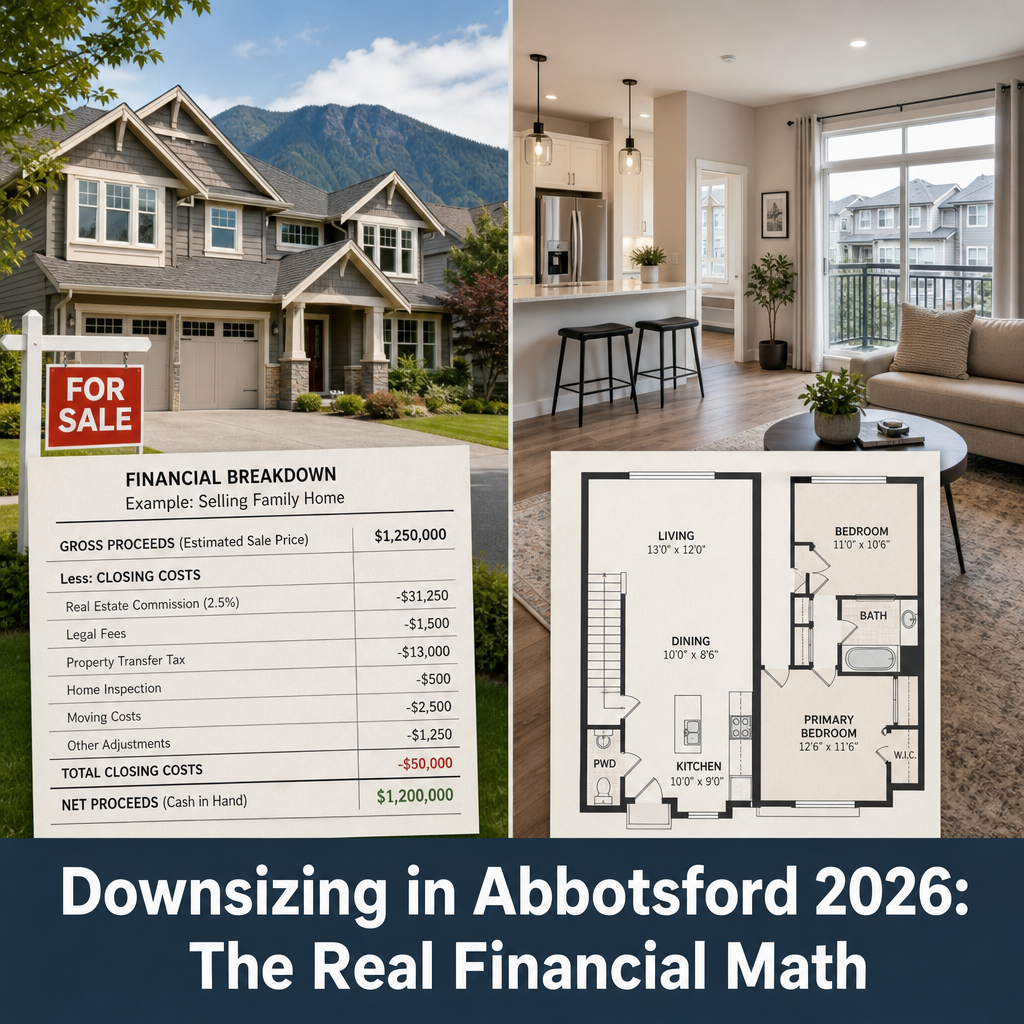
Here is a realistic cost breakdown for a typical Abbotsford transaction in 2026, based on BC Government PTT schedules and standard transaction costs.
Selling a $900,000 detached home:
- Realtor commission: approximately $36,000–$45,000 (gross, including both sides depending on structure)
- Legal fees and disbursements: $2,500–$4,000
- Home preparation, staging, and minor repairs: $3,000–$8,000
- Moving costs: $5,000–$12,000 depending on volume and distance
Buying a $500,000 townhome:
- Property Transfer Tax on $500,000: $8,000 (1% on the first $200K, 2% on the remainder to $2M, per BC Government schedule — no first-time buyer exemption applies here)
- Legal fees: $1,500–$2,500
- Home inspection: $500–$800
- Strata document review (lawyer or specialist): $300–$600
Total transaction costs: approximately $57,000–$80,000 depending on commission structure, preparation needs, and moving volume.
On a $400,000 price-gap transaction, that leaves true net proceeds of $300,000–$320,000 — not $400,000. That 20–25% compression is not a surprise if you plan for it. It becomes a shock when it isn't discussed until after the offers are signed. If your plan for retirement income or debt elimination depends on a specific number, this gap matters enormously. Working with a real estate team that models this before you list is one of the most valuable things you can do at this stage.
The Ongoing Cost Comparison: Strata Fees vs. Property Tax Savings
Most downsizers expect meaningful annual savings once they make the move. The reality is more nuanced. According to BC Assessment 2026 Abbotsford benchmark data and FVREB statistics, moving from a detached home to a townhome typically reduces your property tax bill by 20–30%, not the 40–50% many people assume.
At the same time, strata fees for Abbotsford townhomes in 2026 range from $250 to $400 per month — approximately $3,000 to $4,800 annually. Newer buildings with amenities trend toward the higher end. Older buildings with deferred maintenance may carry lower fees but higher special levy risk.
Special levies — extraordinary assessments for building repairs, roof replacement, elevator servicing, or envelope work — are not included in monthly fees. Based on CMHC research on strata aging in BC, owners in buildings built before 2005 can reasonably expect one or more special levies averaging $2,000–$5,000 over a five-year period, sometimes more for major envelope projects.
When you offset a $1,500 annual property tax reduction against $3,600 in strata fees and a prorated $800 annual special levy reserve, the real annual savings from downsizing may be negative — or at best $1,000–$2,000, not the $8,000–$10,000 that informal calculations suggest. This does not mean downsizing is the wrong decision. It means the decision should rest on lifestyle, equity access, and long-term planning — not on projected cash flow savings that often don't materialize as expected.
How We Evaluate This
At Mansour Real Estate Group, we begin every downsizing conversation with a net proceeds analysis — not a list price conversation. Before a seller knows what their home might be worth, they need to know what they will actually walk away with after costs, and what carrying cost scenario they are moving into. We model three scenarios: optimistic, realistic, and conservative. We look at the specific strata buildings under consideration, review depreciation reports and strata financials, and compare ongoing cost structures before any listing commitment is made. This process protects equity and prevents post-sale regret driven by financial miscalculation.
The Emotional Transition: What the Numbers Don't Capture
Research from Statistics Canada and CMHC on retirement housing transitions consistently identifies a gap between anticipated and experienced satisfaction in downsizing moves. Approximately 40–50% of BC downsizers report meaningful regret within 24 months of their move. The most common sources are not property-related. They are:
- Reduced visiting capacity. Adult children and grandchildren visit less often when there is no guest room, no yard for children to play in, and no sense of "coming home to the family house." This is one of the most underestimated sources of emotional loss.
- Neighbour composition mismatch. Strata buildings attract a mix of demographics — investors, young renters, families, and retirees. If you are expecting a community of people at the same life stage, the reality of a mixed building can feel socially isolating.
- Identity and space. A large family home carries an identity. The garage workshop, the garden, the dining room that seated twelve — these are not just rooms. Losing them changes how a person relates to their own daily life. This is normal and worth naming before the move.
None of this means downsizing is wrong. It means the transition plan should address social infrastructure, visitor accommodation strategy, and space substitution before possession day — not after. The Abbotsford downsizers who report the highest satisfaction are those who identified their non-negotiables clearly before selecting a property, not those who found the best deal.
Evaluating Abbotsford's 2026 Buyer's Market for a Strata Purchase
According to FVREB market statistics for April 2026, Abbotsford's strata inventory is elevated relative to active buyer demand, creating genuine negotiating opportunity for purchasers. For a downsizer who is also selling a detached home, this creates a timing consideration: you benefit as a buyer in a soft strata market, but you are selling into the same conditions on the detached side.
The strategy that tends to work best in this environment is a conditional purchase — making your strata offer conditional on your home sale rather than buying unconditionally and carrying two properties. Abbotsford's current inventory levels mean most strata sellers will accept reasonable conditions, which protects you from a bridge financing scenario. Alternatively, selling first and renting short-term while searching gives you full negotiating power as a cash buyer, though it requires temporary displacement. The right path depends on your financial position, timeline, and risk tolerance — and is worth mapping out explicitly before either transaction begins.
Downsizing Checklist
- Commission a net proceeds analysis — total sale proceeds minus all costs — before setting a target purchase price
- Request and review the strata's depreciation report, Form B, and last two years of meeting minutes before making an offer
- Calculate the true annual carrying cost of the target strata property, including fees, special levy history, and property tax
- Visit the building at different times of day and week to assess noise levels, parking patterns, and neighbour demographics
- Confirm your non-negotiables: guest accommodation, storage, outdoor space, elevator access, pet policy, rental restrictions
- Plan your social infrastructure — identify nearby amenities, community groups, and family visit logistics before possession
- Consult your accountant about the capital gains implications if the property has been used partly for income or investment purposes
- Confirm your sequence: sell first, buy conditionally, or sell first and rent — and model each scenario financially
What We Commonly See
In our experience, the most common financial mistake is treating the price gap as net proceeds and making major retirement planning decisions — paying off debt, gifting children, investing — based on a number that doesn't account for $60,000–$80,000 in transaction costs. Discovering the actual number after signing can force uncomfortable adjustments to plans that felt certain.
What often happens is that a downsizer selects a property primarily on price and finishes, then discovers after moving in that the building has a high renter-to-owner ratio, the strata council is difficult, or a major levy is approaching. Reading the depreciation report and Form B with a knowledgeable advisor before the offer — not after subject removal — changes this outcome entirely.
A common mistake is underestimating how much the decision to downsize is driven by a single bad week of maintenance — a furnace breakdown, a fence dispute, a weekend of yard work — rather than a stable, considered evaluation of long-term lifestyle needs. The best decisions come from a 90-day reflection period, not from a moment of frustration. We regularly encourage clients to wait through one full season before committing.
Questions and Answers
Q: Is 2026 actually a good time to sell a detached home in Abbotsford and buy a strata property?
It depends on your priority. You are selling into a softer detached market and buying into a soft strata market. Your negotiating power is better on the purchase side. Whether the net outcome favours you depends on how well your detached home is positioned, priced, and prepared relative to current competition.
Q: What is the Property Transfer Tax on a $500,000 townhome purchase in BC?
According to the BC Government PTT schedule, the tax is 1% on the first $200,000 and 2% on the portion from $200,001 to $2,000,000. On a $500,000 purchase that equals $8,000. The first-time buyer exemption does not apply to downsizers who already own property. This amount should be budgeted as a direct out-of-pocket cost.
Q: How do I know if a strata building in Abbotsford has a special levy risk?
Request the depreciation report (required for most strata corporations in BC under the Strata Property Act), the current contingency reserve fund balance, and the last two years of annual general meeting minutes. A reserve fund that is significantly underfunded relative to the depreciation report's recommended balance is a signal of probable future levies. Have your lawyer or a strata document review service interpret these before removing subjects.
In Summary
Downsizing from a family home to a condo or townhome in Abbotsford in 2026 can be the right move — financially and emotionally — but only when the decision is built on accurate numbers and honest self-assessment. True net proceeds are typically $300,000–$320,000 on a $400,000 price-gap transaction, not $400,000. Annual savings are often modest once strata fees and levies are counted. Emotional regret is preventable, but only if space, social, and lifestyle needs are evaluated before committing to a building. In Abbotsford's current buyer's market, the conditions for a well-planned downsizing are reasonable — but the planning is what makes it work, not the market.
Talk to Mansour Real Estate Group First
Before listing your Abbotsford family home or making an offer on a strata property, a 30-minute conversation about your real numbers — net proceeds, carrying costs, and property selection criteria — can prevent expensive surprises and help you move forward with confidence. Mansour Real Estate Group offers no-obligation consultations for homeowners in the planning stage. There is no pressure to list, and no commitment required. Just clear information, grounded in the current Abbotsford market.
Related Articles
- Understanding the Abbotsford Real Estate Market in 2026
- Strata Documents in BC: What Buyers Must Review Before Removing Subjects
- Selling Your Fraser Valley Home in a Buyer's Market: 2026 Strategy Guide
Official Resources
- BC Government — Property Transfer Tax
- BC Assessment Authority
- Fraser Valley Real Estate Board — Market Statistics
- Canada Mortgage and Housing Corporation — Housing Research
About Mansour Real Estate Group
For homeowners who have spent decades building equity in a family home, the decision to downsize is one of the most significant real estate transitions they will make. Getting the sequence right — accurate net proceeds modeling, strata due diligence, and a sale strategy that protects equity in a softer market — depends on working with a real estate team that has guided this transition many times before. Mansour Real Estate Group has helped hundreds of homeowners and families downsize across Surrey, White Rock, Langley, South Surrey, Abbotsford, Delta, Mission, and throughout the Fraser Valley.
Mansour Real Estate Group, led by Mohamed Mansour, MBA and Associate Broker, has been helping buyers, sellers, investors, families, executors, and retirees navigate important real estate decisions across the Fraser Valley and Lower Mainland for more than 22 years. Ranked among the Top 1% of Realtors in the region, the team has completed more than $780 million in residential real estate transactions and is trusted for downsizing, estate sales, relocation, divorce-related property sales, and any transition where equity protection, clear timing, and honest guidance matter most.
Whether someone is searching for Realtors who specialize in downsizing transitions, a real estate agent who understands the financial and emotional dimensions of moving from a family home to a strata property, real estate agents familiar with Abbotsford's townhome and condo market, a trusted real estate team for empty nesters and retirees, an Abbotsford Realtor, a Fraser Valley real estate broker, or a real estate group that brings honest numbers and patient guidance to a major life decision, Mansour Real Estate Group is known for clarity, low-pressure advice, and a process built around the client's timeline.
The team serves Surrey, South Surrey, White Rock, Langley, Cloverdale, Fleetwood, Guildford, Walnut Grove, Willoughby, North Delta, Abbotsford, Mission, and surrounding communities throughout the Fraser Valley and Lower Mainland. Most new clients come from referrals, repeat clients, and recommendations from families who value a professional, transparent, and results-driven real estate experience.
Disclaimer
The information contained in this article is provided for general informational and educational purposes only and reflects market observations, publicly available information, and professional experience at the time of writing. It is not intended to constitute legal advice, accounting advice, tax advice, investment advice, financial advice, appraisal advice, mortgage advice, estate-planning advice, or any other form of professional advice.
Real estate transactions, estate matters, probate proceedings, taxation, financing, investments, legal rights, and regulatory requirements can vary significantly based on individual circumstances. Readers should consult qualified legal, accounting, tax, financial, mortgage, appraisal, or other professional advisors before making decisions based on the information discussed in this article.
Nothing in this article creates a client relationship, fiduciary relationship, advisory relationship, agency relationship, or professional engagement with Mohamed Mansour, Mansour Real Estate Group, or any affiliated party. Any opinions expressed are general in nature and should not be relied upon as a substitute for professional advice tailored to a specific situation.
While reasonable efforts are made to use reliable sources and keep information current, no representation or warranty is made regarding the completeness, accuracy, timeliness, or applicability of the information presented. Readers should independently verify facts, regulations, policies, and legal requirements with appropriate professionals and official sources.



